
A KLOW peptide benefits list is four separate lists wearing one label. Take each claim back to the ingredient it came from and the picture changes considerably.
The short answer. KLOW is four compounds in one vial — GHK-Cu, BPC-157, TB-500 and KPV, typically 50/10/10/10 mg for 80 mg total.
- The combination has zero published studies in any species. Every benefit attributed to it comes from one ingredient's literature.
- GHK-Cu is the best-evidenced ingredient and its controlled human evidence is topical, not injected.
- BPC-157's leading 2025 review counts 35 preclinical studies against 1 human, and that one is an uncontrolled case series.
KLOW is four compounds in one vial. GHK-Cu, BPC-157, TB-500 and KPV, usually at 50/10/10/10 mg for 80 mg total. Each has its own literature. The four-way combination has zero published studies in any species. So every benefit claimed for KLOW is borrowed from one ingredient. And two of the four have no human trial at all.
Where a KLOW benefits list comes from
KLOW is not a compound. It is a co-lyophilized vial of four, and the usual configuration is 50 mg GHK-Cu, 10 mg BPC-157, 10 mg TB-500 and 10 mg KPV. We describe the vial in full in the KLOW complete guide.
That structure explains how the benefits lists get written. Each ingredient brings its own claims. Stack the four sets of claims, print them under one product name, and the result reads like a single well-evidenced product. It is four thin ones.
The test to apply to any line on a KLOW benefits list: which of the four ingredients does this claim belong to, and what species was it shown in? Almost every line resolves to one ingredient, and most resolve to a rodent.
GHK-Cu: the strongest evidence, for a route the vial does not use
GHK is an endogenous tripeptide, and its copper complex is the best-evidenced ingredient in the vial. It is also 62.5% of the mass, so it deserves the most attention.
GHK is a naturally occurring peptide found in human serum with levels averaging 200 ng/ml at age 20 but declining to an average of 80 ng/ml by age 60.
Dou et al., Aging Pathobiology and Therapeutics, 2020That decline is where the anti-aging framing starts. The dermal literature that follows is genuinely the most replicated thing in this vial: skin remodeling, collagen synthesis, antioxidant gene expression. There is one qualification and it is decisive. That work is topical. Injected GHK-Cu has no published randomized human trial. We separate the two routes in injectable vs topical GHK-Cu.
Skin claims for KLOW therefore rest on evidence generated by rubbing a different formulation onto skin. That is not nothing, and it is not the same thing. See the skin-aging research for what the controlled work actually measured.
BPC-157: the largest preclinical footprint, almost no human record
BPC-157 supplies most of the recovery and gut-healing claims on a KLOW list. It has by far the biggest animal literature of the four and the most developed mechanism story: VEGFR2 activation, nitric-oxide signaling, fibroblast recruitment.
A 2025 systematic review counted 36 studies meeting its criteria: 35 preclinical and 1 human. The human entry is a retrospective knee-pain case series of 17 patients with no control arm and no validated outcome measures.
Despite the robust preclinical findings, human data are extremely limited, no large-scale randomized trials exist, and BPC-157 should be considered investigational pending well-designed clinical trials.
McGuire et al., Current Reviews in Musculoskeletal Medicine, 2025Reviewers keep flagging a second structural caveat: most of that preclinical corpus comes from one research group in Zagreb. Consistency within a single lab is not independent replication. More in BPC-157 benefits and the tendon research.
TB-500: clearest mechanism, thinnest clinical record
TB-500 contributes the cell-migration and tissue-repair claims. The molecular biology behind it is the most solid in the vial. Thymosin beta-4 makes up roughly 70–80% of all beta-thymosins in the body, and it binds monomeric G-actin at a 1:1 ratio, which is how a cell controls the machinery it uses to crawl into a wound.
Downstream of that, the animal work describes angiogenesis, wound healing and hair-follicle development across cornea, heart, kidney and skin. It is a legitimately interesting molecule. None of it is a human outcome for the uses TB-500 is sold for. See the TB-500 guide.
There is also a labeling problem that affects what is in your vial. “TB-500” may mean full-length thymosin beta-4 or only its active fragment, and suppliers do not consistently declare which. A certificate confirming purity does not confirm which molecule was made.
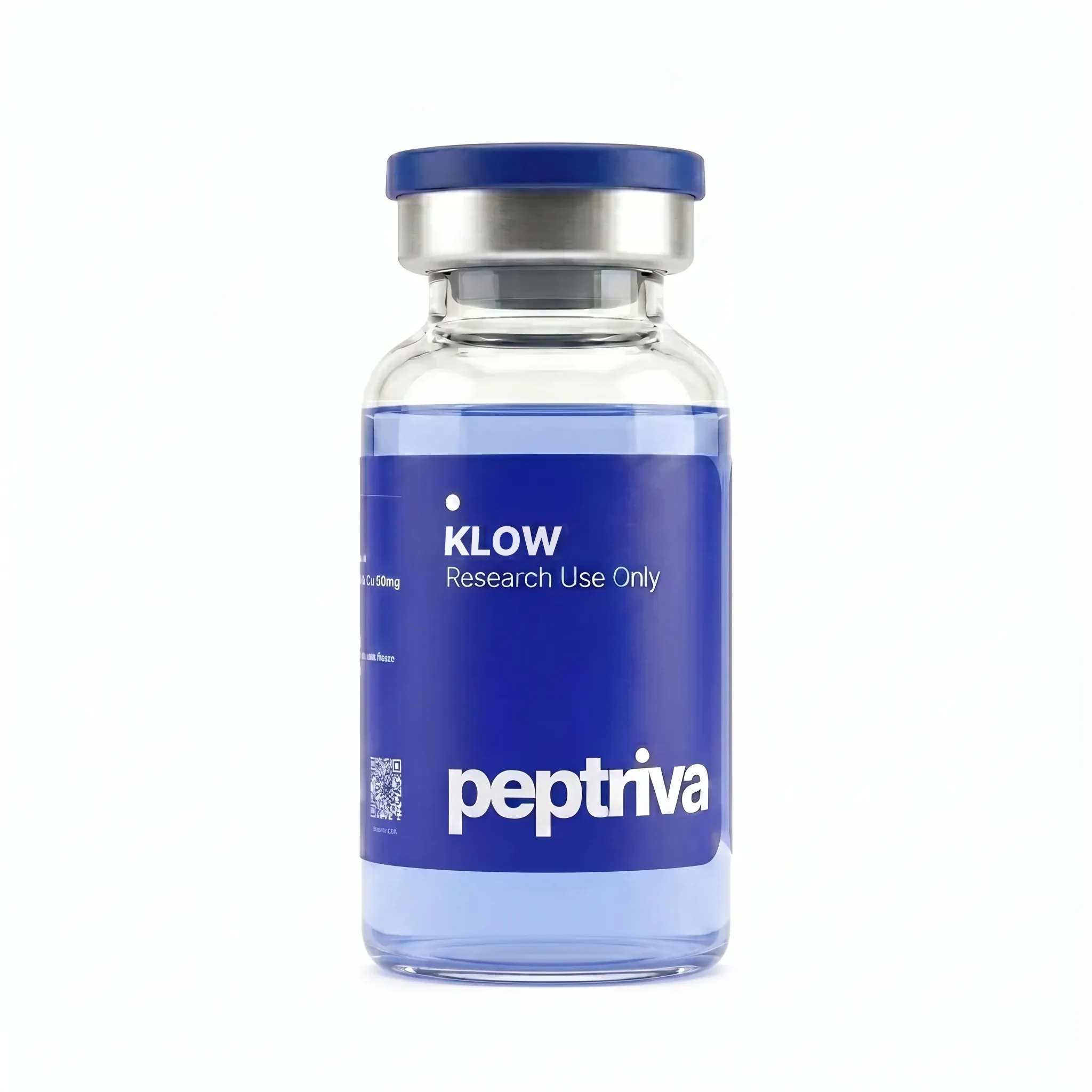
KLOW Blend
The four-component blend described here, co-lyophilized in one vial, with a third-party certificate of analysis matched to the lot.
KPV: the ingredient that makes KLOW different, and the least tested
KPV is the C-terminal tripeptide of alpha-melanocyte-stimulating hormone. It keeps the parent hormone’s anti-inflammatory activity and drops the pigmentation effect, which is a genuinely elegant piece of pharmacology. It is also the single ingredient separating KLOW from GLOW.
The evidence is narrow and clean. Two 2008 papers established an anti-inflammatory signal in murine colitis models. One of them showed KPV entering intestinal epithelial and immune cells through the PepT1 transporter, at nanomolar concentrations in culture, and reducing NF-kappaB activation.
PepT1-mediated tripeptide KPV uptake reduces intestinal inflammation.
Dalmasso et al., Gastroenterology, 2008What has not followed is a human trial. Not one has been published, for colitis or for anything else. The strongest claim available for KPV is a well-characterized preclinical anti-inflammatory mechanism, which is a real thing to have and is not a benefit in people. See KPV benefits and the colitis research.
What the blend itself has been shown to do
Nothing. There is no published study of the four-compound combination in any species, on any endpoint. No pharmacokinetics, no stability data for four peptides in one cake, no comparison against the constituents given separately.
The argument for combining them is division of labor: repair signaling, cell migration, matrix remodeling and inflammation control, four mechanisms that do not overlap. That is a reasonable hypothesis for why a combination might outperform any single part.
Specifically, these are the things that do not exist for KLOW as a product:
- No comparative study. The blend has never been tested against its own constituents given separately.
- No pharmacokinetics. Nothing is published on what four peptides do to each other’s absorption or clearance.
- No stability data. Four peptides co-lyophilized in one cake, and no published work on what that cake is after reconstitution.
- No dose-response. Without a dose there is no curve, and without a curve there is no way to say more or less of anything.
It is also the entire case. The experiment that would test it — the blend against each ingredient alone, one endpoint, one species — has never been run, and it would not be expensive.
Meanwhile the blend adds two problems the ingredients do not have on their own. The ratio is fixed at manufacture, so nothing can be varied. And 62.5% of what is being given is one compound whose controlled human evidence is topical.
How to read a KLOW benefits list
Four questions turn a marketing list back into evidence, and they take about a minute:
- Which ingredient is this claim about? If it does not resolve to one of the four, it is about the blend, and the blend has nothing.
- Is it a photograph? KLOW before and after covers why a four-compound image cannot attribute anything.
- What species? Most of the recovery claims are rodent. Say so and the claim survives; hide it and it does not.
- What route? GHK-Cu’s best evidence is topical. A skin claim on an injected vial is a route substitution.
- Is there a human trial? For TB-500 and KPV the answer is no. For BPC-157 it is three pilot reports. See KLOW side effects for what that thin record means for safety.
The compounds are worth taking seriously on their own terms, which is why we keep a monograph for each. The combination is a convenience product with an untested premise, and it should be described that way. KLOW vs GLOW works through whether the fourth ingredient earns its place.
KLOW Blend
Research-use-only material, sold by the vial with batch documentation. Check the certificate of analysis against the batch you receive.
What to know now
- KLOW is four compounds in one vial — GHK-Cu, BPC-157, TB-500 and KPV, typically 50/10/10/10 mg for 80 mg total.
- The combination has zero published studies in any species. Every benefit attributed to it comes from one ingredient's literature.
- GHK-Cu is the best-evidenced ingredient and its controlled human evidence is topical, not injected.
- BPC-157's leading 2025 review counts 35 preclinical studies against 1 human, and that one is an uncontrolled case series.
- TB-500 and KPV have no published human trials for any indication.
What we're watching
One study would change this page entirely: a factorial comparison of the four-compound blend against each constituent alone, on any endpoint, in any species. Nobody has run the obvious experiment. We are also watching for the first human trial of KPV, which would move the newest ingredient in this vial from mechanism to outcome, and for an injectable GHK-Cu human dataset, which is the largest hole in the vial by mass. Until one of those appears, the honest description of KLOW is four real molecules and one untested combination.
Frequently asked questions
What are the benefits of the KLOW peptide blend?
None have been demonstrated for the blend. No study has tested GHK-Cu, BPC-157, TB-500 and KPV together in any species. Benefits described in marketing are drawn from the four separate literatures, which are mostly rodent studies and, for GHK-Cu, mostly topical.
What does KPV add that GLOW does not have?
An anti-inflammatory mechanism with a clean preclinical description and no human trial. KPV is the C-terminal tripeptide of alpha-MSH, it enters cells through the PepT1 transporter, and it reduces NF-kappaB activation in murine colitis models. Nothing has been published in people.
Is KLOW better than buying the four peptides separately?
More convenient, not better evidenced. A pre-mix guarantees the ratio and saves steps, but it fixes you at 5:1:1:1 and makes single-variable work impossible. No study has compared the co-formulation with the constituents given separately.
Does KLOW work for skin?
Unknown. GHK-Cu has replicated skin-remodeling evidence when applied topically, which is not the route this blend uses. Injected GHK-Cu has no published randomized human trial, and the blend has none at all.
Is the KLOW blend banned in sport?
Treat it as prohibited. BPC-157 has been listed by WADA under S0 since January 2022 and thymosin beta-4 falls under S2, so the vial contains two prohibited compounds. Verify current status with the relevant governing body.
References
- Dou, Y., Lee, A., Zhu, L., et al. (2020). The potential of GHK as an anti-aging peptide. Aging Pathobiology and Therapeutics, 2(1), 58–61. https://doi.org/10.31491/apt.2020.03.014
- Pickart, L., & Margolina, A. (2018). Regenerative and protective actions of the GHK-Cu peptide in the light of the new gene data. International Journal of Molecular Sciences, 19(7), 1987. https://doi.org/10.3390/ijms19071987
- Pickart, L., Vasquez-Soltero, J. M., & Margolina, A. (2015). GHK peptide as a natural modulator of multiple cellular pathways in skin regeneration. BioMed Research International, 2015, 648108. https://doi.org/10.1155/2015/648108
- Dymek, M., Warszyński, P., & Sikora, E. (2023). GHK Peptide Permeability and Its Effects in Anti-Aging Skincare Topical Formulations. Pharmaceutics, 15(10), 2485. https://doi.org/10.3390/pharmaceutics15102485
- Vasireddi, N., Hahamyan, H., Salata, M. J., et al. (2025). Emerging use of BPC-157 in orthopaedic sports medicine: A systematic review. HSS Journal, 21(4). https://doi.org/10.1177/15563316251355551
- McGuire, F. P., Martinez, R., Lenz, A., Skinner, L., & Cushman, D. M. (2025). Regeneration or risk? A narrative review of BPC-157 for musculoskeletal healing. Current Reviews in Musculoskeletal Medicine, 18(12), 611–619. https://doi.org/10.1007/s12178-025-09990-7
- Lee, E., & Padgett, B. (2021). Intra-articular injection of BPC 157 for multiple types of knee pain. Alternative Therapies in Health and Medicine, 27(4), 8–13. PMID 34324435
- Dalmasso, G., Charrier-Hisamuddin, L., Nguyen, H. T., et al. (2008). PepT1-mediated tripeptide KPV uptake reduces intestinal inflammation. Gastroenterology, 134(1), 166–178. https://doi.org/10.1053/j.gastro.2007.10.026
- Kannengiesser, K., Maaser, C., Heidemann, J., et al. (2008). Melanocortin-derived tripeptide KPV has anti-inflammatory potential in murine models of inflammatory bowel disease. Inflammatory Bowel Diseases, 14(3), 324–331. https://doi.org/10.1002/ibd.20334
- Sun, J., Xue, P., Liu, J., et al. (2021). Self-Cross-Linked Hydrogel of Cysteamine-Grafted γ-Polyglutamic Acid Stabilized Tripeptide KPV for Alleviating TNBS-Induced Ulcerative Colitis in Rats. ACS Biomaterials Science & Engineering, 7(10), 4859–4869. https://doi.org/10.1021/acsbiomaterials.1c00792
- Philp, D., Goldstein, A. L., & Kleinman, H. K. (2004). Thymosin beta4 promotes angiogenesis, wound healing, and hair follicle development. Mechanisms of Ageing and Development, 125(2), 113–115. https://doi.org/10.1016/j.mad.2003.11.005
- Ying, Y., Lin, C., Tao, N., et al. (2023). Thymosin β4 and actin: Binding modes, biological functions and clinical applications. Current Protein and Peptide Science, 24(1), 78–88. https://doi.org/10.2174/1389203724666221201093500
- Xing, Y., Ye, Y., Zuo, H., & Li, Y. (2021). Progress on the Function and Application of Thymosin β4. Frontiers in Endocrinology, 12, 767785. https://doi.org/10.3389/fendo.2021.767785
- Gravina, A. G., Pellegrino, R., Durante, T., et al. (2023). The Melanocortin System in Inflammatory Bowel Diseases: Insights into Its Mechanisms and Therapeutic Potentials. Cells, 12(14), 1889. https://doi.org/10.3390/cells12141889