
KLOW peptide is four research compounds co-lyophilized into one vial. Three of them are the GLOW blend. The fourth is KPV. No study has ever given the four together, in any species.
The short answer. KLOW is a market name for a four-compound blend — GHK-Cu, BPC-157, TB-500 and KPV, typically 50/10/10/10 mg in one 80 mg vial.
- It is the GLOW trio plus 10 mg of KPV. That single ingredient is the whole difference between the two products.
- GHK-Cu is 62.5% of the vial by mass, so most of what is being bought and injected is one ingredient.
- The four-compound combination has zero published studies in any species. Every benefit attributed to KLOW is borrowed from a constituent.
KLOW is a blend, not a molecule. The standard vial is 80 mg total: 50 mg GHK-Cu, 10 mg BPC-157, 10 mg TB-500 and 10 mg KPV. That is the GLOW trio plus KPV. GHK-Cu is 62.5% of the mass, so most of what is in the vial is one ingredient. The combination has zero published studies.
What is in a KLOW peptide vial?
“KLOW” is an acronym vendors assembled from the four ingredients, not a name any journal uses. It refers to a single lyophilized cake containing four research peptides. The configuration the market has settled on is 80 mg total:
- GHK-Cu, 50 mg — the copper(II) complex of an endogenous tripeptide, and the reason the reconstituted vial turns blue. Full monograph: GHK-Cu complete guide.
- BPC-157, 10 mg — a synthetic 15-amino-acid peptide derived from a sequence in human gastric juice. Full monograph: BPC-157 complete guide.
- TB-500, 10 mg — the research-market name for thymosin beta-4 or its active fragment. Full monograph: TB-500 complete guide.
- KPV, 10 mg — the C-terminal tripeptide of alpha-MSH, and the only ingredient KLOW does not share with GLOW. Full monograph: KPV complete guide.
Read those milligrams again, because the split is the most important fact on this page. GHK-Cu is 62.5% of the vial by mass. The other three share the remaining 37.5% equally. Whatever else KLOW is, it is mostly a GHK-Cu product.
Not every vendor uses that split. The 80 mg total is close to universal, and 50/10/10/10 is the common configuration, but the ratio is a market convention rather than a specification. Check the label rather than assuming it.
KLOW is GLOW plus KPV
The clearest way to understand KLOW is by subtraction. Take the GLOW blend — BPC-157, TB-500 and GHK-Cu at 10/10/50, for 70 mg — and add 10 mg of KPV. That is KLOW. The letter K is the whole difference.
| Component | GLOW (70 mg) | KLOW (80 mg) | Share of KLOW |
|---|---|---|---|
| GHK-Cu | 50 mg | 50 mg | 62.5% |
| BPC-157 | 10 mg | 10 mg | 12.5% |
| TB-500 | 10 mg | 10 mg | 12.5% |
| KPV | — | 10 mg | 12.5% |
KPV is the C-terminal fragment of alpha-melanocyte-stimulating hormone, the part of the parent hormone that keeps the anti-inflammatory activity and drops the pigmentation. The rationale for adding it is that the other three address repair, and KPV addresses the inflammation running alongside it. That is a reasonable hypothesis. It is also the entire case, and nobody has tested it. We compare the two vials directly in KLOW vs GLOW.
What does the KLOW peptide do?
It does four separate things, because there is no shared mechanism to describe. Each ingredient acts on a different pathway, and the vial does not create a fifth one.
GHK-Cu delivers copper to proteins involved in collagen synthesis and antioxidant defense, and Pickart’s gene-expression work reports it shifting the expression of a large fraction of human genes in culture. Serum GHK falls with age, which is where the anti-aging framing comes from. See the collagen mechanism.
GHK is a naturally occurring peptide found in human serum with levels averaging 200 ng/ml at age 20 but declining to an average of 80 ng/ml by age 60.
Dou et al., Aging Pathobiology and Therapeutics, 2020BPC-157 is described as acting through VEGFR2 activation with downstream nitric-oxide signaling, recruiting fibroblasts into injury sites. That mechanism story is well developed and almost entirely rodent. See the VEGFR2 pathway.
TB-500 binds monomeric G-actin at a 1:1 ratio, which is how a cell controls the actin dynamics it uses to crawl into a wound. This is the cleanest molecular biology of the four. See the actin-binding mechanism.
KPV suppresses NF-kappaB signaling in intestinal epithelial and immune cells, and the colitis work shows it entering those cells through the PepT1 transporter rather than through a melanocortin receptor. See the KPV mechanism.
Four mechanisms that do not overlap is a decent argument for why a combination might beat any single part. It is not evidence that it does. The experiment that would settle it — the blend against each constituent alone, on one endpoint, in one species — has never been run.
What each of the four has behind it
The four are not equally evidenced, and the gap between them is wide. Here is the record for each, at the level of what has actually been published in humans. Each marketing claim traced back to the ingredient it came from is the subject of KLOW peptide benefits.
| Component | Strongest evidence | Human trials | Route studied |
|---|---|---|---|
| GHK-Cu | Controlled dermal studies | Topical only | Applied to skin |
| BPC-157 | Large rodent corpus | Three pilot reports | Intra-articular, IV, peri-vesical |
| TB-500 | Mechanistic and animal | None published | — |
| KPV | Murine colitis models | None published | — |
A 2025 systematic review in the orthopaedic sports-medicine literature counted 36 studies of BPC-157 meeting its criteria: 35 preclinical and 1 human. That single human entry is a retrospective knee-pain case series of 17 patients with no control arm.
Despite the robust preclinical findings, human data are extremely limited, no large-scale randomized trials exist, and BPC-157 should be considered investigational pending well-designed clinical trials.
McGuire et al., Current Reviews in Musculoskeletal Medicine, 2025KPV’s record is thinner still and cleaner to describe. Two 2008 papers established the anti-inflammatory signal in murine colitis models, one of them showing PepT1-mediated uptake at nanomolar concentrations in culture. Nothing has followed in humans. We cover the studies in KPV in ulcerative colitis models.
GHK-Cu is the best evidenced of the four, and it is evidenced for a route this vial does not use. The controlled human work is topical, measured as a formulation percentage. Injected GHK-Cu has no published randomized trial. That distinction is the subject of injectable vs topical GHK-Cu.
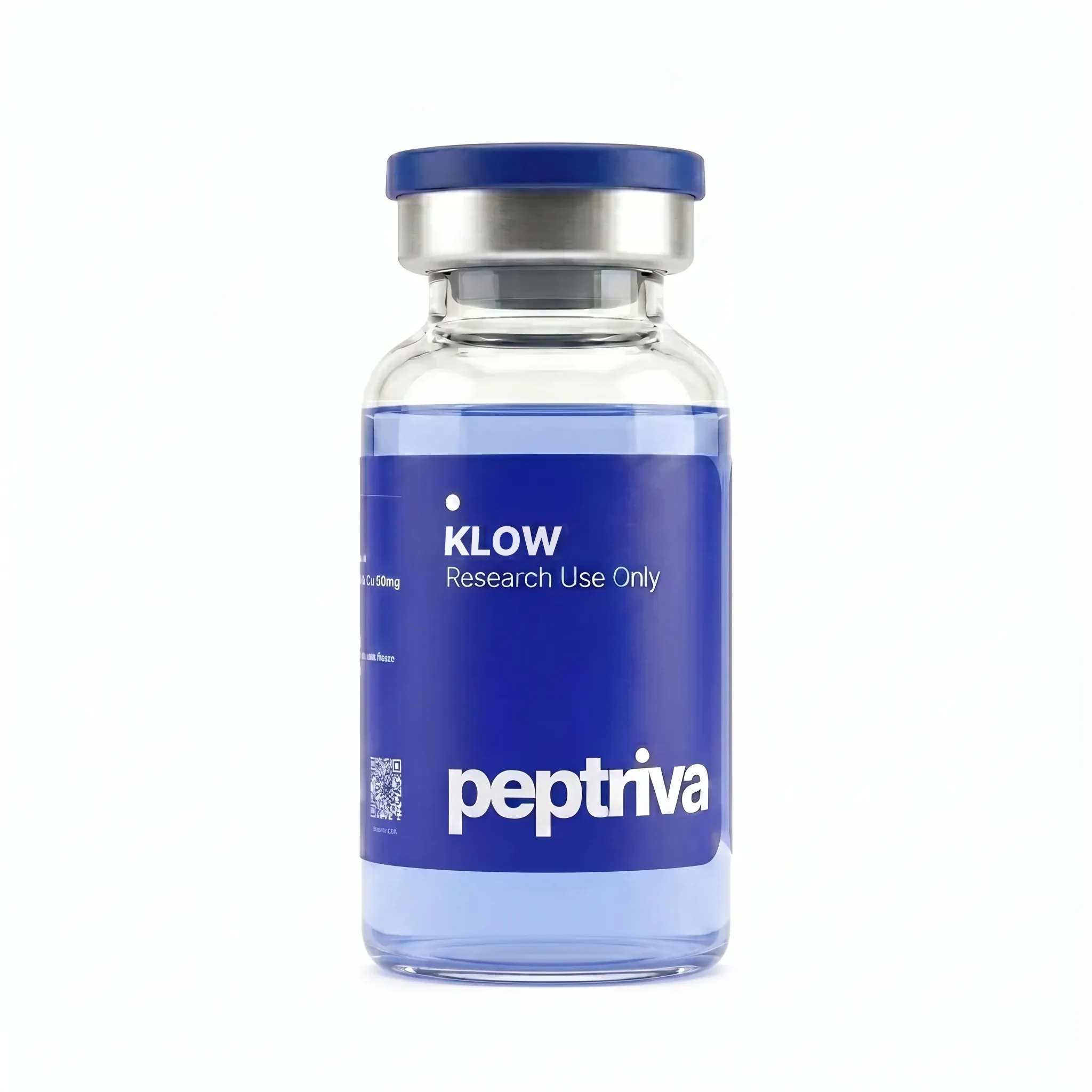
KLOW Blend
The four-component blend described here, co-lyophilized in one vial, with a third-party certificate of analysis matched to the lot.
How long should you be on KLOW peptide?
No study defines a duration, because no study has given the blend at all. Schedules circulating online were reconstructed from the constituents, and two of the four constituents have no human schedule to reconstruct from.
There is a second reason duration is not a free variable here, and it is arithmetic rather than pharmacology. Fifty milligrams of GHK-Cu carries roughly 7.9 mg of elemental copper. The tolerable upper intake level for copper in adults is 10 mg per day from all sources. A vial of KLOW is therefore close to a full day’s ceiling of copper in one container, and how fast you go through it is a copper question before it is a peptide question. We work through this in KLOW peptide dosage.
Two of the four are also prohibited in sport. BPC-157 has been listed by WADA under S0 since January 2022, and thymosin beta-4 falls under S2. A tested athlete is looking at a vial with two banned substances in it.
How much does KLOW peptide cost, and what are you paying for?
Price the vial per milligram and the answer changes shape. At 80 mg total, 50 mg of what you buy is GHK-Cu. If a KLOW vial costs more than a GHK-Cu vial plus a KPV vial, you are paying a premium for co-lyophilization, not for more material.
That premium buys one real thing: the ratio is fixed for you and you mix one vial instead of four. It also costs one real thing, which is that you can never move a single component. More on that trade in the sourcing guide below.
All four are also sold separately, which is how most of this market works, and three of them are sold together as GLOW. So the same composition can be assembled from two or four vials instead of bought pre-mixed. Whether that is cheaper depends entirely on the vendor and the day, and it is worth checking rather than assuming. Where to buy KLOW works through both routes.
What to check before buying a four-way blend
A blend makes the certificate of analysis harder to read, and the difficulty scales with the number of components. Four is the most this market usually asks of a document.
- Per-component quantitation, not a single purity number. “99% pure” on a four-compound vial does not tell you the split. Ask for weight percent per component.
- Identity for all four. Mass spectrometry should confirm four masses. Read how to read a peptide COA before you open one.
- Which TB-500. The name covers both full-length thymosin beta-4 and its active fragment, and suppliers do not consistently declare which. A purity figure does not settle it.
- Lot match. The document should carry the lot number on the vial in your hand, not a representative batch. Storage matters too — see peptide storage temperature.
What people usually want next is results, and that question has its own page: KLOW peptide before and after audits the human record ingredient by ingredient.
The blue color is worth a note, because it gets read as a quality signal. It is not one. Copper(II) complexes are blue, so a KLOW solution turning blue tells you copper is present and nothing else about purity or ratio.
KLOW Blend
Research-use-only material, sold by the vial with batch documentation. Check the certificate of analysis against the batch you receive.
What to know now
- KLOW is a market name for a four-compound blend — GHK-Cu, BPC-157, TB-500 and KPV, typically 50/10/10/10 mg in one 80 mg vial.
- It is the GLOW trio plus 10 mg of KPV. That single ingredient is the whole difference between the two products.
- GHK-Cu is 62.5% of the vial by mass, so most of what is being bought and injected is one ingredient.
- The four-compound combination has zero published studies in any species. Every benefit attributed to KLOW is borrowed from a constituent.
- Two of the four are prohibited in sport: BPC-157 under WADA S0, thymosin beta-4 under S2.
What we're watching
The experiment that would change this page is cheap and still unrun: the four-compound blend against each constituent alone, on any endpoint, in any species. Until it exists, KLOW's case is four separate literatures stapled together. We are also watching for a human dataset on injected GHK-Cu, which is the largest hole in the vial by mass and by evidence, and for any supplier publishing weight-percent-per-component certificates as standard, which would at least make the composition claim checkable.
Frequently asked questions
What is KLOW peptide?
A market name for a blend of four research peptides in one vial: GHK-Cu, BPC-157, TB-500 and KPV. The standard vial is 80 mg, usually split 50/10/10/10. It is not a single compound and it has no published studies as a combination.
What is the difference between KLOW and GLOW?
One ingredient. GLOW is BPC-157, TB-500 and GHK-Cu at 10/10/50 for 70 mg. KLOW adds 10 mg of KPV, the C-terminal tripeptide of alpha-MSH, for 80 mg total. Everything else is the same.
What does the KLOW peptide do?
Four separate things, one per ingredient, with no shared mechanism. GHK-Cu delivers copper to collagen and antioxidant pathways, BPC-157 is described as acting through VEGFR2, TB-500 binds G-actin, and KPV suppresses NF-kappaB signaling. None of that has been tested as a combination.
Why does KLOW turn blue?
Because of the GHK-Cu. Copper(II) complexes are blue in solution, and GHK-Cu is 62.5% of the vial. The color confirms copper is present. It says nothing about purity, ratio or identity.
How long should you be on KLOW peptide?
No study defines a duration, because no study has given the blend. There is also a copper ceiling to consider: 50 mg of GHK-Cu carries roughly 7.9 mg of elemental copper, against a 10 mg per day adult upper intake level from all sources.
Is KLOW peptide banned in sport?
Treat it as prohibited. BPC-157 has been listed by WADA under S0 since January 2022 and thymosin beta-4 falls under S2, so the vial contains two prohibited compounds. Verify current status with the relevant governing body.
What people actually report
These are self-reports, not evidence. No control group, no blinding, and no independent check that the vial held what the label claimed. They are collected here because people asking about KLOW deserve an answer rather than a refusal, and because what the community believes is itself worth knowing. Quotes are excerpts; each links to the original post.
Self-reports split along one line. Skin and joint changes get reported often, usually between weeks three and six. Hair is the inconsistent one. The biggest KLOW before-and-after on Reddit is a hair post, but the same threads carry people who say their hair did not change at all. Null reports recur in every thread, including one at 60 days and two vials. Commenters in the r/tressless thread describe an early breakout phase they call "copper uglies." None of this is controlled. Nobody is blinded, nobody measures, and most people run KLOW alongside other compounds.
Where the community and the published record disagree. The community's own headline evidence does not exist. The most-upvoted KLOW before-and-after on Reddit, at 831 upvotes, credits "a 5 year study on ipamorelin showing 15% hair density increase at year one and 25% by year five" (verified verbatim in the post). PubMed returns zero results for ipamorelin and hair, though ipamorelin alone returns 54 records. The wider gap has the same shape. PubMed has no study of the four-peptide KLOW combination at all. And it has no human trial of injected GHK-Cu: of 180 GHK-Cu records, the only two human trials are topical cream, a 2006 trial on CO2 laser-resurfaced skin and a 1992 trial of a 0.4% cream on venous stasis ulcers. The rest of the skin work people cite is cell culture and animal models. A 2026 review of injectable peptide therapy says these findings are "largely unvalidated in human trials." So the community argues about ratios and cycling for a formulation the literature has never tested once.
“Ankle and knee pain disappeared by week 1. • My skin is thicker and I noticed slight tightening but nothing major.”
“I'm 60 days and 2 vials in and I get nothing from it. I pulled my groin 3 weeks ago I don't even know how but no healing benefits with that.. no skin benefits literally nothing from it and I'm getting sick of injecting every day..”
“around week 6-8 i noticed my hair was actually thicker. not just "i think it looks better" thick, like visibly filling in on the crown.”
GH peptides + KLOW blend saved my hair. before and after pics.
“I had better results with every one separately than using a blend (and you can control dosage of each) but it's way too much burden to do that many pins”
KLOW injections vs individually dosing GHK-CU, KPV, BPC 157 and TB 500
“Around day 3 I noticed I started to have brain fog I couldn't concentrate on nothing. Then having horrible anxiety, along with head pressure.”
“why some people flare up before they feel better, and why peptides should never replace fixing the actual mechanical triggers behind pain and injury”
Posts are quoted under fair use and linked to their authors. Nothing on this page is hosted here, and no claim above has been verified beyond confirming that the person wrote it.
References
- Dou, Y., Lee, A., Zhu, L., et al. (2020). The potential of GHK as an anti-aging peptide. Aging Pathobiology and Therapeutics, 2(1), 58–61. https://doi.org/10.31491/apt.2020.03.014
- Pickart, L., & Margolina, A. (2018). Regenerative and protective actions of the GHK-Cu peptide in the light of the new gene data. International Journal of Molecular Sciences, 19(7), 1987. https://doi.org/10.3390/ijms19071987
- Pickart, L., Vasquez-Soltero, J. M., & Margolina, A. (2015). GHK peptide as a natural modulator of multiple cellular pathways in skin regeneration. BioMed Research International, 2015, 648108. https://doi.org/10.1155/2015/648108
- Vasireddi, N., Hahamyan, H., Salata, M. J., et al. (2025). Emerging use of BPC-157 in orthopaedic sports medicine: A systematic review. HSS Journal, 21(4). https://doi.org/10.1177/15563316251355551
- McGuire, F. P., Martinez, R., Lenz, A., Skinner, L., & Cushman, D. M. (2025). Regeneration or risk? A narrative review of BPC-157 for musculoskeletal healing. Current Reviews in Musculoskeletal Medicine, 18(12), 611–619. https://doi.org/10.1007/s12178-025-09990-7
- Lee, E., & Padgett, B. (2021). Intra-articular injection of BPC 157 for multiple types of knee pain. Alternative Therapies in Health and Medicine, 27(4), 8–13. PMID 34324435
- Lee, E., & Burgess, K. (2025). Safety of intravenous infusion of BPC-157 in humans: A pilot study. Alternative Therapies in Health and Medicine, 31(5), 20–24. PMID 40131143
- Dalmasso, G., Charrier-Hisamuddin, L., Nguyen, H. T., et al. (2008). PepT1-mediated tripeptide KPV uptake reduces intestinal inflammation. Gastroenterology, 134(1), 166–178. https://doi.org/10.1053/j.gastro.2007.10.026
- Kannengiesser, K., Maaser, C., Heidemann, J., et al. (2008). Melanocortin-derived tripeptide KPV has anti-inflammatory potential in murine models of inflammatory bowel disease. Inflammatory Bowel Diseases, 14(3), 324–331. https://doi.org/10.1002/ibd.20334
- Sun, J., Xue, P., Liu, J., et al. (2021). Self-Cross-Linked Hydrogel of Cysteamine-Grafted γ-Polyglutamic Acid Stabilized Tripeptide KPV for Alleviating TNBS-Induced Ulcerative Colitis in Rats. ACS Biomaterials Science & Engineering, 7(10), 4859–4869. https://doi.org/10.1021/acsbiomaterials.1c00792
- Philp, D., Goldstein, A. L., & Kleinman, H. K. (2004). Thymosin beta4 promotes angiogenesis, wound healing, and hair follicle development. Mechanisms of Ageing and Development, 125(2), 113–115. https://doi.org/10.1016/j.mad.2003.11.005
- Ying, Y., Lin, C., Tao, N., et al. (2023). Thymosin β4 and actin: Binding modes, biological functions and clinical applications. Current Protein and Peptide Science, 24(1), 78–88. https://doi.org/10.2174/1389203724666221201093500
- Xing, Y., Ye, Y., Zuo, H., & Li, Y. (2021). Progress on the Function and Application of Thymosin β4. Frontiers in Endocrinology, 12, 767785. https://doi.org/10.3389/fendo.2021.767785
- Dymek, M., Warszyński, P., & Sikora, E. (2023). GHK Peptide Permeability and Its Effects in Anti-Aging Skincare Topical Formulations. Pharmaceutics, 15(10), 2485. https://doi.org/10.3390/pharmaceutics15102485