
Deciding where to buy KLOW peptide starts with a question most guides skip: whether to buy it pre-mixed. The same four compounds are sold separately, and the certificate is easier to read that way.
The short answer. KLOW can be assembled rather than bought pre-mixed — a 70 mg GLOW vial plus a 10 mg KPV vial holds the same four compounds in the same amounts.
- The pre-mix buys one reconstitution instead of two, and sometimes a lower price. It costs the ability to adjust the ratio, which is fixed at manufacture.
- Price per milligram, then remember 50 of the 80 mg are GHK-Cu. A KLOW vial is mostly a GHK-Cu purchase.
- A four-component certificate must show weight percent per component and four confirmed masses. A single purity figure hides the split.
KLOW is 80 mg of four compounds in one vial. The split is 50 mg GHK-Cu, 10 mg BPC-157, 10 mg TB-500 and 10 mg KPV. All four are also sold separately. A 70 mg GLOW vial plus a 10 mg KPV vial holds the same thing. The pre-mix saves one reconstitution. It also fixes the ratio for good. And it puts four identities on one certificate.
Two paths, and they are not the same purchase
Before the vendor question, the format question. KLOW reaches buyers two ways and they behave differently.
- As a research compound. An 80 mg co-lyophilized vial sold for research use, shipped as powder, with a certificate of analysis. No clinician involved, no prescription, and the vial is not an approved drug.
- Through a clinic or med spa. Compounded or supplied under a practitioner, usually at a large multiple of the research price, and with the composition decided for you. Most of the pages ranking for this term are clinics selling this route.
Where To Buy Peptides earns a commission on purchases made through its links. That is exactly why the section below is a list of documents to open rather than a ranking to trust.
This page covers the research-compound route, which is what the search term almost always means. The vial itself is described in the KLOW complete guide.
The pre-mix question comes before the vendor question
KLOW is GHK-Cu, BPC-157, TB-500 and KPV. All four are stocked as individual vials across this market, and three of them are also sold together as the GLOW blend at 10/10/50. Add a 10 mg KPV vial to a 70 mg GLOW vial and you have the KLOW composition in two containers instead of one.
| Route | Vials | Ratio | Certificate |
|---|---|---|---|
| KLOW pre-mix | 1 × 80 mg | Fixed at 5:1:1:1 | Four components on one document |
| GLOW + KPV | 2 vials | KPV adjustable | Three plus one, separately |
| Four separates | 4 vials | Fully adjustable | One component per document |
Melanocortin-derived tripeptide KPV has anti-inflammatory potential in murine models of inflammatory bowel disease.
Kannengiesser et al., Inflammatory Bowel Diseases, 2008That is the reason anyone buys the fourth ingredient, and it is a mouse study. Whether it arrives in a pre-mix or its own vial does not change the evidence behind it, which is worth remembering when a blend is priced as though it does.
The pre-mix wins on convenience for certain: one reconstitution rather than two or four, and a ratio guaranteed without you measuring anything. It can also win on price, and that catches people out. A convenience format is not automatically a premium format, so do the arithmetic instead of assuming.
What neither route changes is the evidence, which belongs to the four ingredients rather than to any packaging of them — see KLOW peptide benefits.
The separates win on everything to do with verification. A single-compound certificate has one identity and one purity figure, and both are unambiguous. They also let you change one thing at a time, which a co-lyophilized cake makes impossible — see KLOW peptide dosage for why the fixed ratio is the binding constraint.
How much does KLOW peptide cost?
Price it per milligram and compare like with like, because an 80 mg vial and a 10 mg vial are not comparable numbers. Then apply one correction most buyers miss: 50 of those 80 mg are GHK-Cu, which is the cheapest of the four per milligram across this market.
So a KLOW vial that looks expensive next to a 10 mg BPC-157 vial may be cheap per milligram, and still be mostly a GHK-Cu purchase. The useful comparison is one KLOW vial against a GLOW vial plus a KPV vial, because those hold the same four compounds in the same amounts. Run it with today’s prices. The pre-mix is sometimes the cheaper side of that comparison, which is the opposite of what most buyers expect.
GHK-Cu is a fairly hydrophilic compound with limited permeation through the lipophilic stratum corneum.
Ogórek et al., Molecules, 2025Worth holding on to while comparing prices: the reason injectable GHK-Cu exists as a product at all is that the topical form permeates poorly. The evidence base, however, is on the topical form. You are paying for the route with less data behind it.
Clinic pricing is a different market and is not comparable at all. Research-compound pricing across the vendors we track is set out in the vendor comparison, benchmarked on BPC-157 because it is the most widely stocked compound in the category.
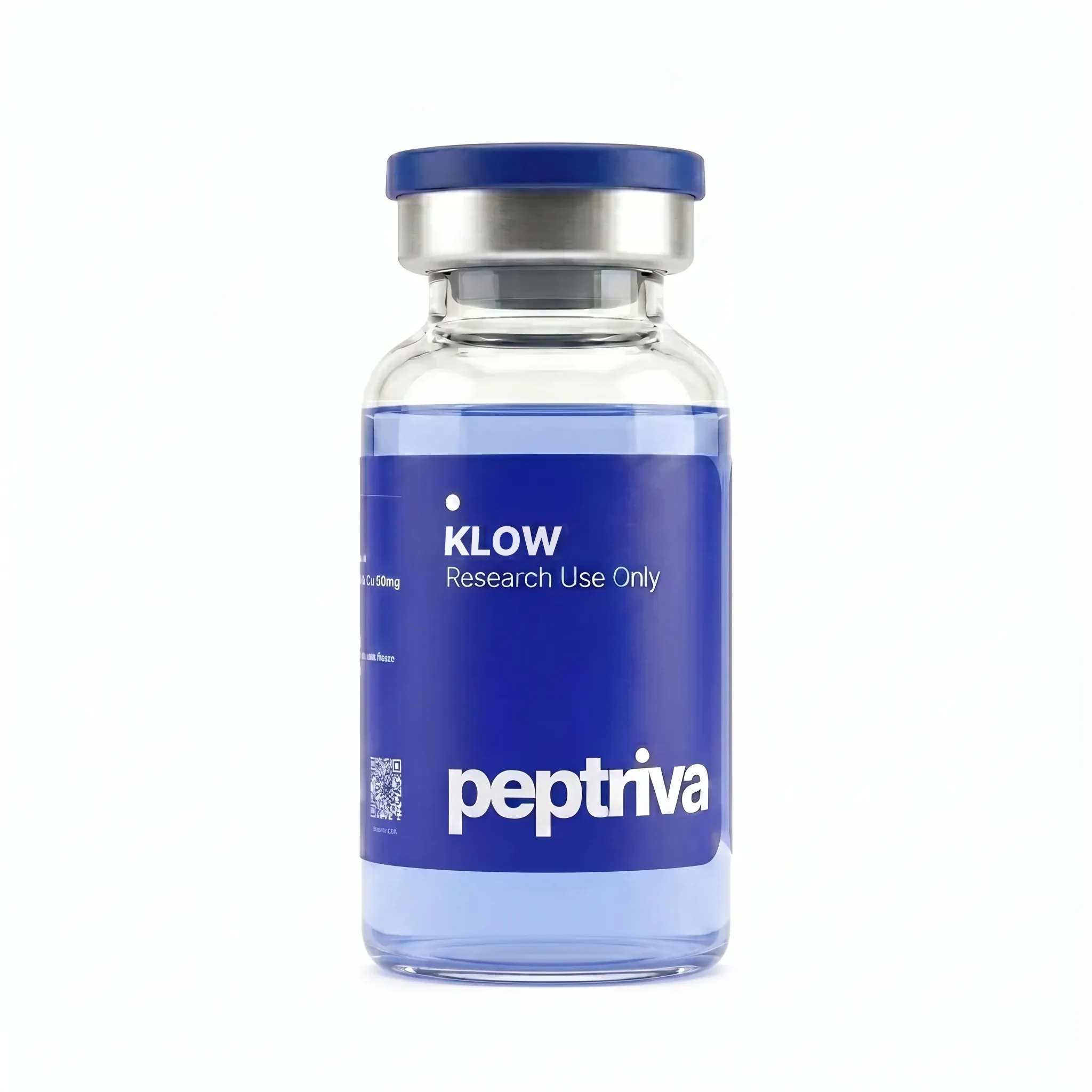
KLOW Blend
The four-component blend described here, co-lyophilized in one vial, with a third-party certificate of analysis matched to the lot.
Four checks a blend certificate has to survive
A four-compound vial asks more of a certificate of analysis than anything else in this market. These are the checks in order of how much signal each carries.
- Weight percent per component. The single most important line and the one most often missing. “99% pure” on a four-compound cake tells you about impurities, not about the split. Without per-component quantitation, the 50/10/10/10 claim is unverified.
- Four masses on the mass spectrum. Identity has to be confirmed for each ingredient, not for the cake as a whole. Three masses and a purity figure is an incomplete document.
- Which TB-500. The name covers both full-length thymosin beta-4 and its active fragment. They are different molecules with different masses, and a purity figure does not distinguish them. The certificate should say which was made.
- The lot number on your vial. Not a representative batch, not an undated PDF. The document has to match the container in your hand.
How to read a peptide certificate of analysis covers what each section of the document is actually claiming, and which lab names carry weight.
One more, specific to this vial: the testing lab should be named on the product page, not just inside the PDF. A vendor that names its lab in public is making a claim it can be held to.
What the blue color does and does not tell you
Reconstituted KLOW turns blue, and the color gets treated online as a freshness or quality signal. It is neither.
Copper(II) complexes are blue in solution. GHK-Cu is 62.5% of the vial, so blue confirms copper is present and nothing else. It does not confirm the other three ingredients are there, it does not confirm the ratio, and it does not indicate purity.
A vial that arrived without any blue on reconstitution would be a genuine red flag. A vial that is blue has passed one very low bar. The elemental copper load and why it matters are covered in KLOW peptide side effects.
Shipping, storage and the parts that go wrong after purchase
Lyophilized peptide is stable in transit, which is why this market ships at ambient temperature without a problem. Once reconstituted, the vial is a refrigerated item with a limited life.
Peptide storage temperature covers the thresholds, and how to reconstitute a peptide covers the mechanics. Bacteriostatic water matters more for a blend than most buyers expect, because the diluent choice decides how many times a vial can be entered, and an 80 mg vial is not a one-entry object.
Broader sourcing questions — domestic versus overseas suppliers, what a good vendor email looks like, what customs does — are covered in the best place to buy peptides online and the USA buying guide.
KLOW Blend
Research-use-only material, sold by the vial with batch documentation. Check the certificate of analysis against the batch you receive.
What to know now
- KLOW can be assembled rather than bought pre-mixed — a 70 mg GLOW vial plus a 10 mg KPV vial holds the same four compounds in the same amounts.
- The pre-mix buys one reconstitution instead of two, and sometimes a lower price. It costs the ability to adjust the ratio, which is fixed at manufacture.
- Price per milligram, then remember 50 of the 80 mg are GHK-Cu. A KLOW vial is mostly a GHK-Cu purchase.
- A four-component certificate must show weight percent per component and four confirmed masses. A single purity figure hides the split.
- Blue on reconstitution confirms copper is present. It is not a purity, identity or ratio check.
What we're watching
The check that would settle most of this is a supplier publishing weight-percent-per-component certificates for blends as standard. Nobody does it consistently, and until someone does, the 50/10/10/10 claim on a KLOW vial is a label rather than a measurement. The second thing worth watching is the price relationship between the pre-mix and the separates. It moves, it is easy to check, and it is currently the only axis on which either format can demonstrate an advantage over the other.
Frequently asked questions
Where can you buy KLOW peptide?
It is sold two ways: as an 80 mg research-use vial from peptide suppliers, and through clinics or med spas at a much higher price. The four compounds are also stocked individually, so the same composition can be assembled from a GLOW blend vial plus a KPV vial.
Is it better to buy KLOW pre-mixed or the compounds separately?
Separately is easier to verify and lets you change one variable at a time. Pre-mixed is one reconstitution instead of two and guarantees the ratio without you measuring. On price neither wins by default, so compare a KLOW vial against a GLOW vial plus a KPV vial at today's prices. Neither format is better evidenced, because no study has compared them.
How much does KLOW peptide cost?
Compare per milligram rather than per vial, and remember that 50 of the 80 mg are GHK-Cu, the cheapest of the four per milligram. The meaningful comparison is a KLOW vial against a GLOW vial plus a KPV vial, which hold the same four compounds.
What should a KLOW certificate of analysis show?
Weight percent for each of the four components, four confirmed masses on the mass spectrum, a statement of which TB-500 species was made, and the lot number that is on your vial. A single purity figure on a four-compound cake does not verify the split.
Does KLOW need to be shipped cold?
Lyophilized powder is stable in ambient transit, which is why this market ships that way. Once reconstituted it is a refrigerated item with a limited life, and the diluent you choose decides how many times the vial can be entered.
References
- Dou, Y., Lee, A., Zhu, L., et al. (2020). The potential of GHK as an anti-aging peptide. Aging Pathobiology and Therapeutics, 2(1), 58–61. https://doi.org/10.31491/apt.2020.03.014
- Pickart, L., & Margolina, A. (2018). Regenerative and protective actions of the GHK-Cu peptide in the light of the new gene data. International Journal of Molecular Sciences, 19(7), 1987. https://doi.org/10.3390/ijms19071987
- Dymek, M., Warszyński, P., & Sikora, E. (2023). GHK Peptide Permeability and Its Effects in Anti-Aging Skincare Topical Formulations. Pharmaceutics, 15(10), 2485. https://doi.org/10.3390/pharmaceutics15102485
- Vasireddi, N., Hahamyan, H., Salata, M. J., et al. (2025). Emerging use of BPC-157 in orthopaedic sports medicine: A systematic review. HSS Journal, 21(4). https://doi.org/10.1177/15563316251355551
- McGuire, F. P., Martinez, R., Lenz, A., Skinner, L., & Cushman, D. M. (2025). Regeneration or risk? A narrative review of BPC-157 for musculoskeletal healing. Current Reviews in Musculoskeletal Medicine, 18(12), 611–619. https://doi.org/10.1007/s12178-025-09990-7
- Dalmasso, G., Charrier-Hisamuddin, L., Nguyen, H. T., et al. (2008). PepT1-mediated tripeptide KPV uptake reduces intestinal inflammation. Gastroenterology, 134(1), 166–178. https://doi.org/10.1053/j.gastro.2007.10.026
- Kannengiesser, K., Maaser, C., Heidemann, J., et al. (2008). Melanocortin-derived tripeptide KPV has anti-inflammatory potential in murine models of inflammatory bowel disease. Inflammatory Bowel Diseases, 14(3), 324–331. https://doi.org/10.1002/ibd.20334
- Ying, Y., Lin, C., Tao, N., et al. (2023). Thymosin β4 and actin: Binding modes, biological functions and clinical applications. Current Protein and Peptide Science, 24(1), 78–88. https://doi.org/10.2174/1389203724666221201093500
- Xing, Y., Ye, Y., Zuo, H., & Li, Y. (2021). Progress on the Function and Application of Thymosin β4. Frontiers in Endocrinology, 12, 767785. https://doi.org/10.3389/fendo.2021.767785
- Ogórek, P., Gostińska, K., Wahab, S., et al. (2025). GHK-Cu in cosmetic applications: skin permeation and delivery strategies. Molecules, 30(1), 136. https://doi.org/10.3390/molecules30010136