
There is no established KLOW peptide dosage. Four compounds share one vial and no trial has given them together in any amount, in any species. Every chart in circulation was reconstructed, not measured.
The short answer. KLOW: No study has given GHK-Cu, BPC-157, TB-500 and KPV together. There is no measured dose for KLOW and no published pharmacokinetics or stability data for the four in one vial.
- The market standard is 80 mg as 50/10/10/10, which fixes the ratio at 5:1:1:1 and cannot be adjusted after manufacture.
- Two of the four constituents — TB-500 and KPV — have no published human dose of any kind to reconstruct from.
- Reconstitution is answerable arithmetic: 80 mg in 4 mL is 20 mg/mL total, 12.5 mg/mL of it GHK-Cu.
No dose exists for KLOW. No study has given the four compounds together. The vial is 80 mg: 50 mg GHK-Cu, 10 mg BPC-157, 10 mg TB-500, 10 mg KPV. Two of the four have no human dose at all. Reconstitution is the part that is answerable. 80 mg in 4 mL gives 20 mg/mL of total peptide. Of that, 12.5 mg/mL is GHK-Cu.
Why there is no KLOW dose
A dose is a measured quantity that produced a measured effect. KLOW has neither. Search the literature for the four-compound combination and you find nothing, in humans or animals. That is not a gap in our reading. It is the state of the field.
The same borrowing runs through the claims made for the vial, which we take apart in KLOW peptide benefits.
The charts you will find were built the same way every time: someone took a per-compound figure from somewhere, scaled it to the ratio in the vial, and published the result as a protocol. The scaling step is arithmetic. The figures it starts from are the problem.
Follow any published KLOW chart back to its inputs and you land on one of four things:
- A rodent study, converted. Animal-to-human scaling is a real technique with real assumptions, and it is not a measured human dose.
- A single-compound pilot report. BPC-157 has three, none of them dose-finding, none of them subcutaneous.
- A topical concentration. GHK-Cu’s controlled human evidence is a formulation percentage applied to skin.
- Nothing at all. For TB-500 and KPV there is no human figure to start from.
Two of the four constituents have no published human dose of any kind. You cannot reconstruct a blend dose from parts that do not have doses, and no amount of confident formatting changes that.
What each of the four was actually given at
Taking them one at a time is the only honest version of this section, because that is the only way the evidence exists.
BPC-157 has three human pilot reports and none of them was dose-finding. A retrospective case series gave intra-articular injections for knee pain in 17 patients. A pilot in interstitial cystitis used a peri-vesical route. A 2025 safety pilot infused it intravenously at 10 mg and then 20 mg. None of those is the subcutaneous route this blend is sold for. More in the BPC-157 dosage guide.
Despite the robust preclinical findings, human data are extremely limited, no large-scale randomized trials exist, and BPC-157 should be considered investigational pending well-designed clinical trials.
McGuire et al., Current Reviews in Musculoskeletal Medicine, 2025TB-500 has no published human dose. The regenerative literature people quote is on full-length thymosin beta-4, which is not necessarily the molecule in the vial. See the TB-500 guide.
GHK-Cu has controlled human evidence, and it is topical. Doses in that work are formulation percentages applied to skin, not milligrams injected. There is no published randomized trial of injected GHK-Cu. See GHK-Cu dosage.
KPV has no human trial. The colitis work reports concentrations, not doses, and a concentration in a dish does not convert into milligrams for a person. See KPV dosage.
Nanomolar concentrations of KPV inhibit the activation of NF-kappaB and MAP kinase inflammatory signaling pathways.
Dalmasso et al., Gastroenterology, 2008| Component | mg in vial | Published human dose | Route studied |
|---|---|---|---|
| GHK-Cu | 50 mg | Topical percentages only | Applied to skin |
| BPC-157 | 10 mg | Three pilot reports, none dose-finding | Intra-articular, IV, peri-vesical |
| TB-500 | 10 mg | None | — |
| KPV | 10 mg | None | — |
KLOW 80 mg reconstitution: the part that is arithmetic
Reconstitution is division and it has a right answer. Milligrams in the vial divided by milliliters of bacteriostatic water gives the concentration. Nothing about that step is a protocol, and the same arithmetic runs in our peptide calculator.
For an 80 mg KLOW vial split 50/10/10/10, the concentrations work out like this:
| Water added | Total peptide | GHK-Cu | Each of BPC-157 / TB-500 / KPV |
|---|---|---|---|
| 2 mL | 40 mg/mL | 25 mg/mL | 5 mg/mL |
| 3 mL | 26.7 mg/mL | 16.7 mg/mL | 3.3 mg/mL |
| 4 mL | 20 mg/mL | 12.5 mg/mL | 2.5 mg/mL |
| 5 mL | 16 mg/mL | 10 mg/mL | 2 mg/mL |
Two things follow from that table and neither is a recommendation. First, the water volume does not change how much peptide is in the vial. It changes only how much liquid a given quantity sits in. Second, the four concentrations move together and always in a 5:1:1:1 ratio, because they are in the same cake.
Handling is the same as any lyophilized peptide: water down the wall, swirl rather than shake, refrigerate once in solution. How to reconstitute a peptide covers the mechanics, and the bacteriostatic water guide covers why the diluent choice limits how many times a vial can be entered.
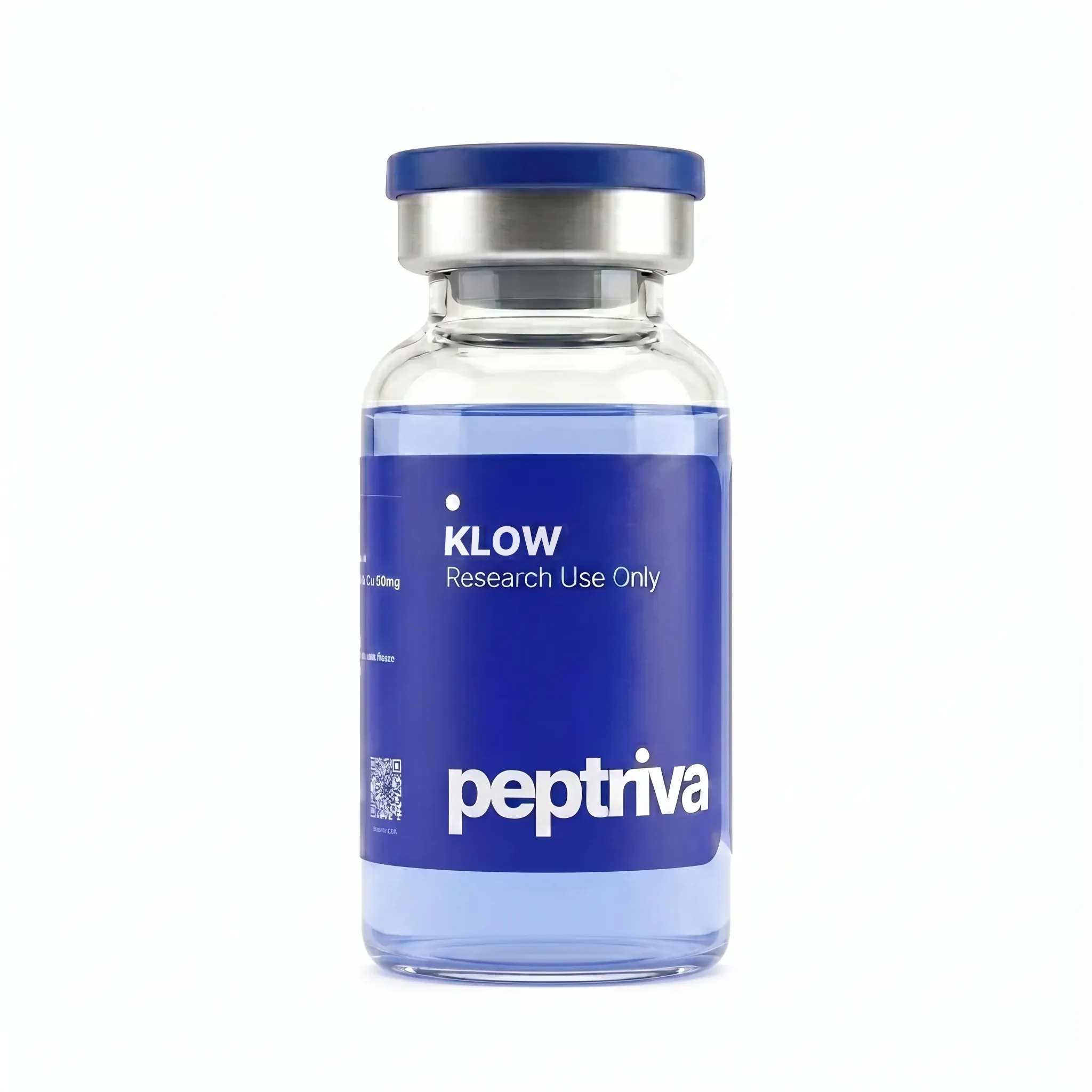
KLOW Blend
The four-component blend described here, co-lyophilized in one vial, with a third-party certificate of analysis matched to the lot.
The fixed ratio is the real constraint
A co-lyophilized vial does not let you move one component. Draw less and all four fall together. Draw more and all four rise together. The 5:1:1:1 ratio is decided at the point of manufacture and it is not adjustable afterwards.
That matters more here than in a two-compound blend, because the four ingredients are not equally characterized. Anyone titrating KLOW to the constituent they care about is simultaneously titrating three others they may not have thought about, including 62.5% of the mass in a compound whose only controlled human evidence is topical.
It also makes single-variable work impossible. If something changes, four things changed. Buying the components separately — which the market does support — keeps the ratio in your hands. That trade is the subject of where to buy KLOW.
The copper ceiling, which is a real number
This is the one part of KLOW dosing where a hard figure exists, and it comes from nutrition science rather than peptide research.
GHK-Cu is a 1:1 complex of the tripeptide with copper(II). Copper is roughly 15.8% of the complex by mass. So a 50 mg GHK-Cu load carries about 7.9 mg of elemental copper.
The tolerable upper intake level for copper in adults is 10 mg per day from all sources, against a recommended intake of 0.9 mg. One 80 mg KLOW vial therefore holds close to a full day’s ceiling of copper, and roughly nine days’ recommended intake, in a single container.
Those reference values were set for oral intake, where absorption is regulated in the gut. An injected route bypasses that regulation entirely, which is a reason to treat the figure as a floor for concern rather than a safe allowance. It is also why the blue color is worth taking literally: what you are looking at is copper in solution.
None of that is a dosing instruction. It is the arithmetic of what is in the vial, which is the part nobody publishes. We cover the rest of the safety picture in KLOW peptide side effects.
What can actually be checked
The dose is unknowable from the literature. The vial is not. These are the things a buyer can verify rather than assume:
- The split, by weight percent. A single purity figure on a four-compound vial does not tell you the ratio. Ask for quantitation per component and read how to read a COA first.
- Four masses on the mass spectrum. Identity for each ingredient, not for the cake as a whole.
- Which TB-500. Full-length thymosin beta-4 and the active fragment are different molecules sold under the same name, and purity does not distinguish them.
- The lot on your vial. Not a representative batch. Storage conditions apply from the moment it ships — see storage temperature.
That is a smaller list than a dosing chart, and every item on it is answerable. The chart is not.
KLOW Blend
Research-use-only material, sold by the vial with batch documentation. Check the certificate of analysis against the batch you receive.
What to know now
- No study has given GHK-Cu, BPC-157, TB-500 and KPV together. There is no measured dose for KLOW and no published pharmacokinetics or stability data for the four in one vial.
- The market standard is 80 mg as 50/10/10/10, which fixes the ratio at 5:1:1:1 and cannot be adjusted after manufacture.
- Two of the four constituents — TB-500 and KPV — have no published human dose of any kind to reconstruct from.
- Reconstitution is answerable arithmetic: 80 mg in 4 mL is 20 mg/mL total, 12.5 mg/mL of it GHK-Cu.
- The vial carries roughly 7.9 mg of elemental copper against a 10 mg daily adult upper intake level from all sources.
What we're watching
The realistic first change is not a blend trial, which nobody funds, but a dose-finding study of BPC-157 alone, which both 2025 reviews call for by name. That would give one of the four a number for the first time. A published human dataset on injected GHK-Cu would matter more still, because that component is 62.5% of the vial and its entire controlled record is topical. We are also watching whether any supplier begins publishing weight-percent-per-component certificates as standard, which would make the composition claim checkable even while the dosing question stays open.
Frequently asked questions
What is the correct KLOW peptide dosage?
There isn't one. No published study has administered GHK-Cu, BPC-157, TB-500 and KPV together, so no dose for the blend has ever been measured. Any chart in circulation was reconstructed from the constituents, two of which have no human dose either.
How much bacteriostatic water do I add to an 80 mg KLOW vial?
That is arithmetic, not a protocol, and the answer depends on the concentration you want. 80 mg in 2 mL is 40 mg/mL of total peptide; in 4 mL it is 20 mg/mL. The water volume never changes how much peptide is in the vial, only how much liquid it sits in.
What is the concentration of each component after reconstitution?
It follows the 5:1:1:1 split. At 4 mL, an 80 mg vial gives 12.5 mg/mL GHK-Cu and 2.5 mg/mL each of BPC-157, TB-500 and KPV. All four move together because they are in the same cake.
Can I use the individual doses for each compound?
Three of the four have nothing usable to borrow. BPC-157 has three human pilot reports, none dose-finding and none subcutaneous. TB-500 and KPV have no published human dose. GHK-Cu's controlled human evidence is topical and measured as a formulation percentage.
How much copper is in a KLOW vial?
Roughly 7.9 mg of elemental copper, from the 50 mg GHK-Cu component. Copper is about 15.8% of the GHK-Cu complex by mass. The adult tolerable upper intake level is 10 mg per day from all sources, and that figure was set for oral intake.
Why does the fixed ratio matter?
Because a co-lyophilized vial cannot be adjusted. Draw less and all four components fall together. If you are titrating to one ingredient you are titrating three others at the same time, including the 62.5% of the mass that is GHK-Cu.
References
- Vasireddi, N., Hahamyan, H., Salata, M. J., et al. (2025). Emerging use of BPC-157 in orthopaedic sports medicine: A systematic review. HSS Journal, 21(4). https://doi.org/10.1177/15563316251355551
- McGuire, F. P., Martinez, R., Lenz, A., Skinner, L., & Cushman, D. M. (2025). Regeneration or risk? A narrative review of BPC-157 for musculoskeletal healing. Current Reviews in Musculoskeletal Medicine, 18(12), 611–619. https://doi.org/10.1007/s12178-025-09990-7
- Lee, E., & Padgett, B. (2021). Intra-articular injection of BPC 157 for multiple types of knee pain. Alternative Therapies in Health and Medicine, 27(4), 8–13. PMID 34324435
- Lee, E., & Burgess, K. (2025). Safety of intravenous infusion of BPC-157 in humans: A pilot study. Alternative Therapies in Health and Medicine, 31(5), 20–24. PMID 40131143
- Lee, E., Walker, C., & Ayadi, B. (2024). Effect of BPC-157 on symptoms in patients with interstitial cystitis: A pilot study. Alternative Therapies in Health and Medicine, 30(10), 12–17. PMID 39325560
- Dalmasso, G., Charrier-Hisamuddin, L., Nguyen, H. T., et al. (2008). PepT1-mediated tripeptide KPV uptake reduces intestinal inflammation. Gastroenterology, 134(1), 166–178. https://doi.org/10.1053/j.gastro.2007.10.026
- Kannengiesser, K., Maaser, C., Heidemann, J., et al. (2008). Melanocortin-derived tripeptide KPV has anti-inflammatory potential in murine models of inflammatory bowel disease. Inflammatory Bowel Diseases, 14(3), 324–331. https://doi.org/10.1002/ibd.20334
- Dou, Y., Lee, A., Zhu, L., et al. (2020). The potential of GHK as an anti-aging peptide. Aging Pathobiology and Therapeutics, 2(1), 58–61. https://doi.org/10.31491/apt.2020.03.014
- Pickart, L., Vasquez-Soltero, J. M., & Margolina, A. (2015). GHK peptide as a natural modulator of multiple cellular pathways in skin regeneration. BioMed Research International, 2015, 648108. https://doi.org/10.1155/2015/648108
- Dymek, M., Warszyński, P., & Sikora, E. (2023). GHK Peptide Permeability and Its Effects in Anti-Aging Skincare Topical Formulations. Pharmaceutics, 15(10), 2485. https://doi.org/10.3390/pharmaceutics15102485
- Goldstein, A. L., Hannappel, E., Sosne, G., & Kleinman, H. K. (2012). Thymosin β4: A multi-functional regenerative peptide. Basic properties and clinical applications. Expert Opinion on Biological Therapy, 12(1), 37–51. https://doi.org/10.1517/14712598.2012.634793
- Xing, Y., Ye, Y., Zuo, H., & Li, Y. (2021). Progress on the Function and Application of Thymosin β4. Frontiers in Endocrinology, 12, 767785. https://doi.org/10.3389/fendo.2021.767785