
There is no KLOW peptide side effects profile, because there is no safety study of the blend. What exists is four separate records, two of which are empty in humans.
The short answer. KLOW: No safety study of the blend exists. Nobody has assessed GHK-Cu, BPC-157, TB-500 and KPV given together, in any species.
- TB-500 and KPV have no human safety data at all. BPC-157's record is three small uncontrolled pilot reports.
- The vial carries roughly 7.9 mg of elemental copper against a 10 mg adult daily upper intake level set for oral intake.
- With four simultaneous variables, no reaction can be attributed to a cause, so an adverse experience teaches nothing.
No study has tested these four compounds together. Not one, in any species. TB-500 and KPV have zero human safety data. BPC-157 has three small pilot reports. GHK-Cu has topical data only. One number here is solid. The 50 mg GHK-Cu load carries about 7.9 mg of elemental copper. The adult daily ceiling is 10 mg from all sources.
Is KLOW peptide safe?
Unknown, and the honest version of that answer is longer than one word. Safety is established by studying a product in people. Nobody has studied this one. There is no trial, no registry, no adverse-event surveillance for the four-compound blend.
What circulates instead is anecdote, and anecdote about a four-compound vial is unusually weak evidence. If someone reports a reaction, four candidate causes were administered simultaneously, plus whatever the excipients and the reconstitution added. Nothing can be attributed. The KLOW complete guide sets out what is in the vial.
The upside of that thin record cuts the same way. What the vial is claimed to do rests on the same four separate literatures, which we go through in KLOW peptide benefits.
“No reported side effects” on a product with no studies means nobody looked. It is not a safety finding, and treating it as one is the single most common error in this category.
What each ingredient's record shows
Four ingredients, four different depths of evidence. Only one of them has any human safety work aimed at safety as the primary question.
| Component | Human safety data | What exists |
|---|---|---|
| BPC-157 | Three pilot reports | Includes a 2025 intravenous safety pilot |
| GHK-Cu | Topical only | Dermal tolerability; nothing for injection |
| TB-500 | None | Animal and mechanistic work only |
| KPV | None | Murine colitis models only |
BPC-157 has the most, and “the most” is three small uncontrolled reports. A 2025 pilot infused it intravenously in a handful of participants and reported no serious events, which is worth something and is not a safety profile. See BPC-157 side effects.
Despite the robust preclinical findings, human data are extremely limited, no large-scale randomized trials exist, and BPC-157 should be considered investigational pending well-designed clinical trials.
McGuire et al., Current Reviews in Musculoskeletal Medicine, 2025KPV showed significant anti-inflammatory effects in 2 murine models of colitis.
Kannengiesser et al., Inflammatory Bowel Diseases, 2008That is the high-water mark for KPV, and it is a mouse. An anti-inflammatory signal in a disease model says nothing about tolerability in a person given 10 mg of the same compound alongside three others.
A 2026 sports-medicine review places TB-500 among unapproved peptides for which rigorous human safety data are scarce and serious harm cannot be excluded. That is the correct standard of caution for the two ingredients with empty human records.
The copper load, which is the one hard number
GHK-Cu is 62.5% of the vial by mass, and it is a copper complex. Copper is roughly 15.8% of that complex by weight, so 50 mg of GHK-Cu carries about 7.9 mg of elemental copper.
For scale: the recommended dietary intake of copper for adults is 0.9 mg per day, and the tolerable upper intake level is 10 mg per day from all sources. A single KLOW vial holds roughly nine days of recommended intake and close to one day’s ceiling.
Those reference values were derived for oral intake, where the gut regulates how much copper is absorbed. An injected route bypasses that regulation. The figures are therefore a reason for caution rather than an allowance to spend.
This is also why the blue color should be read literally rather than as a quality cue. Copper(II) complexes are blue in solution. The color is the copper. The arithmetic is worked through in KLOW peptide dosage.
Anyone with a copper-handling condition, Wilson disease most obviously, is looking at a product built around a copper complex. That is a conversation for a clinician, not a forum.
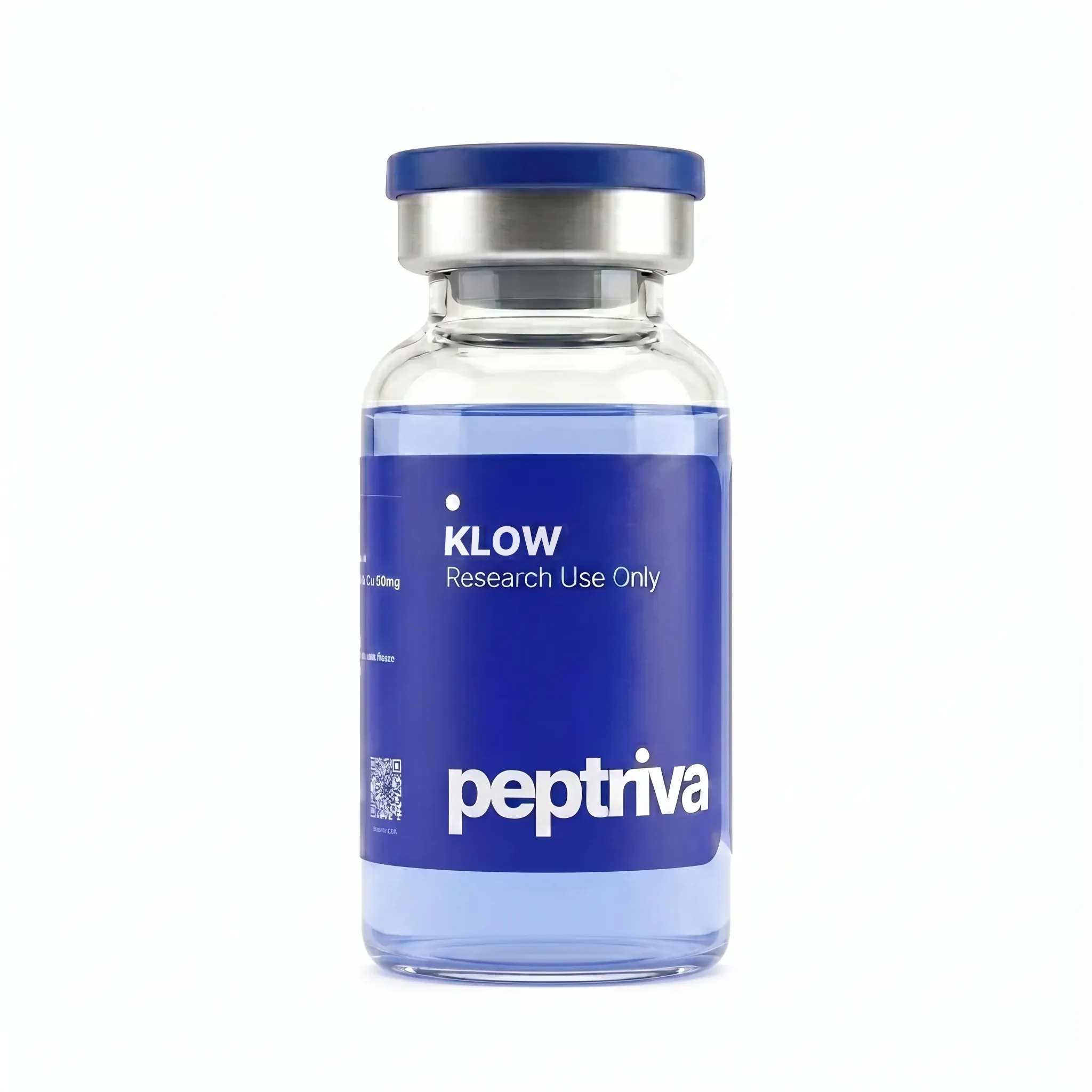
KLOW Blend
The four-component blend described here, co-lyophilized in one vial, with a third-party certificate of analysis matched to the lot.
Risks that come from the blend rather than the compounds
Some of the risk here is structural. It exists because four compounds share a vial, not because any one of them is dangerous.
- Attribution is impossible. Four simultaneous variables means no reaction can be traced to a cause, so nothing is learned from an adverse experience.
- The ratio cannot be adjusted. Reducing exposure to one ingredient means reducing all four, including the three you may have wanted.
- Identity is harder to verify. A four-component certificate has to confirm four masses and quantify four fractions. A single purity figure hides the split entirely.
- Which TB-500 is unclear. Full-length thymosin beta-4 and its active fragment are different molecules sold under one name. Read how to read a COA before assuming.
There is no stability data for four peptides co-lyophilized in one cake either, which matters once a vial is in solution. General handling applies — see peptide storage temperature.
Legal and competition status
Two of the four are prohibited in sport. BPC-157 has been listed by WADA under S0 since January 2022, and thymosin beta-4 falls under S2. A tested athlete is looking at a vial containing two banned substances, and a blend name does not change what is in it.
None of the four is an approved drug. These are research compounds sold for research use, and that framing is a legal position rather than a safety one. Are peptides legal covers the regulatory picture in more detail.
Three practical consequences follow from that status:
- No adverse-event reporting route. There is no post-market surveillance for a research compound, so nothing you experience gets counted anywhere.
- No pharmacist checking interactions. Nobody is looking at what else you take, and a copper complex is exactly the kind of thing that would be checked.
- No batch recall mechanism. If a lot is wrong, the only thing standing between it and you is the certificate.
Anyone reading this because they are already using the product and something feels wrong should speak to a clinician, and should bring the vial and its certificate. Four compounds and a copper complex is a lot to describe from memory.
KLOW Blend
Research-use-only material, sold by the vial with batch documentation. Check the certificate of analysis against the batch you receive.
What to know now
- No safety study of the blend exists. Nobody has assessed GHK-Cu, BPC-157, TB-500 and KPV given together, in any species.
- TB-500 and KPV have no human safety data at all. BPC-157's record is three small uncontrolled pilot reports.
- The vial carries roughly 7.9 mg of elemental copper against a 10 mg adult daily upper intake level set for oral intake.
- With four simultaneous variables, no reaction can be attributed to a cause, so an adverse experience teaches nothing.
- Two of the four are prohibited in sport: BPC-157 under WADA S0, thymosin beta-4 under S2.
What we're watching
The first thing that would move this page is a human safety dataset for injected GHK-Cu, because that ingredient is most of the vial by mass and its entire controlled record is topical. A dose-finding and safety study of BPC-157, which both 2025 reviews call for by name, would be the second. We are also watching for any published stability work on multi-peptide co-lyophilized vials, which does not currently exist and which would tell buyers what they are actually holding after reconstitution.
Frequently asked questions
Is KLOW peptide safe?
Unknown. No published study has assessed the safety of the four compounds together, and two of the four have no human safety data of any kind. An absence of reported side effects on an unstudied product means nobody has looked.
What are the side effects of KLOW peptide?
There is no established side-effect profile for the blend, because no safety study exists. The components have separate records: BPC-157 has three small pilot reports, GHK-Cu has topical tolerability data only, and TB-500 and KPV have nothing in humans.
Is the copper in KLOW a problem?
It is the one quantifiable exposure in the vial. 50 mg of GHK-Cu carries roughly 7.9 mg of elemental copper, against a 10 mg per day adult upper intake level that was set for oral intake with gut regulation in play. An injected route bypasses that regulation.
Why is KLOW blue, and does that mean anything?
The blue is the copper(II) in GHK-Cu, which is 62.5% of the vial. It confirms copper is present. It is not a purity signal, an identity check or a potency indicator.
Can side effects be traced to one ingredient?
No. Four compounds are administered at once in a fixed ratio, so no reaction can be attributed to any one of them. That is a structural property of a blend, not a gap that more anecdotes would fill.
References
- McGuire, F. P., Martinez, R., Lenz, A., Skinner, L., & Cushman, D. M. (2025). Regeneration or risk? A narrative review of BPC-157 for musculoskeletal healing. Current Reviews in Musculoskeletal Medicine, 18(12), 611–619. https://doi.org/10.1007/s12178-025-09990-7
- Vasireddi, N., Hahamyan, H., Salata, M. J., et al. (2025). Emerging use of BPC-157 in orthopaedic sports medicine: A systematic review. HSS Journal, 21(4). https://doi.org/10.1177/15563316251355551
- Lee, E., & Burgess, K. (2025). Safety of intravenous infusion of BPC-157 in humans: A pilot study. Alternative Therapies in Health and Medicine, 31(5), 20–24. PMID 40131143
- Lee, E., Walker, C., & Ayadi, B. (2024). Effect of BPC-157 on symptoms in patients with interstitial cystitis: A pilot study. Alternative Therapies in Health and Medicine, 30(10), 12–17. PMID 39325560
- Lee, E., & Padgett, B. (2021). Intra-articular injection of BPC 157 for multiple types of knee pain. Alternative Therapies in Health and Medicine, 27(4), 8–13. PMID 34324435
- Dou, Y., Lee, A., Zhu, L., et al. (2020). The potential of GHK as an anti-aging peptide. Aging Pathobiology and Therapeutics, 2(1), 58–61. https://doi.org/10.31491/apt.2020.03.014
- Pickart, L., & Margolina, A. (2018). Regenerative and protective actions of the GHK-Cu peptide in the light of the new gene data. International Journal of Molecular Sciences, 19(7), 1987. https://doi.org/10.3390/ijms19071987
- Hostynek, J. J., Dreher, F., & Maibach, H. I. (2010). Human stratum corneum penetration by copper: In vivo study after occlusive and semi-occlusive application of the metal as powder. Food and Chemical Toxicology, 48(6), 1741–1745. https://doi.org/10.1016/j.fct.2006.04.003
- Dalmasso, G., Charrier-Hisamuddin, L., Nguyen, H. T., et al. (2008). PepT1-mediated tripeptide KPV uptake reduces intestinal inflammation. Gastroenterology, 134(1), 166–178. https://doi.org/10.1053/j.gastro.2007.10.026
- Kannengiesser, K., Maaser, C., Heidemann, J., et al. (2008). Melanocortin-derived tripeptide KPV has anti-inflammatory potential in murine models of inflammatory bowel disease. Inflammatory Bowel Diseases, 14(3), 324–331. https://doi.org/10.1002/ibd.20334
- Mendias, C. L., & Awan, T. M. (2026). Safety and efficacy of approved and unapproved peptide therapies for musculoskeletal injuries and athletic performance. Sports Medicine. https://doi.org/10.1007/s40279-026-02437-0
- Xing, Y., Ye, Y., Zuo, H., & Li, Y. (2021). Progress on the Function and Application of Thymosin β4. Frontiers in Endocrinology, 12, 767785. https://doi.org/10.3389/fendo.2021.767785