
There is no established human BPC-157 dosage, because no dose-finding trial has ever been run in people. Every chart you find online agrees with the others, which looks like consensus. We traced that agreement back, and it doesn't end at a study.
The short answer. No dose-finding trial for BPC-157 has ever been run in people, so no established human dose exists.
- Doses used in animal work span several orders of magnitude, leaving no single number to scale from.
- The human record is a knee-pain case series and two small pilots, none built to find a dose.
- Bodyweight scaling is the wrong conversion between species, so animal numbers do not transfer to people.
There is no set human dose for BPC-157. No dose-finding trial has ever been run in people. Animal doses span several orders of magnitude. The three human reports were not built to find a dose. Every chart you have seen is copied or scaled, and those look alike from outside.
The table below reports what the BPC-157 studies cited on this page actually administered, dose by dose as each report gave it; it is not a dosing chart, because not one of those studies was designed to find a dose.
| Study | Species | Dose | Route | Duration | n |
|---|---|---|---|---|---|
| Lee & Padgett, 2021 — knee pain | Human | Not reported — a retrospective chart review, with no standardized dose recorded | Intra-articular knee injection | Injections over one year, telephone follow-up at 6–12 months | 17 |
| Lee et al., 2024 — interstitial cystitis | Human | 10 mg, single dose | Intravesical, instilled during cystoscopy | One administration | 12 |
| Lee & Burgess, 2025 — intravenous safety | Human | 10 mg on day one, 20 mg on day two | Intravenous infusion | 2 days | 2 |
| Matek et al., 2025 — quadriceps reattachment | Rat | 10 ng/kg/day | Oral | Recovery followed to 90 days | — |
A dash means we have no sourced figure for that cell and have not estimated one. Those four studies are the administered record in full: three uncontrolled human pilots and one rat model. None of them is a dose-finding trial, so none of them establishes a human dose for BPC-157, and no row here converts into one.
This isn't a hedge, and it isn't us being cautious. It's the actual state of the evidence, and stating it plainly is the most useful thing this page can do.
BPC-157 is one of the most-searched compounds in the field and one of the least-studied in humans. Those two facts together are why the dosing information around it is as bad as it is.
What human dosing evidence exists for BPC-157?
Three published human reports involve BPC-157, and not one of them is a dose-finding trial. Here they are in full.
- Knee pain (Lee & Padgett, 2021). A retrospective case series of intra-articular BPC-157 for multiple types of knee pain. Retrospective, uncontrolled, and about a delivery route almost nobody discussing “BPC-157 dosage” is using. The case series in detail.
- Interstitial cystitis (Lee et al., 2024). A small pilot study.
- Intravenous safety (Lee & Burgess, 2025). A small pilot on intravenous infusion safety.
Set that against the animal work. A 2025 systematic review in HSS Journal counted 36 studies meeting PRISMA quality criteria, and 35 were animal models.
Roughly 80% of the BPC-157 preclinical literature comes from a single research group in Zagreb. We'd call that a confidence-interval problem rather than a fatal one, but it's the context every dosing claim sits inside. The complete guide works through the evidence base properly.
Why don't the BPC-157 animal doses transfer?
BPC-157 animal doses don't transfer partly because they don't agree with each other. The rodent literature spans nanograms to micrograms per kilogram, many orders of magnitude.
A 2025 rat study reported that oral BPC-157 at 10 ng/kg/day restored muscle-to-bone reattachment after surgical detachment. Other studies use doses thousands of times higher. That spread isn't a detail to average out. It means the dose-response relationship is unresolved even in the animals.
Why bodyweight scaling is the wrong conversion. The standard online method takes the rat dose in mg/kg and multiplies it by human bodyweight. That isn't how interspecies dose translation works.
Smaller animals have far higher metabolic rates per unit mass, so allometric scaling corrects for body surface area rather than weight. Between rats and humans the correction factor is roughly six-fold.
Even applied correctly, the output is a starting point for a Phase 1 safety trial, not a dose. Any chart doing simple mg/kg multiplication has skipped the pharmacology.
Why do all the BPC-157 dosage charts agree?
BPC-157 dosage charts agree because they copy each other. Search the term and you'll find broad agreement across dozens of sites. That agreement is a citation artifact rather than evidence.
The numbers propagate: one source, copied, reworded, copied again, until repetition takes on the texture of consensus. Trace any of them back and the chain ends at a forum post, not a paper. Convergence without an underlying study is just an echo.
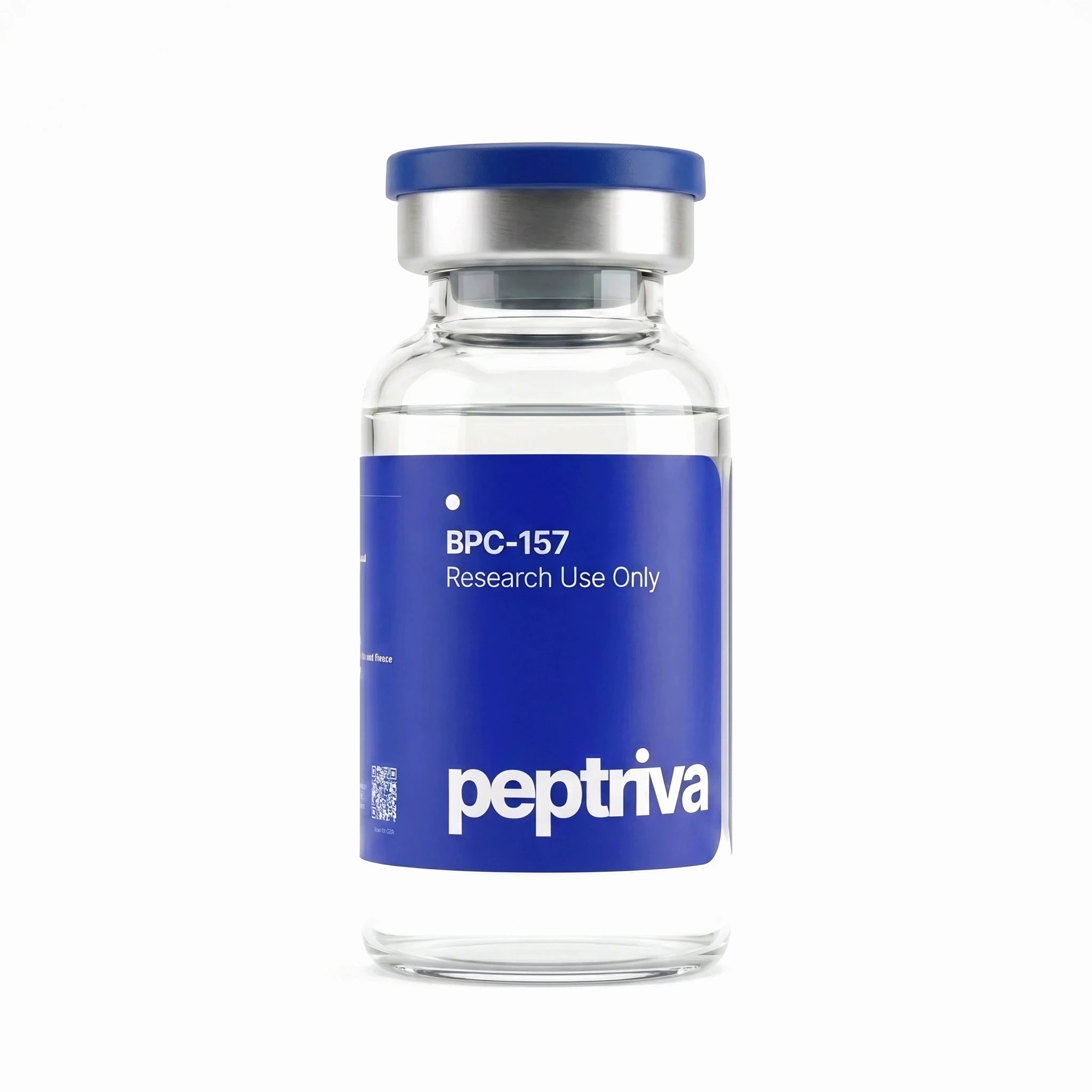
BPC-157
The reference compound cited across the preclinical literature reviewed in this article. Research use only — supplied with a batch-matched certificate of analysis.
What can you actually know about BPC-157 dosing?
Two things about BPC-157 are knowable, and both sit outside the dosing question.
The arithmetic is knowable. If you have a vial and a number, converting between milligrams, milliliters and syringe units is straightforward division. That's what the calculator is for. Easy arithmetic isn't evidence that the number going into it is sound.
The material is verifiable. Whether the vial holds BPC-157 at the stated purity has a real answer. A batch-matched certificate of analysis, showing HPLC purity and mass-spec identity, gives it to you.
Given how much else about this compound is unsettled, we'd verify the one thing that can be verified. How to read a COA and where to buy BPC-157 cover that ground.
What we're watching
A registered randomized controlled trial on ClinicalTrials.gov would change this page completely. An Achilles-tendinopathy or knee-osteoarthritis Phase 2 is the natural first formal test. A dose-finding arm inside it would be the first real answer to the question this page asks.
We're also watching whether labs outside the Zagreb group reproduce the core preclinical findings, and whether the FDA's 2023 Category 2 compounding designation moves in either direction.
Frequently asked questions
What is the correct BPC-157 dosage?
There isn't one. No dose-finding trial has been conducted in humans, so there's no established BPC-157 dose to cite. Not a conservative one, not an aggressive one. Every number circulating online is extrapolated from rodent studies or copied from forums.
What doses were used in BPC-157 animal studies?
The BPC-157 rodent literature spans an enormous range, from nanograms to micrograms per kilogram. One 2025 rat study reported effects from oral BPC-157 at 10 ng/kg/day. The spread across studies runs to many orders of magnitude, which tells you how unsettled the dose-response is.
Can you convert animal doses to human doses?
Not by simple bodyweight scaling, which is the method most online charts use and it's wrong. Allometric scaling adjusts for metabolic rate rather than mass. Even done properly, it produces a starting point for a Phase 1 trial rather than a usable dose.
Has BPC-157 been tested in humans at all?
Barely. BPC-157 has a retrospective case series on intra-articular injection for knee pain, a small pilot in interstitial cystitis, and a small intravenous safety pilot. None of them is a dose-finding trial, and none establishes a dose.
Why do BPC-157 dosing charts all say roughly the same thing?
Because they copy each other, not because they converge on evidence. A number repeated across a hundred sites looks like consensus without carrying any of the substance. No trial underwrites a single one of them.
BPC-157
Research-use-only material, sold by the vial with batch documentation. Check the certificate of analysis against the batch you receive.
BPC-157 is one of the empty rows in our peptide dosage chart, which reports what published studies administered across the whole library and leaves a dash wherever nothing was.
What to know now
- No dose-finding trial for BPC-157 has ever been run in people, so no established human dose exists.
- Doses used in animal work span several orders of magnitude, leaving no single number to scale from.
- The human record is a knee-pain case series and two small pilots, none built to find a dose.
- Bodyweight scaling is the wrong conversion between species, so animal numbers do not transfer to people.
- Every dosing chart online is extrapolation or repetition, and from the outside those two look identical.
References
- Vasireddi, N., Hahamyan, H., Salata, M. J., et al. (2025). Emerging use of BPC-157 in orthopaedic sports medicine: A systematic review. HSS Journal, 21(4). https://doi.org/10.1177/15563316251355551
- McGuire, F. P., Martinez, R., Lenz, A., Skinner, L., & Cushman, D. M. (2025). Regeneration or risk? A narrative review of BPC-157 for musculoskeletal healing. Current Reviews in Musculoskeletal Medicine, 18(12), 611–619. https://doi.org/10.1007/s12178-025-09990-7
- Lee, E., & Padgett, B. (2021). Intra-articular injection of BPC 157 for multiple types of knee pain. Alternative Therapies in Health and Medicine, 27(4), 8–13. PMID 34324435
- Lee, E., Walker, C., & Ayadi, B. (2024). Effect of BPC-157 on symptoms in patients with interstitial cystitis: A pilot study. Alternative Therapies in Health and Medicine, 30(10), 12–17. PMID 39325560
- Lee, E., & Burgess, K. (2025). Safety of intravenous infusion of BPC-157 in humans: A pilot study. Alternative Therapies in Health and Medicine, 31(5), 20–24. PMID 40131143
- Matek, D., Matek, I., Staresinic, E., et al. (2025). Stable gastric pentadecapeptide BPC 157 as therapy after surgical detachment of the quadriceps muscle for muscle-to-bone reattachment in rats. Pharmaceutics, 17(1), 119. https://doi.org/10.3390/pharmaceutics17010119
These are the complete published human reports on BPC-157 as of this revision. None is a dose-finding trial, which is the substance of this article rather than an aside.