
The short answer. BPC-157: Online research-chemical suppliers are the only open route. Pharmacy and compounding channels are both shut.
- CAS 137525-51-0, MW 1419.6, observed [M+H]+ 1420.6. The numbers a credible lab report shows.
- $50–$150 per vial depending on size. 15 residues with no modifications keeps synthesis cheap.
- 503A Category 2 closed compounding pharmacies, not research suppliers. Research sales continue unchanged.
You can buy BPC-157 from research-chemical suppliers online, and that's the only route there is. No pharmacy stocks it, no prescription exists to write, and the FDA closed the compounding-pharmacy door in 2023. So where to buy BPC-157 is really a question about which supplier, and three checks answer it.
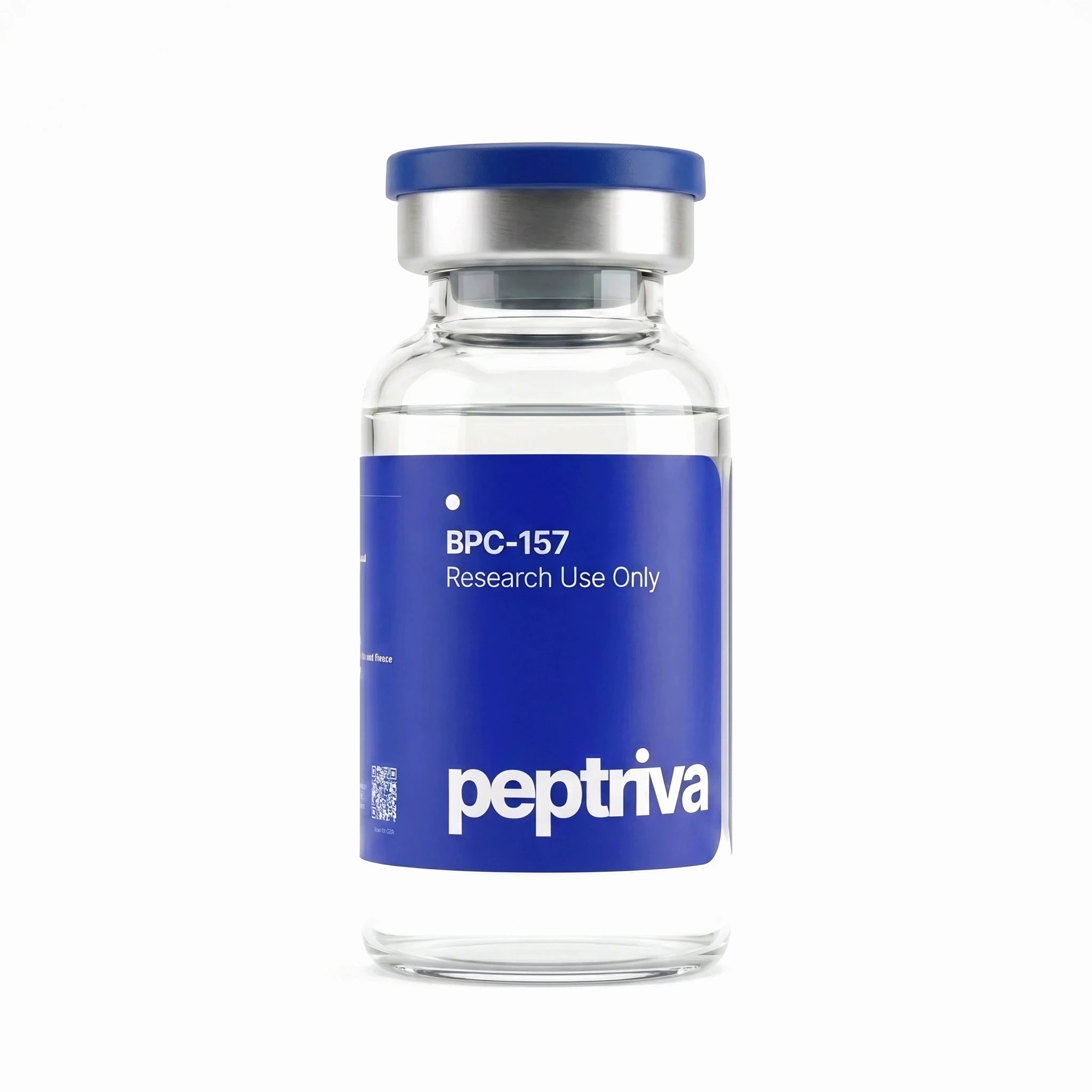
BPC-157
Referenced in this guideThe BPC-157 referenced throughout this article, supplied as a research compound with a certificate of analysis matched to the lot you receive — the check this site argues you should hold any supplier to.
BPC-157 is short for Body Protection Compound-157. It is a synthetic 15-amino-acid peptide, first isolated from human gastric juice. Its certificate should show CAS 137525-51-0 and 1419.6 g/mol. It's legal to buy as research material. The FDA's 2023 503A Category 2 listing closed the compounding pharmacy route. Expect $50–$100 per 5 mg vial or $80–$150 per 10 mg.
Quick answer: Pay $50–$150 per vial for lyophilized BPC-157, meaning freeze-dried powder. Ask for a lab report from an ISO 17025 lab, an internationally recognized testing standard. It should show HPLC purity above 98%, mass-spec at 1420.6, and water under 8%. Stick with the standard pentadecapeptide and skip the “Plus” or “Advanced” variants.
Where can you buy BPC-157?
BPC-157 has exactly one open channel: online research-chemical suppliers, sold under research-use-only labeling with no prescription. No pharmacy stocks it. No compounding pharmacy may prepare it since 2023. We'd rather say that plainly than pad the list out to look thorough.
- Research-chemical suppliers, online. The only route. Sold as research material under research-use-only labeling, no prescription, shipped by mail. Everything below is about telling these suppliers apart.
- Compounding pharmacy: closed. The FDA moved BPC-157 into 503A Category 2 in February 2023, which bars a pharmacy from compounding it for human use.
- Retail pharmacy: nothing to dispense. BPC-157 has no FDA-approved product and no approved indication, so there's no prescription for a pharmacist to fill.
- Clinical trial: nothing we can point you to. Twenty years into the literature, the human evidence is one 17-patient uncontrolled case series. We haven't found a registered controlled trial you could enroll in.
Six vendors, all checked on 13 August 2026, with the BPC-157 price each was charging that day. Read the two certificate columns before the price column — a document that opens, and a lab named where you can see it rather than buried in a PDF. The full ten-vendor version is our vendor comparison.
| Vendor | COA | Lab named | Price | Ships free at |
|---|---|---|---|---|
| Sports Technology Labs | Third-party, published | Site and document (MZ Biolabs, Colmaric) | 5 mg $56.99 — $11.40/mg | $149 |
| Swiss Chems | Third-party, published | Site FAQ (Janoshik) | 5 mg $39.99 — $8.00/mg‡ | $100 |
| Core Peptides | Third-party, published (A2LA #6377.01.01) | Document only (Vanguard Laboratory) | 5 mg $52.00 — $10.40/mg | $200 |
| PS Peptides | Third-party, published | Document only (North American Diagnostics) | 5 mg $49.99 — $10.00/mg | $200 |
| Red Rock Peptides | Claimed, none published | Not named | 10 mg $69.00 — $6.90/mg† | Not offered |
† 10 mg vial; Red Rock does not sell a 5 mg size, so its per-milligram figure is not strictly comparable with the 5 mg rows. ‡ Swiss Chems sells the arginine salt of BPC-157 rather than the plain peptide, so it is not a like-for-like product; the figure shown is a sale price, and list works out at $10.00/mg. Red Rock publishes no certificate of analysis at all, despite advertising verified COAs. Where To Buy Peptides earns a commission on purchases made through its links, Peptriva included — see our disclosure.
The identity check specific to BPC-157: CAS 137525-51-0 on the certificate's identity line, an observed [M+H]+ of 1420.6 against a theoretical 1419.6 g/mol, and lyophilized powder rather than a liquid, capsule or spray.
What is BPC-157?
BPC-157 is a chain of 15 amino acids: Gly-Glu-Pro-Pro-Pro-Gly-Lys-Pro-Ala-Asp-Asp-Ala-Gly-Leu-Val. The name comes from how it was found, as a partial sequence inside a larger protein in human gastric juice.
The evidence behind it is lopsided. We count 35 rodent studies, 1 uncontrolled human case series and zero controlled human trials as of 2026. A 2025 review by Józwiak and colleagues describes diverse effects across animal models, and notes the work is almost entirely preclinical.
One unusual property: BPC-157 stays stable in stomach acid for over 24 hours, per Sikiric and colleagues in 2022. That's why some vendors market “Stable BPC-157” variants. But the standard peptide is already stable. An “improved” variant with no published structure is marketing language, not chemistry.
How do you verify BPC-157 before you buy?
Three checks settle BPC-157 specifically. CAS 137525-51-0 on the lab report's identity line. A mass-spec result at [M+H]+ 1420.6. Lyophilized injectable powder rather than a liquid, capsule or spray. Our eight general criteria apply on top.
1. The CAS number on the lab report must be 137525-51-0
A CAS Registry Number is a unique chemical ID that never changes. BPC-157's is 137525-51-0. A credible report lists it on the identity line, and you can cross-check it against PubChem or ChemSpider in 30 seconds.
A missing CAS number, or one that doesn't resolve to BPC-157, is a critical gap.
2. The mass-spec result must match 1420.6
BPC-157's theoretical mass is 1419.6 g/mol. The report should show observed mass at [M+H]+ 1420.6, within 0.5 Da of theoretical. In negative mode you'd see [M−H]− 1418.6 instead.
An observed mass meaningfully different from that means the vial holds a different molecule, or a partly synthesized fragment. The mass match is your most direct identity check.
3. The form should be lyophilized injectable
BPC-157 ships as a freeze-dried powder. That's the form used across the published preclinical literature, and reconstituting it with bacteriostatic water is standard laboratory practice.
Some vendors sell pre-mixed liquid, oral capsules or sublingual sprays. Pre-mixed liquid has a much shorter stability window, weeks rather than years. Oral and sublingual forms haven't been validated in any controlled study. Research that matches the published literature needs the powder.
Where this falls short: The published BPC-157 literature is large but lopsided. Roughly 75% of preclinical studies come from one research group in Zagreb, and the 35-plus rodent studies haven't been replicated by independent labs at scale.
The single human study is a 17-patient uncontrolled case series. The FDA flagged BPC-157 as a safety question in 2023 precisely because the human data is too thin. Buy it as a research tool. Don't buy it as a proven therapeutic.
What does BPC-157 cost in 2026?
BPC-157 is the benchmark this site prices every vendor on, precisely because almost all of them stock it. Ten vendors priced side by side uses it, and the spread across them is roughly two to one for the same compound.
BPC-157 runs $50–$100 for a 5 mg vial, $80–$150 for 10 mg and $140–$240 for 20 mg at third-party tested retail. It's one of the cheaper research peptides to make: 15 residues, no chemical modifications, a well-established synthesis route.
- 5 mg vial: $50–$100, or $10–$20 per mg. The standard retail size.
- 10 mg vial: $80–$150, or $8–$15 per mg. Better per-mg value than the 5 mg.
- 20 mg vial: $140–$240, or $7–$12 per mg. Available from larger suppliers.
- Multi-vial tiers: 10–25% off for 3- or 6-pack orders at most vendors.
Below $40 per 5 mg vial deserves a question. HPLC purification is the step that separates crude BPC-157, which has the right sequence but carries synthesis byproducts, from tested material purified above 98%. The cheap end of the market usually skips it.
Above $30 per mg, you're paying retail markup rather than synthesis cost.
What does 503A Category 2 mean for BPC-157?
In February 2023 the FDA reviewed BPC-157 and put it in 503A Category 2, the “may present significant safety risks” bucket. Section 503A is the part of federal law that governs compounding pharmacies, the ones that make custom medications a doctor prescribes.
The decision was widely covered as a ban. That's partly true and partly misleading.
What the designation does:
- Closes compounding pharmacies as a human-use channel. Pharmacies can’t include BPC-157 in compounded prescriptions anymore. That shut down a small but visible path BPC-157 had been reaching human users through.
- Signals FDA concern about the human-safety evidence. The decision reflects the agency’s view that human data is too thin.
What the designation does not do:
- It doesn’t stop research-use sales. Research-use-only suppliers operate under a different regulation entirely, 21 CFR § 809.10(b)(9).
- It doesn’t make laboratory research illegal. Animal studies and in-vitro work continue.
- It doesn’t ban formal clinical trials. Pharmaceutical-grade BPC-157 can still be tested in an FDA-approved trial under standard investigational-new-drug procedures.
Our fuller account is in peptides and the 2023 503A categorization.
What are the red flags when buying BPC-157?
Seven BPC-157 warning signs we’d skip:
- “BPC-157 Plus,” “Advanced,” “Stable,” or “Arg” variants. Marketing names without disclosed structural changes. The standard peptide is already gastric-stable; “improved” without a published structure is marketing.
- Pre-mixed liquid shipped without cold chain. The powder survives shipping. Liquid at room temperature degrades fast.
- Capsules, sublingual sprays, or patches. No controlled study has validated any of these. The injectable powder is what the published research uses.
- Clinical claims on the product page. “Treats joint pain.” “Heals tendons in 4 weeks.” A vendor making clinical claims about a 503A Category 2 substance is in FDA enforcement territory.
- Missing CAS number on the lab report. CAS 137525-51-0 is the molecule’s ID. Its absence is a red flag.
- Mass-spec result not at 1420.6. If the mass is wrong, the molecule is wrong.
- Vendor’s own QC instead of third-party testing. Internal QC is fine for raw material. Independent ISO 17025 testing is the standard we'd hold a supplier to.
BPC-157
Standard pentadecapeptide, CAS 137525-51-0. The same reference compound used across the 35+ preclinical studies aggregated in the 2025 HSS Journal systematic review. COA with HPLC trace and mass-spec ships with every order.
Frequently asked questions
Is BPC-157 legal to buy in the USA?
Yes, as a research reference compound. The 2023 FDA 503A Category 2 designation closed the compounding-pharmacy channel for human use. It didn’t affect research-use sales. Buying as research material is legal. Selling with human-use claims isn’t.
How much should third-party tested BPC-157 cost?
$50–$100 for a 5 mg vial, $80–$150 for 10 mg, $140–$240 for 20 mg. Below that range, purity is usually the trade-off. Above it, you’re paying retail markup rather than synthesis cost.
What should a BPC-157 lab report show?
Five things. CAS 137525-51-0 on the identity line. HPLC purity above 98% with the chromatogram attached. Mass-spec at observed [M+H]+ 1420.6. Water content of 2–8% by Karl Fischer titration. Counterion content too, usually trifluoroacetate at 5–15% by mass. The testing lab should be ISO 17025-accredited and named on the report.
What does 503A Category 2 mean for buyers?
Compounding pharmacies can’t prepare BPC-157 for human use anymore. That’s it. Research-use sales operate under a different regulation and aren’t affected.
What are “BPC-157 Plus” or “Advanced” variants?
Marketing names. Vendors claim improved stability or bioavailability but don’t publish the structural modification or any peer-reviewed evidence. These products aren’t the BPC-157 in the literature. If you’re matching published research, buy the standard pentadecapeptide.
How does BPC-157 compare to TB-500?
Different mechanisms. BPC-157 acts through growth-factor pathways and angiogenesis. TB-500 acts through actin and cell migration. Preclinical studies have investigated the two together and note that the mechanisms are largely non-overlapping. See our BPC-157 vs TB-500 comparison.
What to know now
- Online research-chemical suppliers are the only open route. Pharmacy and compounding channels are both shut.
- CAS 137525-51-0, MW 1419.6, observed [M+H]+ 1420.6. The numbers a credible lab report shows.
- $50–$150 per vial depending on size. 15 residues with no modifications keeps synthesis cheap.
- 503A Category 2 closed compounding pharmacies, not research suppliers. Research sales continue unchanged.
- Standard pentadecapeptide only. “Plus,” “Stable,” or “Advanced” without published structures aren’t BPC-157.
- Lyophilized injectable is the literature form. Capsules and sprays aren’t validated.
- Preclinical-heavy evidence. 35+ rodent studies, 1 uncontrolled case series, zero RCTs.
What we’re watching
The development we're tracking is whether a controlled human trial ever publishes. Randomized, blinded, with real outcome measures. Twenty years into the literature, the human evidence is one 17-patient case series.
Both the 2025 HSS Journal review and the 2026 Sports Medicine review explicitly call for proper clinical investigation. Until those trials run, BPC-157 stays a research compound whose preclinical signal outpaces its human data. We're also watching the FDA 503A category review, which happens periodically, for any change to the designation.
References
- Józwiak, M., Bauer, M., Kamysz, W., & Kleczkowska, P. (2025). Multifunctionality and possible medical application of the BPC 157 peptide — literature and patent review. Pharmaceuticals, 18(2), 185. https://doi.org/10.3390/ph18020185
- Vasireddi, N., Vasireddi, N., Shankar, D. S., Mojica, E. S., Boylan, M. R., Aitcheson, J. C., Wilson, A., Strauss, E. J., Alaia, M. J., & Campbell, K. A. (2025). Emerging use of BPC-157 in orthopaedic sports medicine: A systematic review. HSS Journal: The Musculoskeletal Journal of Hospital for Special Surgery. https://doi.org/10.1177/15563316251355551
- Sikiric, P., Skrtic, A., Gojkovic, S., Krezic, I., Zizek, H., Lovric, E., Sikiric, S., Pavlov, K. H., Rucman, R., Boban Blagaic, A., Brcic, L., & Strbe, S. (2022). Gastric pentadecapeptide BPC 157 in cytoprotection to resolve major vessel occlusion disturbances, ischemia-reperfusion injury following Pringle maneuver, and Budd-Chiari syndrome. World Journal of Gastroenterology, 28(1), 23–46. https://doi.org/10.3748/wjg.v28.i1.23
- Mendias, C. L., & Awan, T. M. (2026). Safety and efficacy of approved and unapproved peptide therapies for musculoskeletal injuries and athletic performance. Sports Medicine. https://doi.org/10.1007/s40279-026-02437-0
- Lee, E., & Padgett, B. (2021). Intra-articular injection of BPC 157 for multiple types of knee pain. Altern Ther Health Med. PMID 34324435
- U.S. Food and Drug Administration. (2023). Section 503A of the Federal Food, Drug, and Cosmetic Act. https://www.fda.gov/drugs/human-drug-compounding/section-503a-federal-food-drug-and-cosmetic-act
- International Organization for Standardization. (2017). ISO/IEC 17025:2017 — General requirements for the competence of testing and calibration laboratories. https://www.iso.org/standard/66912.html