
No published study has ever scanned, scored or photographed a BPC-157 before and after. Every image you've seen is an anecdote. We don't mean that as an attack on the compound. It's a description of the evidence behind it.
The short answer. No BPC-157 before-and-after study exists. No published trial has imaged, scored or photographed a treated person against a control.
- The human record is three uncontrolled pilot reports from one clinic: 17 knee patients, 12 cystitis patients, 2 infusion subjects.
- The knee series reported 14 of 16 patients recalling relief by phone — with no control arm and no validated functional measure.
- A 2025 systematic review included 36 studies. Thirty-five were animal work, and it found no clinical safety data at all.
There is no BPC-157 before-and-after study. The whole human record is three small pilot reports. All three come from one Florida clinic. They cover 17, 12 and 2 patients. None had a control group. None had imaging. None had a scored outcome. A 2025 review found that 35 of 36 studies were animal work.
What is the entire BPC-157 human record?
Three published reports have given BPC-157 to people. All three come from the same private clinic in Florida. None had a control group, and none measured anything with an instrument that produces an image.
- Knee pain, 2021. A retrospective chart review of 17 patients given intra-articular BPC-157, followed up by telephone at 6 to 12 months.
- Interstitial cystitis, 2024. 12 women who had failed standard therapy, injected around the bladder during a single cystoscopy and scored on one global questionnaire.
- Intravenous safety, 2025. 2 participants, a 10 mg infusion on day one and 20 mg on day two, with blood work either side.
Only three pilot studies have examined BPC-157 in humans, including its use for intraarticular knee pain, interstitial cystitis, and intravenous safety. No adverse effects were reported, but rigorous, large-scale trials are lacking.
McGuire et al., Current Reviews in Musculoskeletal Medicine, 2025Note what is absent. No randomized trial. No placebo arm. No imaging endpoint. No strength, range-of-motion or return-to-play measure. And no human study at all of the tendon, ligament and muscle injuries the compound is mostly bought for.
What did the BPC-157 knee series actually show?
The closest thing to a published before and after is Lee and Padgett's 2021 chart review. Seventeen patients had received BPC-157 into the knee over a one-year window. Sixteen were reachable by phone afterward, and 14 of 16 said the injection had helped.
Four of the seventeen also received TB-500, and the paper does not separate them. Patients were asked to recall their pain before the injection, months after the fact. The authors state outright that no tools were used to measure improvement in function, quality of life, stiffness or daily activities.
Without a comparison group, 14 of 16 has nothing to be compared against. Knee pain fluctuates, responds to attention, and improves on its own in a large share of people. The number is real; on its own it is uninterpretable. We take that paper apart in more detail in the knee case-series review.
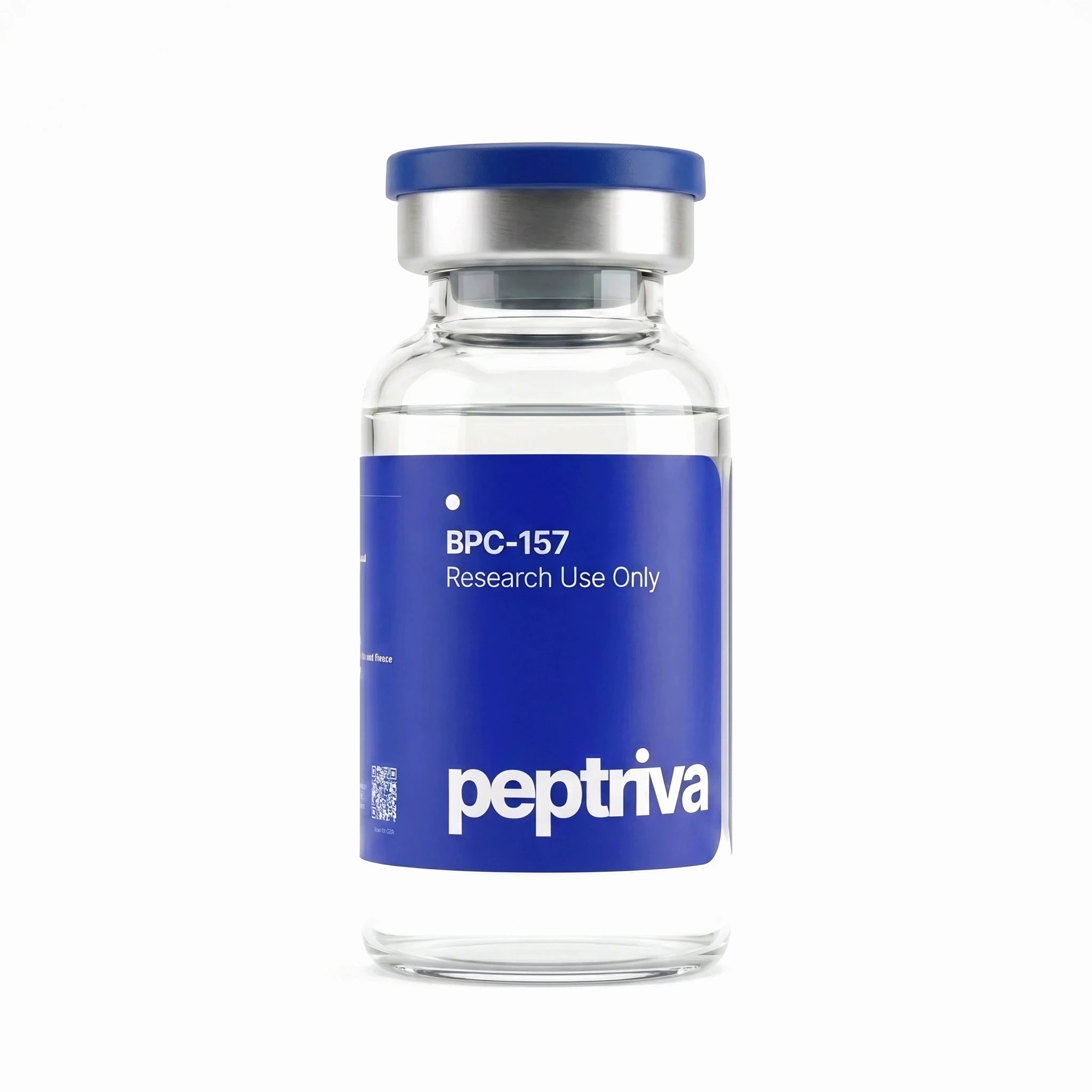
BPC-157
The 15-amino-acid pentadecapeptide behind the preclinical literature reviewed here. Research use only, supplied with a batch-matched certificate of analysis.
What did the 2025 BPC-157 systematic review count?
A 2025 systematic review in HSS Journal searched the literature from 1993 to June 2024. It screened 544 articles and included 36: thirty-five preclinical studies and one clinical study.
Preclinical safety studies showed no adverse effects across several organ systems. No clinical safety data were found.
Vasireddi et al., HSS Journal, 2025The same review reads the single clinical paper more conservatively than the paper's own headline, counting 7 of 12 patients with relief lasting beyond six months. When two careful readings of one small study disagree on the numerator, that is a signal about the study, not about the reviewers.
The review also fixes some pharmacology worth knowing before interpreting any timeline: BPC-157 is metabolized in the liver, cleared by the kidneys, and has a half-life of under 30 minutes.
Where are the real BPC-157 before-and-afters?
The preclinical record does contain measured before-and-afters, and they are genuinely interesting. In a 2025 study, rats had the quadriceps surgically detached from bone and then received BPC-157 at 10 ng/kg per day. Imaging and biomechanical testing showed reattachment and functional recovery holding at 90 days.
Around that sit four decades of rodent work on wound healing, vessel occlusion, gut anastomosis and cytoprotection.
A large share of it comes from the Zagreb laboratory that first described the peptide. That's a structural weakness rather than a fraud. Independent replication is what turns a preclinical literature into an evidence base, and this one has less of it than its volume suggests.
An anecdote isn't a small result. It's a different kind of object: uncontrolled, unblinded, unrepeatable, and selected for by the person sharing it. Stacking more of them doesn't converge on a result.
Nor does the dosing translate. Nanograms per kilogram given orally to a rat with a surgically detached muscle is not a milligram subcutaneous protocol in a person with a strained hamstring. No published work has bridged that gap.
What does a photograph of a healing injury actually show?
A BPC-157 injury photo is the weakest evidence in this category and the most abundant. Five things travel inside every pair you see.
- Time. Soft tissue heals. The 6-to-12-week window most before-and-afters cover is also the natural history of most strains and tendinopathies.
- The rest of the protocol. Rehab, load management, rest, anti-inflammatories, physical therapy and often two or three other compounds.
- Regression to the mean. People start something new when symptoms are at their worst, which is the point from which symptoms usually improve anyway.
- Selection. Nobody posts the pair where nothing happened, and nobody posts the one where it got worse.
- The material. A photo cannot verify what was in the vial. Read the certificate of analysis instead — it is the only part of this you can actually check.
What would settle the BPC-157 question?
The trial that would answer this isn't exotic. Randomize people with a defined tendon or knee problem to BPC-157 or placebo, blind both sides, and measure with imaging plus a validated functional score at fixed intervals. That design has been run hundreds of times for other injectables.
Neither of the 2025 reviews found one, and both land in the same place: the compound is investigational, with a broad preclinical case and essentially no clinical evidence. That is the honest read, and it is unchanged by the number of photographs in circulation.
The safety side of this page has the same shape. An absence of reported harm across 31 people in three uncontrolled reports isn't a finding of safety.
Our BPC-157 side effects review covers why that distinction matters more here than almost anywhere else.
BPC-157
Research-use-only material, sold by the vial with batch documentation. Check the certificate of analysis against the batch you receive.
What to know now
- No BPC-157 before-and-after study exists. No published trial has imaged, scored or photographed a treated person against a control.
- The human record is three uncontrolled pilot reports from one clinic: 17 knee patients, 12 cystitis patients, 2 infusion subjects.
- The knee series reported 14 of 16 patients recalling relief by phone — with no control arm and no validated functional measure.
- A 2025 systematic review included 36 studies. Thirty-five were animal work, and it found no clinical safety data at all.
- The measured recoveries in this literature are real and they are in rats, at nanogram-per-kilogram doses nobody has translated to people.
What we're watching
The gap here is filled by a single trial, and there's enough clinical interest that one may eventually be funded.
We're watching for a randomized, placebo-controlled study in a defined musculoskeletal injury. The endpoint should be imaging or a validated functional score, and the group running it should have no commercial stake in the answer.
Until that exists, every additional case report leaves the evidence in the same place.
Frequently asked questions
Are there real BPC-157 before-and-after results?
Not in the published literature. No trial has measured a treated person against a control with imaging or a validated score. The three human reports that exist are uncontrolled pilots in 17, 12 and 2 patients.
How long does BPC-157 take to work?
Nobody has measured that in people, so nobody can tell you. The animal studies run on timelines of days to weeks, and the one human knee report surveyed patients 6 to 12 months after injection with no defined onset window.
Why do the photos look convincing?
Because injuries heal. The typical before-and-after window is also the natural recovery time for the injuries involved, and the images carry rehab, rest, other treatments and selection along with them.
Does the animal evidence count for anything?
It's why we take BPC-157 seriously as a research candidate. Thirty-five preclinical studies show functional, structural and biomechanical improvement across tissue types. It isn't evidence about people, and no review treats it as such.
What people actually report
These are self-reports, not evidence. No control group, no blinding, and no independent check that the vial held what the label claimed. They are collected here because people asking about BPC-157 deserve an answer rather than a refusal, and because what the community believes is itself worth knowing. Quotes are excerpts; each links to the original post.
The self-reports split by tissue, and none of them is evidence. The most engaged recent account is a gut one: u/GiGiEats on r/Peptides, 203 points and 122 comments, who has ulcerative colitis and writes that her stomach pain is gone. Tendon and joint reports are mixed. In one r/Peptides tendinosis thread, u/fforredditt says three years of hamstring tendinitis was gone after five weeks. In that same thread u/vdreamin says the relief stops when the peptide stops. u/polarfang21 ran a clinic-supervised two-month course for shoulder bursitis and says it did nothing. Most of the positive accounts stack BPC-157 with TB-500, and u/GiGiEats adds four more compounds on top, so no account isolates one substance. All of it is self-reported, uncontrolled, unblinded and unverified.
Where the community and the published record disagree. The community and the literature disagree about what missing trials mean. In a June 2026 r/Peptidesource thread, the poster scores BPC-157 at 23/100 on his own evidence framework and still calls the anecdotal signal deafening. The thread does not settle it. Some commenters argue consistent reports should count; u/zikronix replies that you could have a million "trust me bros" and it would not matter. u/NoodledLily raises a conflict the papers do not carry: the Croatian researcher behind most of the BPC-157 literature holds patents on the compound. The commenter cites Undark, which reported on February 3, 2026 that "Sikiric is named on BPC-157-related patent applications dating back to at least 1989" and that "These conflicts were not disclosed on any of the team's published papers that Undark reviewed." The poster accepted the correction and lowered his own score. The sharper disagreement is about failure. When it does not work, the threads reach for the protocol, not the compound: the top reply to u/polarfang21's null result opens "Wrong protocol." Tendon complaints also change with time and loading, so an uncontrolled account cannot separate the peptide from the clock.
“Formally it’s weak, the evidence is animal only, mostly one research group, and no human RCTs. It scores a 23/100 on the evidence framework I’ve been developing.”
“I went through a local clinic so I didn’t question their dosages and such. [...] Didn’t heal much at all.”
BPC-157 did nothing for shoulder bursitis/bicep tendonitis? Did I just do the wrong protocol
“I have never felt better and the best part is my stomach just feels like a stomach, no pain…. and my sciatic pain is a faint whisper!”
“Nothing lasting for me. It helps while I'm taking them but once I stop issues come back. Works about as well as any NSAID for me”
Chronic tendinosis (5+ years) – Has anyone experienced lasting improvement with BPC-157 or TB-500?
“This vlog shares that journey—not as advice, not as proof, but simply as one person’s experience.”
Does BPC-157 Really Work? | 30 Day Self-Experiment & Recovery Insights
“BPC 157 has exploded in popularity as a supposed healing and recovery peptide, but how much of the hype is actually supported by science?”
Peptide BPC-157 - Does It Work? Breaking Down the Evidence and the Hype
Posts are quoted under fair use and linked to their authors. Nothing on this page is hosted here, and no claim above has been verified beyond confirming that the person wrote it.
References
- Vasireddi, N., Hahamyan, H., Salata, M. J., et al. (2025). Emerging use of BPC-157 in orthopaedic sports medicine: A systematic review. HSS Journal, 21(4). https://doi.org/10.1177/15563316251355551
- McGuire, F. P., Martinez, R., Lenz, A., Skinner, L., & Cushman, D. M. (2025). Regeneration or risk? A narrative review of BPC-157 for musculoskeletal healing. Current Reviews in Musculoskeletal Medicine, 18(12), 611–619. https://doi.org/10.1007/s12178-025-09990-7
- Lee, E., & Padgett, B. (2021). Intra-articular injection of BPC 157 for multiple types of knee pain. Alternative Therapies in Health and Medicine, 27(4), 8–13. PMID 34324435
- Lee, E., Walker, C., & Ayadi, B. (2024). Effect of BPC-157 on symptoms in patients with interstitial cystitis: A pilot study. Alternative Therapies in Health and Medicine, 30(10), 12–17. PMID 39325560
- Lee, E., & Burgess, K. (2025). Safety of intravenous infusion of BPC-157 in humans: A pilot study. Alternative Therapies in Health and Medicine, 31(5), 20–24. PMID 40131143
- Matek, D., Matek, I., Staresinic, E., et al. (2025). Stable gastric pentadecapeptide BPC 157 as therapy after surgical detachment of the quadriceps muscle for muscle-to-bone reattachment in rats. Pharmaceutics, 17(1), 119. https://doi.org/10.3390/pharmaceutics17010119
- Seiwerth, S., Milavic, M., Vukojevic, J., et al. (2021). Stable gastric pentadecapeptide BPC 157 and wound healing. Frontiers in Pharmacology, 12, 627533. https://doi.org/10.3389/fphar.2021.627533
- Sikiric, P., Skrtic, A., Gojkovic, S., et al. (2022). Cytoprotective gastric pentadecapeptide BPC 157 resolves major vessel occlusion disturbances. World Journal of Gastroenterology, 28(1), 23–46. https://doi.org/10.3748/wjg.v28.i1.23
- Józwiak, M., Bauer, M., Kamysz, W., & Kleczkowska, P. (2025). Multifunctionality and possible medical application of the BPC 157 peptide — literature and patent review. Pharmaceuticals, 18(2), 185. https://doi.org/10.3390/ph18020185
- Bajramagic, S., Hadziahmetovic, N., Pravdic, D., et al. (2024). BPC 157 in gastrointestinal anastomosis healing: A systematic review. Pharmaceuticals (Basel), 17(8), 1081. https://doi.org/10.3390/ph17081081