
The documented BPC-157 benefits are faster tendon, ligament, gut and wound repair, and nearly every one of them was measured in a rat. We read the 2025 systematic review those lists are built on. Of its 36 studies, 35 are animal models.
The short answer. A 2025 systematic review found 36 studies on BPC-157 that met PRISMA criteria.
- 35 of those 36 were animal models, so the human evidence is effectively absent.
- About 80% of the work came from a single research group in Zagreb.
- The claimed benefits center on tendon and ligament healing and on gut-barrier repair.
A 2025 systematic review screened 36 studies of BPC-157 against PRISMA criteria. 35 were animal models, and about 80% came from one group in Zagreb. The claims run from tendon healing to gut-barrier repair. That breadth is the appeal. The concentration is the problem.
What benefits does BPC-157 have evidence for?
BPC-157 has published support for five benefit claims: tendon and ligament healing, gut-barrier repair, wound closure, nerve recovery and knee-pain relief. Only the last has ever been examined in people, and that was one uncontrolled case series. Here's each claim against what stands behind it.
| Claimed benefit | Evidence behind it | Weight |
|---|---|---|
| Tendon, ligament and muscle healing | 36-study systematic review; consistent functional, structural and biomechanical improvement across injury models | Broadest signal — all but one study in animals |
| Gut-barrier repair | Reversal of NSAID-induced permeability, anastomosis healing, colitis models | Mechanistically coherent, entirely preclinical |
| Wound healing | Skin, burn, diabetic ulcer, corneal models | Wide but single-group-dominated |
| Nerve and spinal recovery | Rat models of compression and transection | Early, narrow |
| Knee pain relief | One retrospective human case series, intra-articular | The only human efficacy signal, uncontrolled |
Why does BPC-157 seem to help so many tissues?
BPC-157 appears to act on angiogenesis through VEGFR2 signaling and on nitric oxide pathways. Both are upstream, general-purpose repair processes rather than tissue-specific ones.
A compound working that far upstream would show effects wherever repair is happening. That's what the literature reports, and it's why the multi-system list stops reading as implausible once you know the mechanism.
That's a coherent story. It isn't the same as a demonstrated benefit in humans, and that distinction is the whole point of this page. The mechanism in detail.
The 35:1 ratio is the number to carry away. Thirty-five animal studies against one human case series.
A 2025 orthopaedic review flagged BPC-157's authorship concentration explicitly. Roughly 80% of the preclinical work comes from one team, and independent replication is the missing piece. We'd call that a confidence-interval problem rather than a fatal flaw, but you shouldn't read past it.
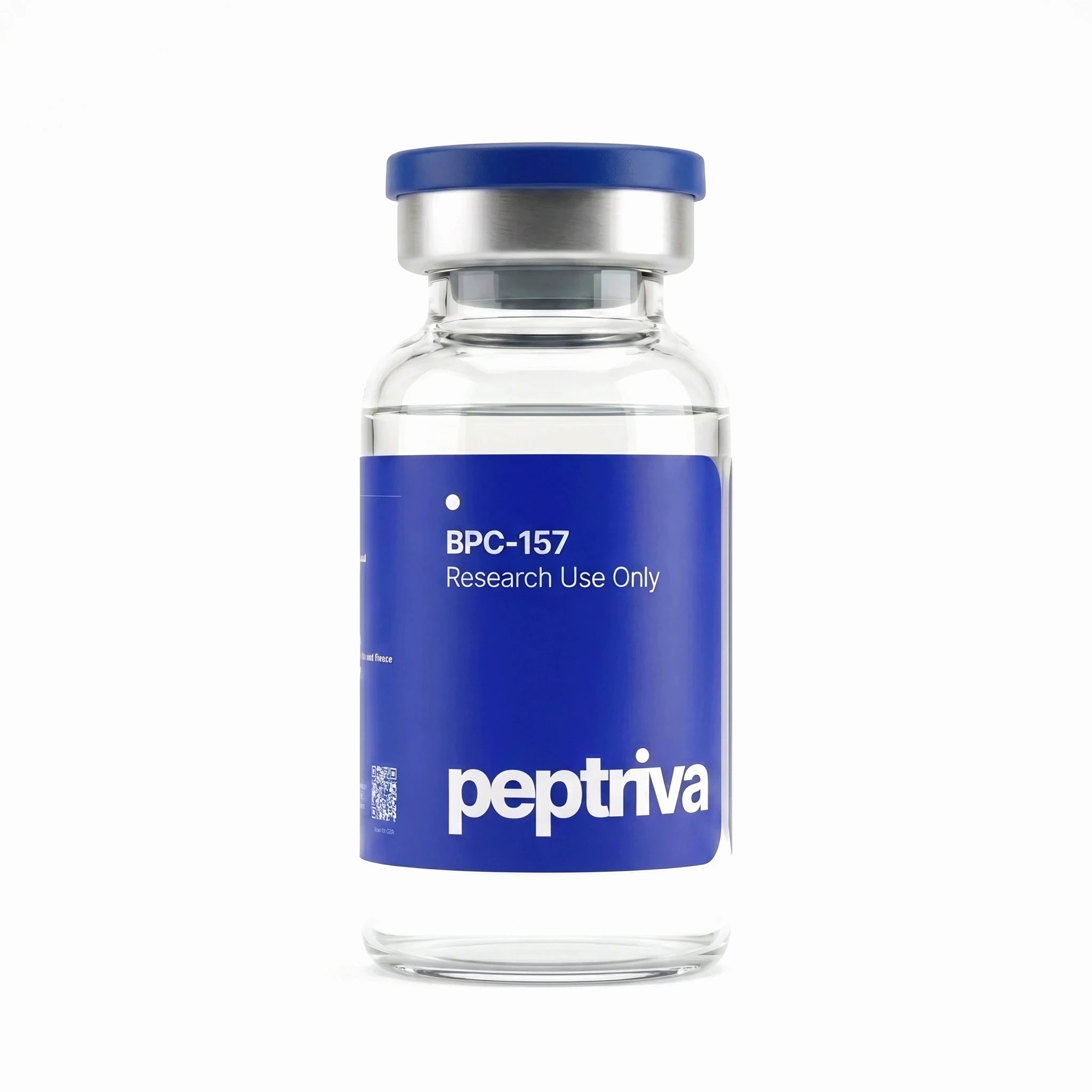
BPC-157
The reference compound cited across the preclinical reviews discussed here. Research use only, supplied with a batch-matched certificate of analysis.
What would change the picture for BPC-157?
One registered randomized controlled trial would change it. An Achilles-tendinopathy or knee-osteoarthritis Phase 2 is the natural first formal test. It would settle in a single study what four decades of rodent work hasn't.
- A controlled human trial in any indication. BPC-157 has none. A Phase 2 with a placebo arm and a real endpoint would move every row of the table above.
- Replication from outside Zagreb. Independent labs reproducing the tendon results would retire the authorship-concentration objection entirely.
- A human dose-finding study. Nothing in the 36-study review establishes a BPC-157 dose in people, so every protocol circulating online is extrapolated from rodents.
Until those exist, every benefit on this page is a hypothesis with animal support. We'd rather you treat it as one. That's a real thing, and it isn't the same thing as a result.
Frequently asked questions
What does BPC-157 actually do?
In animal models, BPC-157 accelerates repair across tendon, ligament, muscle, gut, skin and nerve injury. The proposed mechanism sits upstream: angiogenesis via VEGFR2 and nitric oxide signaling. That's why effects turn up wherever repair is happening rather than in one tissue.
Does BPC-157 work in humans?
One retrospective case series on intra-articular injection for knee pain is the entire human efficacy record for BPC-157. No controlled trial has been run, so you can't put a number on it.
How long does BPC-157 take to work?
No human trial has established a BPC-157 time course. Animal studies report effects over days to weeks depending on the model, and that doesn't translate into an expectation you can hold.
Why is the BPC-157 research questioned?
Roughly 80% of the BPC-157 preclinical literature comes from a single research group in Zagreb. The work is careful and internally consistent, but independent replication is limited. That's the bar a candidate clears before clinical trials.
Is BPC-157 better than TB-500?
Different mechanisms for overlapping problems. BPC-157 works through angiogenesis and nitric oxide. TB-500 is an actin-sequestering fragment of thymosin β4. Neither has controlled human efficacy data, so you'd be picking between two unknowns.
BPC-157
Research-use-only material, sold by the vial with batch documentation. Check the certificate of analysis against the batch you receive.
What to know now
- A 2025 systematic review found 36 studies on BPC-157 that met PRISMA criteria.
- 35 of those 36 were animal models, so the human evidence is effectively absent.
- About 80% of the work came from a single research group in Zagreb.
- The claimed benefits center on tendon and ligament healing and on gut-barrier repair.
- Wound closure and nerve recovery are also claimed, which makes the base unusually broad and unusually narrow at once.
What we’re watching
We're watching for the first registered controlled trial of BPC-157 in any musculoskeletal indication. One would do more for this page than another twenty rodent papers.
We're also watching for tendon results replicated outside Zagreb. Independent labs reproducing them would retire the concentration objection for good.
References
- Vasireddi, N., Hahamyan, H., Salata, M. J., et al. (2025). Emerging use of BPC-157 in orthopaedic sports medicine: A systematic review. HSS Journal, 21(4). https://doi.org/10.1177/15563316251355551
- McGuire, F. P., Martinez, R., Lenz, A., Skinner, L., & Cushman, D. M. (2025). Regeneration or risk? A narrative review of BPC-157 for musculoskeletal healing. Current Reviews in Musculoskeletal Medicine, 18(12), 611–619. https://doi.org/10.1007/s12178-025-09990-7
- Lee, E., & Padgett, B. (2021). Intra-articular injection of BPC 157 for multiple types of knee pain. Alternative Therapies in Health and Medicine, 27(4), 8–13. PMID 34324435
- Matek, D., Matek, I., Staresinic, E., et al. (2025). Stable gastric pentadecapeptide BPC 157 as therapy after surgical detachment of the quadriceps muscle for muscle-to-bone reattachment in rats. Pharmaceutics, 17(1), 119. https://doi.org/10.3390/pharmaceutics17010119
- Lee, E., & Burgess, K. (2025). Safety of intravenous infusion of BPC-157 in humans: A pilot study. Alternative Therapies in Health and Medicine, 31(5), 20–24. PMID 40131143