
The KLOW vs GLOW peptide question has a short answer: KLOW is GLOW with 10 mg of KPV added. The three shared ingredients are identical, at identical amounts.
The short answer. KLOW is GLOW plus 10 mg of KPV. GLOW is 70 mg as 10/10/50; KLOW is 80 mg as 10/10/50/10.
- The three shared ingredients are present at identical amounts in both vials, so everything written about GLOW's components applies unchanged.
- KPV has a clean preclinical anti-inflammatory mechanism through PepT1 uptake and NF-kappaB suppression, and no published human trial.
- Neither blend has been studied as a combination. Both carry zero published studies in any species.
GLOW is 70 mg. That is 10 mg BPC-157, 10 mg TB-500 and 50 mg GHK-Cu. KLOW is 80 mg. The same three, plus 10 mg KPV. That one ingredient is the whole difference. It has no published human trial. Neither blend has been studied as a combination. Both carry zero studies of their own.
What is the difference between KLOW and GLOW?
One ingredient, and 10 mg of it. The three compounds the two vials share are present at the same amounts in both. Nothing is substituted, nothing is reduced.
| Component | GLOW | KLOW | What it contributes |
|---|---|---|---|
| GHK-Cu | 50 mg | 50 mg | Copper delivery, collagen and antioxidant pathways |
| BPC-157 | 10 mg | 10 mg | Repair signaling, described via VEGFR2 |
| TB-500 | 10 mg | 10 mg | G-actin binding, cell migration |
| KPV | — | 10 mg | NF-kappaB suppression, anti-inflammatory |
| Total | 70 mg | 80 mg | — |
Because the shared three are unchanged, everything already written about GLOW applies to KLOW without adjustment. Our GLOW complete guide and KLOW complete guide run in parallel for that reason.
What KPV actually brings
KPV is Lys-Pro-Val, the C-terminal tripeptide of alpha-melanocyte-stimulating hormone. The parent hormone is anti-inflammatory and also drives pigmentation. The fragment keeps the first property and loses the second, which is a clean piece of pharmacology and the reason anyone bothered isolating it.
Melanocortin-derived tripeptide KPV has anti-inflammatory potential in murine models of inflammatory bowel disease.
Kannengiesser et al., Inflammatory Bowel Diseases, 2008The mechanism has an unusual feature worth knowing. KPV does not appear to need a melanocortin receptor. The colitis work shows it entering intestinal epithelial and immune cells through the PepT1 peptide transporter and suppressing NF-kappaB from inside. We cover it in the KPV mechanism.
What KPV does not bring is a human result. No trial has been published, for inflammatory bowel disease or anything else. The choice between these two vials is a choice about a preclinical mechanism, not a demonstrated benefit.
Neither blend has been studied
This is the part that keeps the comparison honest. GLOW has zero published studies as a three-compound combination. KLOW has zero as a four-compound one. Adding an ingredient to an untested blend produces a different untested blend.
So the sensible framing is not “which works better.” No comparative data exists and none is coming from the vendors. The framing that survives contact with the evidence is: which set of ingredients do you have a reason to want, and what does the extra one cost you?
A number of clinical studies confirmed GHK-Cu’s ability to improve appearance of aging skin.
Pickart & Margolina, International Journal of Molecular Sciences, 2018That sentence is the strongest evidence claim either vial can reach for, and it belongs to the ingredient they share, at a route neither vial uses.
Both vials share the same underlying qualification too. GHK-Cu is the majority of the mass in each, and its controlled human evidence is topical rather than injected. That is covered in injectable vs topical GHK-Cu.
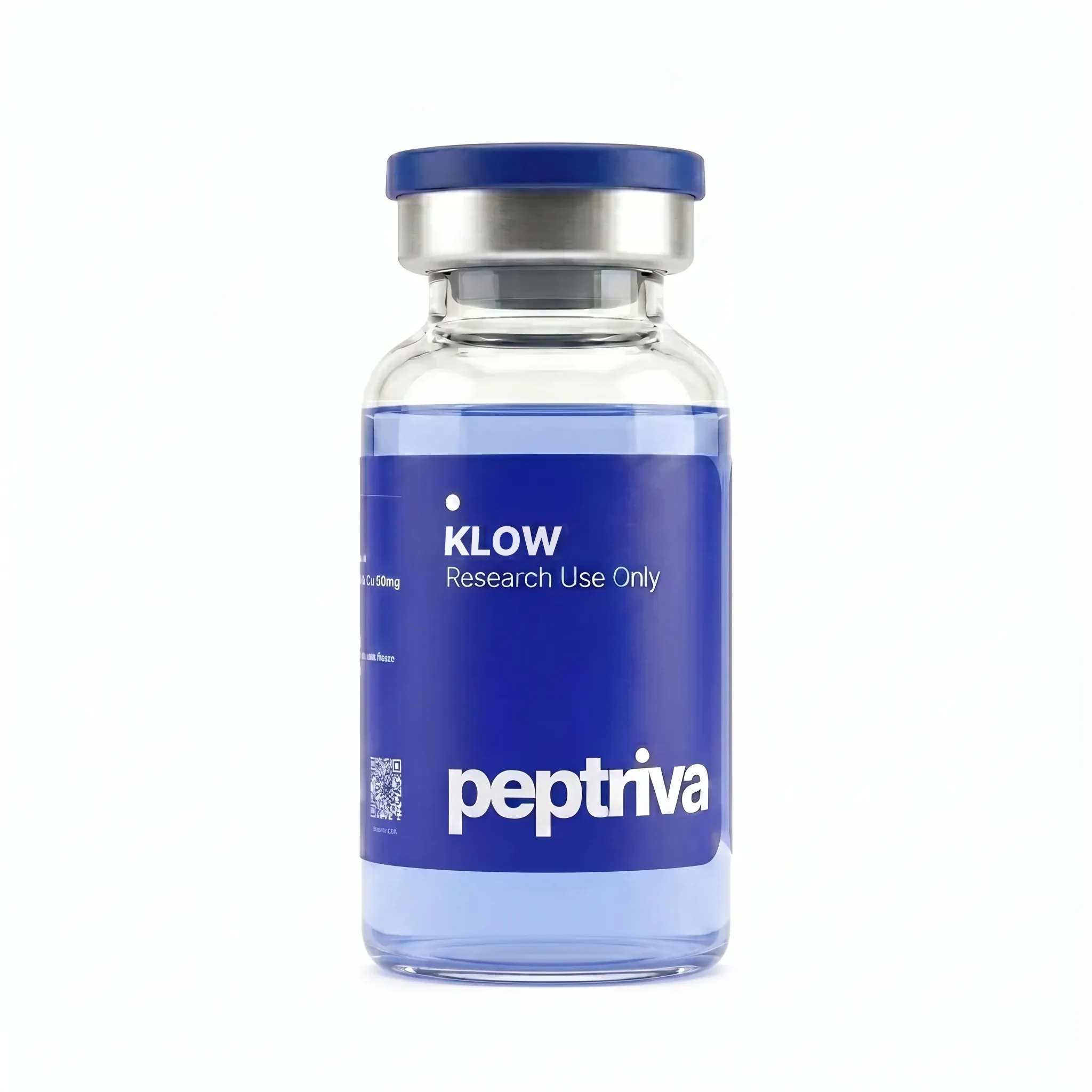
KLOW Blend
The four-component blend described here, co-lyophilized in one vial, with a third-party certificate of analysis matched to the lot.
What the extra ingredient costs
Three things, none of them dramatic and all worth naming.
- A fourth identity to verify. The certificate now has to confirm four masses and quantify four components. Four-way blends are where per-component quantitation most often goes missing.
- A fourth unknown in any observation. If something changes, four variables changed rather than three. Neither vial supports single-variable work, but KLOW is one step further from it.
- A different ratio. GLOW is 1:1:5. KLOW is 1:1:5:1. Because both are co-lyophilized, neither can be adjusted after manufacture.
What it does not cost is copper. Both vials carry the same 50 mg of GHK-Cu, which is roughly 7.9 mg of elemental copper against a 10 mg adult daily upper intake level from all sources. On that axis the two are identical.
Which should you look at?
We do not publish protocols and this is not one. It is a description of what the two products are, which is what the question is usually really asking.
- If the interest is the shared three, the fourth ingredient adds an unverified variable and a fourth thing to check on the certificate. GLOW is the simpler object.
- If the interest is specifically KPV, it is sold on its own at 10 mg, which is the same amount KLOW contains. Buying it separately keeps the ratio adjustable and the certificate readable.
- If the interest is convenience, KLOW is one vial and one reconstitution instead of two, and it is not always the more expensive route. Convenience and price are the only two axes on which either product can currently demonstrate anything.
The separates route is worth taking seriously, because this market supports it well. Where to buy KLOW works through what the pre-mix does and does not buy, and KLOW peptide dosage covers the reconstitution arithmetic for an 80 mg vial.
KLOW Blend
Research-use-only material, sold by the vial with batch documentation. Check the certificate of analysis against the batch you receive.
What to know now
- KLOW is GLOW plus 10 mg of KPV. GLOW is 70 mg as 10/10/50; KLOW is 80 mg as 10/10/50/10.
- The three shared ingredients are present at identical amounts in both vials, so everything written about GLOW's components applies unchanged.
- KPV has a clean preclinical anti-inflammatory mechanism through PepT1 uptake and NF-kappaB suppression, and no published human trial.
- Neither blend has been studied as a combination. Both carry zero published studies in any species.
- Copper load is identical: both hold 50 mg GHK-Cu, roughly 7.9 mg of elemental copper.
What we're watching
The comparison would become answerable the moment anyone ran a factorial study: the four-compound blend against the three-compound one, on any endpoint, in any species. That single experiment would tell you whether the fourth ingredient does anything, and it has never been attempted. We are also watching for the first human KPV trial, which is the only thing that would move this from a mechanism argument to an evidence one.
Frequently asked questions
What is the difference between KLOW and GLOW peptide?
One ingredient. GLOW is BPC-157, TB-500 and GHK-Cu at 10/10/50 mg for 70 mg total. KLOW is the same three at the same amounts plus 10 mg of KPV, for 80 mg total.
Is KLOW better than GLOW?
There is no evidence either way. Neither blend has been studied as a combination, and no comparison between them has been published. The difference is one ingredient with a preclinical mechanism and no human trial.
What does the K in KLOW stand for?
KPV, the C-terminal tripeptide of alpha-MSH. The name is an acronym vendors assembled from the four ingredients: KPV, GHK-Cu, BPC-157 and TB-500.
Do KLOW and GLOW contain the same amount of GHK-Cu?
Yes. Both standard vials carry 50 mg of GHK-Cu, which works out to roughly 7.9 mg of elemental copper. The copper load is identical between the two.
Can I add KPV to GLOW myself?
KPV is sold separately at 10 mg, the same amount KLOW contains, so the composition can be assembled from two vials. That keeps the ratio adjustable, which a co-lyophilized blend does not allow.
References
- Kannengiesser, K., Maaser, C., Heidemann, J., et al. (2008). Melanocortin-derived tripeptide KPV has anti-inflammatory potential in murine models of inflammatory bowel disease. Inflammatory Bowel Diseases, 14(3), 324–331. https://doi.org/10.1002/ibd.20334
- Dalmasso, G., Charrier-Hisamuddin, L., Nguyen, H. T., et al. (2008). PepT1-mediated tripeptide KPV uptake reduces intestinal inflammation. Gastroenterology, 134(1), 166–178. https://doi.org/10.1053/j.gastro.2007.10.026
- Sun, J., Xue, P., Liu, J., et al. (2021). Self-Cross-Linked Hydrogel of Cysteamine-Grafted γ-Polyglutamic Acid Stabilized Tripeptide KPV for Alleviating TNBS-Induced Ulcerative Colitis in Rats. ACS Biomaterials Science & Engineering, 7(10), 4859–4869. https://doi.org/10.1021/acsbiomaterials.1c00792
- Gravina, A. G., Pellegrino, R., Durante, T., et al. (2023). The Melanocortin System in Inflammatory Bowel Diseases: Insights into Its Mechanisms and Therapeutic Potentials. Cells, 12(14), 1889. https://doi.org/10.3390/cells12141889
- Dou, Y., Lee, A., Zhu, L., et al. (2020). The potential of GHK as an anti-aging peptide. Aging Pathobiology and Therapeutics, 2(1), 58–61. https://doi.org/10.31491/apt.2020.03.014
- Pickart, L., & Margolina, A. (2018). Regenerative and protective actions of the GHK-Cu peptide in the light of the new gene data. International Journal of Molecular Sciences, 19(7), 1987. https://doi.org/10.3390/ijms19071987
- Dymek, M., Warszyński, P., & Sikora, E. (2023). GHK Peptide Permeability and Its Effects in Anti-Aging Skincare Topical Formulations. Pharmaceutics, 15(10), 2485. https://doi.org/10.3390/pharmaceutics15102485
- Vasireddi, N., Hahamyan, H., Salata, M. J., et al. (2025). Emerging use of BPC-157 in orthopaedic sports medicine: A systematic review. HSS Journal, 21(4). https://doi.org/10.1177/15563316251355551
- McGuire, F. P., Martinez, R., Lenz, A., Skinner, L., & Cushman, D. M. (2025). Regeneration or risk? A narrative review of BPC-157 for musculoskeletal healing. Current Reviews in Musculoskeletal Medicine, 18(12), 611–619. https://doi.org/10.1007/s12178-025-09990-7
- Philp, D., Goldstein, A. L., & Kleinman, H. K. (2004). Thymosin beta4 promotes angiogenesis, wound healing, and hair follicle development. Mechanisms of Ageing and Development, 125(2), 113–115. https://doi.org/10.1016/j.mad.2003.11.005
- Ying, Y., Lin, C., Tao, N., et al. (2023). Thymosin β4 and actin: Binding modes, biological functions and clinical applications. Current Protein and Peptide Science, 24(1), 78–88. https://doi.org/10.2174/1389203724666221201093500