
The KPV benefits with real support behind them are gut ones. Mice and rats get less colitis. A transporter concentrates the peptide where the inflammation is. We found no Western randomized human trial for that. We found none for the skin and wound claims sold alongside it.
The short answer. KPV is the last three amino acids of α-MSH, and it keeps the parent hormone's anti-inflammatory activity.
- Unlike the full hormone, KPV loses the pigment effect, which is the point of using the fragment.
- Most laboratory work sits in inflammatory bowel disease models, and the mechanism hangs together there.
- Western randomized controlled trials in humans number zero, for any indication at all.
KPV has a strong mechanism and zero human proof. It is the last three amino acids of α-MSH. It keeps the parent hormone's power to calm inflammation. But it loses the pigment effect. Most lab work sits in models of inflammatory bowel disease. Western randomized controlled trials in humans: zero. That holds for any use.
What are the benefits of KPV?
Four benefits are claimed for KPV. One carries real evidence: reduced gut inflammation, shown in mouse and rat colitis models. The other three are wound healing, skin inflammation and a systemic anti-inflammatory effect. Each rests on older, smaller work than the gut strand does.
None of the four has a human randomized controlled trial behind it. That is not a hedge. It is the count. Across 2020–2026 the literature returns roughly four results for KPV, and none are trials. So the useful question is not which benefit is biggest. It is which one has anything under it. The answer is the gut.
Why does a three-residue fragment like KPV do anything?
α-MSH is the hormone the body uses to damp inflammation. It also drives pigmentation, through melanocortin receptors. KPV, or Lys-Pro-Val, is the tail end of that sequence. Splitting those two activities is the whole design rationale. You keep the anti-inflammatory signal. You drop the tanning.
What makes KPV interesting is delivery rather than potency. It is taken up by PepT1. That is a di/tripeptide transporter in the intestine. Inflamed gut epithelium makes more of it.
So the molecule is absorbed best where the inflammation already is. That is an elegant piece of design. It also explains something. The strongest preclinical work on KPV is gastrointestinal.
What does the KPV literature actually contain?
We count four claimed KPV benefits and one that carries weight. Gut inflammation has mouse and rat colitis models behind it, including oral nanoparticle work. The skin and wound claims trail off into older, smaller studies, so you're weighing one strand against three.
| Claimed benefit | Evidence |
|---|---|
| Gut inflammation / colitis | Mouse and rat colitis models, including oral nanoparticle formulations — the deepest strand |
| Skin inflammation | A thin trail of older topical work in atopic dermatitis |
| Wound healing | In-vitro and small animal work |
| Any human indication | No Western randomized controlled trial exists |
Four papers in six years. A PubMed search across 2020–2026 returns roughly four KPV results, plus a longer tail of older preclinical work.
Set that against how confidently KPV is sold for gut health. We'd call the science genuinely interesting and the marketing a long way ahead of it.
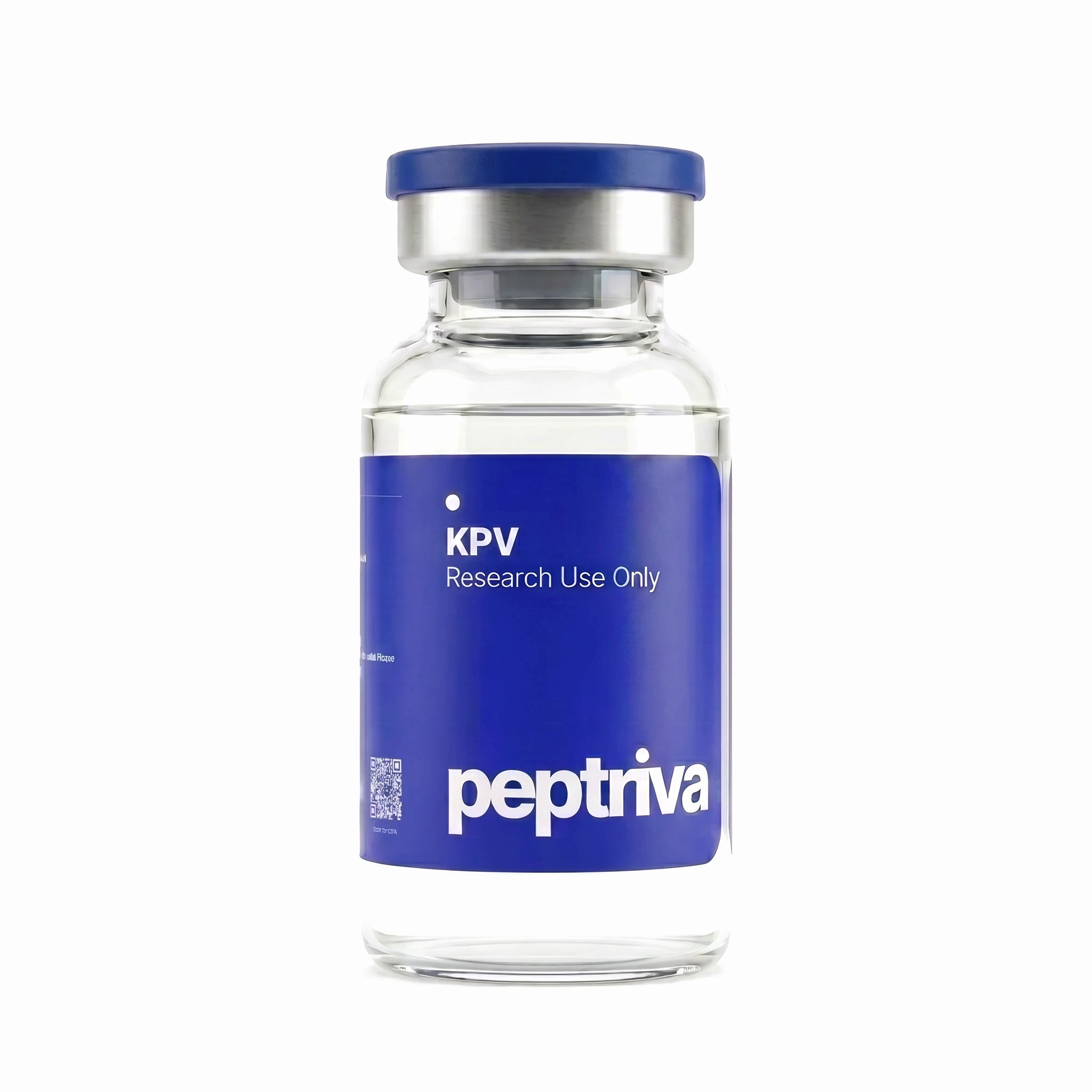
KPV
The tripeptide behind the preclinical literature reviewed here. Research use only, supplied with a batch-matched certificate of analysis.
What would change the picture for KPV?
One controlled human trial in ulcerative colitis would change it. The preclinical rationale is strong enough to justify running one, and the PepT1 delivery story is genuinely novel.
That's what makes the missing trial the most interesting fact about KPV rather than a footnote. Until somebody runs it, you're reading mouse data.
If you are buying KPV anyway, what should you check?
Research-supply vendors online are the route. KPV has no approved product behind it. So no pharmacy can dispense it. The FDA’s compounding advisory committee took KPV up on 23–24 July 2026 for the 503A bulks list. An advisory vote is not rulemaking. And 503A listing concerns prescription compounding, not the research-supply market.
Our verified set holds no CAS number for KPV. So ask for the mass and the sequence instead. The mass is 342.4 g/mol. The identity line should read Lys-Pro-Val and nothing longer. The mass-spec peak should land at 343.4, within 0.5 Da. A longer fragment sold under the KPV name is what that check catches. Expect $40–$80 for a 10 mg vial of lyophilized powder, not capsules. Above $100 is retail markup. The KPV sourcing section has the full check. The complete guide covers the melanocortin pathway.
Frequently asked questions
What is KPV peptide?
KPV is the C-terminal tripeptide of α-MSH: Lys-Pro-Val. It keeps the parent hormone's anti-inflammatory activity without the melanocortin-driven pigmentation effect.
What is KPV used for?
The KPV preclinical literature concentrates on inflammatory bowel disease, with thinner strands in skin inflammation and wound healing. No human indication has controlled-trial support, so we can't tell you it's used for anything.
Does KPV work for gut health?
In mouse and rat colitis models, yes, with a coherent mechanism: KPV is absorbed by PepT1, a transporter upregulated in inflamed intestinal epithelium. Whether that translates to people is untested.
Are there human trials on KPV?
No Western randomized controlled trials of KPV exist, for any indication. A PubMed search across 2020–2026 returns roughly four results, and none of them are RCTs.
Is oral KPV better than injectable?
The most interesting KPV work uses oral nanoparticle formulations, precisely because PepT1 uptake happens in the gut. That's a rationale for oral delivery most peptides don't have, and nobody has tested it in people.
KPV
Research-use-only material, sold by the vial with batch documentation. Check the certificate of analysis against the batch you receive.
What to know now
- KPV is the last three amino acids of α-MSH, and it keeps the parent hormone's anti-inflammatory activity.
- Unlike the full hormone, KPV loses the pigment effect, which is the point of using the fragment.
- Most laboratory work sits in inflammatory bowel disease models, and the mechanism hangs together there.
- Western randomized controlled trials in humans number zero, for any indication at all.
- Few compounds carry a wider gap between how they are marketed and what has actually been tested.
References
- Dalmasso, G., Charrier-Hisamuddin, L., Nguyen, H. T., et al. (2008). PepT1-mediated tripeptide KPV uptake reduces intestinal inflammation. Gastroenterology, 134(1), 166–178. https://doi.org/10.1053/j.gastro.2007.10.026
- Kannengiesser, K., Maaser, C., Heidemann, J., et al. (2008). Melanocortin-derived tripeptide KPV has anti-inflammatory potential in murine models of inflammatory bowel disease. Inflammatory Bowel Diseases, 14(3), 324–331. https://doi.org/10.1002/ibd.20334
- Sun, J., Xue, P., Liu, J., et al. (2021). Self-Cross-Linked Hydrogel of Cysteamine-Grafted γ-Polyglutamic Acid Stabilized Tripeptide KPV for Alleviating TNBS-Induced Ulcerative Colitis in Rats. ACS Biomaterials Science & Engineering, 7(10), 4859–4869. https://doi.org/10.1021/acsbiomaterials.1c00792