
People searching Testagen side effects find tidy lists. The published record behind them is one 2013 paper that gave this peptide to birds and then examined thymus tissue.
The short answer. Testagen: The only study that gave KEDG to an animal used birds and measured thymus tissue, not safety endpoints.
- We found no toxicology study, no human pharmacokinetics and no published case report for Testagen.
- An empty adverse event record reflects no reporting channel, not a clean safety profile.
- The proposed DNA-binding mechanism is exactly the claim that would require genotoxicity testing, and none exists.
Testagen has no published human safety data. The only study to give KEDG used birds. It measured thymus tissue, not harm. We found zero toxicology papers and zero case reports. Western randomized trials number zero. Silence is not the same as safety.
What the Testagen safety record actually contains
Testagen is a 4-amino-acid peptide. Its sequence is Lys-Glu-Asp-Gly, often written KEDG. Its mass sits near 446 Da. PubMed holds about 2 papers on it.
Only one of those gave the peptide to a living animal. That animal was a bird.
Effect of peptides Lys-Glu-Asp-Gly and Ala-Glu-Asp-Gly on the morphology of the thymus in hypophysectomized young and old birds.
Pateyk et al., Bulletin of Experimental Biology and Medicine, 2013 (paper title)The title is the study design. Birds had the pituitary gland removed. Then tissue was examined under a microscope. Nothing in that work was a safety endpoint. No blood chemistry panel. No organ toxicity scoring. No dose at which harm appeared.
| Safety question | What we found for Testagen |
|---|---|
| Acute toxicity study | None published that we found |
| Repeat-dose toxicology | None found |
| Human adverse event data | None found |
| Human pharmacokinetics | None found |
| Genotoxicity testing | None found |
| Species given the peptide | Birds, in one 2013 paper |
| Western randomized trials | Zero |
The Testagen complete guide walks through the full publication list.
Does Testagen have side effects?
Nobody can answer that from evidence. We found no published case report, no registry entry and no clinical safety study in any human population.
That absence is easy to misread. A compound sold as a research chemical has no reporting channel. There is no approved label, so there is no post-marketing surveillance attached to it. If someone had a reaction, there is no obvious place the event would be recorded and counted.
An empty adverse event record for an unapproved peptide tells you how little has been collected. It does not tell you the peptide is gentle.
Most side effect lists for Testagen online appear to be generic injection text: redness, swelling, soreness at the site. Those are the predictable consequences of putting a needle through skin. They are not findings about KEDG.
- No maximum studied exposure. No paper we found identifies a level at which harm began.
- No duration data. There is no published record of long-term administration in any mammal.
- No interaction data. Nothing published on how it behaves alongside other compounds.
- No hormone safety data. The name points at testosterone, and no paper we found measured testosterone at all.
That last point is covered in the Testagen benefits page.
The mechanism nobody has toxicology for
The cytogen class, which Testagen belongs to, is built on an unusual claim. These peptides are said to enter the nucleus and bind DNA directly, favoring certain sequence sites.
Penetration of short fluorescence-labeled peptides into the nucleus in HeLa cells and in vitro specific interaction of the peptides with deoxyribooligonucleotides and DNA.
Fedoreyeva et al., Biochemistry (Moscow), 2011 (paper title)That 2011 work used cancer cells in a dish and labeled peptides. It is a mechanism paper, not a safety paper.
Here is why it matters for this page. If a molecule really does bind DNA, genotoxicity testing is the first thing a regulator asks for. We found none for KEDG. The mechanism marketing leans on is the same mechanism that would most urgently need a toxicology program, and that program does not appear in the literature.
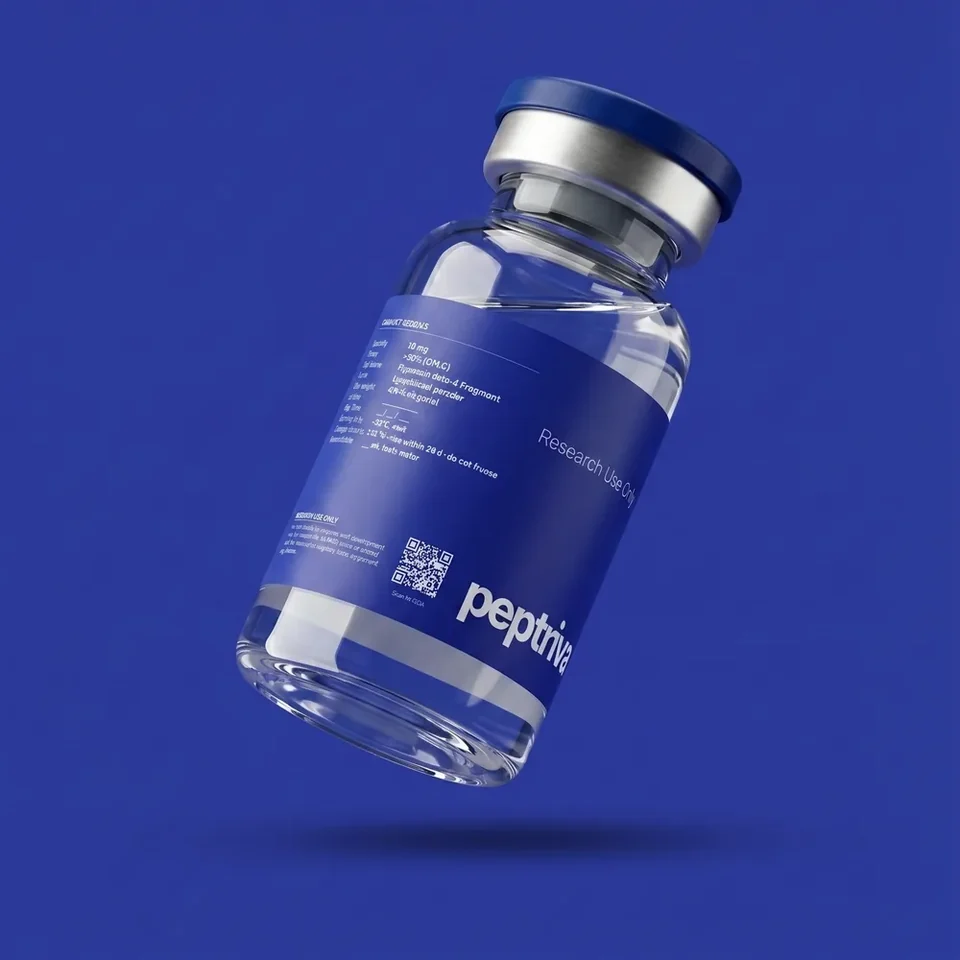
Testagen
The compound discussed here, supplied as a research compound with a certificate of analysis matched to the lot.
What the rest of the cytogen family adds
Testagen has siblings. Epitalon is AEDG. Pinealon is EDR. Cartalax is AED. All run 2 to 4 residues, and most of the published work comes from one research consortium.
A 2020 paper in Molecular Biology Reports looked at short peptides and gene expression in aging human mesenchymal stem cell cultures. A 2020 Molecules paper examined AEDG and gene expression during neurogenesis. A companion Molecules paper looked at EDR and genes tied to Alzheimer's disease pathogenesis.
Read the endpoints. Gene expression. Protein synthesis. Cell cultures. None of those studies was designed to find harm, and none of them administered Testagen.
- Shared authors. Khavinson appears across the family literature, which narrows how independent the body of work is.
- Shared design. Cells and tissue, not controlled dosing in people.
- No safety carryover. A result for AEDG is not a result for KEDG, even with one letter between them.
For contrast, Thymosin Alpha 1 is a 28-residue thymic peptide used in 35+ countries. It has an approval history and a documented safety file. Testagen has neither.
The risks that come from the vial, not the peptide
With no pharmacology record, the measurable risks shift to the product itself. These you can actually check before anything else happens.
Ask for a third-party certificate of analysis tied to the lot number in your hand, not a generic PDF. Our guide to reading a COA explains what identity, purity and mass data should look like, and which documents are decoration.
The rest is handling. Contamination, degraded material and incorrect diluent are real, documented problems in this market, and they are separate from whatever the molecule does.
- Reconstitution basics, including sterile technique.
- What bacteriostatic water is and how it differs from sterile water.
- Storage temperature, since short peptides degrade in solution.
Testagen, drug testing and legal status
Testagen has no FDA approval. It is sold for laboratory research, and that status does not change because a vial arrives at a house.
For anyone tested in sport, the relevant text is not a named entry. The World Anti-Doping Agency Prohibited List carries a catch-all section.
Any pharmacological substance which is not addressed by any of the subsequent sections of the List and with no current approval by any governmental regulatory health authority for human therapeutic use is prohibited at all times.
World Anti-Doping Agency, Prohibited List, Section S0An unapproved research peptide sits squarely inside that wording. Tested athletes should treat it accordingly. Our page on peptide legality covers the research-use framing in more detail, and the before and after page covers what results evidence exists. It is also zero.
Testagen
Research-use-only material, sold by the vial with batch documentation. Check the certificate of analysis against the batch you receive.
What to know now
- The only study that gave KEDG to an animal used birds and measured thymus tissue, not safety endpoints.
- We found no toxicology study, no human pharmacokinetics and no published case report for Testagen.
- An empty adverse event record reflects no reporting channel, not a clean safety profile.
- The proposed DNA-binding mechanism is exactly the claim that would require genotoxicity testing, and none exists.
- Checkable risk here is product risk: lot-matched COA, sterile handling and correct storage.
- Western randomized trials number zero, and there is no FDA approval.
What we're watching
Watch for a repeat-dose toxicology study in a mammal, published outside the original research consortium. Until that exists, every Testagen side effect list is written from guesswork rather than data.
Frequently asked questions
Are there known side effects of Testagen?
None are documented in the published literature. We found no case reports, no toxicology study and no human safety trial. Lists circulating online describe generic injection-site effects, which are consequences of injecting anything, not findings about this peptide.
Has Testagen been tested in humans?
Not in any trial we could find. Western randomized trials number zero. The single study that administered the Lys-Glu-Asp-Gly sequence used birds and examined thymus morphology.
Does Testagen affect testosterone?
No published study we found measured testosterone after giving Testagen. The name suggests a hormone effect that the literature does not document, in either direction.
Is Testagen safe because it is a short natural-type peptide?
Size does not establish safety. Short peptides in this class have been shown to enter cell nuclei and interact with DNA in laboratory work, and no one has published toxicology to accompany that mechanism.
Will Testagen show up on a drug test?
Detection is a separate question from prohibition. The WADA Prohibited List bans substances with no current approval by any regulatory health authority for human therapeutic use, which describes this compound.
References
- World Anti-Doping Agency. The Prohibited List 2026. https://www.wada-ama.org/en/prohibited-list
- Pateyk, A. V., Baranchugova, L. M., Rusaeva, N. S., Obydenko, V. I., & Kuznik, B. I. (2013). Effect of peptides Lys-Glu-Asp-Gly and Ala-Glu-Asp-Gly on the morphology of the thymus in hypophysectomized young and old birds. Bulletin of Experimental Biology and Medicine, 154(5), 681–685. https://doi.org/10.1007/s10517-013-2029-0
- Fedoreyeva, L. I., Kireev, I. I., Khavinson, V. Kh., & Vanyushin, B. F. (2011). Penetration of short fluorescence-labeled peptides into the nucleus in HeLa cells and in vitro specific interaction of the peptides with deoxyribooligonucleotides and DNA. Biochemistry (Moscow), 76(11), 1210–1219. https://doi.org/10.1134/S0006297911110022
- Ashapkin, V., Khavinson, V., Shilovsky, G., Linkova, N., & Vanyushin, B. (2020). Gene expression in human mesenchymal stem cell aging cultures: Modulation by short peptides. Molecular Biology Reports, 47(6), 4323–4329. https://doi.org/10.1007/s11033-020-05506-3
- Khavinson, V., Diomede, F., Mironova, E., et al. (2020). AEDG peptide (epitalon) stimulates gene expression and protein synthesis during neurogenesis: Possible epigenetic mechanism. Molecules, 25(3), 609. https://doi.org/10.3390/molecules25030609
- Khavinson, V., Linkova, N., Kozhevnikova, E., & Trofimova, S. (2020). EDR Peptide: Possible mechanism of gene expression and protein synthesis regulation involved in the pathogenesis of Alzheimer’s disease. Molecules, 26(1), 159. https://doi.org/10.3390/molecules26010159
- Quagliata, M., Papini, A. M., & Rovero, P. (2023). Therapeutic applications of thymosin peptides: A patent landscape 2018-present. Expert Opinion on Therapeutic Patents, 34(1–2), 30–43. https://doi.org/10.1080/13543776.2023.2298833