
Every list of Testagen benefits is borrowed. Testagen is a 4-amino-acid peptide, Lys-Glu-Asp-Gly. The number of Western randomized trials that tested it is zero.
The short answer. Testagen is Lys-Glu-Asp-Gly, a 4-amino-acid peptide near 446 Da.
- The only paper that administered KEDG studied thymus tissue in hypophysectomized birds.
- No published study we found measured testosterone after Testagen.
- The anti-aging and brain claims come from other peptides: AEDG, EDR, and labeled short peptides in cell culture.
Testagen is a 4-amino-acid peptide, Lys-Glu-Asp-Gly. The name suggests testosterone. No published study we found measured testosterone. The one paper that gave KEDG itself used birds. It looked at thymus tissue, not hormones. Western randomized trials number zero.
What are Testagen's claimed benefits?
The seller copy is short and it repeats across sites. Four claims do most of the work.
- Testosterone and male reproductive support. This is the one the brand name does for free.
- Immune support. Usually phrased as thymus or thymic function.
- Anti-aging or cell renewal. Often attached to stem cells.
- Gene-level action. The peptide is said to enter the nucleus and bind DNA.
Each sentence has a paper behind it. That is the part people miss. The papers exist. They are real journals with real DOIs.
What they mostly do not contain is Testagen. They contain its cousins. Testagen sits in the cytogen class next to Epitalon, Pinealon and Cartalax, and the class shares a marketing page more than it shares a dataset. The sequences and masses are set out in the Testagen complete guide.
The one study that actually gave Testagen
There is a paper that administered Lys-Glu-Asp-Gly. It ran in 2013, in the Bulletin of Experimental Biology and Medicine. Its title tells you almost everything.
Effect of peptides Lys-Glu-Asp-Gly and Ala-Glu-Asp-Gly on the morphology of the thymus in hypophysectomized young and old birds.
Pateyk et al., Bulletin of Experimental Biology and Medicine, 2013 — the paper’s full titleRead the nouns. The species is birds. The surgery is hypophysectomy, meaning the pituitary gland was removed. The measurement is thymus morphology, which is tissue structure under a microscope.
It is not a hormone study. It is not a human study. It is not a strength, libido or fertility study.
This is the strongest Testagen-specific result in print. It is tissue structure, in a bird with its pituitary removed. Everything else on the benefit list comes from a different molecule.
PubMed holds only about 2 papers on this peptide. That is the whole library.
Which peptide does each benefit actually belong to?
Here is the trace. Left column is the claim. Right column is what was in the experiment.
| Claimed benefit | Peptide in the study | What was measured |
|---|---|---|
| Thymus / immune | KEDG and AEDG | Thymus morphology in birds (Pateyk, 2013) |
| Anti-aging, stem cells | Short peptides, cell culture | Gene expression in aging human MSC cultures (Ashapkin, 2020) |
| Brain, memory, neurogenesis | AEDG (Epitalon) | Gene expression and protein synthesis (Khavinson, 2020) |
| Neuroprotection, Alzheimer’s | EDR (Pinealon) | Proposed gene regulation mechanism (Khavinson, 2020) |
| Enters the nucleus, binds DNA | Labeled short peptides | HeLa cells and DNA in a tube (Fedoreyeva, 2011) |
| Testosterone | None we found | No published measurement |
One letter separates KEDG from AEDG. That is enough to make them different compounds, and the studies are not transferable between them.
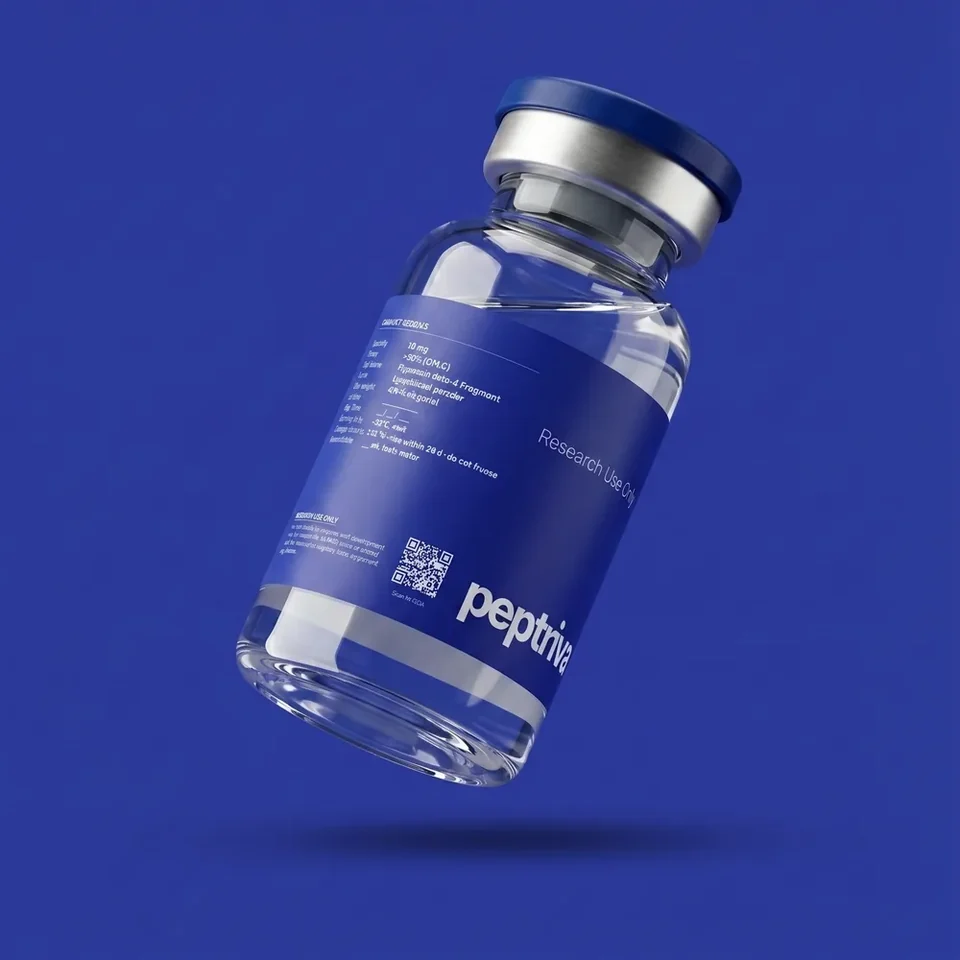
Testagen
The compound discussed here, supplied as a research compound with a certificate of analysis matched to the lot.
Does Testagen raise testosterone?
We found no published study that measured testosterone after Lys-Glu-Asp-Gly. Not in people. Not in animals.
So the answer is not “a little” or “modestly.” The answer is that the question has not been asked in print.
The name is a brand name. It was chosen, not earned by a result. Several peptides in this class carry organ-themed names that describe the tissue the developers were interested in, not an outcome anyone replicated.
A compound named for a hormone, with zero published hormone measurements, is a naming decision. Treat it as one.
What the DNA-binding mechanism really showed
The mechanism claim is the most-repeated one, and it has the clearest source. A 2011 paper in Biochemistry (Moscow) used fluorescence-labeled short peptides and watched where they went.
Penetration of short fluorescence-labeled peptides into the nucleus in HeLa cells and in vitro specific interaction of the peptides with deoxyribooligonucleotides and DNA.
Fedoreyeva et al., Biochemistry (Moscow), 2011 — the paper’s full titleHeLa is a cancer cell line in a dish. “In vitro” means the DNA binding happened in glassware. Both are legitimate findings. Neither is a benefit.
The gene-expression work follows the same pattern. The 2020 stem cell paper by Ashapkin and colleagues read gene expression in aging human cell cultures. The Epitalon and EDR papers in Molecules propose epigenetic mechanisms. All of it is upstream of an outcome.
- A molecule entering a nucleus is a location, not an effect.
- A shifted gene transcript is a signal, not a symptom anyone felt.
- Peptides of 2 to 4 residues are small enough to reach places larger peptides cannot. That cuts both ways for specificity.
There is a second problem. One research consortium produced nearly all of this literature. Independent replication outside that group is what is missing, and it is not a small gap.
The immune claim has a better-anchored peptide
If thymic and immune activity is the actual interest, there is a peptide with a far deeper file.
Thymosin alpha 1 is a 28-residue peptide. It is approved or registered in 35+ countries. A 2023 review in Expert Opinion on Therapeutic Patents mapped the thymosin patent landscape from 2018 onward and found an active, ongoing development pipeline.
Compare that to a tetrapeptide weighing about 446 Da, with no Western RCTs and two indexed papers. These are not the same evidentiary tier, and nothing about the research-vial market changes that.
What you can actually verify before buying
You cannot verify an outcome that was never measured. You can verify the vial.
- Identity and purity. Ask for a third-party HPLC and mass spec result. A mass near 446 Da is what KEDG should show. See how to read a certificate of analysis.
- Storage. Lyophilized powder and reconstituted solution have different requirements. Storage temperature covers it.
- Legal status. These are research compounds with no FDA approval. Are peptides legal sets out the framework.
One more point for anyone tested in sport. The World Anti-Doping Agency’s Prohibited List does not name Testagen. Its S0 category covers substances with no approval from any government health authority for human use, which is a wide net.
For how vendors are compared on documents rather than claims, see buying peptides online.
Testagen
Research-use-only material, sold by the vial with batch documentation. Check the certificate of analysis against the batch you receive.
What to know now
- Testagen is Lys-Glu-Asp-Gly, a 4-amino-acid peptide near 446 Da.
- The only paper that administered KEDG studied thymus tissue in hypophysectomized birds.
- No published study we found measured testosterone after Testagen.
- The anti-aging and brain claims come from other peptides: AEDG, EDR, and labeled short peptides in cell culture.
- Nuclear entry and DNA binding were shown in HeLa cells and in a tube, not as outcomes.
- Thymosin alpha 1 is the far better-anchored thymic peptide, registered in 35+ countries.
What we're watching
Watch for a single study that measures testosterone after Lys-Glu-Asp-Gly, in any species, published by a group outside the original research consortium. Until that exists, the benefit list stays borrowed.
Frequently asked questions
Does Testagen raise testosterone?
We found no published study measuring testosterone after Lys-Glu-Asp-Gly, in humans or animals. The name suggests the effect. The literature does not test it.
Are there human trials of Testagen?
No. Western randomized trials of this peptide number zero, and PubMed holds only about two papers on it. There is no FDA approval.
Is Testagen the same thing as Epitalon?
No. Testagen is KEDG and Epitalon is AEDG. One residue differs. Results from Epitalon studies do not carry over to Testagen.
What did the bird study actually measure?
Pateyk and colleagues, writing in 2013, examined thymus morphology in young and old birds whose pituitary glands had been removed. Both KEDG and AEDG were given. The endpoint was tissue structure, not a hormone or a behavior.
Why do sellers list so many benefits then?
Because the cytogen class shares a story. Papers on AEDG, EDR and short peptides in cell culture get summarized as if they apply to every peptide in the group. They were run on different molecules.
Is there a better-studied option for immune research?
Thymosin alpha 1 has a much larger evidence base. It is a 28-residue peptide, registered in 35+ countries, with an active patent landscape documented through 2023.
References
- Pateyk, A. V., Baranchugova, L. M., Rusaeva, N. S., Obydenko, V. I., & Kuznik, B. I. (2013). Effect of peptides Lys-Glu-Asp-Gly and Ala-Glu-Asp-Gly on the morphology of the thymus in hypophysectomized young and old birds. Bulletin of Experimental Biology and Medicine, 154(5), 681–685. https://doi.org/10.1007/s10517-013-2029-0
- Fedoreyeva, L. I., Kireev, I. I., Khavinson, V. Kh., & Vanyushin, B. F. (2011). Penetration of short fluorescence-labeled peptides into the nucleus in HeLa cells and in vitro specific interaction of the peptides with deoxyribooligonucleotides and DNA. Biochemistry (Moscow), 76(11), 1210–1219. https://doi.org/10.1134/S0006297911110022
- Ashapkin, V., Khavinson, V., Shilovsky, G., Linkova, N., & Vanyushin, B. (2020). Gene expression in human mesenchymal stem cell aging cultures: Modulation by short peptides. Molecular Biology Reports, 47(6), 4323–4329. https://doi.org/10.1007/s11033-020-05506-3
- Khavinson, V., Diomede, F., Mironova, E., et al. (2020). AEDG peptide (epitalon) stimulates gene expression and protein synthesis during neurogenesis: Possible epigenetic mechanism. Molecules, 25(3), 609. https://doi.org/10.3390/molecules25030609
- Khavinson, V., Linkova, N., Kozhevnikova, E., & Trofimova, S. (2020). EDR Peptide: Possible mechanism of gene expression and protein synthesis regulation involved in the pathogenesis of Alzheimer’s disease. Molecules, 26(1), 159. https://doi.org/10.3390/molecules26010159
- Quagliata, M., Papini, A. M., & Rovero, P. (2023). Therapeutic applications of thymosin peptides: A patent landscape 2018-present. Expert Opinion on Therapeutic Patents, 34(1–2), 30–43. https://doi.org/10.1080/13543776.2023.2298833
- World Anti-Doping Agency. The Prohibited List 2026. https://www.wada-ama.org/en/prohibited-list