
Cartalax is a three-amino-acid peptide called AED (Ala-Glu-Asp) sold for joint and cartilage research. It comes from one Russian lab. It isn't FDA-approved. The PubMed evidence is a handful of preclinical papers, all from the same research network. Here's what the data actually shows.
The short answer. Cartalax is a synthetic tripeptide Ala-Glu-Asp (AED), about 333 Da.
- Source: Khavinson group at the Saint Petersburg Institute of Bioregulation and Gerontology. Same consortium as Epitalon, Pinealon, Vesugen, Testagen.
- Published evidence: about 4 PubMed papers since 2015. All Khavinson-affiliated. All preclinical.
- Mechanism: proposed gene regulation via histone or DNA binding. Modulation of IGF1, FOXO1, TERT, TNKS2, and NFκB in stem cells at nanomolar concentrations.
Cartalax is the AED tripeptide. It is a “short peptide bioregulator” from the Khavinson group in Saint Petersburg. It is the joint-focused cousin of Epitalon and Pinealon. The evidence is thin. PubMed holds about 4 papers since 2015. All are preclinical. All come from one group. Zero Western RCTs exist. The work is real but narrow. No clinical role is proven.
What Cartalax actually is
Cartalax is the vendor name for a synthetic tripeptide. The three amino acids are Ala-Glu-Asp, abbreviated AED, and the molecular weight sits at about 333 Da.
It is sold under the "short peptide bioregulator" framework. Vladimir Khavinson leads that program. His base is the Saint Petersburg Institute of Bioregulation and Gerontology. Araj and colleagues described it in 2025.
That program dates to the 1970s. AED is the catalog's cartilage and connective-tissue entry. It is marketed on the same theoretical framework as Epitalon and Pinealon. Epitalon targets the pineal gland. Pinealon targets the brain.
One question is unresolved. Does AED actually reach cartilage tissue at useful concentrations? Nobody has published an answer. We would treat that as the thing to watch.
The Ashapkin 2020 paper: what the evidence actually shows
The most-cited Cartalax-relevant paper came in 2020. It is from Ashapkin, Khavinson and colleagues. It looked at gene-expression changes in aging human stem-cell cultures. Those cultures saw short peptides at nanomolar concentrations.
Short peptides at nanomolar concentrations modulate gene-expression profiles in aging mesenchymal stem cell cultures, with peptide-specific patterns observed across IGF1, FOXO1, TERT, TNKS2, and NFκB.
— Ashapkin et al., 2020, Mol Biol Rep (paraphrased)
Here's the headline. AED nudged 5 genes in cell culture: IGF1, FOXO1, TERT, TNKS2 and NFκB.
That's the entire published case for Cartalax having any biological effect, and it's one in-vitro paper. The joint-health marketing you'll read is an extrapolation from cell-culture data, not a cartilage-tissue outcome study.
The single-source-dominance problem
The evidence-quality issue that runs through the Epitalon literature applies more sharply here. Almost every paper on AED tripeptide comes from the Khavinson network.
The proposed mechanism is direct binding to histones or DNA. That parallels what the same group proposes for Epitalon and Pinealon, per Khavinson and colleagues in 2020.
For Epitalon, Brunel University London has at least replicated specific telomerase findings. For Cartalax, we found no equivalent independent Western confirmation as of mid-2026. That replication gap is the central limitation of the evidence base you’re being sold on.
Where this falls short. Zero Western RCTs evaluate Cartalax for osteoarthritis, cartilage repair, or any clinical use. The published mechanism rests on one in-vitro stem-cell paper from the originating consortium. The "cartilage tissue specificity" claim isn't a measured finding. It's a marketing extrapolation from cell-culture gene chips.
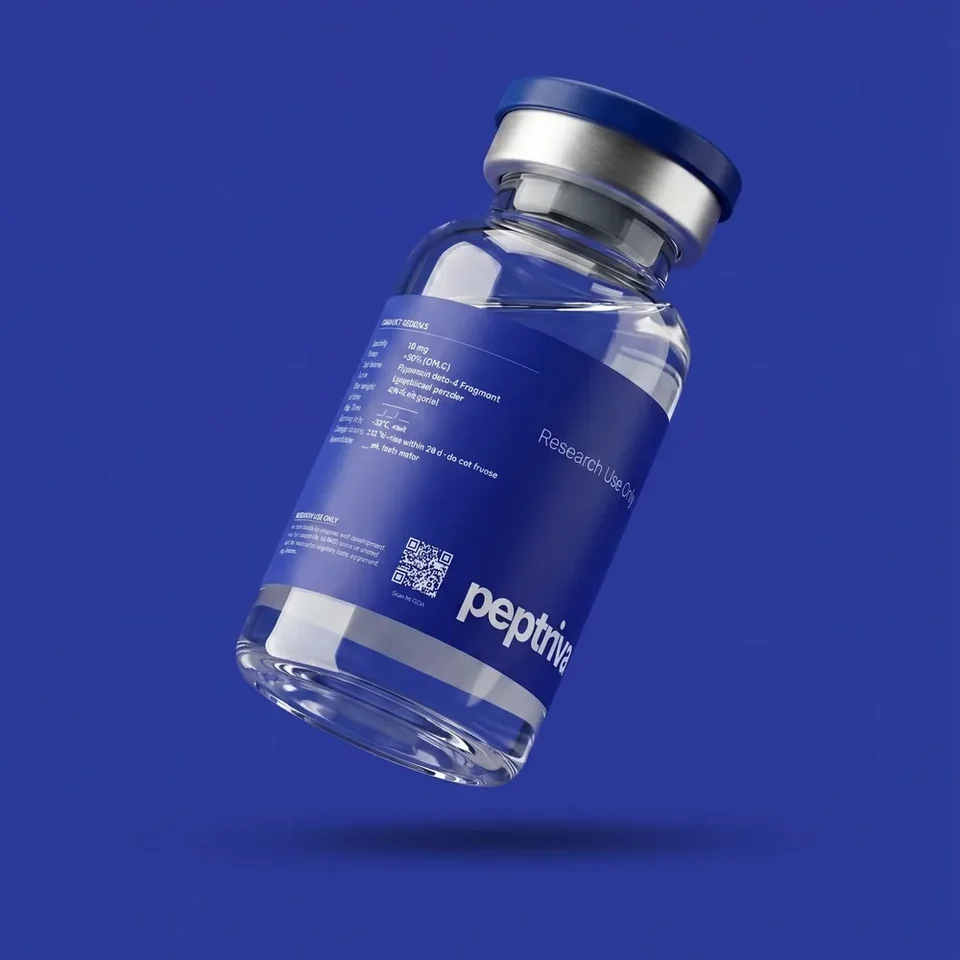
Cartalax research alternative
Cartalax is on the research-content roadmap. For cartilage and joint research, our most-evidenced alternative is the BPC-157 / TB-500 blend — dozens of published preclinical studies on tendon, ligament, and connective-tissue applications. Browse the joint-research category for the full lineup.
Cartalax vs BPC-157 / TB-500 for joints
Set Cartalax against the better-evidenced reference compounds for joint-biology research and the contrast is sharp. Here's how the three compare.
- BPC-157. Dozens of rodent studies on Achilles tendon healing, MCL repair, and connective-tissue applications. Multiple independent groups in Croatia, Korea, and the U.S. Mechanistic support from new-blood-vessel-growth pathways.
- TB-500. Published tissue-repair and vessel-growth data across multiple groups. The parent molecule (thymosin β-4) has reached human clinical trials.
- Cartalax. One Khavinson-group cell-culture paper. No rodent joint-injury study. No in-vivo cartilage outcome study. No independent mechanistic replication.
Marketing claims vs published evidence
Here's what Cartalax vendor pages typically claim, set against what the literature actually supports. You'll see the gap immediately. Reading a product page against its own documents is how we separate a supplier from a reseller.
- "Supports cartilage regeneration." Extrapolated from in-vitro stem-cell gene expression. No cartilage-tissue study.
- "Increases joint mobility." No clinical data.
- "Reduces joint inflammation." Extrapolated from NFκB modulation in stem cells.
- "Used in Russian clinical practice." Category error. Russian approval doesn't validate Western use.
Legal and regulatory status
As of May 2026, Cartalax isn't FDA- or EMA-approved for any use. In the US it's sold only as a research reference compound labeled for laboratory use.
Khavinson-school peptides have been used clinically in Russia, under a different regulatory framework. That doesn't validate use under Western standards, and vendors who cite it as though it does are making a category error.
Cartalax is not currently listed by name on the WADA Prohibited List. It is available strictly under Research Use Only labeling, with no supporting published clinical evidence for any human therapeutic indication.
Browse joint research peptides
Cartalax is on the research-content roadmap. The most-evidenced compound available today for cartilage and joint research is the BPC-157 / TB-500 family — dozens of independent preclinical studies on tendon, ligament, and connective-tissue biology. Lab-verified identity and purity with each lot, COA on request.
Frequently asked questions
What is Cartalax?
Cartalax is a synthetic tripeptide with the sequence Ala-Glu-Asp, developed by the Khavinson group in Saint Petersburg. It belongs to the same "short peptide bioregulator" family as Epitalon and Pinealon. It's marketed for cartilage and joint research, and no Western regulator has approved it.
What has Cartalax been studied for?
Preclinical research has investigated AED tripeptide in the context of cartilage biology, connective-tissue gene expression, and aging-related cellular processes. The biological rationale stems from a single 2020 Khavinson cell-culture study. No published RCTs have evaluated Cartalax for osteoarthritis or any clinical joint indication.
Is Cartalax FDA-approved?
No. Cartalax isn’t approved by the FDA, the EMA or any other Western regulator. In the US you can buy it only as a research reference compound, labeled for laboratory use.
How does Cartalax work?
The proposed mechanism is direct gene regulation through histone or DNA binding. It's the same theoretical framework Khavinson uses for Epitalon and Pinealon. As of mid-2026, no independent Western lab has replicated the AED-specific mechanism in print.
Cartalax vs BPC-157 for joints: which has more evidence?
BPC-157 has dozens of rodent studies across multiple independent groups. Cartalax has one in-vitro paper. For joint biology, BPC-157 and the BPC-157 / TB-500 blend are the more-evidenced reference compounds.
Is the Russian Cartalax research credible?
The Khavinson group's work is methodically reported and isn't fraudulent. The issue is single-source dominance. Marketing claims significantly outpace independent Western replication. Russian-language clinical reports exist but aren't PubMed-indexed. For broader context, see our overview of Russian-school peptides.
What is the regulatory status of Cartalax for joint indications?
Cartalax is sold only as a research reference compound, under Research Use Only labeling. No clinical trial data supports any human therapeutic indication.
For scale, osteoarthritis affects over 595 million people globally, per the GBD 2021 Osteoarthritis Collaborators. The treatments studied in that setting are exercise, weight management, NSAIDs and intra-articular injections. Cartalax has never been evaluated alongside any of them.
What to know now
- Identity: synthetic tripeptide Ala-Glu-Asp (AED), about 333 Da.
- Source: Khavinson group at the Saint Petersburg Institute of Bioregulation and Gerontology. Same consortium as Epitalon, Pinealon, Vesugen, Testagen.
- Published evidence: about 4 PubMed papers since 2015. All Khavinson-affiliated. All preclinical.
- Mechanism: proposed gene regulation via histone or DNA binding. Modulation of IGF1, FOXO1, TERT, TNKS2, and NFκB in stem cells at nanomolar concentrations.
- Clinical evidence: zero Western RCTs for any use.
- Regulatory: not FDA- or EMA-approved. Sold in the U.S. as research reference compound only.
- More-evidenced joint alternative: BPC-157 and the BPC-157 / TB-500 blend.
What we're watching
Two things to track for Cartalax over the next 24–36 months. First, whether any independent Western group publishes a non-Khavinson study of AED. We'd especially want chondrocyte or cartilage-explant work, where the joint-tissue claim can be tested directly.
Second, whether the Brunel-style independent reassessment that produced replication for Epitalon extends to AED.
The single most informative experiment would be a rodent osteoarthritis or tendon-injury study from a non-Khavinson lab. Its absence is the biggest gap in the evidence base as it stands.
What people actually report
These are self-reports, not evidence. No control group, no blinding, and no independent check that the vial held what the label claimed. They are collected here because people asking about Cartalax deserve an answer rather than a refusal, and because what the community believes is itself worth knowing. Quotes are excerpts; each links to the original post.
Uncontrolled, unverified self-report. Users take Cartalax for knee, hip and back pain, almost always stacked with BPC-157, TB-500, KPV, GHK-Cu or HGH, so nothing reported can be attributed to it alone. Most describe subcutaneous injection, though the earliest account here used oral capsules and swore off them. Reported amounts run from 500 mcg to 10 mg a day. Where relief is reported it is described as slow and partial, arriving in the second or third week. Dissent is common. Several ran it for months and reported nothing, and one poster ran a full kit alongside six other compounds, reported no improvement, and went on to a hip replacement.
Where the community and the published record disagree. The self-reports here describe injecting 500 mcg to 10 mg a day. The cartilage study the compound rests on is Myakisheva, Linkova, Polyakova and Ryzhak, Vrach 2023, 34(10):46-49, doi 10.29296/25877305-2023-10-08. It is rat chondrocytes in a dish, grown out of the intervertebral discs of 3-month-old and 20-month-old rats, so it is not a joint and not a person. It tested the AED tripeptide at 20, 200 and 2000 ng/mL. It reported 200 ng/mL as the minimum effective concentration, and it found that 200 and 2000 ng/mL produced the same stimulating effect. That matters, because the community's one troubleshooting move when 2 mg does nothing is to go to 5 mg and then 10 mg. The source experiment gives that no support: ten times more peptide did not do more in the dish, it did the same. A concentration in a culture well also cannot be converted into a daily injected amount, so none of the reported protocols trace back to this study at all.
“Still never touching those oral capsules again.”
“I took 2mg a day for 3 months and didn't notice any difference at all.”
“Joint pain seems to be down considerably but I can’t say for sure if it’s placebo or legit”
“I tried 2mg of cartalax for months and it absolutely nothing.”
Has anybody heard of Cartalax or the "Deadpool Blend" (Cartalax, bpc-157, and tb-500)?
“I’m not certain that my last batch wasn’t just glucose powder.”
“kinda goated niche pep (I think) really does work well though IMO”
Posts are quoted under fair use and linked to their authors. Nothing on this page is hosted here, and no claim above has been verified beyond confirming that the person wrote it.
References
- Ashapkin, V., Khavinson, V., Shilovsky, G., Linkova, N., & Vanyushin, B. (2020). Gene expression in human mesenchymal stem cell aging cultures: Modulation by short peptides. Molecular Biology Reports, 47(6), 4323–4329. https://doi.org/10.1007/s11033-020-05506-3
- Araj, S. K., Brzezik, J., Mądra-Gackowska, K., & Szeleszczuk, Ł. (2025). Overview of epitalon — Highly bioactive pineal tetrapeptide with promising properties. International Journal of Molecular Sciences, 26(6), 2691. https://doi.org/10.3390/ijms26062691
- Khavinson, V., Diomede, F., Mironova, E., et al. (2020). AEDG peptide (epitalon) stimulates gene expression and protein synthesis during neurogenesis: Possible epigenetic mechanism. Molecules, 25(3), 609. https://doi.org/10.3390/molecules25030609
- GBD 2021 Osteoarthritis Collaborators. (2023). Global, regional, and national burden of osteoarthritis, 1990–2020 and projections to 2050: A systematic analysis for the Global Burden of Disease Study 2021. The Lancet Rheumatology, 5(9), e508–e522. https://doi.org/10.1016/S2665-9913(23)00163-7
- PubMed search: “AED tripeptide” OR “Cartalax” OR “Ala-Glu-Asp peptide”, 2015–2026. pubmed.ncbi.nlm.nih.gov