
The BPC-157 + TB-500 blend is among the most co-investigated tissue-repair combinations in the research-peptide literature. It is also the combination with the thinnest dedicated human evidence. This article covers why researchers combine them, what the 7/3 mg ratio actually represents, and the fact that zero published clinical trials have studied the pair together.
The short answer. BPC-157 drives blood-vessel growth (VEGFR2 / Akt-eNOS). Tβ4 binds G-actin and produces Ac-SDKP for vessel-wall repair. The pathways are biologically complementary.
- Ratio: Standard 7 mg BPC-157 / 3 mg TB-500 per 10 mg vial. Format-driven, not trial-derived.
- Preclinical combination data: sparse to nonexistent. Synergy is a hypothesis, not a finding.
- Human combination data: 4 patients in the 2021 Lee & Padgett 17-patient knee case series. No isolated efficacy data for the combination. Zero published RCTs.
The two peptides act through different pathways. BPC-157 promotes angiogenesis. That is the growth of new blood vessels. TB-500 is a fragment of thymosin beta-4. Thymosin beta-4 is a cell-repair protein. Studies look at how it moves cells into injured tissue. The common 7/3 mg vial ratio is a packaging convenience. It is not a trial-validated dose. Only 4 people have received the blend in a published study. That was the 2021 Lee and Padgett knee case series.
This guide is for researchers weighing the blend against two separate vials. It is also for those weighing the mechanistic case for co-administration. We treat the blend strictly. The two molecules are different enough that "synergistic" is a hypothesis. It is not a finding.
The preclinical work on each peptide alone doesn't carry over to support the combination. That's a critical distinction we'll return to.
Why do researchers combine BPC-157 and TB-500?
The pairing is better known by its nickname than by either compound’s name. The Wolverine stack, explained covers where that name came from and what the combination evidence amounts to.
The case for combining them is mechanistic. BPC-157 and TB-500 hit different molecular pathways. Stacking them is meant to engage both at once. The evidence supports the mechanistic distinction. It does not yet support the synergy claim. Nobody has shown that combining them helps clinically.
BPC-157 is a 15-amino-acid fragment of a stomach protein. The 2025 McGuire and colleagues review ran in Current Reviews in Musculoskeletal Medicine. Per that review, it activates VEGFR2, a receptor that triggers blood-vessel growth. It also produces nitric oxide through the Akt-eNOS pathway. The story is angiogenesis-led. New blood vessels reach poorly-supplied tissue. Fibroblasts follow and lay down new matrix. Those are the cells that build connective tissue.
TB-500 is the active fragment of Tβ4. Tβ4 is a 43-amino-acid protein found in most cell types. Ying and colleagues published a 2023 review. It describes Tβ4's main job as grabbing G-actin one molecule at a time. G-actin is the building block of the cell skeleton. That grip regulates how cells move, develop and specialize. A 2025 European Heart Journal study by Zhang found more. Tβ4 also breaks off a 4-amino-acid fragment called Ac-SDKP. That fragment helps blood-vessel walls heal after injury.
The intuition behind the blend is simple. BPC-157 builds new vessels. TB-500 helps the right cells move into them. That story is biologically coherent. It is also untested in any controlled clinical trial.
TB-4 and its derivative TB-500 promoted angiogenesis and tissue repair in preclinical models, but human orthopaedic data are lacking, and both remain banned substances in sports.
— Mayfield et al., American Journal of Sports Medicine, 2026
Where does the 7/3 mg ratio come from?
The 7 mg BPC-157 + 3 mg TB-500 split (10 mg total per vial) is a convenience-blend format. It mirrors preparation volumes researchers working with both peptides separately would typically use. The blend consolidates those into one reconstitution step, and so into one draw and one syringe calculation.
No published clinical trial validated this ratio. None exists for the combination at all. The choice reflects a larger BPC-157 proportion paired with a smaller TB-500 proportion. It is broadly consistent with what the 2021 Lee & Padgett practitioners reported for their combination subgroup.
The 7/3 ratio should not be interpreted as evidence-derived. It is a product format, not a trial-validated protocol. Research designs that require independent titration of each peptide — different intervals or different ratios for different tissue targets — would require two separate vials. The blend locks in a single fixed ratio for the entire preparation.
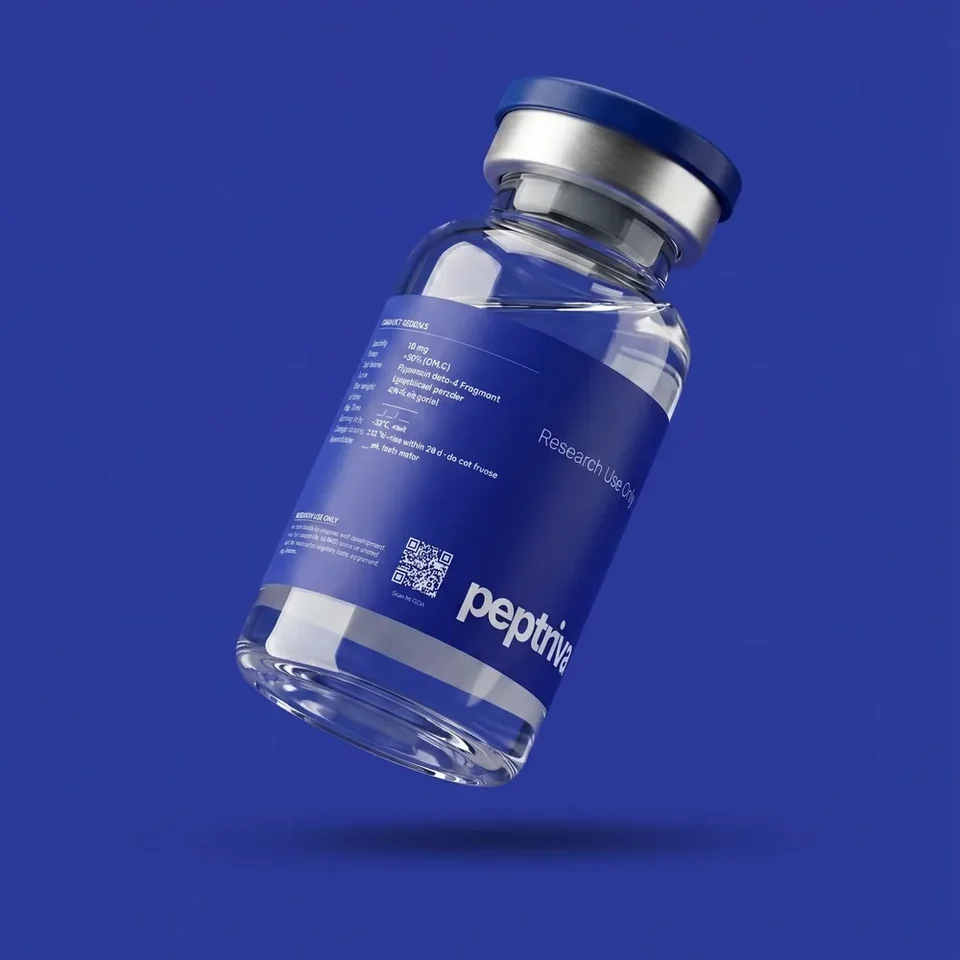
BPC-157 / TB-500 Blend
The same two compounds cited across the 6 preclinical reviews in this article, pre-blended at the convenience ratio used in the cited case-series subgroup. Lab-verified identity and purity.
What does the preclinical evidence say about the combination?
Almost nothing dedicated. We checked. The preclinical literature on each peptide alone is substantial. The 2025 HSS Journal systematic review lists 35 preclinical studies for BPC-157, and Tβ4 has comparable coverage across heart, eye, and kidney models. But work studying the two molecules together is sparse to nonexistent.
That gap matters. Synergy claims in pharmacology require studies that explicitly test the combination against each component alone. The gold standard is a factorial design. We're not aware of any published study that's done this for the BPC-157 + Tβ4 combination in any tissue model. Mechanistic plausibility doesn't substitute for evidence.
What is the human evidence for the combination?
Four study participants. That is the complete combination cohort. They are part of a 17-subject retrospective chart review.
The 2021 Lee & Padgett retrospective case series at a Florida private clinic tracked 17 study participants who received intra-articular BPC-157 for knee pain. Four of them received the BPC-157 + TB-500 combination. The other 13 received BPC-157 alone.
Of 16 study participants reachable by phone at 6 to 12 months, 14 reported subjective relief. The study did not break out the combination subgroup separately. It did not report isolated efficacy data for the combination. A 4-subject subgroup would not support meaningful inference even if it had.
That's the entire published human evidence base. No randomized comparison. No factorial design. No isolated combination efficacy data. Everything else in circulation is clinician testimonial or community-level reporting.
Where this falls short
Four study participants received the combination in the 2021 Lee & Padgett knee series. Zero published RCTs of the combination exist. Mechanistic complementarity is a hypothesis, not a finding. The case series did not break out the four blend subjects with separate outcome data, so no specific effect of the combination can be attributed to those four subjects.
What's the regulatory and risk picture for the blend?
The blend inherits the regulatory status of both components. That's restrictive. Both peptides sit on the WADA Prohibited List (the global anti-doping ban list). BPC-157 has been banned under category S0 (Non-Approved Substances) since January 2022. Tβ4 has been banned under S2 (Peptide Hormones, Growth Factors) for years.
The 2025 Józwiak review documents the BPC-157 listing. The 2026 Mayfield review documents both. Any athlete subject to WADA testing faces sanctions for either component.
The FDA added BPC-157 to its Category 2 (potential safety risk) list in 2023, which constrains compounding-pharmacy access. No Tβ4 or TB-500 product is FDA-approved for any indication. The blend has no approved therapeutic use in any major jurisdiction.
The risk picture also stacks. BPC-157's theoretical concern about feeding tumor blood-vessel growth and Tβ4's theoretical concern about tumor cells migrating both sit in one vial. No published data tells us whether co-administration changes either risk profile. The Mendias and Awan 2026 Sports Medicine review explicitly flags TB-500 as one of the unapproved peptides with scarce human safety data and potential for serious harm.
- Combined WADA exposure. Both components are prohibited. Use in any sport context risks sanctions on both fronts.
- Combined theoretical oncology concern. Two molecules that influence blood-vessel growth in one vial, with no human safety data on co-administration.
- Identity uncertainty for the TB-500 component. "TB-500" in a blend may be full-length Tβ4 or a shorter 7-amino-acid fragment (LKKTETQ). Require a Certificate of Analysis (CoA, a one-page lab report) confirming which form.
- No validated combination dosing protocol. The 7/3 mg ratio is a packaging choice, not a trial-derived dose.
- Authorship concentration on the BPC-157 side. Roughly 80% of BPC-157 preclinical work comes from one Zagreb research group. Independent replication is the missing piece.
BPC-157 / TB-500 Blend
7 mg BPC-157 + 3 mg TB-500 in a single lyophilized vial. Same compounds and same lots as our standalone vials; the convenience is the only difference. COA available with each lot.
When does the blend make sense versus two separate vials?
The blend is a convenience format. Research protocols employing a fixed BPC-157 to Tβ4 ratio benefit from the blend's single-reconstitution workflow and reduced compounding-error risk. That is a real, modest practical advantage.
Protocols requiring independent dosing flexibility — different intervals or different ratios for different tissue targets — are better served by two separate vials. The blend is locked to one ratio for the entire preparation.
Neither format is supported by published human trial data. The blend should not be interpreted as more effective than two separate vials, nor as safer. The blend's defensible value proposition is reduced handling burden.
Price should not decide it either, because the gap is small. The same 10 mg of each in a single 20 mg blend vial is $119.99 — about $13 less, with a batch-matched third-party certificate published against the lot. Decide on whether you need to move the ratio.
What to know now
- Mechanistic rationale: BPC-157 drives blood-vessel growth (VEGFR2 / Akt-eNOS). Tβ4 binds G-actin and produces Ac-SDKP for vessel-wall repair. The pathways are biologically complementary.
- Ratio: Standard 7 mg BPC-157 / 3 mg TB-500 per 10 mg vial. Format-driven, not trial-derived.
- Preclinical combination data: sparse to nonexistent. Synergy is a hypothesis, not a finding.
- Human combination data: 4 patients in the 2021 Lee & Padgett 17-patient knee case series. No isolated efficacy data for the combination. Zero published RCTs.
- Regulatory: BPC-157 (WADA S0, FDA Cat 2). Tβ4 (WADA S2). Neither component is FDA-approved.
- Practical: the blend reduces a reconstitution step. It doesn't add validated efficacy or safety relative to two separate vials.
What we're watching
Two things. First, whether any preclinical or clinical study formally tests the combination against each component alone. A factorial design would be the first real evidence either way. Second, whether independent labs replicate the BPC-157 preclinical signal outside the Zagreb group, since the combination's case for stacking inherits the authorship-concentration risk of its largest component.
References
- Vasireddi, N., Hahamyan, H., Salata, M. J., et al. (2025). Emerging use of BPC-157 in orthopaedic sports medicine: A systematic review. HSS Journal, 21(4). https://doi.org/10.1177/15563316251355551
- McGuire, F. P., Martinez, R., Lenz, A., Skinner, L., & Cushman, D. M. (2025). Regeneration or risk? A narrative review of BPC-157 for musculoskeletal healing. Current Reviews in Musculoskeletal Medicine, 18(12), 611–619. https://doi.org/10.1007/s12178-025-09990-7
- Ying, Y., Lin, C., Tao, N., et al. (2023). Thymosin β4 and actin: Binding modes, biological functions and clinical applications. Current Protein and Peptide Science, 24(1), 78–88. https://doi.org/10.2174/1389203724666221201093500
- Mendias, C. L., & Awan, T. M. (2026). Safety and efficacy of approved and unapproved peptide therapies for musculoskeletal injuries and athletic performance. Sports Medicine. https://doi.org/10.1007/s40279-026-02437-0
- Mayfield, C. K., Bolia, I. K., Feingold, C. L., et al. (2026). Injectable peptide therapy: A primer for orthopaedic and sports medicine physicians. American Journal of Sports Medicine, 54(1), 223–229. https://doi.org/10.1177/03635465251357593
- Józwiak, M., Bauer, M., Kamysz, W., & Kleczkowska, P. (2025). Multifunctionality and possible medical application of the BPC 157 peptide—Literature and patent review. Pharmaceuticals (Basel), 18(2), 185. https://doi.org/10.3390/ph18020185
- Zhang, Q., Li, H., Zhuang, T., et al. (2025). CCN5 suppresses injury-induced vascular restenosis via thymosin β4 and Cd9 pathway. European Heart Journal, 46(17), 1645–1658. https://doi.org/10.1093/eurheartj/ehae911
- Lee, E., & Padgett, B. (2021). Intra-articular injection of BPC 157 for multiple types of knee pain. Alternative Therapies in Health and Medicine, 27(4), 8–13. PMID 34324435