
Testagen is a 4-amino-acid peptide, Lys-Glu-Asp-Gly, usually shortened to KEDG, from the Khavinson research group in Saint Petersburg. It's marketed for thymus support and age-related thymic shrinkage. The Testagen peptide has real preclinical biology and essentially zero Western trial data. That asymmetry is the whole story.
The short answer. Testagen is the Khavinson school's thymus cytogen: tetrapeptide Lys-Glu-Asp-Gly, four residues, in the same class as Epitalon and Pinealon.
- Mechanism is preclinical: nuclear penetration and CAG-preferential DNA binding documented in HeLa cells; thymic structure recovery in chickens after pituitary removal.
- Single-source provenance. Nearly all Testagen literature comes from the Khavinson research network. No independent Western replication.
- Zero Western RCTs. No FDA approval, no EMA approval, no Phase II/III trial in any indication.
Testagen is a synthetic tetrapeptide. Its sequence is Lys-Glu-Asp-Gly, or KEDG. Its mass is near 446 Da. It sits in the cytogen class. So do Epitalon, Pinealon and Cartalax. Their sequences are AEDG, EDR and AED. The proposed mechanism is direct DNA binding. It favors CAG sites.
There are zero Western randomized trials. There is no FDA approval. PubMed holds only about 2 papers on it. Thymosin Alpha 1 is the better-anchored thymic peptide for immune research.
Quick answer
Testagen is a Khavinson-school cytogen. Its evidence profile matches Epitalon and Pinealon. That means narrow but real preclinical work. One research consortium dominates it. There are no Western randomized trials. And consumer marketing runs well ahead of the published evidence.
What Testagen actually is
Testagen is a synthetic linear tetrapeptide, Lys-Glu-Asp-Gly, abbreviated KEDG. Khavinson and colleagues designed it from amino-acid fractions of the anterior pituitary gland.
It is part of the "cytogen" family. The group has built that family since the 1970s. Each cytogen is a short peptide of 2 to 4 residues. Each is positioned to influence tissue-specific gene expression. Each one is named for its target tissue. Epitalon targets the pineal gland. Pinealon targets the brain. Cartalax targets cartilage. Testagen targets the thymus.
Epithalon, testagen, and pinealon seem to preferentially bind with CAG-containing sequences … The site-specific interactions of peptides with DNA can control epigenetically the cell genetic functions.
— Fedoreyeva, Kireev, Khavinson & Vanyushin, 2011, Biochemistry Moscow
What's actually been observed?
The Khavinson group has a working model. The peptide enters the nucleus directly. Then it binds DNA at specific sequences. A 2011 Biochemistry Moscow paper backs part of that. It documented fluorescein-labeled Testagen entering HeLa cell nuclei.
Stern-Volmer fluorescence quenching showed CAG-preferential binding to short DNA strands. That is per Fedoreyeva and colleagues in 2011. The same group claimed in 2020 that Epitalon and Pinealon work through parallel mechanisms.
The most-cited in-vivo Testagen result is a 2013 Chita State Medical Academy paper. Hypophysectomized chickens given KEDG showed recovery of thymic structure compared to untreated controls. KEDG also outperformed the Epitalon analog in the same trial, per Pateyk and colleagues in 2013.
A 2020 Khavinson study reported that the related Ala-Glu-Asp tripeptide changed expression of IGF1, FOXO1 and TERT. That was in mesenchymal stem cell aging cultures, at very low doses, per Ashapkin and colleagues. Same narrow, single-network evidence pattern.
The single-source provenance problem
The defining quality concern for Testagen is the same one that applies to Epitalon and the rest of the cytogen class. Nearly every publication originates from the Khavinson network. There is no Cochrane review. There is no Western Phase II trial.
The 2013 bird-thymus paper sits in a separate Russian institution but works within the same Khavinson-defined paradigm. The work doesn't appear fabricated. But when a peptide's entire evidence base lives inside one research network, you can't easily assess independence or reproducibility.
Where this falls short
A single-network evidence base can't be generalized to broader clinical use. Western regulators require multi-center, double-blind, statistically powered trials. Testagen has none. The cytogen class as a whole has none. We think that gap matters more than any one preclinical finding.
The closest thymic peptide that has cleared the Western evidence bar is Thymosin Alpha 1, generic name thymalfasin, sold as Zadaxin. It's a 28-residue acetylated peptide approved in 35+ countries, studied in hepatitis B and C and as a cancer immunotherapy adjunct.
The 2025 BMJ TESTS Phase III sepsis trial was negative on primary mortality. Quagliata and colleagues map the thymosin development landscape around it. We take that negative readout as a reminder that even the better-anchored thymic peptide isn't universally effective. Thymosin Alpha 1 carries the clinical signal. Testagen does not.
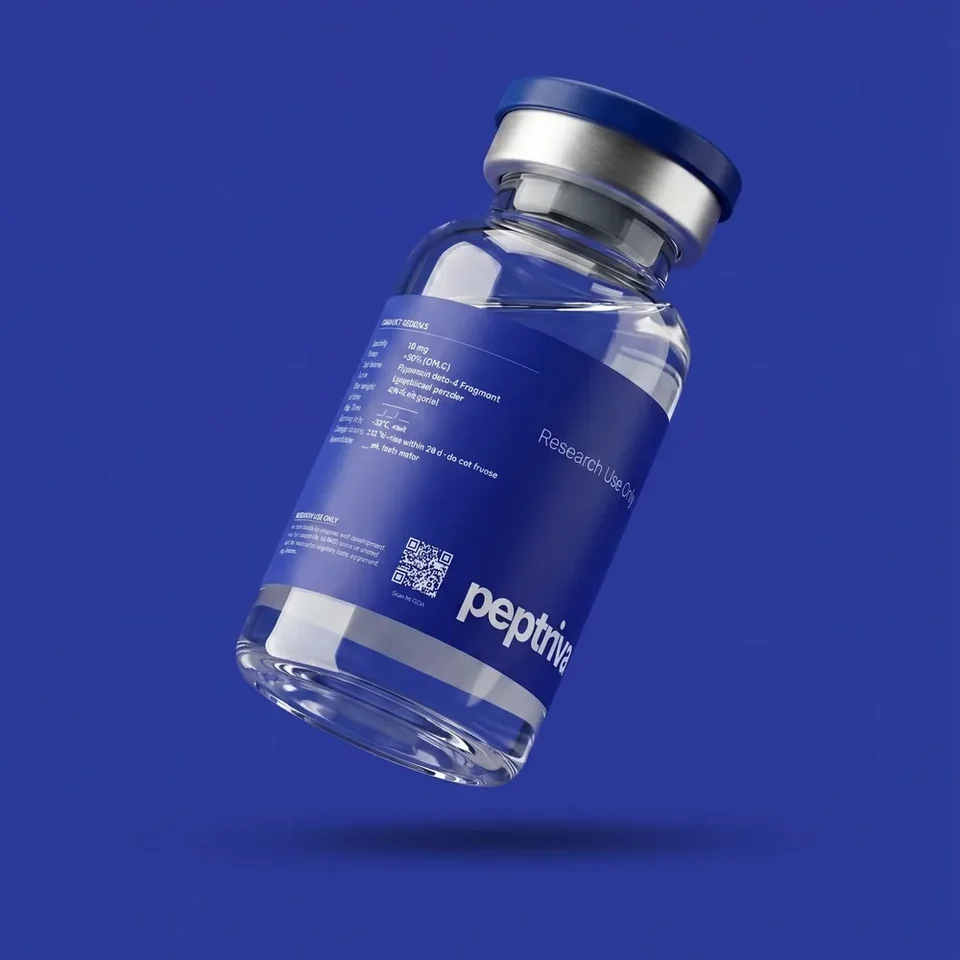
Testagen is on the research-content roadmap
Testagen is on the research-content roadmap, not the product roadmap. The cytogen evidence base sits below our internal stocking threshold. For thymus and immune research with an actual clinical signal, see the immune-support review.
Marketing claims vs. evidence
Consumer marketing frames Testagen as a tool for thymic shrinkage and broad systemic effects. What you'll find in the published literature is much narrower.
- In-vitro nuclear penetration with CAG-preferential DNA binding in HeLa cells (Fedoreyeva 2011).
- Thymic structure recovery in chickens after pituitary removal, more pronounced than the Epitalon analog (Pateyk 2013).
- Cytogen-class gene-expression effects in stem-cell aging cultures, shown for the AED tripeptide rather than Testagen specifically (Ashapkin 2020).
What the evidence does not support is any specific therapeutic claim in humans. No Western RCTs of Testagen exist for any indication. It's not FDA-approved. It's not EMA-approved. In the United States, Testagen sells only as a Research Use Only reference compound. That's the only legal status available to you.
Testagen isn't on the WADA Prohibited List by name. But the S2 category covers peptide hormones broadly enough that if you compete, you should treat unapproved short peptides as off-limits.
Browse what is stocked
Peptriva's active research catalog focuses on peptides with documented Western evidence bases or open mechanistic interest. The cytogen class is on the research-content roadmap rather than the product roadmap. Every stocked compound ships with a batch-matched third-party Certificate of Analysis.
Frequently asked questions
What is Testagen?
Testagen is a synthetic tetrapeptide, Lys-Glu-Asp-Gly or KEDG, from Khavinson's group at the Saint Petersburg Institute of Bioregulation and Gerontology. It sits in the cytogen class with Epitalon, Pinealon and Cartalax. It's marketed for thymus support and age-related thymic shrinkage.
How does Testagen work?
The proposed mechanism is direct nuclear penetration and CAG-preferential DNA binding. The 2011 HeLa-cell study and the 2013 bird thymus study are the two direct references. Both are preclinical. Both come from the Russian research network. Neither establishes mechanism in humans.
Is Testagen FDA-approved?
No. Testagen has no FDA or EMA approval, and no approved therapeutic use anywhere in the West. It sells legally in the U.S. only as a Research Use Only reference compound. No Western randomized trials exist.
Testagen vs Thymosin Alpha 1?
They aren't in the same evidence category. Thymosin Alpha 1, or thymalfasin, sold as Zadaxin, is a 28-residue peptide approved in 35+ countries. The 2025 BMJ TESTS Phase III sepsis trial was negative on primary mortality. Testagen has no Western Phase II or III data in any indication.
Is the Khavinson Testagen research credible?
Testagen's evidence is real but narrow. The two papers, Khavinson 2011 and Pateyk 2013, report consistent findings. Our concern is single-source dominance. The work isn't fabricated, but it hasn't met the multi-center trial standard that translates to Western approval.
Where can I learn more about Khavinson cytogens?
The Epitalon complete guide, Russian aging trials, and Cognitive Peptides: Russian School articles cover the broader cytogen research program.
What to know now
- Testagen is the Khavinson school's thymus cytogen: tetrapeptide Lys-Glu-Asp-Gly, four residues, in the same class as Epitalon and Pinealon.
- Mechanism is preclinical: nuclear penetration and CAG-preferential DNA binding documented in HeLa cells; thymic structure recovery in chickens after pituitary removal.
- Single-source provenance. Nearly all Testagen literature comes from the Khavinson research network. No independent Western replication.
- Zero Western RCTs. No FDA approval, no EMA approval, no Phase II/III trial in any indication.
- On the research-content roadmap. Thymosin Alpha 1 is the better-anchored thymic peptide for immune research.
What we’re watching
One development would meaningfully change the Testagen evidence picture: an independent, non-Khavinson preclinical replication. We'd want a Western lab repeating the 2011 nuclear-penetration biochemistry, or the 2013 thymic-structure work in a mouse model with current immune profiling.
Until that exists, the cytogen class stays in the same evidence tier as Cartalax and Pinealon. That tier reads: real biology, narrow data, a research roadmap rather than a product roadmap.
The Thymosin Alpha 1 story is worth tracking too. After the 2025 TESTS Phase III sepsis miss, the next Phase III readout in the thymic-peptide space resets what "clinically anchored" means for the category.
References
- Fedoreyeva, L. I., Kireev, I. I., Khavinson, V. Kh., & Vanyushin, B. F. (2011). Penetration of short fluorescence-labeled peptides into the nucleus in HeLa cells and in vitro specific interaction of the peptides with deoxyribooligonucleotides and DNA. Biochemistry (Moscow), 76(11), 1210–1219. https://doi.org/10.1134/S0006297911110022
- Pateyk, A. V., Baranchugova, L. M., Rusaeva, N. S., Obydenko, V. I., & Kuznik, B. I. (2013). Effect of peptides Lys-Glu-Asp-Gly and Ala-Glu-Asp-Gly on the morphology of the thymus in hypophysectomized young and old birds. Bulletin of Experimental Biology and Medicine, 154(5), 681–685. https://doi.org/10.1007/s10517-013-2029-0
- Khavinson, V., Diomede, F., Mironova, E., Linkova, N., Trofimova, S., Trubiani, O., Caputi, S., & Sinjari, B. (2020). AEDG peptide (Epitalon) stimulates gene expression and protein synthesis during neurogenesis: Possible epigenetic mechanism. Molecules, 25(3), 609. https://doi.org/10.3390/molecules25030609
- Khavinson, V., Linkova, N., Kozhevnikova, E., & Trofimova, S. (2020). EDR peptide: Possible mechanism of gene expression and protein synthesis regulation involved in the pathogenesis of Alzheimer’s disease. Molecules, 26(1), 159. https://doi.org/10.3390/molecules26010159
- Ashapkin, V., Khavinson, V., Shilovsky, G., Linkova, N., & Vanyushin, B. (2020). Gene expression in human mesenchymal stem cell aging cultures: Modulation by short peptides. Molecular Biology Reports, 47(6), 4323–4329. https://doi.org/10.1007/s11033-020-05506-3
- Quagliata, M., Papini, A. M., & Rovero, P. (2023). Therapeutic applications of thymosin peptides: A patent landscape 2018-present. Expert Opinion on Therapeutic Patents, 34(1–2), 30–43. https://doi.org/10.1080/13543776.2023.2298833
- World Anti-Doping Agency. (2026). The World Anti-Doping Code International Standard: Prohibited List. https://www.wada-ama.org/en/prohibited-list