
Search Testagen before and after and you get physique photos. The only published study to administer this exact peptide used hypophysectomized birds, in 2013, and its outcome was thymus morphology.
The short answer. Testagen is Lys-Glu-Asp-Gly, a 4-amino-acid peptide near 446 Da.
- The only study to give KEDG used hypophysectomized birds and measured thymus tissue, in 2013.
- No published paper we found measured testosterone after Testagen, in any species.
- Western randomized controlled trials number zero, and PubMed holds about 2 papers on it.
Testagen is a 4-amino-acid peptide. Its sequence is Lys-Glu-Asp-Gly. One published study gave it to birds. That study looked at thymus tissue, not hormones. No paper we found measured testosterone. Western randomized trials number zero.
What the one Testagen study actually measured
There is one paper that gave KEDG itself. Pateyk and colleagues published it in Bulletin of Experimental Biology and Medicine in 2013. The subjects were birds. The birds had their pituitary glands removed, which is what hypophysectomized means.
The outcome was the shape and cell makeup of the thymus. Young birds and old birds were compared. The paper also tested AEDG, the sequence sold as Epitalon.
Effect of peptides Lys-Glu-Asp-Gly and Ala-Glu-Asp-Gly on the morphology of the thymus in hypophysectomized young and old birds.
Title of the only published study to administer KEDG. Pateyk et al., Bulletin of Experimental Biology and Medicine, 2013Read that title again, because it is the whole human-facing evidence base in one line. No people. No hormone panel. No body composition. No before-and-after photograph of anything.
- Species: birds, not humans.
- Model: pituitary surgically removed, which is not a state any buyer is in.
- Measure: tissue morphology under a microscope.
- Not measured: testosterone, strength, muscle mass, libido, body fat.
PubMed holds roughly 2 papers on this peptide at all. The Testagen complete guide walks through what each one covers.
Does Testagen raise testosterone?
No published study we found measured testosterone after giving Testagen. Not in humans. Not in rodents. Not in the birds.
The belief comes from the name. The cytogen family is named after tissues, and sellers lean on the first syllable. The sequence itself is Lys-Glu-Asp-Gly, four residues and about 446 Da. Nothing in that structure is a steroid, a steroid precursor, or a gonadotropin.
A before-and-after photo implies a measurement nobody took. If testosterone had moved in a study, there would be a number. There is no number, because there is no study.
We cover the claim in more detail on the Testagen benefits page.
So what is in the photos?
Whatever the person did for the months between the two frames. Training, diet, sleep, lighting, posture, camera angle, water, tan. None of that is controlled in a photo set, and none of it is separated out.
Two more things usually sit behind the image. First, almost nobody runs a single obscure tetrapeptide alone. Stacks are the norm, so the photo cannot be assigned to one vial. Second, the photo is often posted by someone selling the vial.
There is no placebo arm in a photograph. There is no baseline lab value either. That is the gap between a picture and a result, and in this compound's case the gap is the entire record.
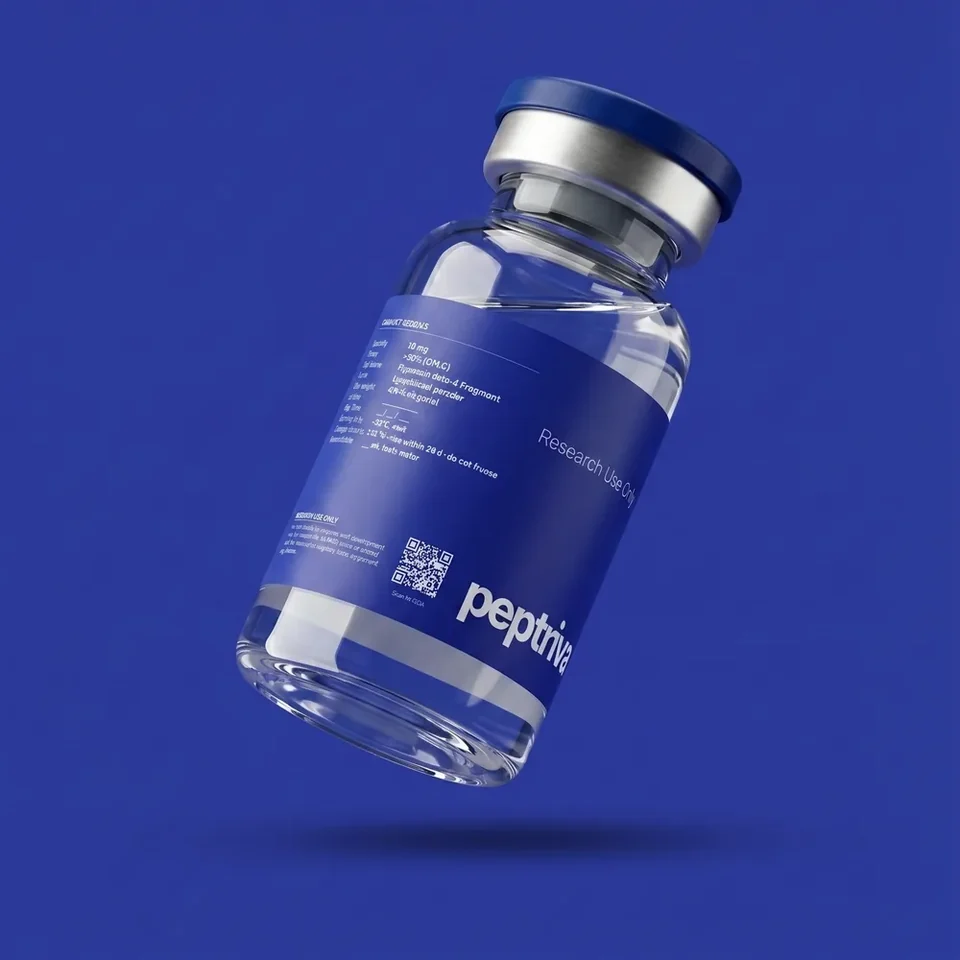
Testagen
The compound discussed here, supplied as a research compound with a certificate of analysis matched to the lot.
What the cytogen class evidence does support
The class has real laboratory work behind it, and it is worth being accurate about what that work shows. It is molecular, it is mostly in cells, and most of it uses other sequences.
Fedoreyeva and colleagues reported in 2011 that short labeled peptides entered the nucleus of HeLa cells and bound DNA in vitro. That is the mechanistic root of the whole direct-DNA-binding story.
Gene expression in human mesenchymal stem cell aging cultures: Modulation by short peptides.
Ashapkin, Khavinson, Shilovsky, Linkova & Vanyushin, Molecular Biology Reports, 2020That is a cell culture study of gene expression. It is not an outcome in a person. The same applies to the AEDG neurogenesis work published in Molecules in 2020 and the EDR Alzheimer's mechanism paper that followed it.
| Peptide | Sequence | Strongest published record |
|---|---|---|
| Testagen | KEDG | One 2013 bird thymus study |
| Epitalon | AEDG | Cell and gene expression work; same bird study |
| Pinealon | EDR | Proposed gene expression mechanism papers |
| Cartalax | AED | Class mechanism work only |
| Thymosin Alpha 1 | 28-residue peptide | Approved or registered in 35+ countries |
The contrast in the last row matters. Thymosin Alpha 1 is a 28-residue peptide with a patent and regulatory footprint across 35+ countries, reviewed by Quagliata and colleagues in 2023. Testagen has no Western RCTs.
One more thing about the class literature: a single research consortium produced most of it. Independent replication outside that group is thin.
What a real Testagen before and after would need
Nothing here is a plan. It is a list of what the published record is missing, so a reader can see how far the photos sit from evidence.
- A control arm. Without one, time and training get credited to the vial.
- Blinding. People who know what they took report feeling better.
- A defined endpoint. Serum testosterone is a standard lab measure. No study has reported it for this peptide.
- Identity of the material. A photo proves nothing about what was in the vial.
That last point is checkable before anything else. A third-party certificate with mass and purity is the only link between a label and a molecule. See how to read a certificate of analysis and peptide storage temperature.
Is Testagen banned in sport?
We did not find Testagen named on the World Anti-Doping Agency Prohibited List. That is not the same as clearance.
WADA's list carries a category for non-approved substances: anything with no current regulatory approval for human therapeutic use. A synthetic tetrapeptide with zero approvals sits inside that description by default. Tested athletes should read the current list themselves rather than a vendor page.
Research-use labeling is not a legal status and not a safety finding. It is a sales category.
For the regulatory picture, see are peptides legal and how to compare suppliers on documents.
Testagen
Research-use-only material, sold by the vial with batch documentation. Check the certificate of analysis against the batch you receive.
What to know now
- Testagen is Lys-Glu-Asp-Gly, a 4-amino-acid peptide near 446 Da.
- The only study to give KEDG used hypophysectomized birds and measured thymus tissue, in 2013.
- No published paper we found measured testosterone after Testagen, in any species.
- Western randomized controlled trials number zero, and PubMed holds about 2 papers on it.
- The class mechanism work is cell culture and DNA binding, mostly using other sequences.
- Thymosin Alpha 1, a 28-residue peptide registered in 35+ countries, is the better-anchored thymic comparison.
What we're watching
Watch for the word "clinical" on Testagen listings. The 2013 bird study is the only paper that gave this exact peptide, and what it counted was thymus tissue.
Frequently asked questions
Does Testagen increase testosterone?
No published study we found measured testosterone after giving Testagen. The name suggests it. The evidence does not address it. The one paper that administered KEDG looked at thymus morphology in birds.
How long does Testagen take to show results?
There is no published answer. No human trial has reported a timeline, an endpoint, or a measured change for this peptide. Any figure you see for "time to results" is not coming from the literature.
Are there human studies of Testagen?
We found none. Western randomized controlled trials number zero. The published record is roughly 2 papers, and the one that used KEDG itself used hypophysectomized birds in 2013.
Is Testagen the same as Epitalon?
No, but they are close relatives. Testagen is KEDG and Epitalon is AEDG. Both sit in the cytogen class, and both appeared in the same 2013 bird thymus study.
Why do before-and-after photos exist if nothing was measured?
Photos are not measurements. They capture months of training, diet, lighting and posture, usually alongside other compounds, and they are often posted by someone selling the vial.
References
- Pateyk, A. V., Baranchugova, L. M., Rusaeva, N. S., Obydenko, V. I., & Kuznik, B. I. (2013). Effect of peptides Lys-Glu-Asp-Gly and Ala-Glu-Asp-Gly on the morphology of the thymus in hypophysectomized young and old birds. Bulletin of Experimental Biology and Medicine, 154(5), 681–685. https://doi.org/10.1007/s10517-013-2029-0
- Fedoreyeva, L. I., Kireev, I. I., Khavinson, V. Kh., & Vanyushin, B. F. (2011). Penetration of short fluorescence-labeled peptides into the nucleus in HeLa cells and in vitro specific interaction of the peptides with deoxyribooligonucleotides and DNA. Biochemistry (Moscow), 76(11), 1210–1219. https://doi.org/10.1134/S0006297911110022
- Ashapkin, V., Khavinson, V., Shilovsky, G., Linkova, N., & Vanyushin, B. (2020). Gene expression in human mesenchymal stem cell aging cultures: Modulation by short peptides. Molecular Biology Reports, 47(6), 4323–4329. https://doi.org/10.1007/s11033-020-05506-3
- Khavinson, V., Diomede, F., Mironova, E., et al. (2020). AEDG peptide (epitalon) stimulates gene expression and protein synthesis during neurogenesis: Possible epigenetic mechanism. Molecules, 25(3), 609. https://doi.org/10.3390/molecules25030609
- Khavinson, V., Linkova, N., Kozhevnikova, E., & Trofimova, S. (2020). EDR Peptide: Possible mechanism of gene expression and protein synthesis regulation involved in the pathogenesis of Alzheimer’s disease. Molecules, 26(1), 159. https://doi.org/10.3390/molecules26010159
- Quagliata, M., Papini, A. M., & Rovero, P. (2023). Therapeutic applications of thymosin peptides: A patent landscape 2018-present. Expert Opinion on Therapeutic Patents, 34(1–2), 30–43. https://doi.org/10.1080/13543776.2023.2298833
- World Anti-Doping Agency. The Prohibited List 2026. https://www.wada-ama.org/en/prohibited-list