
Search Vilon before and after and you get photographs and testimonials. The published record contains neither. It contains mouse lifespan, rat bladder tumors, and gene expression in mouse heart tissue. There are 0 Western RCTs of Vilon, for any use.
The short answer. No human before-and-after study of Vilon exists; there are 0 Western RCTs, for any use.
- The measured endpoints were mouse lifespan, rat tumors, rat gut enzymes, mouse heart gene chips and cultured thymus cells.
- The 2000 lifespan paper reported extended median lifespan in mice given intramuscular Vilon, with no independent replication.
- Nearly all 20+ preclinical papers come from one group in St. Petersburg, which means consistency without outside verification.
What a Vilon before and after actually measured
Every result attached to Vilon came from an endpoint you cannot see in a mirror. That is the first thing to understand about this query.
The lab measured lifespan in mice, tumors in rats, enzyme activity in rat gut, markers in cultured thymus cells, and gene expression on a microarray. None of those produce a photograph. All of them produce a table.
| Study | Subject | What was measured |
|---|---|---|
| Khavinson et al., 2000 | Mice | Biological age and lifespan; median lifespan extended on intramuscular Vilon |
| Pliss et al., 2001 | Rats | Induced bladder tumor development; reduced |
| Khavinson et al., 2001 | Rats of various ages | Activity of digestive enzymes |
| Anisimov et al., 2002 | Mouse heart tissue | Gene expression by DNA microarray |
| Sevostianova et al., 2013 | Cultured human and animal thymus cells | Immune markers in a dish |
That is the whole visible-results problem in one table. A rodent lifespan curve and a photo of a person are not the same kind of claim. The Vilon benefits page goes claim by claim through what each of these supports.
Has Vilon ever been tested in people?
Not in a trial you can open. A PubMed search returns 0 Western randomized controlled trials of Vilon, for any indication. There are 0 Phase III trials of Vilon, all-time.
The closest thing to human material is the 2013 thymus work. Human cells were used. A human was not. The phrase in the title does the work:
Immunomodulating effects of Vilon and its analog in the culture of human and animal thymus cells.
Sevostianova et al., Bulletin of Experimental Biology and Medicine, 2013 (paper title)In the culture of is the key clause. Cells in a dish have no immune system, no liver, no circulation and no age. A marker that moves in a culture well has cleared the lowest bar in biology, not the highest.
So when a page shows you a Vilon before and after, it is showing you something that has never been measured in a controlled human study. The photograph is not weak evidence of the claim. It is unrelated to it.
The mouse lifespan study, and what it did and did not show
The paper people are usually reaching for is Khavinson and colleagues, Bulletin of Experimental Biology and Medicine, 2000. The title is also the claim:
Effect of vilon on biological age and lifespan in mice.
Khavinson, Anisimov, Zavarzina et al., Bulletin of Experimental Biology and Medicine, 2000 (paper title)The reported finding was an extension of median lifespan in mice given Vilon by intramuscular injection. That is what the study administered. It is not a schedule for anything, and it was never repeated in a second species by a second group.
- Mice are not a small human. Rodent lifespan results have a long history of not transferring.
- Median is not maximum. A shift in median lifespan can come from fewer early deaths, not slower aging.
- No independent replication. We found no Western lab that ran the same experiment and published it.
- Different route. The study injected intramuscularly. That is not how the research market generally sells it.
The oncology result from 2001 sits in the same place. Pliss and colleagues reported reduced development of chemically induced bladder tumors in rats. Interesting, specific, and in rats.
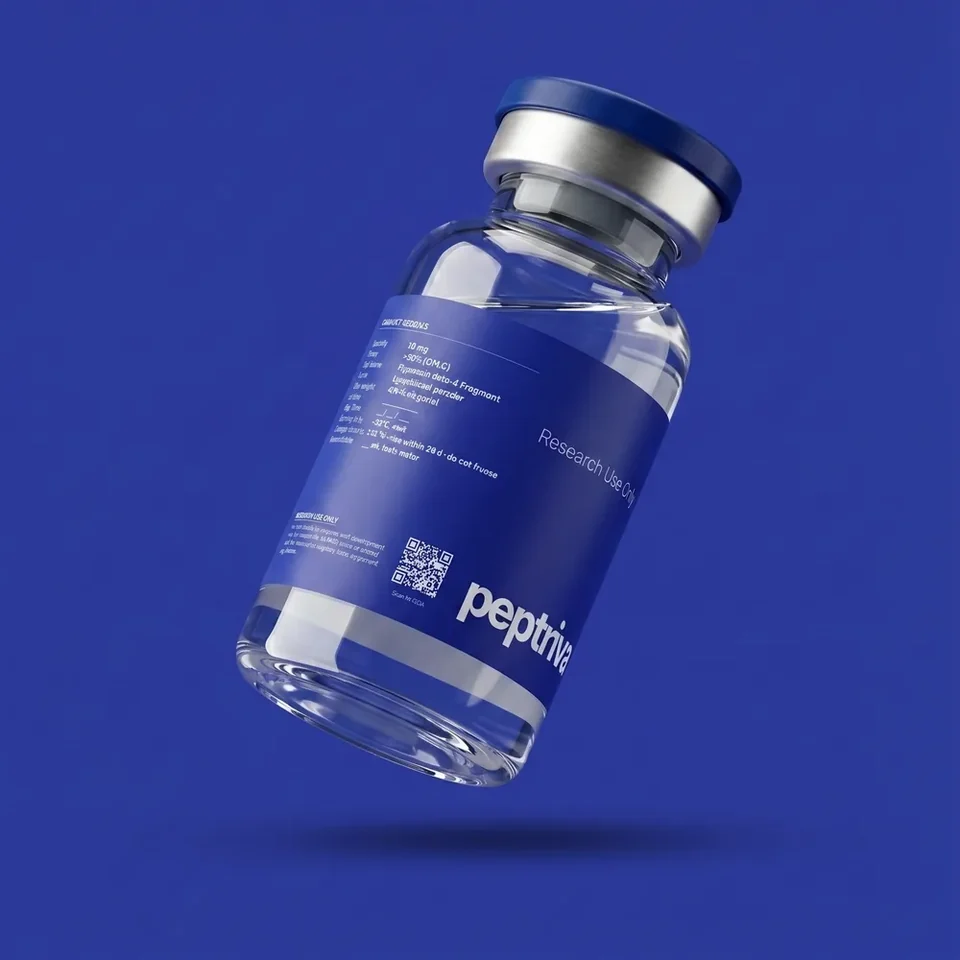
Vilon
The compound discussed here, supplied as a research compound with a certificate of analysis matched to the lot.
Why one lab is the entire evidence base
Vladimir Khavinson's group in St. Petersburg has published 20+ preclinical papers on Vilon and related short peptides. The 2015 Royal Society of Chemistry chapter by Khavinson and Popovich states the program's thesis directly in its title: short peptides regulate gene expression, protein synthesis and enhance life span.
The group's wider output runs the same way. The 2002 microarray study reported that multiple inflammation and stress-response gene clusters shifted in mouse heart. The 2020 Molecules paper on the EDR tripeptide proposes gene-expression mechanisms in Alzheimer's disease. The mechanism story is detailed and internally consistent.
Internal consistency is not replication. A body of work where the same group designs, runs, measures and interprets every experiment has one failure mode, and no outside check on it.
Western labs have barely attempted the work. That is not a claim the findings are wrong. It is a claim nobody has tested whether they are right. The Vilon complete guide covers the history of the program.
What is a Vilon before and after photo actually showing?
Start with what Vilon is sold for. Immune support. "Age-related thymus decline." Neither of those is visible. You cannot photograph a thymus, and you cannot photograph an immune system.
So any visible change in a paired photo is being produced by something else. The usual candidates are well known and they are not peptide-specific.
- Stacking. Vilon is rarely bought alone. Whatever else was in the protocol is uncontrolled.
- Diet and training. People start compounds when they start trying. Both arms are the same person.
- Photography. Lighting, posture, time of day, hydration and pump move a photo more than most drugs do.
- Selection. You see the photos someone chose to post. You do not see the ones they did not.
And "I felt better this month" is a real experience that no uncontrolled timeline can attribute. That is exactly why the control arm exists.
What you can verify instead
The evidence question is settled: there is none in humans. The product question is still open, and it is checkable.
- Identity and purity. Vilon is 2 residues, Lys-Glu, around 275 Da. A mass spec trace should land there. See how to read a certificate of analysis.
- Batch match. The COA lot number should match the vial you received, not a sample from last year.
- Handling. Storage temperature and reconstitution basics are the parts of this that are actually documented.
- Legal status. Vilon is not FDA-approved and is sold for research use. The legality page explains what that means.
A short dipeptide is cheap to make and easy to test. A seller that will not show you the trace is telling you something.
Vilon
Research-use-only material, sold by the vial with batch documentation. Check the certificate of analysis against the batch you receive.
What to know now
- No human before-and-after study of Vilon exists; there are 0 Western RCTs, for any use.
- The measured endpoints were mouse lifespan, rat tumors, rat gut enzymes, mouse heart gene chips and cultured thymus cells.
- The 2000 lifespan paper reported extended median lifespan in mice given intramuscular Vilon, with no independent replication.
- Nearly all 20+ preclinical papers come from one group in St. Petersburg, which means consistency without outside verification.
- The claims Vilon is sold for, immune support and thymus aging, are not visible in a photograph at all.
- 0 Phase III trials of Vilon have ever run, all-time.
What we're watching
Watch for the first Vilon study run by a group outside the Khavinson program, with a control arm and a registered protocol. Until that exists, every before-and-after image is measuring something the published record never tested.
Frequently asked questions
Are there real Vilon before and after photos?
There are photos. There is no study behind them. Vilon's published results are in mice, rats and cultured cells, and none of those endpoints are visible in a photograph. A paired image of a person is not part of the evidence base for this compound.
Has Vilon been tested in humans?
Not in a controlled trial you can open. PubMed returns 0 Western RCTs of Vilon for any indication, and 0 Phase III trials all-time. The 2013 thymus study used human cells in culture, not human subjects.
Did Vilon extend lifespan?
In mice, in one 2000 paper from the Khavinson group, median lifespan was reported as extended on intramuscular Vilon. That result has not been repeated by an independent lab, and it has never been tested in people.
How long until Vilon shows results?
There is no answer to that, because no study measured a human outcome over time. Asking when results appear assumes an effect that has not been demonstrated in people. The honest answer is that the timeline is unknown.
Is Vilon FDA approved?
No. Vilon is not FDA-approved for any use and is sold as a research compound. It is also not on the WADA prohibited list. Research-use status is not a safety or efficacy finding.
What would a credible Vilon result look like?
A randomized, controlled human trial with a pre-registered endpoint, run by a group outside the original lab, and published where anyone can check it. No such trial has been published.
What people actually report
These are self-reports, not evidence. No control group, no blinding, and no independent check that the vial held what the label claimed. They are collected here because people asking about Vilon deserve an answer rather than a refusal, and because what the community believes is itself worth knowing. Quotes are excerpts; each links to the original post.
Uncontrolled self-report, and thin. Vilon barely appears on Reddit, and the first-hand accounts never run it on its own: each one pairs it with VIP or thymulin, so nothing here isolates Vilon. The most detailed thread claimed an overnight remission in 2022, then the same author added an update in 2024 downgrading that to a positive effect in about a quarter of people, and not durable. A CIRS commenter credits a course with less brain fog a year on, then raises placebo unprompted. The dissent is that better-researched compounds do the same job. None of it is controlled and none of it is verified.
Where the community and the published record disagree. The community talks about Vilon as a healing compound, a gentler BPC-157, and a Vilon video on YouTube sells it for autoimmune disease. The literature never measured that. A PubMed search pairing vilon with wound, tendon, healing or tissue repair returns three records, and none of them studies musculoskeletal repair: two are rat studies of radiation exposure and premature aging, and the third is a 1991 French survey of bone loss in anorexia nervosa that matched on an author name, not on the peptide. A search for vilon alone returns 80 records, 27 of which name Vilon in the title, and those are dominated by rodent tumor and lifespan work, chromatin and thymocyte experiments, and small reports in diabetes patients of varying ages. The closest thing to repair anywhere in that body of work is a 2000 Tsitologiia paper on liver regeneration in rats poisoned with carbon tetrachloride. No wound, tendon or muscle study exists. The community has built a repair peptide on an evidence base that measured almost everything except repair.
“VIP/Vilon seems to only have had a positive effect on 25% of those who tried it and even then the effect was not durable.”
Great results with VIP/Vilon combo for ME/CFS/LongCovid (I'm vax injured)
“so I'm not entirely sure VIP and Vilon alone did the job, but I don't have PEM anymore”
“I’m left wondering why the peptide Vilon is so much less popular compared to BPC157, TB500, etc”
“Id say its not necesarrily unsafe its just not very worth the risk of the unknown when there are other compounds thatll do the same thing that have more research”
“Anecdotally they have had long lasting benefits as I did a course 1 year ago and I’ve had less brain fog since, but I don’t know how much of it is placebo”
“Vilon has incredible benefits for autoimmune diseases like Hashimoto’s, fibromyalgia, endometriosis, and rheumatoid arthritis”
Posts are quoted under fair use and linked to their authors. Nothing on this page is hosted here, and no claim above has been verified beyond confirming that the person wrote it.
References
- Khavinson, V. K., Anisimov, V. N., Zavarzina, N. Y., Zabezhinskii, M. A., Zimina, O. A., Popovich, I. G., Shtylik, A. V., Malinin, V. V., & Morozov, V. G. (2000). Effect of vilon on biological age and lifespan in mice. Bulletin of Experimental Biology and Medicine, 130(7), 687–690. https://doi.org/10.1007/bf02682106
- Pliss, G. B., Mel'nikov, A. S., Malinin, V. V., & Khavinson, V. Kh. (2001). Inhibitory effect of peptide Vilon on the development of induced rat urinary bladder tumors. Bulletin of Experimental Biology and Medicine, 132(2), 791–793. https://doi.org/10.1023/a:1012354603132
- Khavinson, V. Kh., Timofeeva, N. M., Malinin, V. V., Egorova, V. V., & Nikitina, A. A. (2001). Effect of the dipeptide Vilon on activity of digestive enzymes in rats of various ages. Bulletin of Experimental Biology and Medicine, 132(3), 866–868. https://doi.org/10.1023/a:1012319122696
- Anisimov, S. V., Khavinson, V. Kh., & Anisimov, V. N. (2002). Studies of the effects of Vilon and Epithalon on gene expression in mouse heart using DNA-microarray technology. Bulletin of Experimental Biology and Medicine, 133(3), 293–299. https://doi.org/10.1023/a:1015859322630
- Sevostianova, N. N., Linkova, N. S., Polyakova, V. O., Chervyakova, N. A., Kostylev, A. V., Durnova, A. O., & Kvetnoy, I. M. (2013). Immunomodulating effects of Vilon and its analogue in the culture of human and animal thymus cells. Bulletin of Experimental Biology and Medicine, 154(4), 562–565. https://doi.org/10.1007/s10517-013-2000-0
- Khavinson, V., & Popovich, I. (2015). Short peptides regulate gene expression, protein synthesis and enhance life span. In Drug Discovery (Chapter 20, pp. 496–513). Royal Society of Chemistry. https://doi.org/10.1039/9781782626602-00496
- Khavinson, V., Linkova, N., Kozhevnikova, E., & Trofimova, S. (2020). EDR Peptide: Possible mechanism of gene expression and protein synthesis regulation involved in the pathogenesis of Alzheimer’s disease. Molecules, 26(1), 159. https://doi.org/10.3390/molecules26010159