
Search thymosin alpha 1 side effects and you get a short, reassuring list. The more useful finding sits in a 2025 BMJ trial of 1,106 sepsis patients, which reported no survival benefit and a worse-looking result in younger adults.
The short answer. Thymosin alpha-1 is approved as thymalfasin in 35+ countries, but not by the FDA.
- The BMJ TESTS trial gave it to 1,106 sepsis patients and found 23.4% versus 24.1% mortality at 28 days, P=0.93.
- Younger patients in that trial fared worse, 35.0% against 26.0%, which is a subgroup signal and not proof.
- This site could not source a published frequency table of adverse events from its reference set.
Thymosin alpha-1 is generally described as well tolerated. Its largest trial enrolled 1,106 sepsis patients. Deaths at 28 days were 23.4% and 24.1%. The P value was 0.93, so the drug did not help. One subgroup looked worse: younger patients. The FDA has never reviewed its safety.
What the safety record actually contains
Most of what is known about thymosin alpha-1 tolerability comes from registration and hospital trials run abroad, where the peptide is sold as thymalfasin. It is approved in 35+ countries for chronic hepatitis B and C. It is not approved in the United States.
The hepatitis programs administered 1.6 mg subcutaneously, twice a week, for up to 48 weeks. That is reporting what those trials gave, not a schedule for anyone to follow. Our dosage page lists what each trial used.
Thymosin alpha-1 has been used in clinical practice for decades with a favorable safety profile.
Garaci et al., Frontiers in Medicine, 2024Garaci and colleagues review roughly three decades of clinical use. That is a real asset. It is also a claim about a manufactured, inspected drug given in hospitals, not about a vial shipped as a research chemical.
| Study or setting | Population | What it tells you about harm |
|---|---|---|
| TESTS, BMJ 2025 | 1,106 sepsis patients | Largest controlled safety dataset; negative on survival |
| Hepatitis B/C registration use | Chronic hepatitis, abroad | Basis of approval in 35+ countries |
| PRaG 5.0 protocol, BMJ Open 2024 | Advanced solid tumors | Protocol only; results not published |
| SARS-CoV-2 immunology work | Cells and small cohorts | Mechanism, not a safety dataset |
| Healthy adults, wellness use | None found | Nothing |
The one signal the biggest trial found
The TESTS trial, published in BMJ in 2025 by Wu and colleagues, is the single most important safety document for this peptide. It was multicenter, double blinded, randomized and placebo controlled. It enrolled 1,106 adults with sepsis.
Deaths at 28 days were 23.4% in one arm and 24.1% in the other. The P value was 0.93. That is as flat as a result gets.
Thymosin alpha 1 did not reduce 28 day all cause mortality in adults with sepsis.
Wu et al., BMJ, 2025Inside that flat average sat an age split. Among younger patients, mortality in the thymosin arm ran 35.0% against 26.0% in the comparison group. A subgroup is not proof of harm. It is also the only directional safety signal the literature contains, and it points the wrong way.
An immune modulator that does nothing on average can still do something in a specific group. That is the honest reading. The complete guide walks through the trial design in full.
What side effects are commonly reported?
Here is the part the vendor pages skip. We cannot source a published frequency table of adverse events for thymosin alpha-1 from the references this site uses. Not a rate for injection site reactions, not a rate for fatigue, not a rate for anything.
So the common phrasing "mild and transient side effects" is not wrong, but it is not measured either. It is a summary of an impression.
- No per-event rates we can cite. Reviews describe the profile as favorable without giving this site a percentage to quote.
- No comparison against placebo for symptoms. The headline outcome in TESTS was death, not tolerability scoring.
- No dataset in healthy people. Every population studied was sick: hepatitis, sepsis, cancer.
- No long-term follow-up past the trial windows. The longest reported exposure in the hepatitis programs was 48 weeks.
Naming the absence is more useful than repeating a list nobody counted.
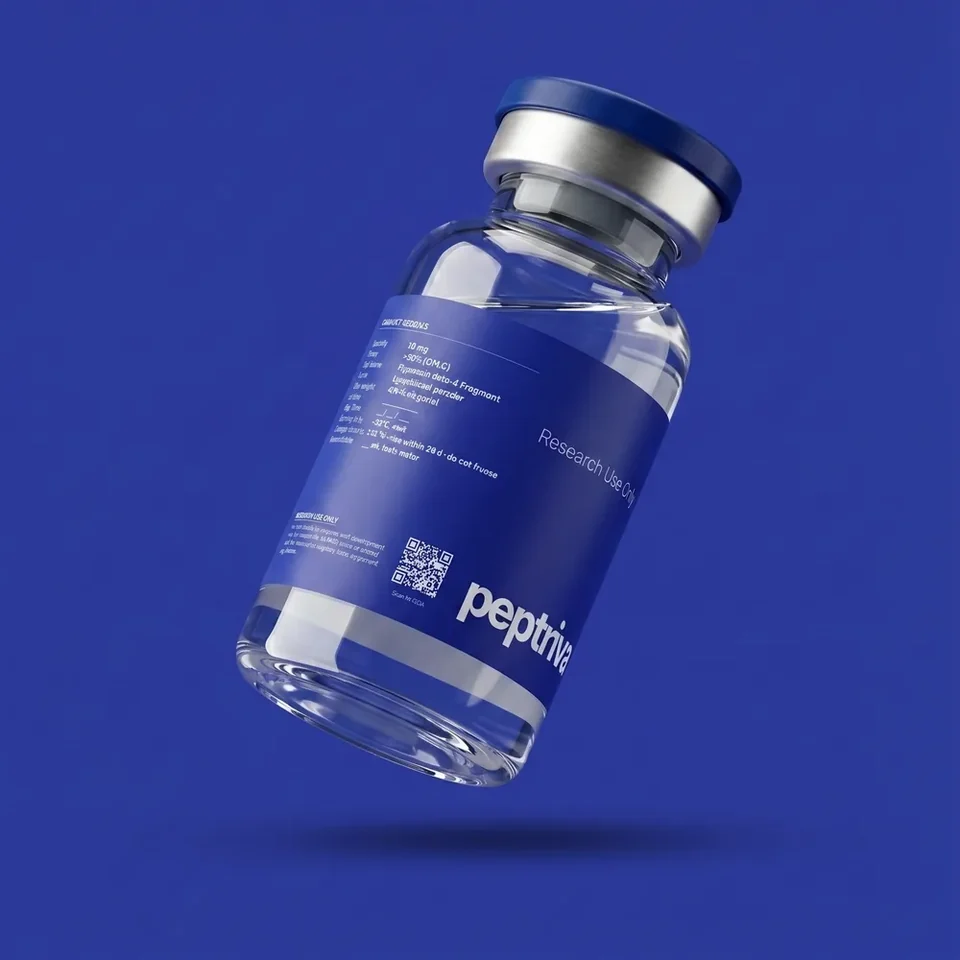
Thymosin α-1
The compound discussed here, supplied as a research compound with a certificate of analysis matched to the lot.
What the safety record does not cover
The approved uses abroad are chronic hepatitis B and C. Everything else people buy it for sits outside the evidence that produced those approvals.
- Cancer support. Liu and Lu reviewed thymosin in lung cancer in Frontiers in Immunology in 2023, and Kong and colleagues published a thymalfasin-containing protocol in BMJ Open in 2024. A protocol is a plan, not a result.
- Viral immunity in general. Espinar-Buitrago and colleagues studied thymosin alpha-1 as an immunomodulator against SARS-CoV-2 in Immunity & Aging in 2023. That is mechanism work.
- Daily wellness, energy, recovery, aging. Zero controlled trials in healthy adults. See before and after.
- Stacks and blends. No safety data exists for thymosin alpha-1 combined with other research peptides.
An immune modulator with no measured effect in healthy immunity also has no measured risk in healthy immunity. Both halves of that sentence are true. Our benefits page covers the claim side.
The research vial is not the approved drug
Thymalfasin is a licensed product in 35+ countries. A research vial labeled thymosin alpha-1 is not that product, and the safety record of one does not transfer to the other.
A 28-amino-acid peptide can be made well or badly. What changes the risk is purity, endotoxin, peptide content and handling, none of which a trial result tells you about. Research-grade material commonly lists around $40-$80 per 10 mg vial, and price says nothing about any of it.
The document that speaks to batch safety is a third-party certificate of analysis with an identifiable lot number. See how to read a COA and storage temperature.
US status is its own question. There is no FDA approval for any indication, and compounding access is under live review. That is set out on the FDA approval status page, with the legal framing on are peptides legal.
So is thymosin alpha 1 safe?
On the evidence available: it is well tolerated in the populations that have been studied, and it has never been shown to do anything in the populations buying it.
Those are two different findings and they get blurred together. "Few side effects" is often used as a reason to try something. In a compound whose largest trial returned a P value of 0.93, low harm and no benefit is the complete result, not half of one.
The remaining open question is the age subgroup in TESTS. Until someone tests it directly, it stays a signal rather than a finding.
Thymosin α-1
Third-party tested research compounds, each shipped with a batch-matched certificate of analysis showing HPLC purity and mass-spec identity — the documentation this site argues you should hold any supplier to.
What to know now
- Thymosin alpha-1 is approved as thymalfasin in 35+ countries, but not by the FDA.
- The BMJ TESTS trial gave it to 1,106 sepsis patients and found 23.4% versus 24.1% mortality at 28 days, P=0.93.
- Younger patients in that trial fared worse, 35.0% against 26.0%, which is a subgroup signal and not proof.
- This site could not source a published frequency table of adverse events from its reference set.
- No controlled trial has measured thymosin alpha-1 in healthy adults, so neither benefit nor risk is quantified there.
What we're watching
Two things to follow: any published reanalysis of the age subgroup in the BMJ TESTS trial, and the FDA Pharmacy Compounding Advisory Committee's 2026 activity on thymosin alpha-1, which decides US availability more than any safety finding will.
Frequently asked questions
What are the most common thymosin alpha 1 side effects?
Reviews describe the profile as favorable, but this site could not source a published table giving event rates. Garaci and colleagues summarize roughly three decades of clinical use in Frontiers in Medicine without supplying a percentage we can quote. Treat "mild and transient" as an impression, not a measurement.
Did the big sepsis trial find any harm?
Not overall. Wu and colleagues reported 28-day mortality of 23.4% and 24.1% across 1,106 patients, with a P value of 0.93. Within that, younger patients in the thymosin arm showed higher mortality, 35.0% against 26.0%. That is a subgroup observation from a negative trial.
Is thymosin alpha 1 safe for long-term use?
Unknown beyond the trial windows. The hepatitis programs that supported approval abroad ran up to 48 weeks. We found no published follow-up extending past that, and no long-term data in people without liver disease.
Does FDA approval abroad mean the research vial is safe?
No. Thymalfasin is a licensed, inspected product in more than 35 countries. A research-grade vial is a separate manufacturing chain, and its risks come from purity, endotoxin and handling rather than from trial results. A third-party certificate of analysis is the document that addresses that.
Is it risky to combine thymosin alpha 1 with other peptides?
There is no evidence either way. No controlled study has given thymosin alpha-1 alongside other research peptides, so no interaction or safety data exists for any stack.
References
- Wu, J., Pei, F., Zhou, L., et al. (2025). The efficacy and safety of thymosin α1 for sepsis (TESTS): multicentre, double blinded, randomised, placebo controlled, phase 3 trial. BMJ, 388, e082583. https://doi.org/10.1136/bmj-2024-082583
- Garaci, E., Paci, M., Matteucci, C., et al. (2024). Phenotypic drug discovery: A case for thymosin alpha-1. Frontiers in Medicine, 11, 1388959. https://doi.org/10.3389/fmed.2024.1388959
- Espinar-Buitrago, M. S., Tarancon-Diez, L., Vazquez-Alejo, E., et al. (2023). The use of alpha 1 thymosin as an immunomodulator of the response against SARS-Cov2. Immunity & Ageing, 20(1), 32. https://doi.org/10.1186/s12979-023-00351-x
- Kong, Y., Chen, R., Xu, M., et al. (2024). Evaluation of the efficacy and safety of a precise thymalfasin-regulated PRaG regimen for advanced refractory solid tumours: Protocol for the PRaG 5.0 study. BMJ Open, 14(3), e075642. https://doi.org/10.1136/bmjopen-2023-075642
- Liu, Y., & Lu, J. (2023). Mechanism and clinical application of thymosin in the treatment of lung cancer. Frontiers in Immunology, 14, 1237978. https://doi.org/10.3389/fimmu.2023.1237978