
Search KPV before and after and you get skin photos and gut-symptom testimonials. The published record contains zero human randomized trials. What was measured was rodent colon.
The short answer. Western randomized controlled trials of KPV in humans: zero. So are registered Phase I trials.
- The measured before-and-after is rodent colon tissue: disease activity index, myeloperoxidase, TNF-alpha and IL-6.
- Dalmasso 2008 and Kannengiesser 2008 used mice; Sun's 2021 hydrogel study used rats by a rectal route.
- Skin and wound-healing photos have no published KPV study behind them in any species.
KPV is a three-amino-acid tail of alpha-MSH. Western human randomized trials of it number zero. The real measurements come from mice and rats. Researchers scored disease activity and cut out colon tissue. Myeloperoxidase fell. TNF-alpha and IL-6 expression dropped. No photograph has ever been a KPV endpoint.
What was actually measured in the KPV studies
Four published papers carry most of the weight here. None of them involved a person. All of them measured inflammation inside an animal's gut.
Dalmasso and colleagues published in Gastroenterology in 2008. They gave mice KPV and looked at what happened to colitis driven by DSS and by TNBS. The endpoints were weight loss, colon length, histology scores and inflammatory gene expression. Kannengiesser and colleagues published in Inflammatory Bowel Diseases the same year, using murine models of inflammatory bowel disease.
Sun and colleagues published a hydrogel study in ACS Biomaterials Science & Engineering in 2021. That one used rats and a rectal route. Disease activity index dropped in rats in 2021. Myeloperoxidase fell. TNF-α and IL-6 expression decreased.
- Disease activity index. A composite score of weight loss, stool consistency and blood. Scored by a researcher, not reported by the animal.
- Myeloperoxidase. An enzyme assay on tissue. It stands in for how many neutrophils flooded the wall of the colon.
- Cytokine expression. TNF-alpha and IL-6, measured in excised tissue.
- Histology. Stained colon sections under a microscope.
Every one of those endpoints requires the animal to be dissected. That is the literal before and after for KPV: a scored colon under a microscope. There is no version of it a buyer can reproduce or photograph.
The full breakdown of those colitis papers sits on the KPV ulcerative colitis research page.
Are there any human KPV trials?
No. Western randomized controlled trials of KPV: zero. We checked the clinical-trial index directly and every hit was a false match on the letters.
A PubMed sweep of 2020 to 2026 returned 4 papers on KPV and 0 RCTs. There are also zero registered Phase I trials, which matters more than it sounds. Phase I is where a compound first gets a measured human safety profile. KPV does not have one.
Despite the robust preclinical findings, human data are extremely limited, and these agents should be considered investigational.
Mendias & Awan, Sports Medicine, 2026, on unapproved peptide therapiesSo any before-and-after you are shown is one person's uncontrolled experience, with no comparison arm, no blinding, and no measurement beyond how they felt and what the light did in the photo. The KPV benefits page works through what each claimed effect actually rests on.
Why the rodent result is still interesting
The gap is real, but the mechanism is not hand-waving. KPV is the last three amino acids of alpha-MSH, the hormone the body uses to dial inflammation down. It keeps the calming action and loses the pigment effect.
The delivery story is the clever part. PepT1 is a peptide pump. Inflamed colon tissue upregulates PepT1. Dalmasso's 2008 work in Gastroenterology showed PepT1-mediated uptake of KPV reducing intestinal inflammation, which means the sicker the tissue, the more compound it pulls in.
PepT1-mediated tripeptide KPV uptake reduces intestinal inflammation.
Dalmasso et al., Gastroenterology, 2008 (title)Sun's 2021 hydrogel took the same idea into rats by a rectal route, in a design that works much like mesalamine formulations. A 2023 review in Cells, by Gravina and colleagues, places KPV inside the wider melanocortin system work on inflammatory bowel disease. The mechanism page explains why three competing explanations are still on the table.
A good mechanism predicts which trial is worth running. It does not substitute for the trial. Nothing about the PepT1 story tells you what happens in a human face, a human joint, or a human gut given a reconstituted vial.
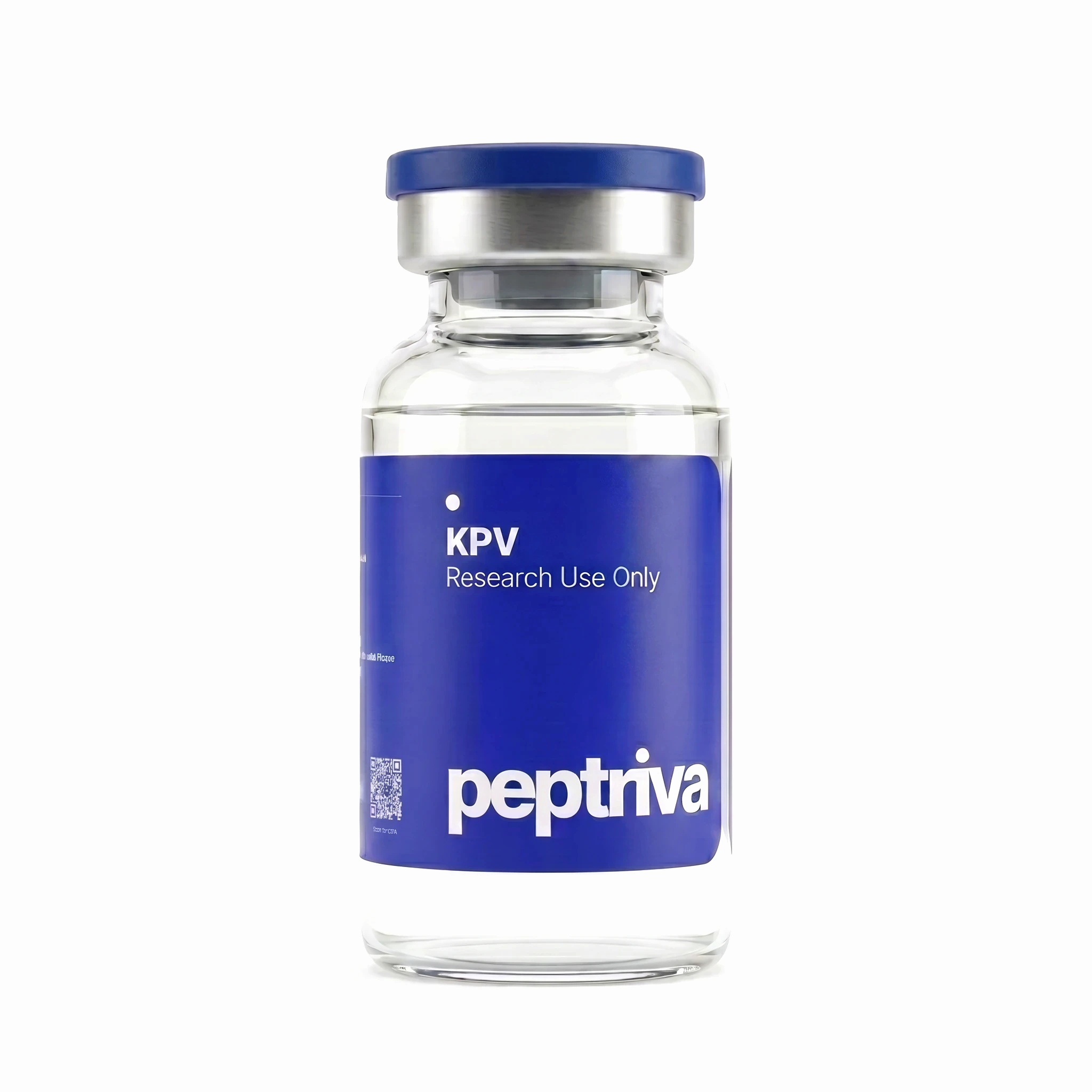
KPV
The compound discussed here, supplied as a research compound with a certificate of analysis matched to the lot.
The skin photos have no study behind them at all
Most KPV before-and-after images are skin: acne, eczema, rosacea, wound healing. Here is the thing to hold onto. The animal work is gut work.
The colitis papers measured colon tissue after oral or rectal delivery. They did not photograph fur, did not score dermatitis, and did not test topical application. Carrying a colon result across to a cheek is an assumption, not a finding.
| Claim in the photo | Species it was measured in | Endpoint used |
|---|---|---|
| Calmer gut, fewer flares | Mouse, rat | Disease activity index, MPO, histology |
| Lower inflammatory signaling | Mouse, rat, cultured cells | TNF-alpha and IL-6 expression |
| Clearer skin | None published | None |
| Faster wound closure | None published | None |
| Joint comfort | Related melanocortin agonists only | Chondrocyte assays, not KPV |
That last row needs care. Can and colleagues, in the European Journal of Pharmacology in 2020, tested melanocortin MC1 and MC3 receptor agonists on LPS-activated chondrocytes. Those were different molecules. KPV was not the compound under test.
What a reader can actually check
If no human outcome exists, the only verifiable things left are about the vial itself. Those are worth doing because they are the part you can hold a document against.
- Identity and mass. KPV is 3 amino acids, Lys-Pro-Val, at 342.4 g/mol. A mass-spec trace should land there. Compare that to 15-residue BPC-157 and you see how small it is.
- Purity. Ask for the HPLC chromatogram, not a summary line. How to read a certificate of analysis covers what a real one shows.
- Batch match. The lot number on the COA should match the lot on the vial. If it does not, the document describes a different batch.
- Handling. Storage temperature and bacteriostatic water are documented, testable things in a field where the outcome data is not.
For the legal frame on research compounds, see are peptides legal. For how the quantities in the published work were expressed, see the KPV dosage page, which reports what the studies used and nothing more.
The honest summary
KPV has a tidy mechanism, a small and consistent rodent literature, and no human evidence. Those three facts do not cancel out. They sit side by side.
Dalmasso 2008 and Kannengiesser 2008 are 18 years old. In that time, the compound has not produced a single registered Phase I trial. Compounds that work usually get further than that. Compounds that are hard to fund, hard to patent or hard to formulate often do not. Either explanation fits what we can see, and neither is proven.
So when you look at a before and after, ask what instrument produced it. For KPV, the instruments were a scoring sheet, an enzyme assay and a microscope, pointed at rodent colon. The complete guide collects the whole record in one place.
KPV
Research-use-only material, sold by the vial with batch documentation. Check the certificate of analysis against the batch you receive.
What to know now
- Western randomized controlled trials of KPV in humans: zero. So are registered Phase I trials.
- The measured before-and-after is rodent colon tissue: disease activity index, myeloperoxidase, TNF-alpha and IL-6.
- Dalmasso 2008 and Kannengiesser 2008 used mice; Sun's 2021 hydrogel study used rats by a rectal route.
- Skin and wound-healing photos have no published KPV study behind them in any species.
- The PepT1 uptake mechanism is well described, but a mechanism is not an outcome.
- What you can verify is the vial: mass near 342.4 g/mol, an HPLC trace, and a matching lot number.
What we're watching
Watch for before-and-after images that borrow the colitis literature to sell a skin result. The rodent studies measured excised gut tissue. No published KPV work applied it to skin or scored a dermatologic endpoint.
Frequently asked questions
Are there real KPV before and after results?
Not in humans. Western randomized controlled trials of KPV number zero, and a PubMed sweep of 2020 to 2026 found 4 papers and 0 RCTs. The documented changes come from mice and rats, measured as disease activity index, myeloperoxidase and cytokine expression in colon tissue.
How long did the animal studies run?
The mouse colitis work reported by Dalmasso and by Kannengiesser in 2008 ran over days, not months. One commonly cited protocol used KPV in drinking water for 8 days. That is what the researchers administered to animals; it is not a schedule for anyone else.
Does KPV help acne or eczema?
No published study has tested that. The KPV literature is gut-focused: mouse and rat models of inflammatory bowel disease. Applying a colon result to skin is an assumption, and nobody has checked it.
Why is there no human trial after 18 years?
Nobody has published a reason. KPV is a three-amino-acid sequence, which makes it hard to protect commercially, and the colitis field already has formulated drugs. Those are plausible explanations, not established ones.
What is KPV's molecular weight?
About 342.4 g/mol, roughly 342 daltons, across three amino acids: lysine, proline, valine. A mass-spec trace on a certificate of analysis should land on that figure.
References
- Dalmasso, G., Charrier-Hisamuddin, L., Nguyen, H. T., Yan, Y., Sitaraman, S., & Merlin, D. (2008). PepT1-mediated tripeptide KPV uptake reduces intestinal inflammation. Gastroenterology, 134(1), 166–178. PMID 18061177
- Kannengiesser, K., Maaser, C., Heidemann, J., et al. (2008). Melanocortin-derived tripeptide KPV has anti-inflammatory potential in murine models of inflammatory bowel disease. Inflammatory Bowel Diseases, 14(3), 324–331. PMID 18092346
- Sun, J., Xue, P., Liu, J., et al. (2021). Self-Cross-Linked Hydrogel of Cysteamine-Grafted γ-Polyglutamic Acid Stabilized Tripeptide KPV for Alleviating TNBS-Induced Ulcerative Colitis in Rats. ACS Biomaterials Science & Engineering, 7(10), 4859–4869. https://doi.org/10.1021/acsbiomaterials.1c00792
- Gravina, A. G., Pellegrino, R., Durante, T., et al. (2023). The Melanocortin System in Inflammatory Bowel Diseases: Insights into Its Mechanisms and Therapeutic Potentials. Cells, 12(14), 1889. https://doi.org/10.3390/cells12141889
- Can, V. C., Locke, I. C., Kaneva, M. K., et al. (2020). Novel anti-inflammatory and chondroprotective effects of the human melanocortin MC1 receptor agonist BMS-470539 dihydrochloride and human melanocortin MC3 receptor agonist PG-990 on lipopolysaccharide activated chondrocytes. European Journal of Pharmacology, 872, 172971. https://doi.org/10.1016/j.ejphar.2020.172971
- Mendias, C. L., & Awan, T. M. (2026). Safety and efficacy of approved and unapproved peptide therapies for musculoskeletal injuries and athletic performance. Sports Medicine. https://doi.org/10.1007/s40279-026-02437-0