
Search KPV side effects and you get tidy lists. None of them come from a human trial. The published record is 4 papers of animal and cell work and 0 RCTs.
The short answer. No human safety study of KPV has been published, and zero Phase I trials are registered.
- The rodent studies scored colitis severity and inflammation markers, not adverse events.
- Published exposures ran days, not months, so nothing addresses long-term use.
- "No skin darkening" removes one alpha-MSH effect; it does not substitute for a safety profile.
KPV has no published human safety data. Western human trials of it number zero. The side effect lists online are not measured. They come from rodent colitis work. Those studies scored disease, not harm. No Phase I safety trial has been run.
Is there a KPV side effect list from human trials?
No. There is no human safety dataset for KPV at all.
When this site searched the literature and the trial registries on 23–24 July 2026, the core KPV record came to 4 papers. All of them are animal or cell work. Western randomized controlled trials: zero. Zero registered Phase I trials, which is the stage where side effects are supposed to be found in the first place.
A side effect profile is a thing that gets measured. For KPV, nobody has measured it. That is different from saying the compound is clean, and it is different from saying it is dangerous.
The mechanism story is unusually good for a compound with this little human data. We cover it in the KPV mechanism page, and the full picture sits in the KPV complete guide.
What the animal studies measured, and what they skipped
Three studies carry most of the weight. Read what each one looked at.
Dalmasso and colleagues, writing in Gastroenterology in 2008, gave KPV to mice with chemically induced colitis and traced its uptake through PepT1, a peptide pump that an inflamed gut turns up. Their cell work used KPV at 10 nM. The mouse drinking water work used 100 µM over 8 days. Kannengiesser and colleagues, in Inflammatory Bowel Diseases the same year, ran murine IBD models and reported the same direction of effect. Sun and colleagues, in 2021, built a hydrogel and delivered KPV rectally to rats with TNBS colitis.
Their endpoints were disease activity scores, myeloperoxidase in colon tissue, and TNF-alpha and IL-6 expression. Those are inflammation readouts. They tell you whether the colitis got better. They do not tell you what else the compound did.
- No long-term dosing. The published exposures are days, not months.
- No immunogenicity work. Nobody has reported whether KPV provokes an antibody response in people.
- No human pharmacokinetics. Half-life, clearance and distribution in humans are unpublished.
- No injection-site data. The studied routes were oral and rectal. The research market sells it for injection and for nebulizing.
- No reproductive, developmental or carcinogenicity package. These are standard before first-in-human work. None exists here.
In a colitis model, body weight is tracked as a sign of disease, not as a safety signal. That distinction is what separates an efficacy study from a toxicology study. The colitis research page goes through each design.
The melanocortin system is a promising therapeutic target in inflammatory bowel disease, but its clinical translation remains at an early stage.
Gravina et al., Cells, 2023Why "no skin darkening" is not a safety record
The most repeated KPV safety claim is that it keeps the anti-inflammatory half of alpha-MSH and drops the pigment half. That part is fair. KPV is just 3 amino acids, Lys-Pro-Val, weighing about 342 daltons. It is the tail of the parent hormone, and the tanning signal is not in that tail.
But the absence of one known effect is not a safety profile. The melanocortin system reaches skin, gut, immune cells, cartilage and the brain. Work by Can and colleagues in the European Journal of Pharmacology, published in 2020, showed melanocortin MC1 and MC3 receptor agonists acting on activated chondrocytes, well away from pigment biology. A molecule that touches that system has more than one place to act.
"It does not cause tanning" answers one question. It says nothing about the dozens nobody has asked yet.
And the upstream target is still contested. Our benefits page lays out the three competing mechanisms. If the binding target is unsettled, the off-target map cannot be settled either.
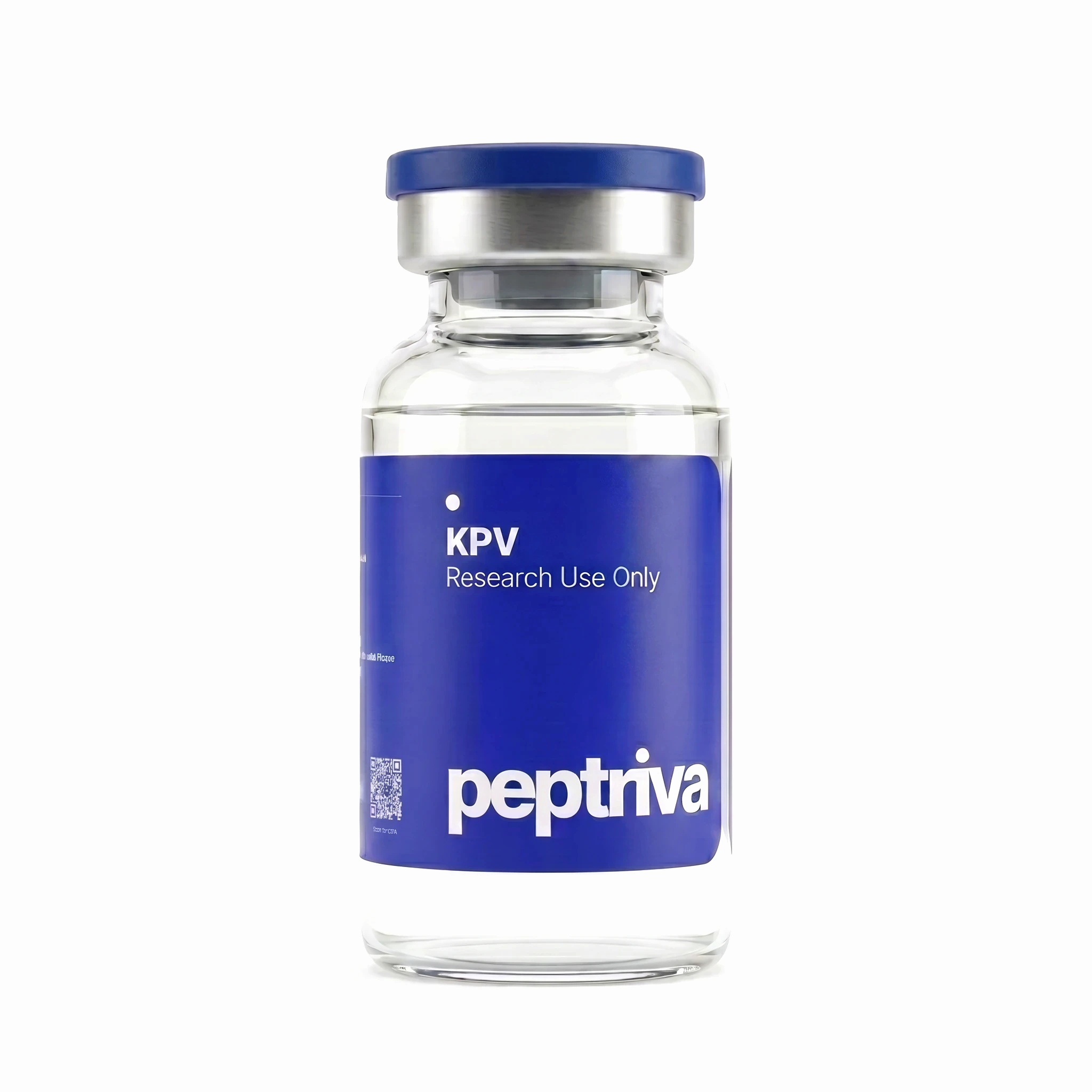
KPV
The compound discussed here, supplied as a research compound with a certificate of analysis matched to the lot.
What is documented is the vial, not the molecule
For research peptides, the risks you can actually inspect are manufacturing risks. Nobody runs pharmacovigilance on a research chemical. There is no adverse event reporting system collecting KPV reports, so online anecdotes are not a dataset and this page will not dress them up as one.
What you can check before anything else:
- Third-party identity and purity testing. See how to read a certificate of analysis, including whether the lot number on the paper matches the vial.
- Endotoxin and sterility testing. Often missing from research-grade COAs entirely.
- Storage and shipping conditions. Covered in the storage temperature guide.
- Diluent quality. See the bacteriostatic water guide.
- Legal status. Research-use rules differ by country. KPV has 0 Phase III trials and no approval anywhere as a drug.
Many peptides marketed for musculoskeletal injury and athletic performance have never been assessed in controlled human trials, and their safety profiles are unknown.
Mendias & Awan, Sports Medicine, 2026Is KPV safe?
Unknown is the honest answer, and it is the only one the record supports.
| Safety question | What exists | What is missing |
|---|---|---|
| Acute tolerability in humans | Nothing published | Phase I dose escalation |
| Long-term exposure | Rodent studies of days | Any chronic dosing data |
| Immune response | Nothing published | Anti-drug antibody testing |
| Human pharmacokinetics | Nothing published | Half-life, clearance, route data |
| Skin pigmentation | Sequence lacks the pigment signal | Human confirmation |
| Gut anti-inflammatory effect | Mouse and rat colitis models | Human RCTs, which number zero |
Compare that against a compound with a real file. Approved GLP-1 drugs went through Phase III programs in thousands of study participants before their side effect tables were written. KPV has not had its first ten.
For what the rodent work did show, and what no photograph ever showed, see KPV before and after. For the amounts each published study used, see the KPV dosage page.
KPV
Research-use-only material, sold by the vial with batch documentation. Check the certificate of analysis against the batch you receive.
What to know now
- No human safety study of KPV has been published, and zero Phase I trials are registered.
- The rodent studies scored colitis severity and inflammation markers, not adverse events.
- Published exposures ran days, not months, so nothing addresses long-term use.
- "No skin darkening" removes one alpha-MSH effect; it does not substitute for a safety profile.
- The documented, checkable risks are purity, endotoxin and storage, not the peptide sequence.
What we're watching
Watch for a registered Phase I safety trial of KPV. Until one is run and reported, every published side effect list for this peptide is inference from rodent colitis models.
Frequently asked questions
Does KPV have side effects?
Nobody has measured them. There are no human trials, so no adverse event table exists. The rodent studies tracked colitis severity, not harm. Absence of a reported side effect here means absence of a study, not absence of risk.
Has KPV ever been tested in humans?
Not in a Western randomized controlled trial. Our registry and literature check found zero. The published work is mouse, rat and cell studies, mostly in models of inflammatory bowel disease.
Can KPV cause skin darkening like alpha-MSH?
The pigment signal sits elsewhere in the parent hormone, and KPV is only the last three residues. That is a sequence argument, not a human finding. No trial has confirmed it in people.
Is KPV approved by the FDA?
No. KPV is sold as a research compound. It has no approved drug status and no Phase III program. The regulatory status of any related melanocortin drug is not the status of a research vial.
What can actually be checked before buying KPV?
The paperwork. A third-party certificate of analysis with a matching lot number, identity and purity results, and any endotoxin or sterility testing. Those are the only risk factors here that produce a document you can read.
References
- Dalmasso, G., Charrier-Hisamuddin, L., Nguyen, H. T., Yan, Y., Sitaraman, S., & Merlin, D. (2008). PepT1-mediated tripeptide KPV uptake reduces intestinal inflammation. Gastroenterology, 134(1), 166–178. PMID 18061177
- Kannengiesser, K., Maaser, C., Heidemann, J., et al. (2008). Melanocortin-derived tripeptide KPV has anti-inflammatory potential in murine models of inflammatory bowel disease. Inflammatory Bowel Diseases, 14(3), 324–331. PMID 18092346
- Sun, J., Xue, P., Liu, J., et al. (2021). Self-Cross-Linked Hydrogel of Cysteamine-Grafted γ-Polyglutamic Acid Stabilized Tripeptide KPV for Alleviating TNBS-Induced Ulcerative Colitis in Rats. ACS Biomaterials Science & Engineering, 7(10), 4859–4869. https://doi.org/10.1021/acsbiomaterials.1c00792
- Gravina, A. G., Pellegrino, R., Durante, T., et al. (2023). The Melanocortin System in Inflammatory Bowel Diseases: Insights into Its Mechanisms and Therapeutic Potentials. Cells, 12(14), 1889. https://doi.org/10.3390/cells12141889
- Can, V. C., Locke, I. C., Kaneva, M. K., et al. (2020). Novel anti-inflammatory and chondroprotective effects of the human melanocortin MC1 receptor agonist BMS-470539 dihydrochloride and human melanocortin MC3 receptor agonist PG-990 on lipopolysaccharide activated chondrocytes. European Journal of Pharmacology, 872, 172971. https://doi.org/10.1016/j.ejphar.2020.172971
- Mendias, C. L., & Awan, T. M. (2026). Safety and efficacy of approved and unapproved peptide therapies for musculoskeletal injuries and athletic performance. Sports Medicine. https://doi.org/10.1007/s40279-026-02437-0