
Pages listing Pinealon side effects are filling a gap, not reporting one. PubMed lists 3 papers on this peptide from 2020–2026. Randomized human trials number zero. No trial means nobody counted adverse events.
The short answer. PubMed lists 3 Pinealon papers from 2020 to 2026, and one is by its inventor.
- Randomized human trials number zero, so no adverse event data exists in either direction.
- "No reported side effects" describes an empty literature, not a tested safety profile.
- The antioxidant claim comes from a 4-residue peptide studied in mice, not from Pinealon.
Pinealon has no published safety record. PubMed lists 3 papers since 2020. Randomized human trials number zero. No trial means no adverse event data exists. "No side effects reported" means nobody looked. The only checkable risks are purity, sterility and the seller.
Does Pinealon have side effects?
Nobody knows. That is the honest answer, and it is not the same as "no."
A side effect record is built one way. You give a compound to people in a controlled study. You collect what they report. You compare it against a placebo group. You publish the counts. None of that has happened with Pinealon.
PubMed lists 3 indexed papers on the compound across 2020–2026. One of the three is by the team that invented it. Randomized controlled human trials number zero. We found no published human safety study, no dose-escalation report, and no pharmacokinetic data in people.
Treat "no reported side effects" as a statement about the literature, not about the molecule. An empty column in a table nobody filled in is not a clean safety profile.
Our Pinealon complete guide walks the full paper trail. The short version is that the gap between what is marketed and what was measured is the widest we cover.
What the three published papers actually measured
Pinealon is a synthetic tripeptide, 3 amino acids long, around 418 g/mol. It comes from the Saint Petersburg lab that produced Epitalon.
The most cited item in the record is a 2020 review in Molecules by Khavinson and colleagues. Its subject is the EDR peptide and gene expression. Read the title carefully, because the title is the claim:
EDR Peptide: Possible mechanism of gene expression and protein synthesis regulation involved in the pathogenesis of Alzheimer's disease.
Khavinson, Linkova, Kozhevnikova & Trofimova, Molecules, 2020"Possible mechanism" is a proposal. A review paper proposing a mechanism does not measure harm, and this one was written by the group that developed the compound. Nothing in it functions as a safety study.
- No control arm anywhere. There is no published placebo comparison in people.
- No adverse event tally. No paper reports what participants experienced, because there were no participants.
- No organ or blood chemistry panel in humans. Liver, kidney and hematology effects are unmeasured.
- No long-term follow-up. Nothing addresses repeated use over months or years.
The Pinealon benefits page covers the other side of the same emptiness.
Where the "safe and antioxidant" claim comes from
Vendor copy often pairs "well tolerated" with "antioxidant." The antioxidant line is traceable. It traces to a different molecule.
A 2021 paper in Food & Function studied a peptide pulled from Jiuzao, the solid residue left over from Chinese liquor production. That peptide is Asp-Arg-Glu-Leu. It has 4 residues. Pinealon has 3.
Optimization of Jiuzao protein hydrolysis conditions and antioxidant activity in vivo of Jiuzao tetrapeptide Asp-Arg-Glu-Leu by elevating the Nrf2/Keap1-p38/PI3K-MafK signaling pathway.
Jiang, Zhang, Lin & Cheng, Food & Function, 2021That work was done in mice, on a tetrapeptide from distillery byproduct. It is not a Pinealon study. Borrowing its findings to describe Pinealon tolerability in humans crosses a species line and a molecule line at once.
A mouse antioxidant result on a 4-residue peptide says nothing about how a 3-residue peptide behaves in a person. We lay the substitution out in Pinealon before and after.
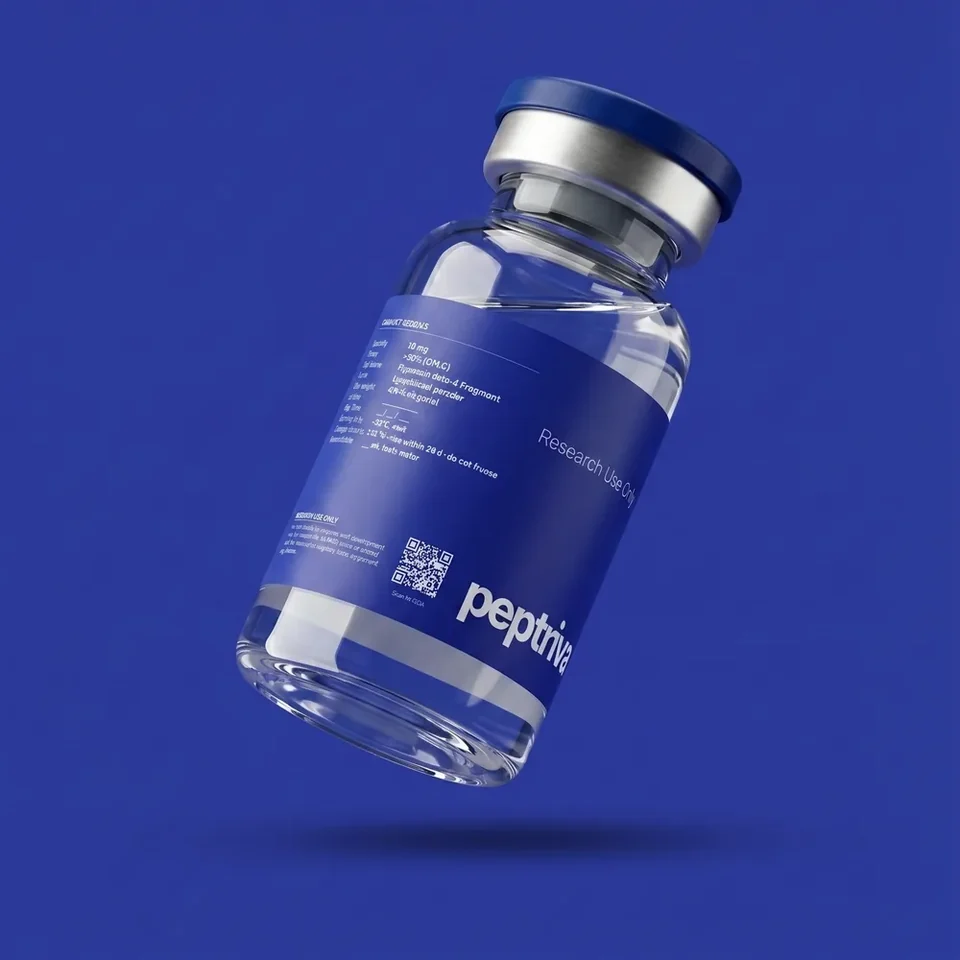
Pinealon
The compound discussed here, supplied as a research compound with a certificate of analysis matched to the lot.
What a safety record would contain, and what Pinealon has
Here is the checklist a regulator or a clinician would run. Every row is a question with a known source. For Pinealon, every row is empty.
| Safety question | Where the answer normally comes from | Pinealon |
|---|---|---|
| What adverse events occur? | Phase I and II trial reports | None published |
| How long does it stay in the body? | Human pharmacokinetic study | None found |
| Does it interact with medication? | Drug interaction studies | None found |
| Is it safe in pregnancy? | Reproductive toxicity data | None found |
| What happens over years? | Long-term follow-up cohorts | None found |
| Carcinogenicity | Rodent lifetime bioassay | None found |
Six empty rows is itself the finding. Any page that fills them with reassuring text is writing fiction, and any page that fills them with scary text is doing the same thing in the other direction.
The risks you can actually check before buying
The molecule is unmeasured. The vial is not. With research peptides selling around $35–$80 per 10 mg vial, the realistic hazards sit in manufacturing and handling, and those leave documents.
- Identity and purity. A third-party certificate of analysis with HPLC and mass spec is the only proof the powder matches the label.
- Sterility and endotoxin. Research-grade lyophilized powder is not made to injectable pharmaceutical standards, and most COAs do not test for endotoxin at all.
- Handling. Degradation depends on storage temperature and on reconstitution practice, including which diluent is used.
- Legal status. These are sold for laboratory research, not human use. See are peptides legal.
The FDA's Section 503A sets the terms under which a licensed pharmacy may compound with a bulk drug substance. A research vial ordered online sits outside that framework entirely. There is no pharmacist, no prescription, and no agency reviewing the batch.
Does Pinealon show up on a drug test?
We read the World Anti-Doping Agency Prohibited List for 2026. Pinealon is not named on it.
That is not the end of the question. Section S0 of the list covers substances with no current approval by any government health authority for human therapeutic use. Pinealon has no such approval anywhere we can find. A tested athlete should read S0 before assuming an unnamed compound is permitted, and should ask their own federation.
Separately, routine workplace or clinical drug panels do not screen for small research peptides. Not being detected is not the same as being cleared.
Pinealon
Research-use-only material, sold by the vial with batch documentation. Check the certificate of analysis against the batch you receive.
What to know now
- PubMed lists 3 Pinealon papers from 2020 to 2026, and one is by its inventor.
- Randomized human trials number zero, so no adverse event data exists in either direction.
- "No reported side effects" describes an empty literature, not a tested safety profile.
- The antioxidant claim comes from a 4-residue peptide studied in mice, not from Pinealon.
- Purity, sterility and storage are the risks you can verify with documents today.
- Pinealon is not named on the WADA 2026 Prohibited List, but Section S0 covers unapproved substances.
What we're watching
Khavinson peptide bioregulators: what the published evidence actually shows
Frequently asked questions
Is Pinealon safe?
Unknown. Safety is a measurement, and the measurement has not been made. PubMed lists 3 papers on Pinealon and zero randomized human trials. No study has collected adverse events in people, so there is no basis to call it safe or unsafe.
Has anyone reported side effects from Pinealon?
Not in the indexed literature we can find. There are no published case reports, no trial safety tables, and no pharmacovigilance entries, because no regulated trial has run. Forum reports are not adverse event data and cannot be verified.
Does Pinealon interact with medications?
No interaction studies exist for this peptide. Nobody has tested it alongside any prescription drug in people. Anyone taking medication should raise it with their own physician rather than relying on a vendor page.
Is Pinealon safe during pregnancy or breastfeeding?
There is no reproductive toxicity data for Pinealon in any species that we could locate. The absence applies to pregnancy, breastfeeding and fertility equally.
Will Pinealon fail a drug test?
Pinealon is not named on the WADA 2026 Prohibited List. Section S0 of that list covers pharmacological substances with no regulatory approval for human therapeutic use, which is a category tested athletes should read closely before assuming anything.
Why do vendor pages say it is well tolerated?
That phrase usually traces back to mechanism reviews by the compound's own developers and to a 2021 mouse study of a different 4-residue peptide from liquor production residue. Neither measured tolerability in humans.
References
- PubMed. Search results for “Pinealon”. U.S. National Library of Medicine. PMID ?term=pinealon
- Khavinson, V., Linkova, N., Kozhevnikova, E., & Trofimova, S. (2020). EDR Peptide: Possible mechanism of gene expression and protein synthesis regulation involved in the pathogenesis of Alzheimer’s disease. Molecules, 26(1), 159. https://doi.org/10.3390/molecules26010159
- Jiang, Y., Zhang, M., Lin, S., & Cheng, S. (2021). Optimization of Jiuzao protein hydrolysis conditions and antioxidant activity in vivo of Jiuzao tetrapeptide Asp-Arg-Glu-Leu by elevating the Nrf2/Keap1-p38/PI3K-MafK signaling pathway. Food & Function, 12(11), 4808–4824. https://doi.org/10.1039/d0fo02852e
- World Anti-Doping Agency. The Prohibited List 2026. https://www.wada-ama.org/en/prohibited-list
- U.S. Food and Drug Administration. (2024). Section 503A of the Federal Food, Drug, and Cosmetic Act. https://www.fda.gov/drugs/human-drug-compounding/section-503a-federal-food-drug-and-cosmetic-act