
Search Pinealon before and after and you get testimonials. The indexed literature is 3 papers, one of them by the peptide's own inventor, and zero randomized human trials.
The short answer. PubMed indexes 3 Pinealon papers from 2020 to 2026, and one is by the inventor's own lab.
- Randomized human trials of Pinealon number zero, so there is no measured before and after.
- The antioxidant evidence belongs to Asp-Arg-Glu-Leu, a 4-residue peptide tested in mice.
- The inventor's 2020 Molecules paper describes a possible mechanism, not a clinical result.
Pinealon is a synthetic tripeptide of 3 amino acids. PubMed lists 3 papers from 2020 to 2026. One of those three is by its own inventor. Randomized human trials number zero. No before and after has been measured in people. The antioxidant claim comes from a different peptide, in mice.
What has actually been measured in people
Nothing. There is no published human before and after for Pinealon. No photo set in a journal, no validated cognitive scale, no blood marker, no imaging.
PubMed indexes 3 papers on Pinealon across 2020–2026. That search takes ten seconds and you can run it yourself. One of those three comes from the Saint Petersburg lab that created the peptide. Randomized controlled trials in people number zero.
So when a page shows a before and after, it is not reporting a measurement. It is reporting a feeling, after the fact, with nothing on the other side of it.
- No placebo arm. Nobody has compared Pinealon against saline in people.
- No validated outcome. No MMSE, no MoCA, no reaction-time battery, no sleep study.
- No human pharmacokinetics. There is no published data on what happens to the peptide after injection in a person.
- No dose-finding work. There is no human study to compare any amount against any other.
The Pinealon benefits page goes claim by claim through what the marketing says and what sits under each one.
Where the antioxidant claim actually comes from
This is the part worth slowing down for. Pinealon is sold as an antioxidant and neuroprotectant. There is real antioxidant data in the literature. It is not about Pinealon.
The study people reach for is Jiang and colleagues, published in Food & Function in 2021. It tested a peptide recovered from Jiuzao, a byproduct of Chinese liquor production, and measured antioxidant activity in mice.
Optimization of Jiuzao protein hydrolysis conditions and antioxidant activity in vivo of Jiuzao tetrapeptide Asp-Arg-Glu-Leu by elevating the Nrf2/Keap1-p38/PI3K-MafK signaling pathway.
Jiang, Zhang, Lin & Cheng, Food & Function, 2021Read the title again. The molecule tested was Asp-Arg-Glu-Leu. That is 4 residues. Pinealon is Glu-Asp-Arg, 3 residues, about 418 g/mol. The letters overlap. The molecules are not the same.
A four-amino-acid peptide from liquor waste, tested in mice, is not evidence for a three-amino-acid peptide in a human. Two things are being swapped: the compound, and the species.
What the inventor's own paper says
The third strand of the story is the Khavinson group's own 2020 paper in Molecules. It is the paper most often cited as proof.
EDR Peptide: Possible mechanism of gene expression and protein synthesis regulation involved in the pathogenesis of Alzheimer's disease.
Khavinson, Linkova, Kozhevnikova & Trofimova, Molecules, 2020The word carrying the weight is possible. The paper sets out a proposed mechanism. The team says the peptide binds histones, the proteins that package DNA, and that this switches genes on or off.
A mechanism paper is a hypothesis about how something might work. It is not a measurement of whether it does. And the authors proposing it are the people who made the compound. That is not misconduct, it is just a single source, and it is the only source.
The Pinealon complete guide covers the lab, the Epitalon connection, and the full publication history.
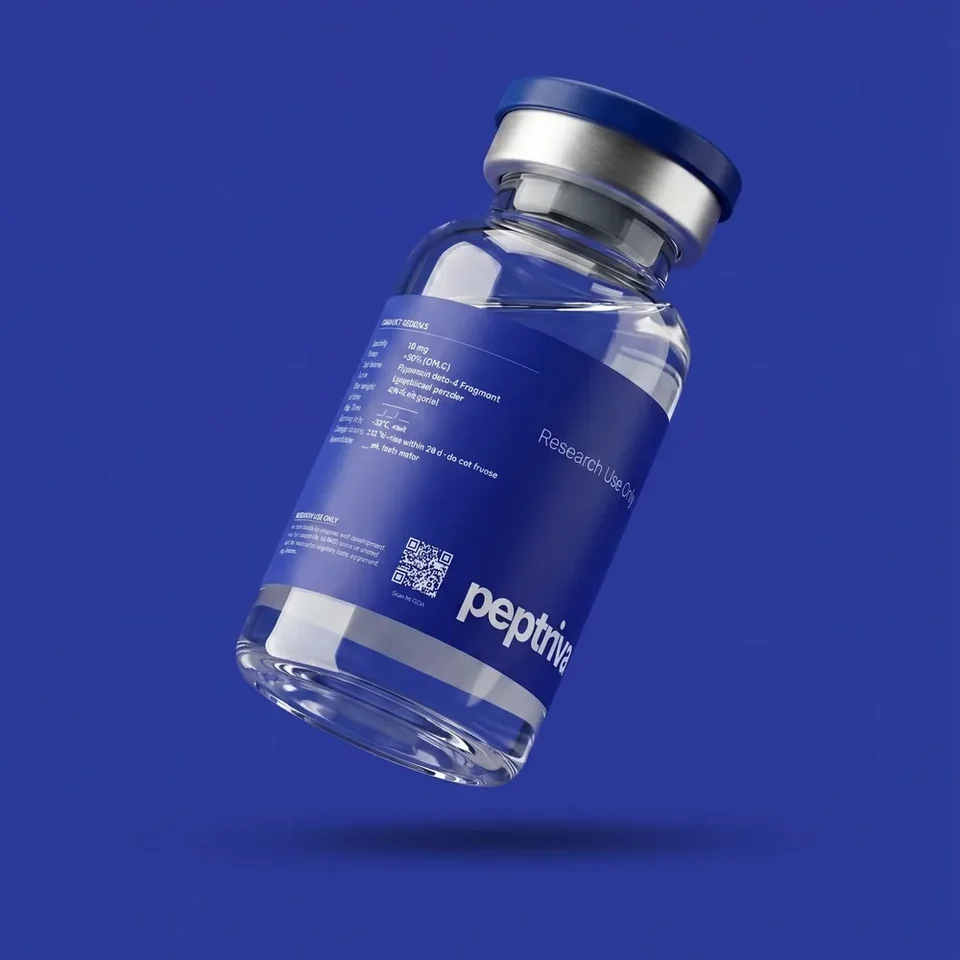
Pinealon
The compound discussed here, supplied as a research compound with a certificate of analysis matched to the lot.
What a Pinealon before and after photo can actually show
Almost nothing visible. The claimed effects are cognitive: clearer thinking, better focus, better sleep, less brain fog. None of those show up in a mirror.
So the photo is decoration. The real claim is the caption, and the caption is a self-report with no baseline, no control, and no blinding. People who buy a peptide expect it to work. That expectation moves self-reported cognition more than almost any other outcome type.
| Marketing claim | What sits under it | Measured in |
|---|---|---|
| Antioxidant protection | Jiuzao tetrapeptide Asp-Arg-Glu-Leu, Nrf2/Keap1 pathway | Mice, different peptide |
| Regulates gene expression | Histone-binding hypothesis, inventor's own review | Proposed mechanism |
| Alzheimer's relevance | A paper titled “possible mechanism” | No patients |
| Sharper focus, better sleep | No published human measurement | Nothing |
The gap between the right column and the left column is the widest in anything this site covers.
What you can verify before you buy
If the efficacy question has no answer, the identity question still does. These are checkable things.
- A current certificate of analysis. Mass spectrometry should land near 418 g/mol for a Glu-Asp-Arg tripeptide, with HPLC purity on the same document. How to read a COA walks through the traps.
- Price sanity. Vials commonly run $35–$80 per 10 mg vial. A tripeptide is cheap to make, so a very high price is not a quality signal.
- Handling. Storage temperature, bacteriostatic water and reconstitution are the parts under your control.
- Legal status. Pinealon is not an FDA-approved drug. Section 503A limits which bulk substances a compounding pharmacy may use, and an unapproved research peptide does not clear that bar. Legal status has the detail.
- Sport testing. WADA's S0 category covers substances with no approval from any health authority for human use. Any athlete should read the current Prohibited List directly.
Vendor documentation standards vary widely. Our sourcing criteria page sets out what we check.
Pinealon
Research-use-only material, sold by the vial with batch documentation. Check the certificate of analysis against the batch you receive.
What to know now
- PubMed indexes 3 Pinealon papers from 2020 to 2026, and one is by the inventor's own lab.
- Randomized human trials of Pinealon number zero, so there is no measured before and after.
- The antioxidant evidence belongs to Asp-Arg-Glu-Leu, a 4-residue peptide tested in mice.
- The inventor's 2020 Molecules paper describes a possible mechanism, not a clinical result.
- Claimed effects are cognitive and self-reported, which is the hardest category to photograph or confirm.
What we're watching
Watch for the first randomized, placebo-controlled human trial of Pinealon with a validated cognitive endpoint. Until one appears in the PubMed index, every before and after remains a self-report with no baseline.
Frequently asked questions
Are Pinealon before and after photos real?
The people in them may be real. The measurement is not. No published study has recorded a human outcome for Pinealon, so there is no baseline to compare any photo or report against. The claimed effects are cognitive anyway, which a photograph cannot show.
Has Pinealon been tested in humans?
Not in any randomized controlled trial indexed on PubMed. The search returns 3 papers from 2020 to 2026, and one of them comes from the lab that created the peptide. There is no published human pharmacokinetic data either.
How long does Pinealon take to work?
There is no answer from published research. No human study has measured an onset, a duration, or an effect at any timepoint. Any timeline you read online comes from user reports, not from a trial.
Is Pinealon the same as Epitalon?
No. They are different peptides with different sequences, though they come from the same Saint Petersburg research group. Pinealon is a tripeptide. Evidence for one is not evidence for the other.
Why do so many pages cite an antioxidant study?
Because one exists, but it tested a different molecule. Jiang and colleagues, writing in Food and Function in 2021, measured Asp-Arg-Glu-Leu, a 4-residue peptide from liquor production waste, in mice. Pinealon is 3 residues.
What people actually report
These are self-reports, not evidence. No control group, no blinding, and no independent check that the vial held what the label claimed. They are collected here because people asking about Pinealon deserve an answer rather than a refusal, and because what the community believes is itself worth knowing. Quotes are excerpts; each links to the original post.
Uncontrolled, unverified self-report. Across five threads, the posters who report an effect describe a sleep effect: higher wearable sleep scores and vivid dreams, sometimes within days. The dissent is loud, and it comes from people who ran Pinealon on its own. One tester escalated the dose across four evening injections and logged nothing consistent or reproducible; replies there blamed his evening timing rather than the compound. Another posted that he woke irritated and unrested, then edited his own thread to attribute it to GLP-1 dopamine sensitivity rather than to Pinealon. In a 2024 nootropics thread, a user looking for intranasal reports said he could hardly find anecdotes at all.
Where the community and the published record disagree. The community made Pinealon a sleep peptide. The measured record did not. PubMed returns 15 papers with pinealon in the title or abstract, all 15 carrying abstracts, and not one measures sleep, melatonin or circadian rhythm. The work is rat and cell-culture neuroprotection: pinealon protecting rat offspring from prenatal hyperhomocysteinemia, antihypoxic screening of short peptides, and fluorescence-labeled peptide entering the nucleus in HeLa cells. The one indexed paper tying pinealon to circadian regulation is a 2026 narrative review in JAAOS Global Research and Reviews, which groups it with epithalon and DSIP in a single sentence, measures nothing itself, and states there is a current lack of clinical trials. The melatonin-restoration finding people attach to Pinealon belongs to Epitalon: a 2007 Advances in Gerontology paper reports Epithalamin and Epitalon recovering night melatonin release in old monkeys and elderly people, and never mentions pinealon. They are different molecules, and one paper lists both side by side: epithalon, Ala-Glu-Asp-Gly; pinealon, Glu-Asp-Arg. The swap is visible inside the self-reports themselves. The one Pinealon sleep dataset with an exported wearable record runs Epitalon in the same cycle, so it cannot separate the two, and its author concedes he does not know which one is responsible. He had ChatGPT analyze the Garmin export rather than run any blinded comparison.
“The data backs up my anecdotal experience of significantly better sleep.”
“For me personally, Pinealon had no meaningful impact on sleep or recovery.”
Pinealon for sleep – my short experience (no noticeable effect)
“Has anyone had any positive effects using this that they feel pretty certain they can track to to Pinealon?”
“Within 30 minutes I was feeling extremely irritated.”
“I can hardly find anecdotes regarding this substance anywhere.”
“05:17 Pinealon and Melatonin Production”
Posts are quoted under fair use and linked to their authors. Nothing on this page is hosted here, and no claim above has been verified beyond confirming that the person wrote it.
References
- PubMed. Search results for “Pinealon”. U.S. National Library of Medicine. PMID ?term=pinealon
- Khavinson, V., Linkova, N., Kozhevnikova, E., & Trofimova, S. (2020). EDR Peptide: Possible mechanism of gene expression and protein synthesis regulation involved in the pathogenesis of Alzheimer’s disease. Molecules, 26(1), 159. https://doi.org/10.3390/molecules26010159
- Jiang, Y., Zhang, M., Lin, S., & Cheng, S. (2021). Optimization of Jiuzao protein hydrolysis conditions and antioxidant activity in vivo of Jiuzao tetrapeptide Asp-Arg-Glu-Leu by elevating the Nrf2/Keap1-p38/PI3K-MafK signaling pathway. Food & Function, 12(11), 4808–4824. https://doi.org/10.1039/d0fo02852e
- U.S. Food and Drug Administration. (2024). Section 503A of the Federal Food, Drug, and Cosmetic Act. https://www.fda.gov/drugs/human-drug-compounding/section-503a-federal-food-drug-and-cosmetic-act
- World Anti-Doping Agency. The Prohibited List 2026. https://www.wada-ama.org/en/prohibited-list