
Stomach acid destroys most peptides in minutes. Oral BPC-157 is the documented exception, and the evidence behind it is genuine. Every bit of that evidence is in rats, and none of it measures absorption.
The short answer. The oral route was genuinely tested — in rats. Drinking water at 10 µg/kg and 10 ng/kg per day is the standard Zagreb protocol.
- The rationale is gastric stability: BPC-157 is reported to survive more than 24 hours in human gastric juice.
- Stability is not absorption. No published study reports oral bioavailability for BPC-157 in humans, and a 2026 review calls its human pharmacokinetics “critically undercharacterized.”
- All four published human studies used other routes entirely — intra-articular, intravesical and intravenous.
Oral BPC-157 has been studied more closely than most peptides. But all of that work is in rats. The Zagreb group gives it in drinking water. The daily amount is 10 µg/kg or 10 ng/kg. They report the same results as injection. No published study measures how much of an oral dose reaches human blood.
Why oral BPC-157 is a real question
Almost everything in a peptide catalog is sold as a powder for injection. The reason is chemistry, not preference. Stomach acid and gut enzymes take most peptides apart. They do it before the peptide reaches the blood. So an oral version of a research peptide is usually a marketing format. It is rarely a pharmacological one. The routes published protocols actually use are the comparison any oral claim has to beat.
BPC-157 is the exception the literature keeps returning to. The Zagreb group reports that it survives more than 24 hours in human gastric juice. It does not degrade. They treat that stability as the reason to test an oral route at all.
No degradation in human gastric juice for more than 24 h, and thereby, the therapeutic effectiveness (including via a therapeutic per-oral regimen).
Sikiric et al., World Journal of Gastroenterology, 2022Stability is not absorption. A molecule can sit intact in the stomach all day. It can still cross the gut wall in amounts too small to matter. The first claim has been measured. The second has not.
What the oral rat studies actually did
The oral arm in this literature is not a capsule. It is drinking water. The protocol is unusually consistent across two decades of Zagreb papers. A 2026 rat study of tracheocutaneous fistula healing states it in full:
- Two doses, six orders of magnitude apart. 10 µg/kg and 10 ng/kg per day, run as parallel arms in the same experiment.
- Delivered in the water supply. Those doses correspond to 0.16 µg/mL and 0.16 ng/mL, at an assumed intake of 12 mL per rat per day.
- Compared against injection, not placebo alone. The same study ran matched intraperitoneal arms and reported that both routes recovered the fistula course.
- Scale. That single experiment used 270 rats across control, oral, injected and nitric-oxide-agent groups.
A 2025 study of quadriceps muscle-to-bone reattachment used the same per-oral pairing of 10 µg/kg and 10 ng/kg, with walking-pattern and structural outcomes followed out to 90 days after surgery. So the oral route in BPC-157 research is genuinely a tested route, not an assumption borrowed from injection work.
Two things about that design are worth holding onto. Dosing in drinking water spreads exposure across the whole day rather than delivering a bolus, and a rat that drinks continuously is not a person swallowing a capsule after breakfast. And a dose range spanning a thousand-fold with reportedly similar results is a signal that the dose-response relationship is not established, in either direction.
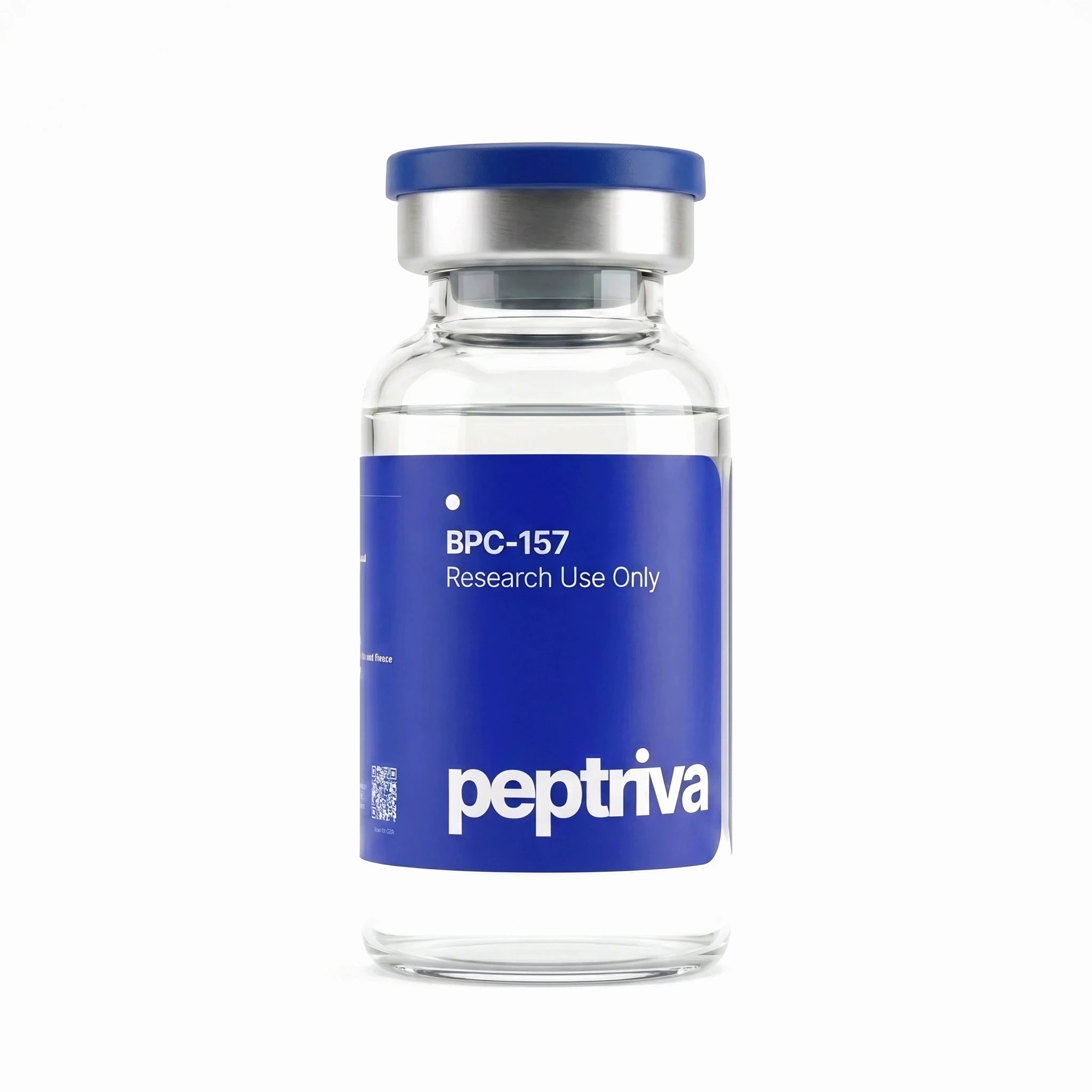
BPC-157
The same pentadecapeptide used across the rodent oral-route studies cited here, supplied as lyophilized powder with a certificate of analysis matched to the lot.
The number nobody has
Bioavailability is the fraction of an administered dose that reaches systemic circulation intact. It is the number that separates a route from a claim, and for oral BPC-157 in humans it has never been published.
A 2026 biopharmaceutical review is the most direct attempt to assemble what is known. It reports a plasma half-life under 30 minutes, linear dose-proportional kinetics, and intramuscular bioavailability of 14–51% depending on species. Those are the only bioavailability figures it carries, and they are neither oral nor human.
Despite over three decades of preclinical research demonstrating consistent biological activity, its pharmaceutical development remains rudimentary, with no approved formulation, no validated dosing regimen, and no completed Phase II clinical trial.
Mateescu et al., Pharmaceutics, 2026The same review describes BPC-157's human pharmacokinetic profile as “critically undercharacterized.” That is the honest status of oral dosing: a route with rodent efficacy data behind it and no human absorption measurement in front of it.
Every human study used a different route
The published human record for BPC-157 is four papers and fewer than fifty exposures. Not one of them is oral.
- Intra-articular. A retrospective knee-pain series of 17 patients, injected into the joint, with no controls and no validated outcome measures.
- Intravesical. A pilot in 12 women with interstitial cystitis, given as a single 10 mg dose instilled around the inflamed bladder wall during cystoscopy.
- Intravenous. A safety pilot in 2 adults who received consecutive 10 mg and 20 mg infusions, which the authors say is far too small to establish anything about safety.
- Oral. Nothing. No published human study has administered BPC-157 by mouth and reported an outcome or a plasma level.
This matters more than it looks. Every one of those three routes bypasses the gut entirely, which means the human dataset says nothing at all about whether swallowing the compound does anything. Reviews of the field reach the same place from the other direction: BPC-157 is treated as investigational, and route is one of the several things nobody has settled.
What a capsule is being sold on
Oral BPC-157 is sold as capsules, sublingual drops and “stabilized” formulations. The argument behind all of them is the gastric-juice finding, compressed into an implication it does not support: because the molecule survives the stomach, an oral dose must work like an injected one.
The rat literature supports something narrower and more interesting. Given continuously in drinking water, at doses set by body weight, BPC-157 produced outcomes the same group reported for injection in the same animals. That is a finding about rats on a continuous-exposure protocol. It is not a bioequivalence claim, and no bioequivalence study exists.
Many unapproved peptides demonstrate favorable tissue repair and metabolic outcomes in animal models, but rigorous human safety data are scarce, and there is potential for serious harm to patients.
Mendias & Awan, Sports Medicine, 2026A supplier listing an oral format is telling you what is in the bottle. It is not telling you what fraction of it gets into your blood, because that number has not been measured in a human by any route except intravenous, where it is 100% by definition.
What would settle it
The study that would answer this is small, cheap and boring: a human pharmacokinetic trial with an oral arm and a subcutaneous arm, plasma sampling over a few hours, and a published area-under-the-curve ratio. That design does not require an efficacy claim, an indication, or a large sample.
It has not been run, and the 2026 review is fairly direct about why. There is no approved formulation to test, no validated dose to test it at, and the regulatory position in the United States, where BPC-157 sits on the FDA's Category 2 list for 503A compounding, discourages the sponsors who would normally fund that work.
Until someone runs it, our read is that “oral BPC-157” describes a format rather than a route with known behavior. The rat work is real, the gastric stability is real, and the step from those to a human oral dose is the step nobody has taken.
BPC-157
Research-use-only material, sold by the vial with batch documentation. Check the certificate of analysis against the batch you receive.
What to know now
- The oral route was genuinely tested — in rats. Drinking water at 10 µg/kg and 10 ng/kg per day is the standard Zagreb protocol.
- The rationale is gastric stability: BPC-157 is reported to survive more than 24 hours in human gastric juice.
- Stability is not absorption. No published study reports oral bioavailability for BPC-157 in humans, and a 2026 review calls its human pharmacokinetics “critically undercharacterized.”
- All four published human studies used other routes entirely — intra-articular, intravesical and intravenous.
- A capsule is a format claim. Treating it as a route claim is the inference the evidence does not carry.
What we're watching
The missing study is a human pharmacokinetic trial with paired oral and subcutaneous arms, and it would be inexpensive to run. We are also watching whether the formulation literature that has started to appear — enteric coatings, permeation enhancers, salt forms — produces a candidate anyone takes into a registered trial, and whether the FDA's Category 2 compounding designation moves in either direction. Any of the three would change this page.
Frequently asked questions
Does oral BPC-157 work?
In rats, oral dosing in drinking water produced results the same research group reported for injection. In humans, nobody has tested it. There is no published human study of oral BPC-157 and no measurement of how much an oral dose absorbs.
What is the oral bioavailability of BPC-157?
Unpublished. A 2026 biopharmaceutical review reports intramuscular bioavailability of 14 to 51 percent depending on species, and describes the human pharmacokinetic profile as critically undercharacterized. No oral figure appears for any species in that review.
Why is BPC-157 given orally in animal studies when other peptides are not?
Because it is reported to survive more than 24 hours in human gastric juice without degrading, which is unusual. Most peptides break down within minutes, so an oral arm would be pointless.
Are oral capsules equivalent to injection?
No study has compared them in humans, so equivalence is unestablished. The rat protocol is continuous dosing in drinking water at body-weight-scaled doses, which is not the same exposure pattern as a capsule taken once or twice a day.
References
- Sikiric, P., Skrtic, A., Gojkovic, S., et al. (2022). Cytoprotective gastric pentadecapeptide BPC 157 resolves major vessel occlusion disturbances. World Journal of Gastroenterology, 28(1), 23–46. https://doi.org/10.3748/wjg.v28.i1.23
- Madzarac, G., Becejac, T., Penovic, T., et al. (2026). Tracheocutaneous fistula resolved by pentadecapeptide BPC 157 therapy through the NO-system-triple NO-agent approach in rats. Pharmaceuticals (Basel), 19(1), 145. https://doi.org/10.3390/ph19010145
- Matek, D., Matek, I., Staresinic, E., et al. (2025). Stable gastric pentadecapeptide BPC 157 as therapy after surgical detachment of the quadriceps muscle for muscle-to-bone reattachment in rats. Pharmaceutics, 17(1), 119. https://doi.org/10.3390/pharmaceutics17010119
- Mateescu, D. M., Gavrilescu, D. M., Constantinescu, F. E., et al. (2026). BPC-157 as an investigational peptide therapeutic: Biopharmaceutical challenges, formulation strategies, and translational development barriers. Pharmaceutics, 18(5), 625. https://doi.org/10.3390/pharmaceutics18050625
- Józwiak, M., Bauer, M., Kamysz, W., & Kleczkowska, P. (2025). Multifunctionality and possible medical application of the BPC 157 peptide — literature and patent review. Pharmaceuticals, 18(2), 185. https://doi.org/10.3390/ph18020185
- Vasireddi, N., Hahamyan, H., Salata, M. J., et al. (2025). Emerging use of BPC-157 in orthopaedic sports medicine: A systematic review. HSS Journal, 21(4). https://doi.org/10.1177/15563316251355551
- McGuire, F. P., Martinez, R., Lenz, A., Skinner, L., & Cushman, D. M. (2025). Regeneration or risk? A narrative review of BPC-157 for musculoskeletal healing. Current Reviews in Musculoskeletal Medicine, 18(12), 611–619. https://doi.org/10.1007/s12178-025-09990-7
- Park, J. M., Lee, H. J., Sikiric, P., & Hahm, K. B. (2020). BPC 157 Rescued NSAID-cytotoxicity Via Stabilizing Intestinal Permeability and Enhancing Cytoprotection. Current Pharmaceutical Design, 26(25), 2971–2981. https://doi.org/10.2174/1381612826666200523180301
- Lee, E., & Padgett, B. (2021). Intra-articular injection of BPC 157 for multiple types of knee pain. Alternative Therapies in Health and Medicine, 27(4), 8–13. PMID 34324435
- Lee, E., Walker, C., & Ayadi, B. (2024). Effect of BPC-157 on symptoms in patients with interstitial cystitis: A pilot study. Alternative Therapies in Health and Medicine, 30(10), 12–17. PMID 39325560
- Lee, E., & Burgess, K. (2025). Safety of intravenous infusion of BPC-157 in humans: A pilot study. Alternative Therapies in Health and Medicine, 31(5), 20–24. PMID 40131143
- Mendias, C. L., & Awan, T. M. (2026). Safety and efficacy of approved and unapproved peptide therapies for musculoskeletal injuries and athletic performance. Sports Medicine. https://doi.org/10.1007/s40279-026-02437-0
- U.S. Food and Drug Administration. (2024). Section 503A of the Federal Food, Drug, and Cosmetic Act. https://www.fda.gov/drugs/human-drug-compounding/section-503a-federal-food-drug-and-cosmetic-act