
The short answer. Every check that matters ends somewhere the vendor does not control. A document you open, a directory you search, a price you load.
- Accreditation belongs to the laboratory, not the seller. Ask which lab, then check the lab, then check the scope covers the method.
- Ask before you order, not after. The certificate for the lot in stock is the one question that sorts suppliers in minutes.
- Reviews carry almost nothing here: only three of ten audited vendors had a rating with real volume behind it.
You can vet a peptide vendor without trusting a single thing it says about itself. There is no register of legitimate sellers in this market and no license to look up, so every usable check is a document you open or a name you look up somewhere else. This page collects the ones that work.
Work outside-in. Start with what the vendor has already published, because that costs you nothing and can be checked against a third party. Move to what it will answer in writing. Buy last. Of sixteen vendors we checked on 13 August 2026, six failed before the documents mattered: four storefronts could not be bought from that day, one is a business-to-business reagent house that states it does not sell to individuals, and one sells no peptides at all.
How can you tell if a peptide vendor is legitimate?
By running four checks, in this order. Each one is settled in about ten minutes, and each has an answer that exists outside the vendor's own site. That last part is what makes them worth running: a standard you cannot audit is an advertisement with numbers on it.
We scored ten vendors on their own storefronts on 13 August 2026. The column on the right is what that audit found, and it is there to show you where the market actually thins out rather than to rank anybody here.
| Check | What clears it | Where you verify it | What the audit found, 13 Aug 2026 |
|---|---|---|---|
| A certificate that opens | A third-party report that loads, for the compound you are buying | The vendor's own product page | Eight of ten publish a real third-party report |
| A laboratory named | The testing lab named in the vendor's own copy, not only on the letterhead | The product page or the site's FAQ | Three of ten name a lab anywhere in their own copy |
| That laboratory is real and accredited for the method | The lab appears in its accreditation body's directory, with a scope covering the assay | The accreditation body's public directory, not the vendor | One certificate in the set carries a checkable A2LA certificate number, Core Peptides' lab at 6377.01.01 |
| A lot code that ties the document to your vial | The lot on the certificate is the lot printed on the vial you receive | The vial in your hand, after it arrives | Only answerable at the point of sale — ask before you order |
Checks one and two fail more often than the rest combined, and they are the cheapest to run. Eight of the ten publish something real; only three tell you who ran it without making you open a PDF and read the letterhead. The seven checks scored across ten vendors is the long version of that audit, and the COA verification checklist is what to do with the document once it arrives.
A vendor is not accredited. A laboratory is. ISO/IEC 17025 accredits a testing laboratory as competent to run specific named methods, and the accreditation lists them. A seller cannot hold it, so “ISO 17025 certified” on a storefront is either shorthand for the lab it uses or a misunderstanding of the standard. Ask which lab, then check the lab. What accreditation actually certifies covers the difference.
What questions should you ask a peptide vendor before purchasing?
Six, and they are worth sending as one email before you order anything. The point is not the answers a vendor is happy to give. It is that each question has a complete answer that costs an honest seller nothing, and an evasive answer that is itself the finding.
| Ask this | A complete answer | An answer that ends the exercise |
|---|---|---|
| Can you send the certificate of analysis for the lot you would ship me? | A document carrying a lot code, a purity result with the method stated, and an identity result | A product-line PDF with no lot code, or “COA available on request” repeated back |
| Which laboratory ran it? | A name, ideally with a certificate number you can look up yourself | “Third-party tested”, a logo, or a lab named only inside a document they will not send |
| Is that the manufacturer's certificate or an independent one? | A direct answer either way — both are legitimate documents that answer different questions | Treating the question as an accusation |
| What is the lot code on the vials you have in stock now? | A code read off the shelf, which you can match on arrival | A promise to send it after payment clears |
| What happens if the lot on my vial does not match the certificate? | A stated policy: reship, refund, or return | Nothing written down anywhere on the site |
| Who is the seller — registered entity and address? | A company name and a real address, which usually appear in the terms or the footer | A contact form and no other identifying detail |
If you send only one, send the first. Here is the wording that gets a usable reply, because a vague ask gets a vague answer:
Hi — before I order, could you send the certificate of analysis for the lot you would ship for [compound]? I am looking for the identity result, the purity result with the method used, and the name of the laboratory that ran them. If the certificate you hold is from the manufacturer rather than an independent lab, please say so.
The last sentence does more work than it looks like it does. Manufacturer certificates and independent certificates are both real documents, and a vendor that distinguishes them without being pushed is telling you how it handles the rest of its evidence.
What makes a peptide vendor trustworthy from a documentation standpoint?
A chain, not a badge. Each link below is checkable, and each one is worth nothing if the link above it is missing. A certificate with no lot code cannot be matched to your vial, however good its numbers are.
- The certificate exists and opens. A file that loads, for the compound you are buying, rather than a purity badge or a claim in the footer.
- It carries a lot or batch code, and that code is the one printed on the vial. This is the link that turns a document into evidence about your material.
- Identity is reported separately from purity. Purity is a chromatographic ratio describing how much of the sample is the main peak. Identity, normally by mass spectrometry, is what establishes which peak it is.
- The method is stated, not just the number. A purity figure with no method attached cannot be compared to anything.
- A laboratory is named, and its accreditation is verifiable in a directory the vendor does not control.
- The scope covers the assay. Accreditation is granted for named methods, so a laboratory can be accredited for one and not another.
The last two links are the ones almost nobody checks, and they are the only ones that leave the vendor's own website. In the United States, A2LA publishes a searchable directory of accredited organizations that takes a certificate number, an organization name or a test method, filtered by program and by accreditation status. It also publishes separate lists of suspended, withdrawn and inactive certificates, and of false claims of accreditation. For a laboratory outside the US, ILAC's signatory search finds the accreditation body for that economy and links through to its own directory of accredited facilities.
For a product in the laboratory research phase of development, and not represented as an effective in vitro diagnostic product, all labeling bears the statement, prominently placed: “For Research Use Only. Not for use in diagnostic procedures.”
— 21 CFR 809.10(c)(2)(i), labeling for in vitro diagnostic products
That paragraph is the origin of the research-use-only convention, and it is worth reading carefully, because it is narrower than the sentence printed on most peptide vials. It governs in-vitro diagnostic products. Research-peptide sellers borrow the wording; nothing in it is a quality credential, and every vendor in this market uses some version of it. What research use only actually covers is the longer version, and the legal status page covers where the category sits.
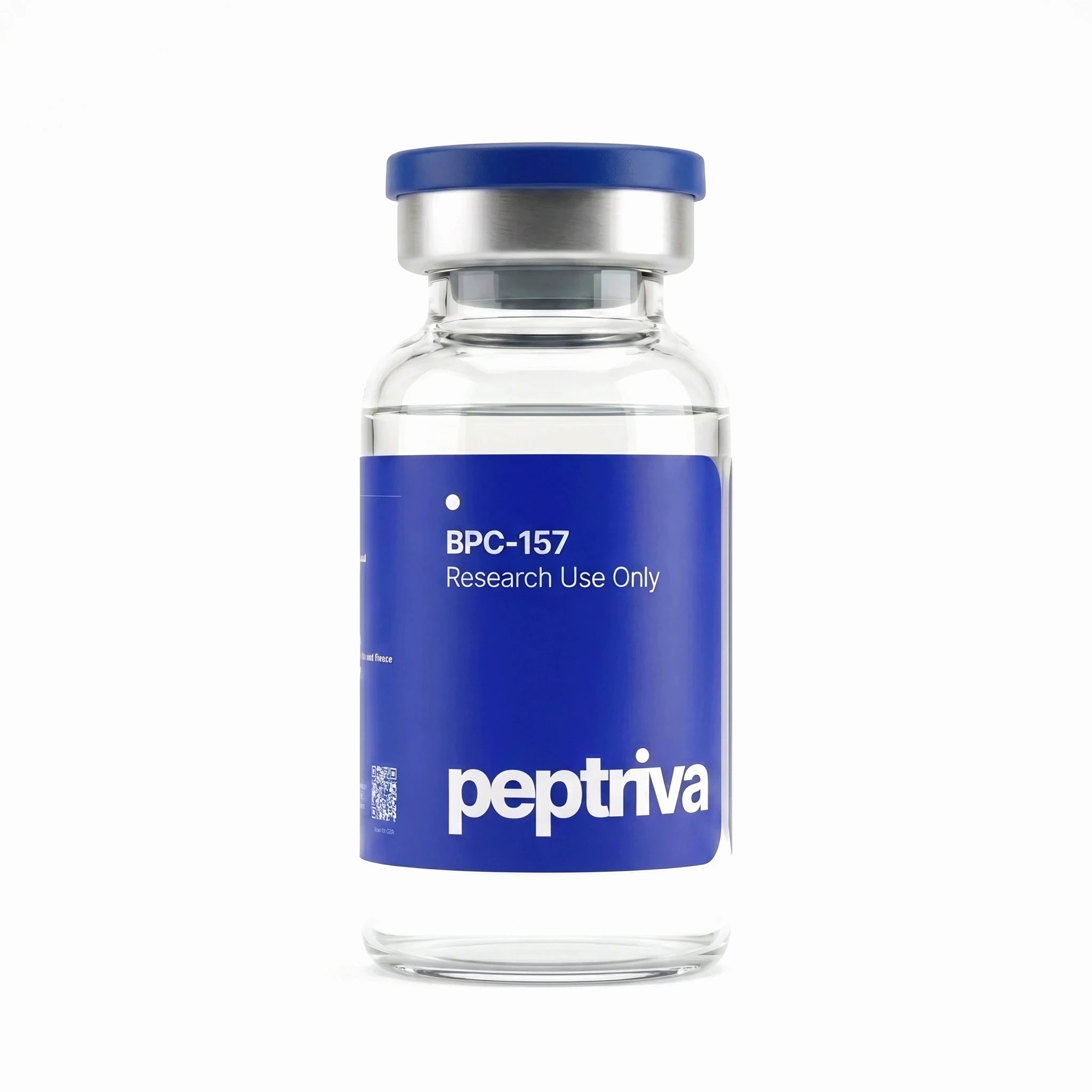
BPC-157
The benchmark compound in this market, and the one every vendor check on this page can be run against. Research-use-only material, sold by the vial with batch documentation.
What are the common red flags when evaluating a research peptide vendor?
None of these prove a product is wrong. Each one means a specific thing is unverified, which is a more useful finding than a verdict, and each has a matching question in the table above.
- “Third-party tested” with no laboratory named. Unverifiable by construction. There is nothing to look up.
- A certificate claim with no certificate. One vendor in our set advertised “Verified With COAs” on 13 August 2026 while publishing none: Red Rock Peptides, which was also the cheapest row in the audit at $6.90 per milligram.
- One certificate covering several products. A certificate describes a batch. A document spanning a catalog is a marketing asset.
- Coverage that stops at the flagship. Swiss Chems published 47 reports against roughly 142 products; Core Peptides and BioTech Peptides both listed SKUs with none.
- Documents older than the inventory. The newest genuine report from Behemoth Labz was dated 8 August 2024 when we checked, two years older than the stock it was standing behind.
- A price under the synthesis floor. Third-party testing is a real per-lot cost, and the cheapest way to remove it is not to do it. Across the set, the same compound ran $6.90 to $12.45 per milligram, roughly 2×.
- Dosing charts or human protocols on the seller's own site. Research-use-only material sold with human instructions is a vendor contradicting its own labeling, which tells you what the label is there for.
- No identifiable company. No entity, no address, no stated policy for a wrong or missing lot.
The price flag is the one people get backwards. A cheap vial is not evidence of a bargain or of fraud; it is a question about which line item was removed. What drives peptide prices works through the cost floor, and the upstream supplier picture covers where the material is actually made.
How do you evaluate peptide vendors without relying on forum recommendations?
By preferring evidence that has an author and a date. A forum thread has neither, and in this category the ratings infrastructure most buyers fall back on barely exists. Of the ten vendors we audited, only three carried a review-platform rating with real volume behind it. Two profiles had been removed for guideline violations and returned HTTP 451, three had no live profile at all, one was live with zero reviews, and one returned a 404.
That is not enough data to rank anyone on, and a market this thin on ratings is a market where fabricated ones work. It is also now a market with a rule attached. The Federal Trade Commission's Rule on the Use of Consumer Reviews and Testimonials, 16 CFR Part 465, took effect on 21 October 2024, and its section headings map the failure modes almost exactly: fake or false consumer reviews, buying positive or negative reviews, insider reviews, company-controlled review websites, and review suppression.
The same body of guidance applies to sites like this one. The FTC's endorsement guides address review sites that take money from the sellers they rank:
When there exists a connection between the endorser and the seller of the advertised product that might materially affect the weight or credibility of the endorsement, and that connection is not reasonably expected by the audience, such connection must be disclosed clearly and conspicuously.
— 16 CFR §255.5, Guides Concerning Use of Endorsements and Testimonials in Advertising
Which is why this page names its own arrangement in the block at the top and on every page. Where To Buy Peptides earns a commission on purchases made through its product links. That is exactly the reason the material here is a method rather than a verdict: a method survives our incentives, and a verdict does not. Our editorial policy sets out what the arrangement does and does not change.
So the replacement for a forum recommendation is not a better forum. It is three things a stranger cannot fake for you: a document you opened, a laboratory you looked up in a directory the vendor does not control, and a price you loaded yourself.
How do you evaluate a peptide vendor you have never bought from before?
In an order that puts the cheap, reversible steps first. Nothing below requires a purchase until step four, and the first three settle most of it.
- Read what is already published. Certificate, lab name, lot codes, entity and address. This is free and takes ten minutes.
- Look the laboratory up in its accreditation body's directory, and check the scope covers the method on the certificate.
- Send the six questions and keep the reply. How fast and how specifically a vendor answers is itself the finding.
- Order the smallest unit sold, not the quantity you want. A first order is a test of the vendor, not a supply run.
- Match the vial to the document on arrival. Lot code first, character for character, before reading a single result.
- Keep the certificate with the lot. If a later batch arrives with the same document, you now know it was reused.
Step five is where a surprising number of vendors fail after passing everything else, because a certificate published for one batch and shipped with the next is easy to miss and cheap to do. How to read a certificate line by line covers what to check once the codes match, and what HPLC purity does and does not prove covers the number people over-read.
What a complete answer looks like in practice. The strongest documentation in our audit named the compound, the lot, the method and the lab together: a certificate reporting 99.58% purity by HPLC with LC-MS identity and an endotoxin pass, against lot BC10-260504, from a laboratory named on the product page rather than buried in the PDF. Every element of that is checkable by a buyer who has not spent anything yet. That is the bar, and it is a bar any vendor could clear.
BPC-157
Research-use-only material, sold by the vial with batch documentation. Check the certificate of analysis against the batch you receive.
What to know now
- Every check that matters ends somewhere the vendor does not control. A document you open, a directory you search, a price you load.
- Accreditation belongs to the laboratory, not the seller. Ask which lab, then check the lab, then check the scope covers the method.
- Ask before you order, not after. The certificate for the lot in stock is the one question that sorts suppliers in minutes.
- Reviews carry almost nothing here: only three of ten audited vendors had a rating with real volume behind it.
- A red flag is a finding, not a verdict. Each one means something specific is unverified, which is what you act on.
What we're watching
Whether any vendor in this market starts publishing certificates retrievable by lot code rather than by product, which is the single change that would make most of this page unnecessary. We are also watching whether the FTC's reviews rule reaches this category, since nothing about a research-chemical storefront exempts it from 16 CFR Part 465.
Frequently asked questions
What is the fastest way to check whether a peptide vendor is legitimate?
Ask for the certificate of analysis for the lot the vendor would ship you, and see whether the document names a laboratory. Those two answers arrive in minutes and sort suppliers further than anything else you can do from outside.
Does a peptide vendor need to be ISO 17025 accredited?
No, and a vendor claiming to be accredited has usually misread the standard. ISO/IEC 17025 accredits a testing laboratory for named methods, not a seller. The check is whether the laboratory on the certificate appears in its accreditation body's directory with a scope covering the method used.
Are online reviews any use for evaluating peptide vendors?
Less than in most categories. Of the ten vendors we audited on 13 August 2026, only three carried a review-platform rating with real volume behind it: two profiles had been removed for guideline violations, three had no live profile, one had zero reviews and one returned a 404. A rating that thin cannot separate suppliers.
What should I ask a peptide vendor before a first order?
Four things: the certificate of analysis for the lot in stock, the name of the laboratory that ran it, whether that certificate is the manufacturer's or an independent one, and what happens if the lot code on the vial does not match the document. A vendor that answers all four in writing has told you most of what an outside check can establish.
Is a vendor that will not name its testing laboratory a scam?
Not necessarily, and treating it that way is the wrong conclusion. It means the testing claim is unverified rather than disproved. Naming a laboratory costs a legitimate vendor nothing, because accredited laboratories are listed in public directories, so the refusal is information about how the vendor handles evidence.
Does a research use only label tell you anything about vendor quality?
No. Research-use-only is a labeling category, not a credential, and every vendor in this market uses it. It says what the material may be sold for. It says nothing about who tested it, or whether the vial matches the document.
References
- Federal Trade Commission. (2024). Trade Regulation Rule on the Use of Consumer Reviews and Testimonials, 16 CFR Part 465. Federal Register, 22 August 2024; effective 21 October 2024. Checked 28 August 2026. https://www.govinfo.gov/content/pkg/FR-2024-08-22/html/2024-18519.htm
- Federal Trade Commission. Guides Concerning Use of Endorsements and Testimonials in Advertising, 16 CFR Part 255, §255.5 (Disclosure of material connections). Code of Federal Regulations, 2024 edition. Checked 28 August 2026. https://www.govinfo.gov/content/pkg/CFR-2024-title16-vol1/pdf/CFR-2024-title16-vol1-part255.pdf
- U.S. Food and Drug Administration. Labeling for in vitro diagnostic products, 21 CFR 809.10(c)(2)(i). Code of Federal Regulations, 2024 edition. Checked 28 August 2026. https://www.govinfo.gov/content/pkg/CFR-2024-title21-vol8/pdf/CFR-2024-title21-vol8-sec809-10.pdf
- American Association for Laboratory Accreditation (A2LA). Directory of Accredited Organizations — searchable by organization, certificate number, scope and test method, with separate listings for suspended, withdrawn and inactive certificates and for false claims of accreditation. Checked 28 August 2026. https://customer.a2la.org/index.cfm?event=directory.index
- International Laboratory Accreditation Cooperation (ILAC). MRA signatory search — find the accreditation body for an economy and its directory of accredited facilities. Checked 28 August 2026. https://ilac.org/signatory-search/
- Where To Buy Peptides. (2026). Sixteen-vendor storefront audit; ten ranked on published documentation and price per milligram.