
No GLOW peptide dosage has ever been established, because no study has given the blend to anybody. Three compounds share the vial, and no trial has ever administered them together in any amount. That's the answer, and we'd rather you had it plainly than dressed up as a chart.
The short answer. GLOW: No study has given BPC-157, TB-500 and GHK-Cu together. There is no measured dose for the blend, and no published pharmacokinetics or stability data for the three in one vial.
- The market standard is 70 mg as 10/10/50, which fixes the ratio at 1:1:5 and puts roughly 8 mg of elemental copper in the vial.
- BPC-157's entire human record is three pilot reports — intra-articular, peri-vesical at 10 mg, and intravenous at 10 then 20 mg. None was a dose-finding trial.
- TB-500 has no published human dose. The regenerative literature is on full-length thymosin β4, which is a different molecule from the fragment usually sold.
No dose has been established for GLOW, because no study has ever given the three compounds together. The blend is BPC-157, TB-500 and GHK-Cu, usually 10 mg, 10 mg and 50 mg in a single vial. Each constituent has its own thin evidence base, by routes the blend does not use. The combination has zero published studies.
This is the dosage page of three. The complete guide covers what is in the vial, at what ratio and what the components cost. GLOW peptide benefits takes each claimed benefit and states the evidence tier behind it. Here we do the only thing a dosage page honestly can: report what the cited studies administered, constituent by constituent, and stop there.
The blend per constituent, and what its cited studies used
The first three columns are a product decision, fixed at fill. The fourth is the only part of the table drawn from published administration, and every entry in it belongs to a single compound rather than to the blend.
| Component | Amount in the vial | Share of the ratio | What the cited studies administered | Route in those studies |
|---|---|---|---|---|
| BPC-157 | 10 mg | 1 part of 1:1:5 | Three published human reports, none of them a dose-finding design. A retrospective knee series (Lee & Padgett, 2021) that set no dose. 10 mg total in a single procedure across 12 patients (Lee et al., 2024). 10 mg on day 1 and 20 mg on day 2 in 2 participants (Lee & Burgess, 2025). Behind those sits a 2025 systematic review that screened 544 articles and included 36 studies, 35 of them animal work. | Intra-articular into the knee; injected around the bladder wall at cystoscopy; intravenous infusion over one hour |
| TB-500 | 10 mg | 1 part of 1:1:5 | No published human dose. The regenerative literature people cite is on full-length thymosin β4, and TB-500 as sold is generally described as a short synthetic fragment of that molecule. Neither line produces a milligram figure for a subcutaneous blend. | The full-length thymosin β4 clinical work has been in dermal wounds, corneal injuries, and the repair of heart and CNS tissue |
| GHK-Cu | 50 mg — about 71% of the mass, carrying roughly 8 mg of elemental copper | 5 parts of 1:1:5 | No published randomized trial of the injectable form, so there is no injectable amount to quote. The controlled human evidence is cosmetic: creams and serums studied over weeks to months, where the variable is formulation concentration — a percentage, not an injected milligram amount. | Topical |
| The blend as supplied | 70 mg total | 1:1:5, fixed at fill | Nothing. No randomized trial, case series, pilot or pharmacokinetic study of the three administered together, and no published stability or compatibility data for the three co-lyophilized in one vial. | Never administered as a blend in any published study |
Nothing in the fourth column is a protocol, and none of it converts into one. Two of the three components have no published human amount at all; the third has three pilot reports with no dose-finding trial among them; and the routes on record are intra-articular, peri-vesical, intravenous and topical, none of which is a subcutaneous 70 mg blend. Reading a number out of that table and applying it to this vial would change the compound’s company, the route and the context in one move.
What is in the vial
The market standard is a single lyophilized cake totaling 70 mg: 10 mg BPC-157, 10 mg TB-500 and 50 mg GHK-Cu. That fixes the ratio at 1:1:5 before anyone touches it. The four-compound KLOW vial keeps those three amounts and adds 10 mg of KPV, for 80 mg at 1:1:5:1 — KLOW vs GLOW.
GHK-Cu is a copper complex, so the copper travels with it. At a molecular weight near 404 with copper contributing about 63.5 of that, a 50 mg component carries roughly 8 mg of elemental copper into the vial. That is a fact about the formulation, not a claim about what it does — nobody has published what happens to it.
Two of the three are tissue-repair compounds and one is a skin compound. The pairing is a marketing thesis, and there is nothing wrong with a thesis. It becomes a problem when it is presented with a milligram schedule attached, because the schedule has no source.
Nothing has been given as a blend
This is the whole answer, and it's worth stating without hedging. We searched the literature for the three together and found nothing. No randomized trial, no case series, no pilot, no pharmacokinetic study. No published stability or compatibility data for the three co-lyophilized in one vial, either.
A blend is not the sum of its parts on paper. Co-administration can change absorption, and co-lyophilization can change what survives reconstitution. Both are empirical questions. For GLOW, neither has been asked in print — so a dosing chart for the blend is not summarizing weak evidence. It is summarizing none.
What follows is what the constituents were given at, separately, so the distance between those studies and a subcutaneous 70 mg blend is visible rather than assumed.
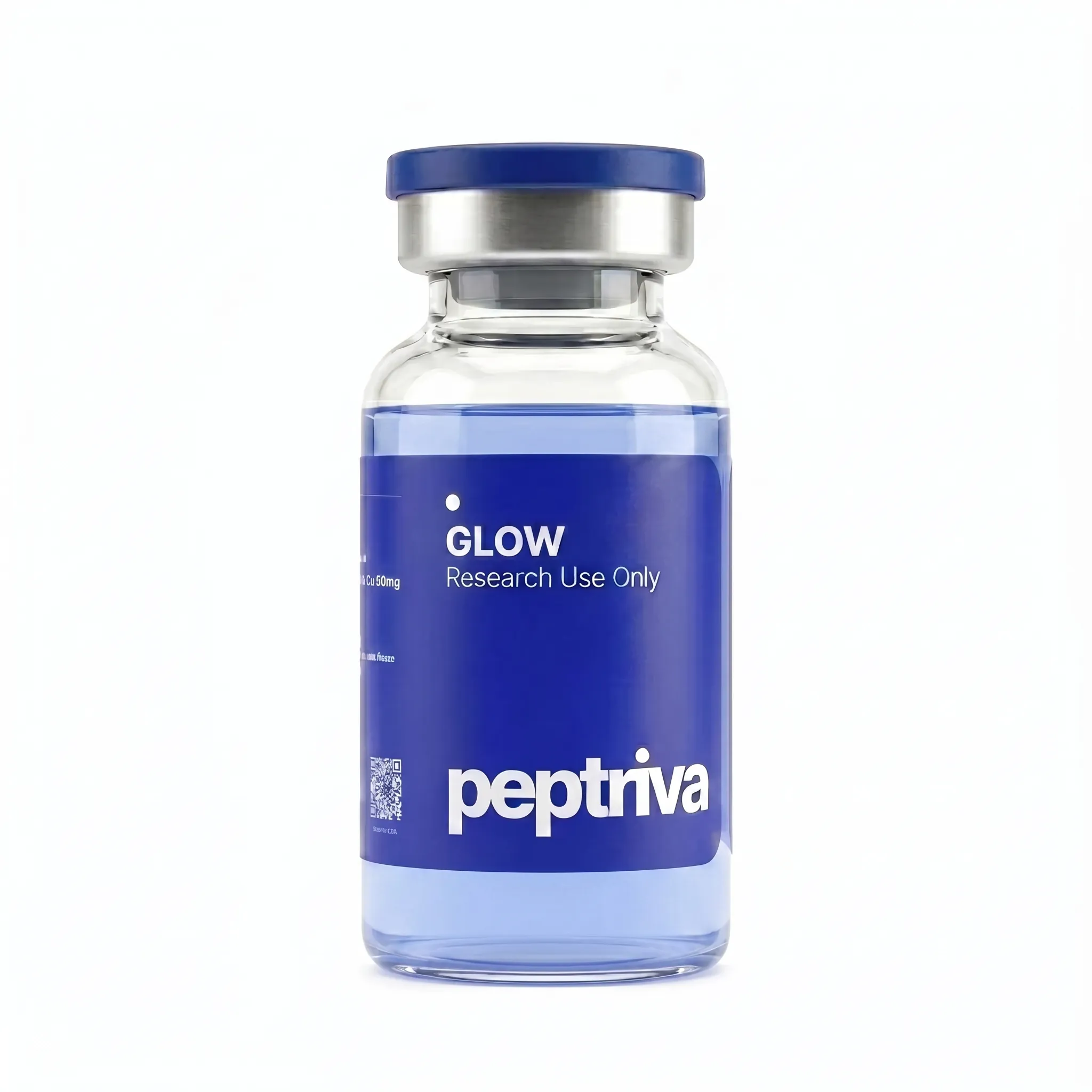
GLOW Blend
The three-component blend discussed here, supplied as a research compound with a certificate of analysis matched to the lot.
What each constituent was administered at
BPC-157 is the only one of the three with published human administration, and the routes are not the ones this blend implies.
| Study | Compound | Dose administered | Route |
|---|---|---|---|
| Lee & Padgett, 2021 | BPC-157 | Not a dose-finding design; retrospective series | Intra-articular, knee |
| Lee et al., 2024 | BPC-157 | 10 mg total, single procedure, 12 patients | Injected around the bladder wall at cystoscopy |
| Lee & Burgess, 2025 | BPC-157 | 10 mg on day 1, 20 mg on day 2, 2 participants | Intravenous infusion over one hour |
Set against the preclinical base, those three reports are the entire human record. A 2025 systematic review in HSS Journal screened 544 articles and included 36 studies, of which 35 were animal work.
A total of 544 articles from 1993 to 2024 were identified. After duplicates were removed, 36 studies were included (35 preclinical studies, 1 clinical study).
Vasireddi et al., HSS Journal, 2025A 2025 narrative review reached the same place from a different direction, counting the pilots and drawing the obvious conclusion.
Until well-designed clinical trials are conducted, BPC-157 should be considered investigational, and its use approached with caution.
McGuire et al., Current Reviews in Musculoskeletal Medicine, 2025TB-500 has no published human dose at all. The regenerative literature people cite is on full-length thymosin β4, the naturally occurring peptide. Its clinical work has been in dermal wounds, corneal injuries and the repair of heart and CNS tissue.
TB-500 as sold is generally described as a short synthetic fragment of that molecule. Work defining activity in short peptide sequences is separate from the trials of the full-length one. Neither line produces a milligram figure for a subcutaneous blend.
GHK-Cu has controlled human data, and it's topical. The cosmetic literature studies creams and serums over weeks to months. The variable is formulation concentration, a percentage, not an injected milligram amount.
Recent work on skin permeation and delivery strategies exists precisely because getting the peptide across the barrier is the open problem. No published randomized trial of injectable GHK-Cu exists, so there's no injectable dose to quote you.
GHK (glycyl-L-histidyl-L-lysine) is present in human plasma, saliva, and urine but declines with age.
Pickart et al., BioMed Research International, 2015The fixed ratio is its own problem
Even if each constituent had an established dose, the blend would not inherit them, because a co-lyophilized vial removes the ability to give any of them independently.
- One draw, three doses. Every volume drawn delivers all three in the ratio the filler chose. Adjusting one means adjusting all of them, in lockstep, by the same factor.
- The ratio came from nowhere. No study selected 1:1:5. It is a product decision, and GHK-Cu is much the cheapest of the three per milligram, which is a reason to be curious about why it makes up 71% of the mass.
- The routes do not line up. The human BPC-157 doses were intra-articular, peri-vesical and intravenous. The GHK-Cu evidence is topical. A subcutaneous blend matches none of them, so even the transfer of a single number from a single study would be a change of route as well as a change of context.
Half-life makes the mismatch worse rather than better: the systematic review puts BPC-157's at under 30 minutes, cleared renally after hepatic metabolism. Three compounds with different clearances, locked into one ratio, on a schedule nobody has measured.
What can actually be checked
The dose cannot be sourced. The material can be.
- Ask for weight percent per component, not just purity. A vial can hit 70 mg total while being mostly the cheap constituent, and three separate ≥98% purity figures will not reveal it. Only a component breakdown will.
- Check identity for all three. Mass-spec identity on one component says nothing about the other two, and a blend is exactly where partial testing hides.
- Price the components separately. If a 70 mg tri-blend costs less than its three constituents bought individually, that gap is information about what is in the cake.
Our editorial line doesn't change because a product is a blend. We report what trials administered, and where nothing was administered we say so instead of publishing a chart. For GLOW, nothing was administered.
Three of our pages take this further. How to read a COA covers the component checks. The complete guide works through the per-constituent evidence. GHK-Cu dosage covers the topical-versus-injectable split.
GLOW Blend
Research-use-only material, sold by the vial with batch documentation. Check the certificate of analysis against the batch you receive.
Each constituent appears separately in our peptide dosage chart, which is the clearest way to see how far the blend sits from anything that was ever studied.
Because the vial holds three compounds at a fixed ratio, the per-component arithmetic is easy to get wrong; the peptide calculator works from the total mass and the diluent volume. For what has actually been measured rather than administered, see GLOW peptide before and after.
What to know now
- No study has given BPC-157, TB-500 and GHK-Cu together. There is no measured dose for the blend, and no published pharmacokinetics or stability data for the three in one vial.
- The market standard is 70 mg as 10/10/50, which fixes the ratio at 1:1:5 and puts roughly 8 mg of elemental copper in the vial.
- BPC-157's entire human record is three pilot reports — intra-articular, peri-vesical at 10 mg, and intravenous at 10 then 20 mg. None was a dose-finding trial.
- TB-500 has no published human dose. The regenerative literature is on full-length thymosin β4, which is a different molecule from the fragment usually sold.
- GHK-Cu's controlled human evidence is topical and measured as formulation concentration. There is no published randomized trial of the injectable form.
What we're watching
The realistic first change isn't a blend trial, because nobody funds those. It's a proper dose-finding study of BPC-157 alone, which both 2025 reviews call for explicitly. That would give one of the three constituents a number for the first time.
We're also watching the paperwork. If suppliers start publishing weight-percent-per-component certificates as standard, you'd at least be able to check the composition claim while the dosing question stays open.
Frequently asked questions
What is the correct GLOW peptide dose?
There isn't one. No published study has administered BPC-157, TB-500 and GHK-Cu together, so no dose for the blend has ever been measured. Any schedule in circulation was reconstructed from the constituents, not from a study of the blend.
What is in a GLOW blend vial?
Typically 70 mg as a single lyophilized cake: 10 mg BPC-157, 10 mg TB-500 and 50 mg GHK-Cu. The 50 mg GHK-Cu component carries roughly 8 mg of elemental copper.
Can I use the individual doses for each compound?
Two of the three have no established dose to borrow. BPC-157 has three human pilot reports, none of them dose-finding and none subcutaneous. TB-500 has no published human dose. GHK-Cu's controlled human evidence is topical, measured as a formulation percentage rather than an injected amount.
Why does the fixed ratio matter?
Because a co-lyophilized vial can't be dosed one component at a time. Every draw delivers all three in the ratio the filler chose, so the three can only move together. That's the opposite of what a dose-finding study needs to do.
Has the GLOW combination been tested at all?
No. There is no randomized trial, case series, pilot study or pharmacokinetic report of the three compounds administered together, and no published stability data for them co-lyophilized.
References
- Vasireddi, N., Hahamyan, H., Salata, M. J., et al. (2025). Emerging use of BPC-157 in orthopaedic sports medicine: A systematic review. HSS Journal, 21(4). https://doi.org/10.1177/15563316251355551
- McGuire, F. P., Martinez, R., Lenz, A., Skinner, L., & Cushman, D. M. (2025). Regeneration or risk? A narrative review of BPC-157 for musculoskeletal healing. Current Reviews in Musculoskeletal Medicine, 18(12), 611–619. https://doi.org/10.1007/s12178-025-09990-7
- Lee, E., & Padgett, B. (2021). Intra-articular injection of BPC 157 for multiple types of knee pain. Alternative Therapies in Health and Medicine, 27(4), 8–13. PMID 34324435
- Lee, E., Walker, C., & Ayadi, B. (2024). Effect of BPC-157 on symptoms in patients with interstitial cystitis: A pilot study. Alternative Therapies in Health and Medicine, 30(10), 12–17. PMID 39325560
- Lee, E., & Burgess, K. (2025). Safety of intravenous infusion of BPC-157 in humans: A pilot study. Alternative Therapies in Health and Medicine, 31(5), 20–24. PMID 40131143
- Seiwerth, S., Milavic, M., Vukojevic, J., et al. (2021). Stable gastric pentadecapeptide BPC 157 and wound healing. Frontiers in Pharmacology, 12, 627533. https://doi.org/10.3389/fphar.2021.627533
- Goldstein, A. L., Hannappel, E., Sosne, G., & Kleinman, H. K. (2012). Thymosin β4: A multi-functional regenerative peptide. Basic properties and clinical applications. Expert Opinion on Biological Therapy, 12(1), 37–51. https://doi.org/10.1517/14712598.2012.634793
- Sosne, G., Qiu, P., Goldstein, A. L., & Wheater, M. (2010). Biological activities of thymosin β4 defined by active sites in short peptide sequences. FASEB Journal, 24(7), 2144–2151. https://doi.org/10.1096/fj.09-142307
- Pickart, L., Vasquez-Soltero, J. M., & Margolina, A. (2015). GHK peptide as a natural modulator of multiple cellular pathways in skin regeneration. BioMed Research International, 2015, 648108. https://doi.org/10.1155/2015/648108
- Dymek, M., Warszyński, P., & Sikora, E. (2023). GHK Peptide Permeability and Its Effects in Anti-Aging Skincare Topical Formulations. Pharmaceutics, 15(10), 2485. https://doi.org/10.3390/pharmaceutics15102485
- Ogórek, P., Gostińska, K., Wahab, S., et al. (2025). GHK-Cu in cosmetic applications: skin permeation and delivery strategies. Molecules, 30(1), 136. https://doi.org/10.3390/molecules30010136