
Every GLOW peptide benefit you'll see claimed belongs to one of its three ingredients, because the blend itself has zero published studies in any species. The compounds are genuine. The combination they're sold in has never been tested.
The short answer. GLOW is a blend, not a compound — BPC-157, TB-500 and GHK-Cu, typically 10/10/50 mg in one 70 mg vial.
- The combination has zero published studies in any species. Every benefit attributed to it comes from one ingredient's literature.
- BPC-157's leading review counts 35 preclinical studies against 1 human one, and that human study is an uncontrolled case series.
- GHK-Cu is the best-evidenced constituent, but for topical use. Injectable GHK-Cu has no human randomized trials.
GLOW puts three research compounds in one vial: BPC-157, TB-500 and GHK-Cu, usually at 10 mg, 10 mg and 50 mg. Each has its own literature. The combination has zero published studies in any species. Every benefit claimed for it is borrowed from one ingredient.
The three GLOW pages in this library answer different questions. The complete guide is the product page: what is in the vial, at what ratio, and what the components cost. GLOW peptide dosage sets out what each constituent’s cited studies actually administered. This page does one thing — it takes the benefits claimed for GLOW one at a time and states the tier of evidence behind each.
The seven benefits claimed for GLOW, with the tier behind each
Every benefit below belongs to one ingredient, never to the mixture. We label each with one of five tiers, so the claim and the strength of its support arrive together rather than one paragraph apart.
| Tier | What it means | What it can support |
|---|---|---|
| Human, topical | Replicated human and dermal literature for a compound applied to skin | Claims about that compound, applied that way. This vial is injected, so the route does not carry across. |
| Human, uncontrolled | A retrospective case series with no control arm and no validated outcome measures | A hypothesis worth testing. Not an effect size, and not a probability that it works for you. |
| Animal only | Preclinical work with no human outcome | A mechanism worth investigating. Stating it in human terms is species transfer. |
| In vitro only | A number measured in cell culture or a cell-free system | That the chemistry happens in a dish. Nothing about a person. |
| No study | Nothing published, in any species, for the claim | Nothing. This is the tier the blend itself sits in. |
- 1. Tendon, ligament and soft-tissue repair — tier: animal only. From BPC-157, whose mechanism story is the most cited of the three: VEGFR2 activation with downstream nitric-oxide signaling, ERK1/2 activation, and fibroblast recruitment into injury sites. In the leading 2025 systematic review, 35 of 36 included studies are preclinical, and the great majority of that corpus comes from a single research group in Zagreb.
- 2. Knee pain relief — tier: human, uncontrolled. Also BPC-157, and this is the single human entry in that review: a retrospective knee-pain case series of 17 patients with no control arm and no validated outcome measures. It is the strongest human item anywhere in the vial, and it is a chart review.
- 3. Wound closure and faster cell migration — tier: animal only. From TB-500, which has the clearest mechanism of the three: thymosin beta-4 makes up roughly 70–80% of all beta-thymosins in the human body and binds monomeric G-actin in a 1:1 ratio, controlling the actin dynamics a cell uses to crawl into a wound. The wound-healing work behind the claim spans cornea, heart, kidney and skin, and none of it is a human outcome.
- 4. New blood-vessel growth — tier: animal only. Angiogenesis is described downstream of TB-500 in the same preclinical literature. TB-500 has no published human studies for the recovery, athletic and aesthetic uses it is sold for.
- 5. Hair-follicle development — tier: animal only. Same source, same literature, same gap. It is a preclinical finding stated in human terms whenever it appears on a benefits list.
- 6. Skin remodeling, the “glow” itself — tier: human, topical. From GHK-Cu, the best-evidenced constituent by some distance: independent groups report skin remodeling, wound healing and matrix effects, and serum GHK averages about 200 ng/mL at age 20, falling to roughly 80 ng/mL by age 60, which is where the anti-aging framing comes from. Almost all of that evidence concerns GHK-Cu applied to skin. Injectable GHK-Cu has no human randomized trials, and the injectable format is what this vial contains.
- 7. Photoaging protection through elastase inhibition — tier: in vitro only. One 2023 liposome study measured 48.9% elastase inhibition. That is the sort of number the photoaging claims rest on, and it was measured in a dish rather than on a face.
And the claim sitting underneath all seven: that GLOW delivers any of this as a blend. Tier: no study. There is no published study of BPC-157, TB-500 and GHK-Cu administered together, in humans, in animals or in cell culture. No pharmacokinetics for the combination, no comparison against any single constituent, and no safety data for the co-formulation as a co-formulation. The sections below take each constituent on its own evidence, then return to what is left for the blend.
What is actually in the vial
“GLOW” is a market name, not a compound. It's a co-formulated blend of three research peptides in one lyophilized cake. The de facto standard ratio is 10 mg BPC-157, 10 mg TB-500 and 50 mg GHK-Cu, for 70 mg total.
The rationale offered for the trio is division of labor: growth-factor signaling, cell migration, matrix remodeling. Three mechanisms that don't overlap is a reasonable hypothesis for why a combination might beat any single part. It's also the entire theoretical case. The same argument is used to sell a four-compound version, KLOW, which adds KPV to the trio — KLOW vs GLOW sets the two vials side by side.
The sections below take each constituent on its own evidence, then ask what's left for the blend. We've kept them separate deliberately, because collapsing them is how the claims in this category get manufactured.
BPC-157: broad in rodents, almost absent in people
BPC-157 is a synthetic 15-amino-acid peptide derived from a sequence found in human gastric juice. It has by far the largest preclinical footprint of the three. Its mechanism story is also the most cited: VEGFR2 activation with downstream nitric-oxide signaling, ERK1/2 activation, and fibroblast recruitment into injury sites.
A 2025 systematic review in the orthopaedic sports-medicine literature counted 36 studies meeting its criteria: 35 preclinical and 1 human. That ratio is the compound's defining feature. The single human entry is a retrospective knee-pain case series of 17 patients with no control arm and no validated outcome measures.
Despite the robust preclinical findings, human data are extremely limited, no large-scale randomized trials exist, and BPC-157 should be considered investigational pending well-designed clinical trials.
McGuire et al., Current Reviews in Musculoskeletal Medicine, 2025A second structural caveat that reviewers keep flagging: the great majority of that preclinical corpus comes from one research group in Zagreb. Consistency within a single lab is not the same thing as independent replication.
TB-500: the best-characterized molecule, the thinnest clinical record
TB-500 is the research-market name for thymosin beta-4 or its active fragment. Confusingly, the molecular biology here is the most solid of the three.
Thymosin beta-4 makes up roughly 70–80% of all beta-thymosins in the human body. It binds monomeric G-actin in a 1:1 ratio, which is how it controls the actin dynamics a cell uses to crawl into a wound.
Downstream of that, the preclinical literature describes angiogenesis, wound healing and hair-follicle development, and animal work spans cornea, heart, kidney and skin. It's a legitimately interesting molecule with a mechanism you can draw.
None of that is a human outcome. TB-500 is sold for recovery, athletic and aesthetic uses. A 2026 sports-medicine review places it among unapproved peptides for which rigorous human safety data are scarce and serious harm can't be excluded.
There's also a labeling problem that affects what you're buying. “TB-500” may mean full-length thymosin beta-4 or only its active fragment, and suppliers don't consistently declare which. A certificate confirming purity doesn't necessarily confirm which of the two molecules was made.
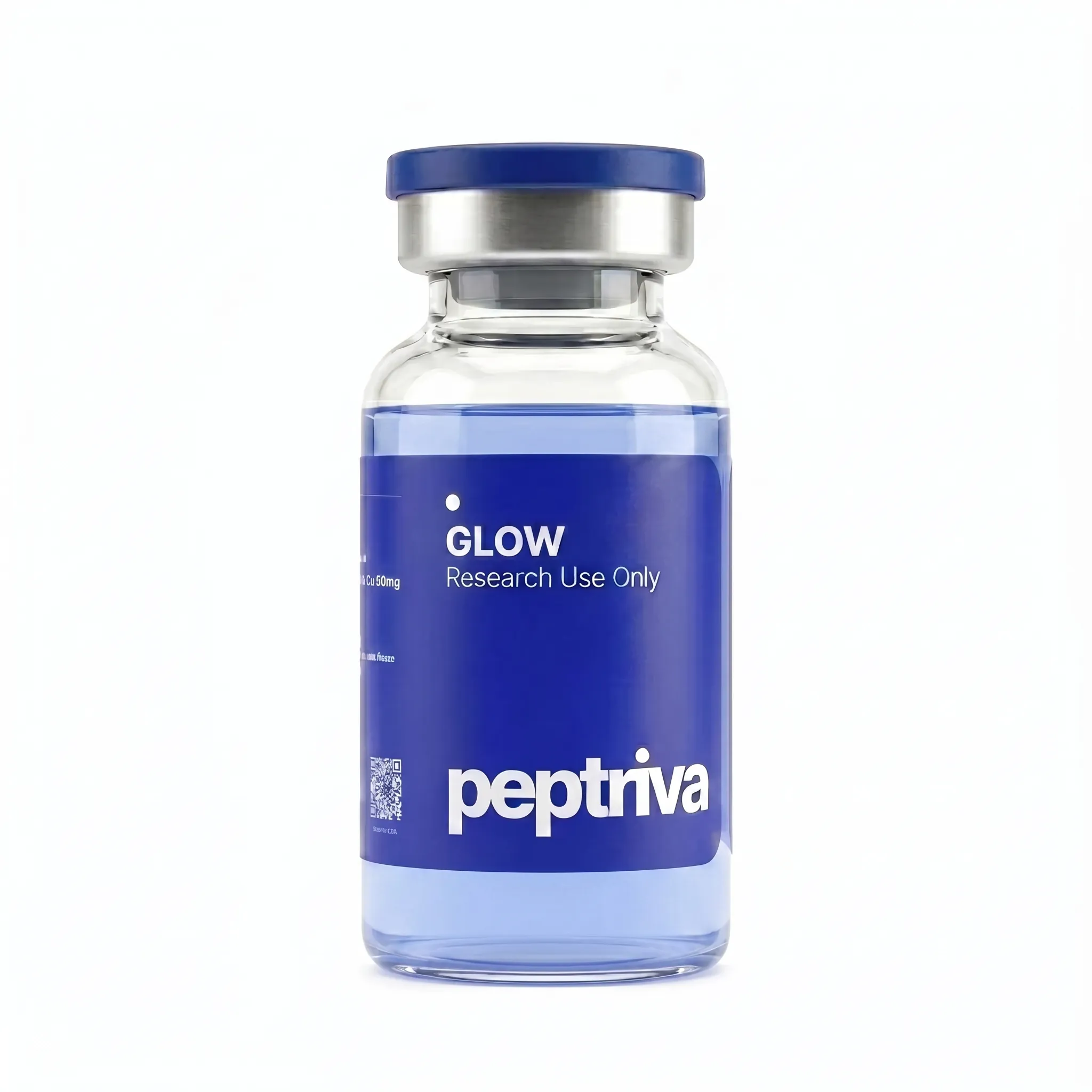
GLOW blend
The three compounds discussed here in one lyophilized vial, with per-component identity testing and a certificate of analysis matched to the lot.
GHK-Cu: real evidence, for a route this blend does not use
GHK is a naturally occurring tripeptide in human serum, and its copper complex is the compound that puts the “glow” in the name. Serum levels average about 200 ng/mL at age 20 and fall to roughly 80 ng/mL by age 60, which is where the anti-aging framing originates.
GHK is a naturally occurring peptide found in human serum with levels averaging 200 ng/ml at age 20 but declining to an average of 80 ng/ml by age 60.
Dou et al., Aging Pathobiology and Therapeutics, 2020The dermal literature is the most replicated of anything in this vial. Independent groups report skin remodeling, wound healing and matrix effects. Formulation studies quantify the mechanism, and one 2023 liposome study measured 48.9% elastase inhibition in vitro. That's the sort of number the photoaging claims rest on.
- Almost all of it is topical. Decades of cosmetic use, and the replicated wound-healing work, concern GHK-Cu applied to skin.
- Skin penetration is itself a problem. The same formulation literature exists because GHK-Cu crosses the stratum corneum poorly and needs carriers to get anywhere.
- Injectable GHK-Cu has no human randomized trials. The blend inherits the injectable evidence tier, which is empty, not the topical one, which is not.
This is the cleanest example in the whole category of a route swap sold as an evidence transfer. Topical GHK-Cu having good data doesn't tell you what injected GHK-Cu does, and no study has looked.
What the blend itself has been shown to do
Nothing. We found no published study of BPC-157, TB-500 and GHK-Cu administered together, in humans, in animals, or in cell culture. No pharmacokinetics for the combination. No comparison against any single constituent. No safety data for the co-formulation as a co-formulation.
The closest thing in the record is a footnote inside the knee-pain series. Of the 16 patients reached for follow-up, 4 had received BPC-157 combined with TB-500, and 75% of that subgroup reported improvement.
That's two of the three compounds, in four people, uncontrolled, retrospective, and collected by phone survey months later. It can't support a conclusion about a two-compound stack, let alone a three-compound one.
This is the inference to refuse: “BPC-157 has tendon data, therefore GLOW helps tendons.” The blend has no tendon data. It contains a compound with rodent tendon data. Those are different sentences, and only one of them is true.
We're not arguing the blend does nothing. We're saying nobody has looked. The obvious experiment, the combination against each constituent on any endpoint in any species, has never been run.
How to read a GLOW benefits list
Almost every benefit claim for this blend is produced by one of three moves. Once you can name them, the lists become easy to audit.
- Constituent-to-blend transfer. An ingredient's evidence is attributed to the mixture. This is the most common move and the least defensible, because co-formulation changes exposure and nobody has measured it.
- Route transfer. Topical GHK-Cu findings are used to sell an injected product. The compound is the same; the pharmacology is not.
- Species transfer. Rodent results are stated in human terms. For BPC-157 that is 35 of the 36 studies in the leading review.
One more thing matters if the blend goes anywhere near tested sport. It's two prohibited compounds in a single vial. BPC-157 has been on the WADA Prohibited List under S0 since January 2022, and thymosin beta-4 falls under S2.
Our read: three real molecules, one untested combination, and a benefits list that borrows from all three without earning any of it.
GLOW blend
Research-use-only material, sold by the vial with batch documentation. Check the certificate of analysis against the batch you receive.
What to know now
- GLOW is a blend, not a compound — BPC-157, TB-500 and GHK-Cu, typically 10/10/50 mg in one 70 mg vial.
- The combination has zero published studies in any species. Every benefit attributed to it comes from one ingredient's literature.
- BPC-157's leading review counts 35 preclinical studies against 1 human one, and that human study is an uncontrolled case series.
- GHK-Cu is the best-evidenced constituent, but for topical use. Injectable GHK-Cu has no human randomized trials.
- TB-500 has the clearest mechanism of the three and no published human studies for the uses it is sold for.
What we're watching
One study would change this page entirely: a factorial comparison of the blend against each constituent alone, on any endpoint, in any species. Nobody has run the obvious experiment, and it wouldn't be expensive.
We're also watching for an injectable GHK-Cu human safety dataset, which is the single largest hole in the vial, and for regulatory movement on BPC-157's Category 2 compounding designation.
Until at least one of those appears, the honest description stays the same. Three real molecules, one untested combination.
Frequently asked questions
What are the benefits of the GLOW peptide blend?
None have been demonstrated for the blend. No study has tested the three compounds together in any species. Benefits described in marketing are drawn from the separate literatures of BPC-157, TB-500 and GHK-Cu, which are mostly rodent studies and, for GHK-Cu, mostly topical.
Is GLOW better than buying the three peptides separately?
More convenient, not better evidenced. A pre-mix guarantees the ratio and saves steps, but it fixes you at 10/10/50 and makes single-variable work impossible. No study has compared the co-formulation with the constituents given separately.
Does GLOW work for skin?
Unknown. GHK-Cu has replicated skin-remodeling evidence when applied topically, which is not the route this blend uses. Injectable GHK-Cu has no published human randomized trials, and the blend has none at all.
Is the GLOW blend banned in sport?
Treat it as prohibited. BPC-157 has been listed by WADA under S0 since January 2022 and thymosin beta-4 falls under S2, so the vial contains two prohibited compounds. Verify current status with the relevant governing body.
References
- Vasireddi, N., Hahamyan, H., Salata, M. J., et al. (2025). Emerging use of BPC-157 in orthopaedic sports medicine: A systematic review. HSS Journal, 21(4). https://doi.org/10.1177/15563316251355551
- McGuire, F. P., Martinez, R., Lenz, A., Skinner, L., & Cushman, D. M. (2025). Regeneration or risk? A narrative review of BPC-157 for musculoskeletal healing. Current Reviews in Musculoskeletal Medicine, 18(12), 611–619. https://doi.org/10.1007/s12178-025-09990-7
- Józwiak, M., Bauer, M., Kamysz, W., & Kleczkowska, P. (2025). Multifunctionality and possible medical application of the BPC 157 peptide — literature and patent review. Pharmaceuticals, 18(2), 185. https://doi.org/10.3390/ph18020185
- Lee, E., & Padgett, B. (2021). Intra-articular injection of BPC 157 for multiple types of knee pain. Alternative Therapies in Health and Medicine, 27(4), 8–13. PMID 34324435
- Ying, Y., Lin, C., Tao, N., et al. (2023). Thymosin β4 and actin: Binding modes, biological functions and clinical applications. Current Protein and Peptide Science, 24(1), 78–88. https://doi.org/10.2174/1389203724666221201093500
- Philp, D., Goldstein, A. L., & Kleinman, H. K. (2004). Thymosin beta4 promotes angiogenesis, wound healing, and hair follicle development. Mechanisms of Ageing and Development, 125(2), 113–115. https://doi.org/10.1016/j.mad.2003.11.005
- Xing, Y., Ye, Y., Zuo, H., & Li, Y. (2021). Progress on the Function and Application of Thymosin β4. Frontiers in Endocrinology, 12, 767785. https://doi.org/10.3389/fendo.2021.767785
- Mendias, C. L., & Awan, T. M. (2026). Safety and efficacy of approved and unapproved peptide therapies for musculoskeletal injuries and athletic performance. Sports Medicine. https://doi.org/10.1007/s40279-026-02437-0
- Dou, Y., Lee, A., Zhu, L., et al. (2020). The potential of GHK as an anti-aging peptide. Aging Pathobiology and Therapeutics, 2(1), 58–61. https://doi.org/10.31491/apt.2020.03.014
- Pickart, L., & Margolina, A. (2018). Regenerative and protective actions of the GHK-Cu peptide in the light of the new gene data. International Journal of Molecular Sciences, 19(7), 1987. https://doi.org/10.3390/ijms19071987
- Dymek, M., Warszyński, P., & Sikora, E. (2023). GHK Peptide Permeability and Its Effects in Anti-Aging Skincare Topical Formulations. Pharmaceutics, 15(10), 2485. https://doi.org/10.3390/pharmaceutics15102485
- Ogórek, P., Gostińska, K., Wahab, S., et al. (2025). GHK-Cu in cosmetic applications: skin permeation and delivery strategies. Molecules, 30(1), 136. https://doi.org/10.3390/molecules30010136
- Lee, M., Kim, B., Kim, S., et al. (2023). Photo-crosslinkable hyaluronic acid hydrogel with GHK peptide nanofibers for wound healing. Acta Biomaterialia. https://doi.org/10.1016/j.actbio.2023.10.011