
You can buy KPV from research-supply vendors online, or occasionally from a compounding pharmacy if a prescriber writes for it. Nobody sells it over a retail pharmacy counter. That's the honest answer to where to buy KPV, and the rest of this guide is about telling good vendors from careless ones.
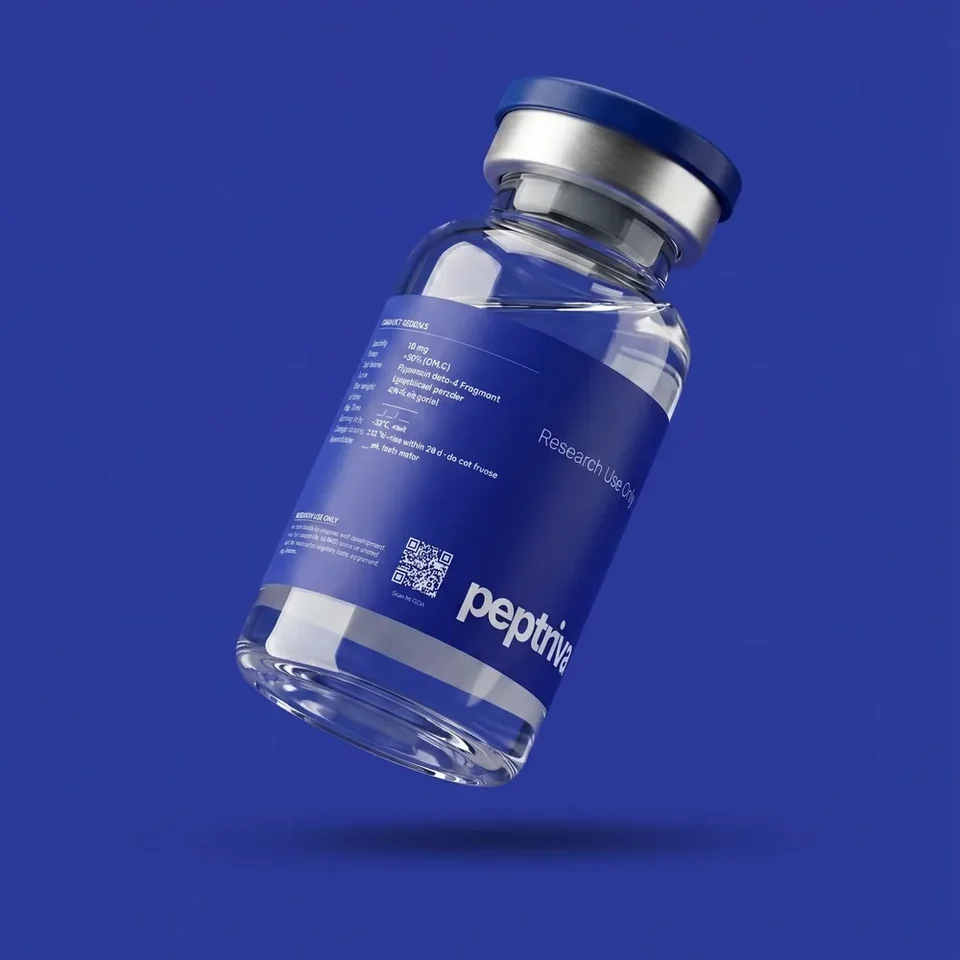
KPV
Referenced in this guideThe KPV referenced throughout this article, supplied as a research compound with a certificate of analysis matched to the lot you receive — the check this site argues you should hold any supplier to.
KPV is a synthetic three-amino-acid peptide, Lys-Pro-Val, molecular weight 342.4 g/mol, and the tail end of a natural hormone. Research-supply vendors are the route, though compounding pharmacies will prepare it on prescription, at $40–$80 per 5–10 mg vial. Two traps recur: longer fragments sold as KPV, and oral capsules with no delivery system.
The 60-second answer: Buy from a research-supply vendor. Get a third-party CoA showing HPLC purity ≥98%, mass-spec at 342.4 g/mol, and the sequence Lys-Pro-Val and nothing more. Expect $40–$80 per vial.
Where can you buy KPV?
KPV comes from research-supply vendors online, and occasionally from a compounding pharmacy if you have a prescriber. KPV has the quietest regulatory profile of any peptide in this guide: no FDA approval, no scheduled status, no WADA listing. Here's what that leaves you.
- Doctor's prescription: Not available. KPV isn't an FDA-approved drug, so no physician can write a normal prescription for it.
- Compounding pharmacy: Unusual, but real. Some compounding pharmacies will prepare KPV against a prescription. The FDA hasn't formally evaluated it under the 503A bulk-drug-substances framework, so the status is ambiguous and can change.
- Research-supply vendor: The standard channel. Lyophilized powder, meaning freeze-dried, sold under Research Use Only labeling. No prescription needed.
Most readers land in the third row. We'd still ask a compounder first if you have a prescriber, because that route comes with oversight the research channel can't offer.
What the research-supply channel doesn't give you. No physician oversight. No prescribed dose. No FDA-regulated batch testing. No human trial safety data either: zero KPV randomized controlled trials in humans have been published. You're also unlikely to find a properly delivery-engineered oral formulation. Vendors ship the bare lyophilized peptide.
Six vendors, all checked on 13 August 2026 against what each will show you before you pay: a third-party certificate you can open, and whether the testing lab is named in the vendor's own copy or only inside the PDF. We did not verify KPV prices, so there is no price column here — pricing across these same vendors is benchmarked on BPC-157 in our full vendor comparison, where the spread runs $6.30–$12.45 per mg. Stock varies by compound, so check each catalogue for KPV.
| Vendor | COA | Lab named | Ships free at |
|---|---|---|---|
| Peptriva Premium brand | Third-party, published | Product page (Freedom Diagnostics) | $200 |
| Sports Technology Labs | Third-party, published | Site and document (MZ Biolabs, Colmaric) | $149 |
| Swiss Chems | Third-party, published | Site FAQ (Janoshik) | $100 |
| Core Peptides | Third-party, published (A2LA #6377.01.01) | Document only (Vanguard Laboratory) | $200 |
| PS Peptides | Third-party, published | Document only (North American Diagnostics) | $200 |
| Red Rock Peptides | Claimed, none published | Not named | Not offered |
Three caveats travel with that table. Peptriva and Red Rock sell 10 mg vials only, so their per-milligram figures in the BPC-157 benchmark are not comparable with a 5 mg row. Swiss Chems sells its BPC-157 as the arginine salt rather than the plain peptide, so it is not a like-for-like product. And Red Rock publishes no certificate of analysis at all, despite advertising verified COAs. Where To Buy Peptides earns a commission on purchases made through its links, Peptriva included — see our disclosure.
The identity check specific to KPV: our verified set holds no CAS number for it, so ask for the mass and the sequence instead — 342.4 g/mol, and an identity line reading Lys-Pro-Val and nothing longer. Substitution with a longer fragment is the trap here.
What is KPV, exactly?
KPV is the simplest peptide in this library. Sequence: Lys-Pro-Val. Three residues, no modifications, no conjugation. Molecular formula C16H30N4O4, mass 342.4 g/mol.
The biology is what makes a three-residue peptide interesting. KPV is the tail end of a natural hormone called α-MSH. That hormone engages five receptors, MC1R through MC5R, which drive pigmentation, appetite and inflammation.
The truncation matters. KPV keeps most of the anti-inflammatory activity of the full hormone. It loses the receptor engagement that drives pigmentation and cardiovascular effects, as Gravina and colleagues set out in 2023.
The smallness is also why oral delivery is on the table. Most peptide drugs get destroyed by stomach acid and gut enzymes. Insulin does. So do the GLP-1 drugs, and so does the 15-residue BPC-157.
A tripeptide is small enough to ride a built-in transporter called PepT1 in the gut wall. That was the basis for the foundational 2008 Dalmasso paper, which showed oral KPV nanoparticles reduced colitis in mice.
“
PepT1-mediated tripeptide KPV uptake reduces intestinal inflammation.
Dalmasso et al., Gastroenterology, 2008
“
Melanocortin-derived tripeptide KPV has anti-inflammatory potential in murine models of inflammatory bowel disease.
Kannengiesser et al., Inflammatory Bowel Diseases, 2008
What should you check before buying KPV?
Check KPV for the sequence Lys-Pro-Val and nothing longer. Then a mass-spec peak at 343.4, lyophilized powder rather than capsules, and a price of $40–$80 per 10 mg. The standard eight vendor criteria apply too. Four are sharper here.
1. Sequence: Lys-Pro-Val, nothing else
The CoA identity line should read L-Lysyl-L-Prolyl-L-Valine or H-Lys-Pro-Val-OH. Mass-spec at 342.4 g/mol confirms it, and we wouldn't accept a vial without that line.
Watch for vendors marketing longer α-MSH fragments under the KPV brand. The 4-residue HFRW core, the 7-residue Ac-EHFRWGK, and the full 13-residue α-MSH all show up this way.
Those are different molecules with different receptor effects. If the CoA doesn't say Lys-Pro-Val, you aren't buying KPV.
2. Mass-spec at 343.4 [M+H]+
The theoretical free-peptide mass is 342.4 g/mol. The mass-spec peak should land at 343.4, within 0.5 Da.
A higher mass means a longer peptide, a modified variant, or extra counterion. For a peptide this small, the mass-spec check is the single most direct identity confirmation you can get.
3. Form: injectable lyophilized, not capsules
This is where KPV diverges from most peptides in this series. The published IBD evidence uses delivery-engineered formulations: pH-sensitive nanoparticles and hydrogels, not bare capsules.
The 2021 Sun paper used a crosslinked hydrogel for rectal delivery in a colitis rat model.
Research vendors stock KPV as lyophilized powder. Over-the-counter “oral KPV capsules” without a delivery system don't match anything in the published literature.
4. Pricing: three residues should be cheap
Three-residue synthesis is among the cheapest peptide production there is. Our expected landing zone for a 10 mg vial is $40–$80.
Above $100 is retail markup. Below $25 means skipped HPLC purification, which leaves you with crude tripeptide carrying synthesis impurities.
What does KPV cost in 2026?
KPV costs $40–$80 for a 10 mg vial, the cheapest band in this catalog. Three residues, no modifications, and almost nothing to purify. Here's the 2026 retail map:
- 5 mg vial: $30–$50, or $6–$10/mg.
- 10 mg vial: $40–$80, or $4–$8/mg. Standard third-party tested vial.
- 20 mg vial: $70–$130, or $3.50–$6.50/mg. Best per-mg value.
- Multi-vial discounts: 10–25% off for 3-pack or 6-pack purchases.
Tirzepatide has dozens of synthesis steps. A tripeptide does not. KPV at $150 per 10 mg is markup, not chemistry. Below $25 per 10 mg, you're getting crude tripeptide with skipped purification.
Is KPV legal to buy?
Yes. KPV is legal to buy as a research reference compound, and it's the quietest peptide in the regulatory landscape. No FDA approval. Not on the 503A categorization lists. Not scheduled under the Controlled Substances Act. Not on the WADA Prohibited List.
The operating channel is sale as a research reference compound under Research Use Only labeling, at 21 CFR § 809.10(b)(9).
We read the quiet status as a sign of the thin evidence base, not of regulatory endorsement. KPV simply hasn't been the subject of a trial big enough to force a regulator's hand either way.
What are the red flags when buying KPV?
The KPV red flag we see most often is a longer melanocortin fragment sold under the KPV name. Six more:
- “KPV-Plus,” “Advanced KPV,” or KPV-branded longer fragments. KPV is Lys-Pro-Val. Three residues. Any longer fragment under the KPV brand is a different molecule.
- Over-the-counter oral KPV capsules without a delivery system. The published IBD literature uses delivery-engineered nanoparticles and hydrogels. Bare oral KPV gets destroyed in the upper gut before it reaches the colon.
- Clinical claims about IBD treatment. “KPV treats ulcerative colitis.” “Natural alternative to mesalamine.” That’s an unapproved drug claim. The FDA acts on these.
- Pricing above $100 per 10 mg vial. Three-residue synthesis is cheap. High prices are markup, not chemistry.
- Pricing below $25 per 10 mg vial. Below this floor, the HPLC purification step was likely skipped.
- Mass-spec not matching 343.4 [M+H]+. Wrong mass means wrong molecule. Critical for a peptide this small, where any sequence change shifts the total mass noticeably.
- Internal QC only, no third-party ISO 17025 lab. The standard is an outside accredited lab on the report.
KPV
Lys-Pro-Val tripeptide, theoretical mass 342.4 g/mol. The same reference compound used across the foundational 2008 IBD nanoparticle work and the 2021 colitis hydrogel study. COA with HPLC trace and mass-spec ships with every order.
Frequently asked questions
Can a compounding pharmacy make KPV for you?
Sometimes, with a prescription. The FDA hasn't categorized KPV under the 503A bulk-drug-substances framework, so compounders are working in an unresolved space rather than a prohibited one. Some will, most won't. Ask before you assume, and expect the answer to change if a categorization lands.
Is KPV legal to buy in the USA?
Yes, as a research reference compound. It isn't FDA-approved, isn't scheduled, and isn't on the WADA Prohibited List. Selling it for human consumption is illegal. Buying it as research material under Research Use Only labeling is not.
What evidence supports KPV for IBD research?
The IBD evidence is preclinical, and it's built on delivery-engineered formulations rather than bare peptide. The 2008 Dalmasso paper showed oral KPV nanoparticles reduced colitis in mice. The 2021 Sun paper used a hydrogel in rats. The 2023 Gravina review aggregates the melanocortin case. Zero randomized controlled trials of KPV in human IBD have been published.
How does KPV differ from its α-MSH parent peptide?
α-MSH is a 13-residue hormone. It activates five melanocortin receptors that drive pigmentation, appetite and inflammation. KPV is only the last three residues. The truncation drops the pigmentation and cardiovascular effects while keeping most of the anti-inflammatory activity.
Oral capsules or injectable KPV?
The published research uses delivery-engineered oral formulations: pH-sensitive nanoparticles or hydrogels that release KPV in the colon. Vendors mostly stock lyophilized powder for reconstitution and injection. Over-the-counter capsules without a delivery system don't match anything tested in the literature.
Have KPV and BPC-157 been co-investigated in research?
No published controlled study has tested the KPV plus BPC-157 combination in any model. The rationale that appears in the literature is mechanistic: BPC-157 has been investigated for tissue-repair and angiogenesis pathways, and KPV for NF-κB-driven inflammatory transcription.
That makes co-investigation plausible but empirically untested. Both compounds individually have preclinical evidence bases that far outpace their controlled human-trial data.
How much should third-party tested KPV cost?
2026 pricing runs $30–$50 per 5 mg vial, $40–$80 per 10 mg, and $70–$130 per 20 mg. Above that range is retail markup. Below it, you're probably getting crude tripeptide with skipped purification.
What to know now
- Two live channels, not three. Research-supply vendors online, plus the occasional compounding pharmacy with a prescription. No retail pharmacy route exists.
- Sequence Lys-Pro-Val, MW 342.4 g/mol, [M+H]+ 343.4. The numbers your CoA should show.
- $40–$80 per 10 mg vial. Three residues, no modifications, and the cheapest synthesis in the catalog.
- Not scheduled, not WADA-listed, not 503A categorized. Research Use Only labeling is the operating channel.
- Published IBD evidence uses delivery-engineered formulations. Nanoparticles or hydrogels, not bare capsules.
- Three residues only. Longer fragments mislabeled as “KPV variants” are different molecules.
- Among the thinnest evidence bases in the library. 4 PubMed papers 2020–2026, 3 foundational IBD studies, 0 RCTs.
What we’re watching
The KPV development we're tracking is whether a delivery-engineered oral or rectal formulation reaches a Phase I or II trial in mild-to-moderate ulcerative colitis. The translational case has always been strongest as a colon-targeted anti-inflammatory. The 2008 nanoparticle work and the 2021 hydrogel paper establish proof of concept in rodents, and the next step hasn't happened.
Separately, watch for any FDA 503A bulk-drug-substances review of KPV. The molecule hasn't been formally evaluated under that framework as of May 2026, and the compounding route could open or close once it is.
References
- Sun, J., Xue, P., Liu, J., Huang, L., Lin, G., Ralahy, K., Yu, J., & Chen, Y. (2021). Self-cross-linked hydrogel of cysteamine-grafted γ-polyglutamic acid stabilized tripeptide KPV for alleviating TNBS-induced ulcerative colitis in rats. ACS Biomaterials Science & Engineering, 7(10), 4859–4869. https://doi.org/10.1021/acsbiomaterials.1c00792
- Gravina, A. G., Pellegrino, R., Durante, T., Palladino, G., D’Onofrio, R., Mammone, S., Arboretto, G., Auletta, S., Imperio, G., Ventura, A., Romeo, M., & Federico, A. (2023). The melanocortin system in inflammatory bowel diseases: Insights into its mechanisms and therapeutic potentials. Cells, 12(14), 1889. https://doi.org/10.3390/cells12141889
- Can, V. C., Locke, I. C., Kaneva, M. K., Kerrigan, M. J. P., Merlino, F., De Pascale, C., Grieco, P., Getting, S. J., & Stewart, J. M. (2020). Novel anti-inflammatory and chondroprotective effects of the human melanocortin MC1 receptor agonist BMS-470539 dihydrochloride and human melanocortin MC3 receptor agonist PG-990 on lipopolysaccharide activated chondrocytes. European Journal of Pharmacology, 872, 172971. https://doi.org/10.1016/j.ejphar.2020.172971
- Dalmasso, G., Charrier-Hisamuddin, L., Nguyen, H. T., Yan, Y., Sitaraman, S., & Merlin, D. (2008). PepT1-mediated tripeptide KPV uptake reduces intestinal inflammation. Gastroenterology, 134(1), 166–178. https://doi.org/10.1053/j.gastro.2007.10.026
- Kannengiesser, K., Maaser, C., Heidemann, J., Luegering, A., Ross, M., Brzoska, T., Bohm, M., Luger, T. A., Domschke, W., & Kucharzik, T. (2008). Melanocortin-derived tripeptide KPV has anti-inflammatory potential in murine models of inflammatory bowel disease. Inflammatory Bowel Diseases, 14(3), 324–331. PMID 18092346
- U.S. Food and Drug Administration. (2024). Research Use Only In Vitro Diagnostic Products: Guidance for Industry and FDA Staff. 21 CFR § 809.10(b)(9). https://www.fda.gov/regulatory-information/search-fda-guidance-documents/distribution-vitro-diagnostic-products-labeled-research-use-only-or-investigational-use-only
- International Organization for Standardization. (2017). ISO/IEC 17025:2017 — General requirements for the competence of testing and calibration laboratories. https://www.iso.org/standard/66912.html