
Search vesugen side effects and you get tidy lists. None of them trace to a human study. Randomized human trials of this peptide number zero, so no trial has ever recorded a side effect for it.
The short answer. Randomized human trials of Vesugen number zero, so no side effect data exists.
- The published rat papers measured vessel density and microcirculation, not adverse events.
- We found no toxicology study, no human pharmacokinetics and no blood pressure data in people.
- The safety claim rests on the molecule being small and made of common amino acids, not on testing.
Vesugen is a 3-amino-acid peptide, Lys-Glu-Asp. Randomized human trials number zero. So no side effect table exists anywhere. The published rat work counted blood vessels, not harms. We found no published toxicology study for KED. “No reported side effects” means nobody has looked.
Does Vesugen have side effects?
Nobody can answer that from data. The honest answer is that the safety record is empty, not clean.
Vesugen is a synthetic 3-amino-acid peptide, Lys-Glu-Asp, often written KED. Its molecular weight is about 390 g/mol. Randomized human trials number zero. Adverse events are collected inside trials. No trial means no collection.
That matters more than it sounds. A side effect list for an approved drug is a count: how many people in each arm reported nausea, headache, injection site pain. For Vesugen there is no arm, no count and no denominator.
“No reported side effects” and “no side effects” are different sentences. The first describes a literature. The second describes a molecule. Only the first one is true here, and it is true because the studies that would generate reports were never run.
The wider picture is on the Vesugen complete guide, which sets out what the compound is and where it came from.
What the published studies actually measured
There is a literature. It is small, and its outcome measures are not safety measures.
2 related papers counted blood vessels in rat brain cortex. The titles tell you the endpoint.
Effects of vascular peptide bioregulator on the density of microvascular network in the brain cortex of aged rats.
Sokolova, Ryzhak, Mel’nikova, Sergeev & Khavinson, Bulletin of Experimental Biology and Medicine, 2016 — paper titleA 2018 paper in Advances in Gerontology ran the same kind of work in spontaneously hypertensive rats, looking at microcirculation in the cortex. A 2015 paper from the same group looked at endothelial cell proliferation in culture. A 2021 follow-up in Bulletin of Experimental Biology and Medicine looked at KED and genes tied to neurogenesis in Alzheimer’s disease.
Count the endpoints. Vessel density. Microcirculation. Cell proliferation. Gene expression. Not one of them is an adverse event.
- No published toxicology study for KED turned up in our search: no species, no duration, no lethal dose work.
- No human Phase I. Dose-finding safety studies are where side effects are first catalogued, and there is no such study on record for this peptide.
- No blood pressure measured in people. The compound is sold on a vascular story, and the human vascular record is blank.
- No pharmacokinetics in humans. There is no published account of where the peptide goes, how long it lasts, or what it becomes.
What the rat work did show is covered in the Vesugen before and after page.
Why people say Vesugen has no side effects
The claim is usually built from chemistry, not from testing. The argument runs: the molecule is tiny, it is made of three ordinary amino acids, and the amounts used are small. Therefore it cannot hurt you.
That is a hypothesis. It is the same reasoning that was applied to the whole peptide bioregulator family, which has been under study by one Saint Petersburg group since the 1970s — roughly 50 years of work across 6+ peptides. The 2009 review that summarized that program is a review of the program by the people running it.
Peptide bioregulation of aging: results and prospects.
Anisimov & Khavinson, Biogerontology, 2009 — paper titleSelf-reported safety from a compound’s own developers is the weakest form of safety evidence there is. The concentration problem is real here: one Russian lab wrote about 10 of the 12 KED papers, with only 1 recent independent paper outside it. Nobody with an incentive to find harm has gone looking.
The benefit side of that same literature is unpacked on the Vesugen benefits page.
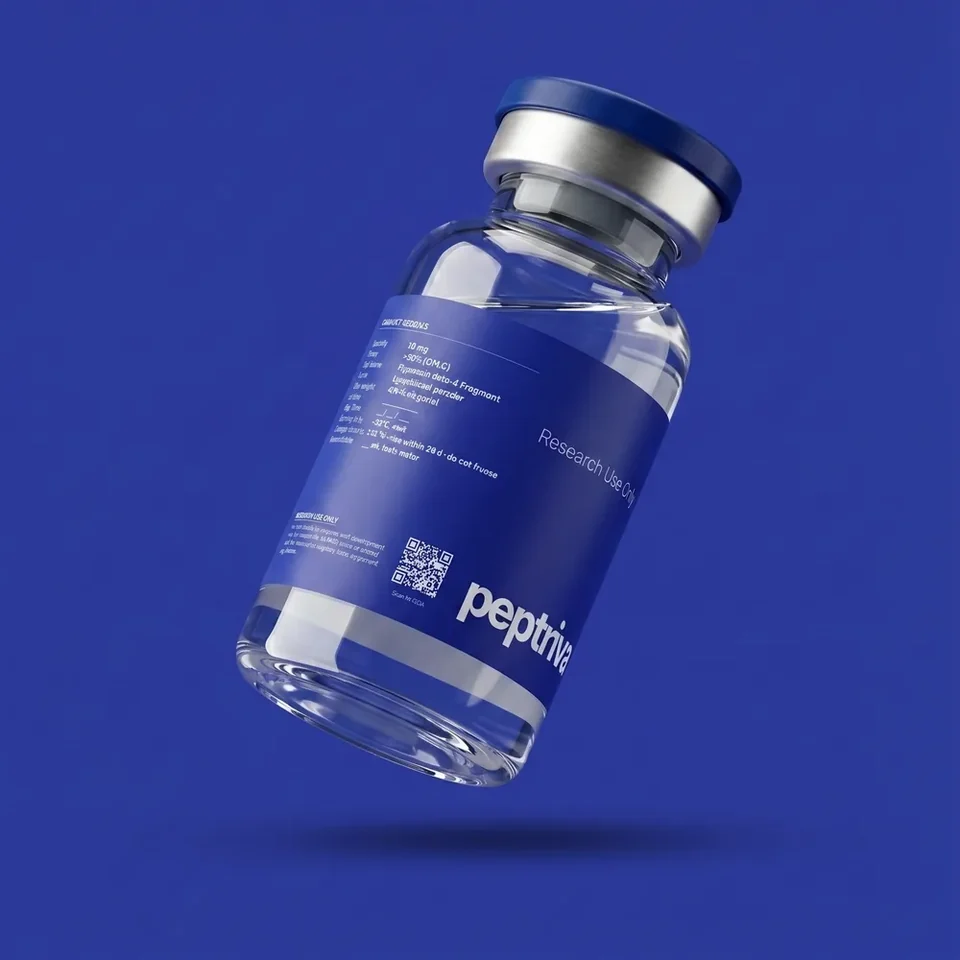
Vesugen
The compound discussed here, supplied as a research compound with a certificate of analysis matched to the lot.
The risks that come from the vial, not the molecule
This is the part the side effect lists skip, and it is the part that is actually documented.
A research vial is not a pharmacy product. Nothing about Vesugen’s pharmacology has to be dangerous for a handling or purity problem to be. Those risks exist regardless of what the peptide does.
- Identity. A third-party certificate of analysis is the only document that says what is in the vial. Read who signed it and when.
- Sterility. Reconstitution introduces whatever is on the stopper or in the water. See the bacteriostatic water guide and how to reconstitute peptides.
- Degradation. Short peptides are sensitive to heat and light. Storage temperature changes what you have after a month.
- Seller documentation. How sellers differ on paperwork is covered in our buying guide.
For a compound with no human safety data, the product-quality questions are the only safety questions that have answers. They are documents, and you can open them.
Is Vesugen approved by the FDA?
No. Vesugen is not approved by the FDA or the EMA. Russia permits it. That difference is regulatory, not scientific, and it does not import a safety review that was never performed here.
| Safety question | What exists |
|---|---|
| Randomized human trials | Zero |
| Human adverse-event data | None found |
| Published toxicology | None found |
| Human pharmacokinetics | None found |
| Rodent papers on vessels | 2 related papers |
| FDA or EMA approval | No |
Legal status for research compounds varies by country and by use. Are peptides legal covers the framework.
What would make the safety answer real
A short, specific list. None of it exists yet, and saying so is the point.
First, published toxicology with the species, duration and administered amounts stated. Second, a human dose-finding study that collects adverse events on a schedule. Third, replication by a lab outside the originating group, since 10 of the 12 papers currently come from one place. Fourth, human pharmacokinetics, so there is some idea of exposure.
Until those appear, the correct description of Vesugen is a rodent and cell-culture tool with an unknown human safety profile. Not a safe compound. Not a dangerous one. An untested one.
Vesugen
Research-use-only material, sold by the vial with batch documentation. Check the certificate of analysis against the batch you receive.
What to know now
- Randomized human trials of Vesugen number zero, so no side effect data exists.
- The published rat papers measured vessel density and microcirculation, not adverse events.
- We found no toxicology study, no human pharmacokinetics and no blood pressure data in people.
- The safety claim rests on the molecule being small and made of common amino acids, not on testing.
- About 10 of the 12 KED papers come from one Russian lab, with 1 recent independent paper.
- The documented risks here are sterility, identity and storage, which are vial problems, not pharmacology.
What we're watching
Watch the gap between “no reported side effects” and “tested and found safe.” For Vesugen only the first is true, and it is true because no human study collected reports. The checkable risks are the ones attached to the vial: a current third-party certificate of analysis, sterile handling at reconstitution, and cold storage.
Frequently asked questions
Is Vesugen safe?
Unknown. Randomized human trials number zero, and we found no published toxicology study. Safety is a measurement, and this measurement has not been made. A compound with no safety data is untested, not safe.
Are there any reported side effects of Vesugen?
We found no published human adverse-event reports. That is because no human trial collected them, not because a study looked and found nothing. The rat papers measured vessel density and microcirculation in brain cortex, which are efficacy endpoints.
Does Vesugen affect blood pressure?
No study we found measured blood pressure in people. A 2018 paper in Advances in Gerontology used spontaneously hypertensive rats, but the reported outcome was microcirculation in the brain cortex. Human cardiovascular effects, helpful or harmful, are unmeasured.
Is Vesugen FDA approved?
No. It is not approved by the FDA or the EMA. Russia permits it. Approval elsewhere is a regulatory fact and does not mean a US-style safety review was performed.
What is the biggest practical risk with a Vesugen vial?
Product quality, not known pharmacology. Identity, sterility and degradation are the risks that can actually be checked. A third-party certificate of analysis, clean reconstitution and correct storage temperature are the documents and steps that address them.
Why do vendor pages say it is well tolerated?
That phrasing comes from the developing group's own summaries of a peptide program running since the 1970s. Self-reported tolerability from a compound's originators is the weakest form of safety evidence, and here it is not backed by a published human trial.
References
- Anisimov, V. N., & Khavinson, V. K. (2009). Peptide bioregulation of aging: Results and prospects. Biogerontology, 11(2), 139–149. https://doi.org/10.1007/s10522-009-9249-8
- Sokolova, I. B., Ryzhak, G. A., Mel’nikova, E. V., Sergeev, I. V., & Khavinson, V. K. (2016). Effects of vascular peptide bioregulator on the density of microvascular network in the brain cortex of aged rats. Bulletin of Experimental Biology and Medicine, 161(4), 569–572. https://doi.org/10.1007/s10517-016-3400-8
- Sokolova, I. B., Ryzhak, G. A., & Khavinson, V. K. (2018). Functional cumulation of the influence of vascular peptide bioregulator on microcirculation in the brain cortex of spontaneously hypertensive rats. Advances in Gerontology, 8(2), 119–123. https://doi.org/10.1134/s2079057018020170
- Khavinson, V. K., Tarnovskaya, S. I., Linkova, N. S., Gutop, E. O., & Elashkina, E. V. (2015). Epigenetic aspects of peptidergic regulation of vascular endothelial cell proliferation in aging. Advances in Gerontology, 5(4), 217–220. https://doi.org/10.1134/s2079057015040116
- Khavinson, V. K., Lin’kova, N. S., & Umnov, R. S. (2021). Peptide KED: Molecular-genetic aspects of neurogenesis regulation in Alzheimer’s disease. Bulletin of Experimental Biology and Medicine, 171(2), 190–193. https://doi.org/10.1007/s10517-021-05192-6