
Search Vesugen before and after and you get skin photos and blood pressure stories. The published record is blood vessels counted in rat brain cortex, in 2 related papers, from one lab.
The short answer. Randomized human trials of Vesugen number zero; the before and after is rodent.
- Two Sokolova papers counted microvessel density in rat brain cortex, in aged and hypertensive rats.
- No published study we found measured blood pressure or any vascular outcome in people.
- One Saint Petersburg group wrote about 10 of the 12 KED papers; independent replication is one paper.
Vesugen is a 3-amino-acid peptide, Lys-Glu-Asp. Randomized human trials number zero. The before and after on record is in rats. Two papers counted vessels in rat brain cortex. One Russian lab wrote 10 of the 12 KED papers. No study we found measured blood pressure in people.
What was actually measured
There is no human before and after for Vesugen. The record is rodent and cell culture.
Two papers from the Sokolova group counted blood vessels in the brain cortex of rats. The 2016 paper used aged rats. The 2018 paper used spontaneously hypertensive rats. In both, the measured thing was the microvascular network: how dense the small vessels were in a slice of cortex, seen under a microscope.
Effects of vascular peptide bioregulator on the density of microvascular network in the brain cortex of aged rats.
Sokolova, Ryzhak, Mel’nikova, Sergeev & Khavinson, Bulletin of Experimental Biology and Medicine, 2016 — the paper's full titleThat title is the entire scope of the study. Rats. Brain cortex. Vessel density. The 2018 follow-up asked a narrower question still: whether repeated courses added up over time in hypertensive rats. It is called functional cumulation, and it is a question about rat microcirculation, not about a person's face, legs or readings at a pharmacy cuff.
- No human blood pressure. We found no study that measured it in people.
- No human imaging. No skin, no retina, no vascular ultrasound.
- No placebo arm in people. There is no human arm at all.
- No before-and-after photograph anywhere in the source papers. The output is a vessel count.
The underlying claim set is laid out in what Vesugen is claimed to do.
Why there is no human before and after
Because nobody has run the trial. Randomized human trials of KED number zero. That is not a gap waiting on more data. It is the state of the file after roughly 50 years of work on this peptide family, which began in the 1970s.
A compound can have decades of papers and still have no human result. Vesugen is that case. Every number attached to it describes a rat, a cell, or a gene model.
The 2015 paper from Khavinson's group worked on vascular endothelial cells and their proliferation during aging. The 2021 follow-up on KED is molecular-genetic, about neurogenesis signals in Alzheimer's disease. Both are laboratory work. Neither enrolled a patient.
Vesugen is also not FDA- or EMA-approved. Russia permits related products. The research vial you can buy carries none of that status. Peptide legality by category covers where research compounds sit.
Who counted the vessels
This matters more than the result itself. One Saint Petersburg group wrote about 10 of the 12 KED papers we could find. The same names appear on the rat studies, the cell work and the reviews that summarize them.
Replication is the point of science, and replication means a second lab. There is 1 recent independent paper in the file. That is thin for a compound sold on vascular promises.
Peptide bioregulation of aging: results and prospects.
Anisimov & Khavinson, Biogerontology, 2009 — the review's titleThat 2009 review is the clearest summary of the program behind Vesugen: 6+ peptides, one framework, one originating group. The word prospects in its own title is doing a lot of honest work. The Vesugen complete guide traces the family tree.
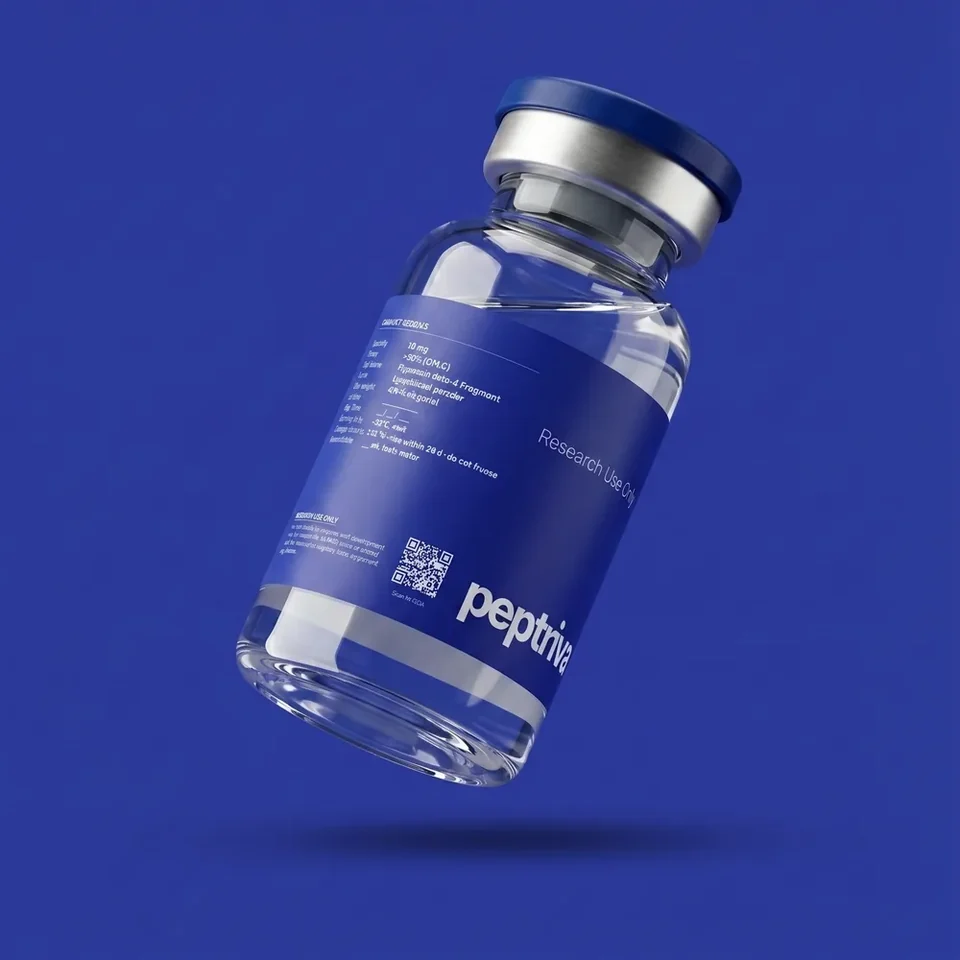
Vesugen
The compound discussed here, supplied as a research compound with a certificate of analysis matched to the lot.
What the photos are competing against
Here is every published Vesugen study people cite, next to what it actually measured.
| Study | Subject | What was measured | Human endpoint |
|---|---|---|---|
| Sokolova et al., 2016 | Aged rats | Microvascular network density, brain cortex | None |
| Sokolova et al., 2018 | Spontaneously hypertensive rats | Cortex microcirculation over repeated courses | None |
| Khavinson et al., 2015 | Vascular endothelial cells | Proliferation and epigenetic signals in aging | None |
| Khavinson et al., 2021 | Molecular-genetic model | Neurogenesis regulation, Alzheimer's context | None |
Now look at the picture in the ad. Brighter skin, a flatter face, a better cuff reading. Nothing in the table above can produce that photograph, because none of it was measured in a person. A denser capillary bed in a rat cortex slice has no visible outside.
The photos and the papers are not describing the same thing. They are not even describing the same species.
What you can verify before you buy
You cannot verify an effect that was never tested in people. You can verify the vial.
- Identity and mass. KED is 3-amino-acid, Lys-Glu-Asp, near 390 g/mol. A mass spectrum should land there.
- Purity, with a date and a batch. See how to read a certificate of analysis.
- Storage. Short peptides are not forgiving. Storage temperature guidance covers lyophilized and reconstituted states.
- Handling. Reconstitution basics and bacteriostatic water explain the laboratory steps.
Those checks tell you whether the powder is what the label says. They tell you nothing about whether it does anything, because that question has no human answer yet. Sourcing standards are compared in how to evaluate peptide suppliers.
Vesugen
Research-use-only material, sold by the vial with batch documentation. Check the certificate of analysis against the batch you receive.
What to know now
- Randomized human trials of Vesugen number zero; the before and after is rodent.
- Two Sokolova papers counted microvessel density in rat brain cortex, in aged and hypertensive rats.
- No published study we found measured blood pressure or any vascular outcome in people.
- One Saint Petersburg group wrote about 10 of the 12 KED papers; independent replication is one paper.
- Vesugen is not FDA- or EMA-approved, and a research vial carries no drug status.
- What you can check is identity, purity and storage, not outcomes.
What we're watching
Watch for a second lab. The signal that would change this page is an independent group, outside Saint Petersburg, measuring a vascular endpoint in people with a control arm. Until a human trial with a named endpoint and a placebo group is published, every Vesugen before-and-after image is unconnected to the research record.
Frequently asked questions
Are there real Vesugen before and after photos?
None from a study. The published Vesugen record is rat brain cortex and cell culture. No source paper photographed a person, and randomized human trials number zero. Images circulating online have no published measurement behind them.
How long does Vesugen take to work?
Unknown, because no human trial has measured it. The 2018 Sokolova paper looked at whether repeated courses accumulated in rats, not in people. There is no human timeline to report, and we do not publish schedules.
Did Vesugen lower blood pressure in any study?
Not in people. The 2018 paper used spontaneously hypertensive rats and measured brain cortex microcirculation, not human blood pressure. We found no study measuring blood pressure in humans.
Is Vesugen approved anywhere?
It is not FDA- or EMA-approved. Russia permits related peptide products. Approval of a product in one country is not evidence of effect, and it does not apply to a research vial sold elsewhere.
Why do so many papers exist if nothing was proven in people?
The program dates to the 1970s and covers 6+ peptides, but the work is preclinical. The 2009 Anisimov and Khavinson review in Biogerontology sums up results and prospects. Prospects is the accurate word.
What people actually report
These are self-reports, not evidence. No control group, no blinding, and no independent check that the vial held what the label claimed. They are collected here because people asking about Vesugen deserve an answer rather than a refusal, and because what the community believes is itself worth knowing. Quotes are excerpts; each links to the original post.
Uncontrolled, unverified self-report, and thin. Vesugen gets named far more often than it gets described. In a July 2026 r/NTNPerformance overview of bioregulators it appears exactly once, as a row in a table marked "Vascular." The author closes by asking whether anyone has actually run any of them. Not one reply mentions Vesugen. The r/peptidebioregulators dose thread has run since January 2024, but its outcome questions sit unanswered: what benefits do you see, what results did you experience, how did your cycle go. The clearest first-hand account is u/Street_Exam_6859 in August 2026, who says he finished two 30-day cycles and that it took a while to notice a difference. Where Vesugen does appear inside a documented protocol, it is one of ten compounds, injected in a shared syringe with two others, so nothing in that diary can be pinned on Vesugen alone. The one repeat user, u/vegasroller, says the results show up very quickly. He is also the origin of the thread's injection numbers, and when two later readers ask him where they came from, neither gets an answer.
Where the community and the published record disagree. Users treat Vesugen as a vascular injectable. Both halves run ahead of the published record. The r/peptidebioregulators thread that set the community's subcutaneous practice opens with u/Heelhook1997 saying the only information he could find was for capsules. The injection protocol that follows comes from one commenter describing what he and his family took, and it is never sourced to anything published. The human vascular data is one uncontrolled before-and-after study in 41 patients with vasculogenic erectile dysfunction, co-authored by Khavinson (Kitachev et al., Adv Gerontol 2014;27(1):156-9, PMID 25051774). Two things about that paper are worth checking yourself: its title is about chronic arterial insufficiency in the lower limbs, not erections, and PubMed spells the compound "Vezugen," so a search for "Vesugen" returns nothing. The other human study gave Vesugen and Pinealon to 32 patients aged 41 to 83 (Meshchaninov et al., Adv Gerontol 2015;28(1):62-7, PMID 26390612). Its authors report prooxidant activity by chemiluminescence and a fall in CD34+ hematopoietic cells that they read as significant inhibition of hemopoiesis. That is the only human measurement of a stem-cell marker on record for this compound, and it went down. A Peptide Science Institute video on Vesugen is titled for peptide-activated stem cells. None of the self-reports above mention the CD34+ finding.
“The only info I can find online is for capsules.”
“Overall better cardio performance. It pairs nicely with heart peptides like cardiogen.”
Comment on "Vesugen Peptide Dose?" — the thread's one repeat user
“I’ve done two 30 day cycles. It takes a while to notice a difference.”
“Anyone here actually run any of these?”
Bioregulators explained: the Russian short peptides nobody in the West talks about, and why
“I mixed Cortagen, Vesugen, and Pinealon ... into a single morning syringe”
I tried to rewire my brain with 10 peptides in 30 days-my diary
“Want our most trusted & recommended peptide store? Go here”
Vesugen: Achieving "Superhuman" Regeneration With Peptide-Activated Stem Cells
Posts are quoted under fair use and linked to their authors. Nothing on this page is hosted here, and no claim above has been verified beyond confirming that the person wrote it.
References
- Anisimov, V. N., & Khavinson, V. K. (2009). Peptide bioregulation of aging: Results and prospects. Biogerontology, 11(2), 139–149. https://doi.org/10.1007/s10522-009-9249-8
- Sokolova, I. B., Ryzhak, G. A., Mel’nikova, E. V., Sergeev, I. V., & Khavinson, V. K. (2016). Effects of vascular peptide bioregulator on the density of microvascular network in the brain cortex of aged rats. Bulletin of Experimental Biology and Medicine, 161(4), 569–572. https://doi.org/10.1007/s10517-016-3400-8
- Sokolova, I. B., Ryzhak, G. A., & Khavinson, V. K. (2018). Functional cumulation of the influence of vascular peptide bioregulator on microcirculation in the brain cortex of spontaneously hypertensive rats. Advances in Gerontology, 8(2), 119–123. https://doi.org/10.1134/s2079057018020170
- Khavinson, V. K., Tarnovskaya, S. I., Linkova, N. S., Gutop, E. O., & Elashkina, E. V. (2015). Epigenetic aspects of peptidergic regulation of vascular endothelial cell proliferation in aging. Advances in Gerontology, 5(4), 217–220. https://doi.org/10.1134/s2079057015040116
- Khavinson, V. K., Lin’kova, N. S., & Umnov, R. S. (2021). Peptide KED: Molecular-genetic aspects of neurogenesis regulation in Alzheimer’s disease. Bulletin of Experimental Biology and Medicine, 171(2), 190–193. https://doi.org/10.1007/s10517-021-05192-6