
Search NAD+ side effects and you get tidy lists. The controlled human record under them is four short trials of oral precursors in about 230 adults. The intravenous drip most clinics sell is not in that record at all.
The short answer. The published safety record covers oral NMN and NR, not intravenous NAD+.
- Four randomized trials, about 230 adults, doses of 250–900 mg/day, weeks to months long.
- No serious adverse event was attributed to the compound in those trials.
- A group that size cannot detect rare or slow-developing effects.
Most NAD+ safety data comes from oral NMN and NR. Four randomized trials covered about 230 adults. They ran weeks to months, not years. No serious harm was tied to the compound. That sample is too small to rule out rare events. Intravenous NAD+ has no randomized safety data.
What the NAD+ safety record actually contains
Almost everything known about how people tolerate NAD+ comes from precursor capsules, not from NAD+ itself. The tested molecules are β-nicotinamide mononucleotide (NMN) and nicotinamide riboside (NR). Both are swallowed. Both raise blood NAD levels.
Four randomized, placebo-controlled trials sit under the whole category. Together they cover roughly 230 adults at 250–900 mg/day. The longest ran a few months.
| Study | What was given | What it was built to measure |
|---|---|---|
| Yi et al., GeroScience, 2023 | Oral NMN, up to 900 mg/day, 60 days, 80 healthy middle-aged adults | Efficacy and safety, by dose |
| Igarashi et al., NPJ Aging, 2022 | Oral NMN, 250 mg/day, healthy older men | Blood NAD and muscle function |
| Katayoshi et al., Scientific Reports, 2023 | Oral NMN, 250 mg/day, long-term | NAD metabolism and arterial stiffness |
| Morifuji et al., GeroScience, 2024 | Oral NMN, older adults | Blood NAD, walking speed, sleep quality |
| Freeberg et al., Front. Cardiovasc. Med., 2022 | Oral NR, 500 mg twice daily | Systolic blood pressure and arterial stiffness |
| Intravenous NAD+ | No randomized trial found | — |
The results side of those trials is covered in NAD+ before and after. This page is only about what they say on harm.
What side effects did the trials report?
Short answer: nothing serious was tied to the compound. The Yi trial put safety in its own title and dosed 80 healthy middle-aged adults for 60 days, at three dose levels.
The efficacy and safety of β-nicotinamide mononucleotide (NMN) supplementation in healthy middle-aged adults: a randomized, multicenter, double-blind, placebo-controlled, parallel-group, dose-dependent clinical trial.
Yi et al., GeroScience, 2023 — the trial's own titleThe other trials were not designed as safety studies. They were designed to measure something else, and they logged adverse events alongside it.
- What they watched. Blood NAD levels, walking speed, grip strength, blood pressure, arterial stiffness, sleep quality, routine bloodwork.
- What they could not watch. Anything that takes longer than the trial. Anything rarer than one person in the group.
- Who was enrolled. Mostly healthy adults and older adults. Not people on multiple medications, not pregnant people, not the sick.
Ingestion of β-nicotinamide mononucleotide increased blood NAD levels, maintained walking speed, and improved sleep quality in older adults.
Morifuji et al., GeroScience, 2024 — the trial's own titleThat is the tone of the whole literature. Small effects, small groups, no alarm bells.
Why "well tolerated" in 80 people is a weak claim
A trial can only find a side effect that is common enough to show up in the people it enrolled. With 80 participants, an event that hits one person in a hundred will often not appear once. With 230 across the whole field, the same is true for anything rarer.
Duration is the second limit. These studies ran weeks to a few months. People who buy NAD+ products often take them for years. Nothing published covers that span.
"No side effects were reported" and "there are no side effects" are different sentences. The first is a fact about a small study. The second is a claim no one has the data to make.
The decline the whole field is built on is real: tissue NAD+ falls with age, by roughly 30–50% in some tissues. That does not tell you what happens when you push it back up for a decade. The sirtuin mechanism page covers why the biology is more tangled than the marketing.
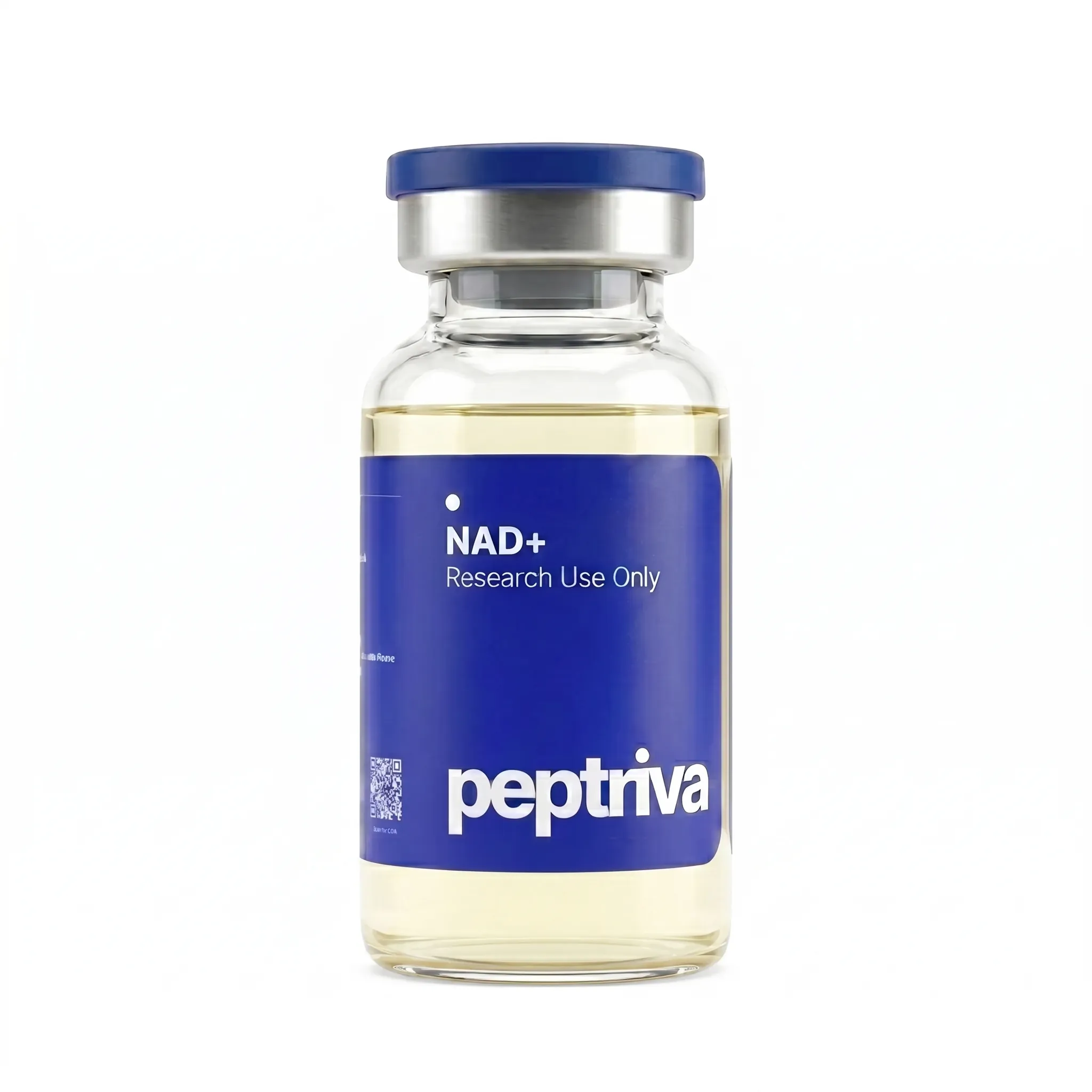
NAD+
The compound discussed here, supplied as a research compound with a certificate of analysis matched to the lot.
Are IV NAD+ side effects different from the pills?
Different route, and a different evidence problem. We found no randomized controlled trial of intravenous NAD+ that publishes an adverse event table. The safety record described above is oral. It does not transfer.
Reports of discomfort during an infusion circulate widely. They come from clinics and from users, not from controlled studies. Without a placebo arm there is no way to separate the compound from the needle, the volume, the drip rate, or the setting.
Infusions are also the expensive end of this market, commonly $500–$1,000 per session, against oral precursor vials that price out near $0.18 per milligram. The price gap is not matched by an evidence gap in the same direction. It runs the other way.
The route with the most human data is the one nobody markets as a therapy. The route sold as therapy has none.
The concerns reviews raise that no trial has settled
The major reviews of NAD+ biology do not report harms. They flag open questions. That distinction matters, and it is usually lost in both directions online.
- Long-term use. Covarrubias and colleagues, writing in Nature Reviews Molecular Cell Biology in 2021, describe NAD+ as central to metabolism, DNA repair and stress signaling. A molecule that central has effects that short trials will not see.
- Cancer biology. Dividing cells need NAD+ too. Rajman, Chwalek and Sinclair raised this in Cell Metabolism in 2018 as something the in vivo evidence had not resolved. It still has not been tested in a human trial.
- Which precursor, and where it goes. Yoshino, Baur and Imai laid out in 2018 that NMN and NR follow different paths into the NAD+ pool. Safety findings for one are not automatically findings for the other.
- The consumer enzymes. CD38 levels rise substantially with age, and seven sirtuins plus PARPs draw on the same pool. Raising supply changes several systems at once.
None of that is evidence of harm. It is a list of things nobody has checked.
What would actually settle this
Bigger trials, running longer, with adverse events named as an endpoint before the study starts. Some are being registered. Gao and colleagues published a protocol in Trials in 2023 for a multicenter, randomized, double-blinded trial of oral NMN in chronic insomnia. A protocol is not a result. It is a promise to measure something.
For anyone handling research material rather than a capsule, the practical risk is usually not the molecule. It is the vial.
- Identity and purity. A batch-specific certificate of analysis is the only document that says what is in there.
- Handling. Storage temperature and reconstitution change what a solution contains over time.
- Status. These are research compounds. What that means legally is its own page.
For the full picture on the compound, start with the NAD+ complete guide.
NAD+
Research-use-only material, sold by the vial with batch documentation. Check the certificate of analysis against the batch you receive.
What to know now
- The published safety record covers oral NMN and NR, not intravenous NAD+.
- Four randomized trials, about 230 adults, doses of 250–900 mg/day, weeks to months long.
- No serious adverse event was attributed to the compound in those trials.
- A group that size cannot detect rare or slow-developing effects.
- Intravenous NAD+ has no randomized trial reporting adverse events.
- Reviews raise open questions about long-term use and cancer biology. No human trial has answered them.
What we're watching
Watch the route before you read any side effect list. The tolerability data is for swallowed NMN and NR capsules in healthy adults, over weeks to a few months. It does not cover intravenous infusion, reconstituted research vials, or years of continuous use, which is what "NAD+ therapy" usually means in practice.
Frequently asked questions
Does NAD+ cause nausea or flushing?
The randomized trials of oral NMN and NR did not attribute serious adverse events to the compound. Reports of nausea, flushing or chest tightness are associated with rapid intravenous infusion, and they come from clinics and users rather than from controlled studies. Without a placebo arm, those reports cannot be separated from the infusion itself.
Is NAD+ safe to take long term?
Nobody knows. The longest published randomized trials of oral NMN ran weeks to a few months. Yi and colleagues dosed 80 healthy middle-aged adults for 60 days. There is no published human data on years of continuous use.
Does boosting NAD+ increase cancer risk?
It is an open question, not a finding. Rajman, Chwalek and Sinclair flagged in Cell Metabolism in 2018 that dividing cells also depend on NAD+, and that the in vivo evidence had not resolved the issue. No human trial has tested it.
Are NMN and NR side effects the same?
They are not automatically the same. Yoshino, Baur and Imai described in 2018 how the two precursors follow different routes into the NAD+ pool. Most of the randomized trial data is on NMN. The NR data here is a blood pressure and arterial stiffness study by Freeberg and colleagues.
Why does IV NAD+ have no side effect data?
Because no randomized controlled trial of intravenous NAD+ has published one. The route is sold widely, often at $500–$1,000 per session, but the human trial literature behind NAD+ is oral precursors. That is the gap this page exists to name.
References
- Yi, L., Maier, A. B., Tao, R., et al. (2023). The efficacy and safety of β-nicotinamide mononucleotide (NMN) supplementation in healthy middle-aged adults: A randomized, multicenter, double-blind, placebo-controlled, parallel-group, dose-dependent clinical trial. GeroScience, 45(1), 29–43. https://doi.org/10.1007/s11357-022-00705-1
- Morifuji, M., Higashi, S., Ebihara, S., & Nagata, M. (2024). Ingestion of β-nicotinamide mononucleotide increased blood NAD levels, maintained walking speed, and improved sleep quality in older adults in a double-blind randomized, placebo-controlled study. GeroScience, 46(5), 4671–4688. https://doi.org/10.1007/s11357-024-01204-1
- Katayoshi, T., Uehata, S., Nakashima, N., et al. (2023). Nicotinamide adenine dinucleotide metabolism and arterial stiffness after long-term nicotinamide mononucleotide supplementation: A randomized, double-blind, placebo-controlled trial. Scientific Reports, 13(1), 2786. https://doi.org/10.1038/s41598-023-29787-3
- Igarashi, M., Nakagawa-Nagahama, Y., Miura, M., et al. (2022). Chronic nicotinamide mononucleotide supplementation elevates blood nicotinamide adenine dinucleotide levels and alters muscle function in healthy older men. NPJ Aging, 8(1), 5. https://doi.org/10.1038/s41514-022-00084-z
- Freeberg, K. A., Craighead, D. H., Martens, C. R., et al. (2022). Nicotinamide riboside supplementation for treating elevated systolic blood pressure and arterial stiffness in midlife and older adults. Frontiers in Cardiovascular Medicine, 9, 881703. https://doi.org/10.3389/fcvm.2022.881703
- Yoshino, J., Baur, J. A., & Imai, S. I. (2018). NAD+ intermediates: The biology and therapeutic potential of NMN and NR. Cell Metabolism, 27(3), 513–528. https://doi.org/10.1016/j.cmet.2017.11.002
- Rajman, L., Chwalek, K., & Sinclair, D. A. (2018). Therapeutic potential of NAD-boosting molecules: The in vivo evidence. Cell Metabolism, 27(3), 529–547. https://doi.org/10.1016/j.cmet.2018.02.011
- Covarrubias, A. J., Perrone, R., Grozio, A., & Verdin, E. (2021). NAD+ metabolism and its roles in cellular processes during ageing. Nature Reviews Molecular Cell Biology, 22(2), 119–141. https://doi.org/10.1038/s41580-020-00313-x
- Gao, X., Li, J., Xu, S., et al. (2023). Oral nicotinamide mononucleotide (NMN) to treat chronic insomnia: Protocol for a multicenter, randomized, double-blinded, placebo-controlled trial. Trials, 24(1), 340. https://doi.org/10.1186/s13063-023-07351-8
- Imai, S., & Guarente, L. (2014). NAD+ and sirtuins in aging and disease. Trends in Cell Biology, 24(8), 464–471. https://doi.org/10.1016/j.tcb.2014.04.002