
The NAD+ before and after people search for is an IV drip costing $500–$1,000. The randomized evidence is oral precursors, and its endpoints are walking speed and grip strength.
The short answer. NAD+: The randomized evidence is oral precursors, NMN and NR — roughly 230 adults at 250–900 mg/day.
- The measured before-and-after is small gains in walking speed and grip strength, not appearance or same-day energy.
- Intravenous NAD+ has no randomized support for its marketed claims, at $500–$1,000 a session.
- Tissue NAD+ does decline with age, by roughly 30–50% in some tissues. That part is not in dispute.
Tissue NAD+ falls with age, by roughly 30–50% in some tissues, and that decline is real. What has been tested in randomized trials is the oral precursors, NMN and NR. Four RCTs across roughly 230 adults at 250–900 mg/day found small gains in walking speed and grip strength. Intravenous NAD+ has no randomized support for the claims it is marketed on.
What the randomized trials measured
This is a compound where the evidence is better than the photographs suggest and different from what they show.
- NMN, 80 healthy middle-aged adults, 60 days, at doses up to 900 mg/day.
- NMN, 60 older adults, at 250 mg/day and above.
- NR, chronic supplementation, well tolerated and shown to raise NAD+ in a controlled setting.
Across roughly 230 adults, the pooled picture is consistent and modest: measurable increases in blood NAD+, and small improvements in walking speed and grip strength. Those are real endpoints, chosen because they predict things that matter in aging.
Chronic nicotinamide riboside supplementation is well-tolerated and elevates NAD+ in healthy middle-aged and older adults.
Martens et al., Nature Communications, 2018The drip is not what was tested
Almost every NAD+ before-and-after in circulation is an intravenous infusion, usually at a clinic, usually at $500–$1,000 a session.
No randomized trial supports the marketed claims for intravenous NAD+. The controlled human evidence in this area is on oral precursors, at oral doses, over weeks. A drip is a different molecule, a different route and a different timescale.
That is not a claim the drip does nothing. It is the observation that nobody has run the study, which leaves the strong subjective reports people give after an infusion without anything to be checked against. NAD IV vs oral precursors compares the two routes directly.
Why the effect size is small, and why that is the honest part
Walking speed and grip strength moving slightly over sixty days is not a dramatic before-and-after, and it is worth sitting with why the trials chose those endpoints anyway.
Both are strong predictors of functional decline. A small, measured, replicated change in a validated marker is worth considerably more than a large unmeasured change in how someone reports feeling. It is also much harder to photograph.
NAD+ intermediates: the biology and therapeutic potential of NMN and NR.
Yoshino, Baur & Imai, Cell Metabolism, 2018The underlying biology holds up. NAD+ is an electron carrier cells use for metabolism, DNA repair and stress signaling, and tissue levels do decline with age. The question the trials are answering is narrower: whether topping it up changes anything measurable. So far, a little. See the NAD+ complete guide.
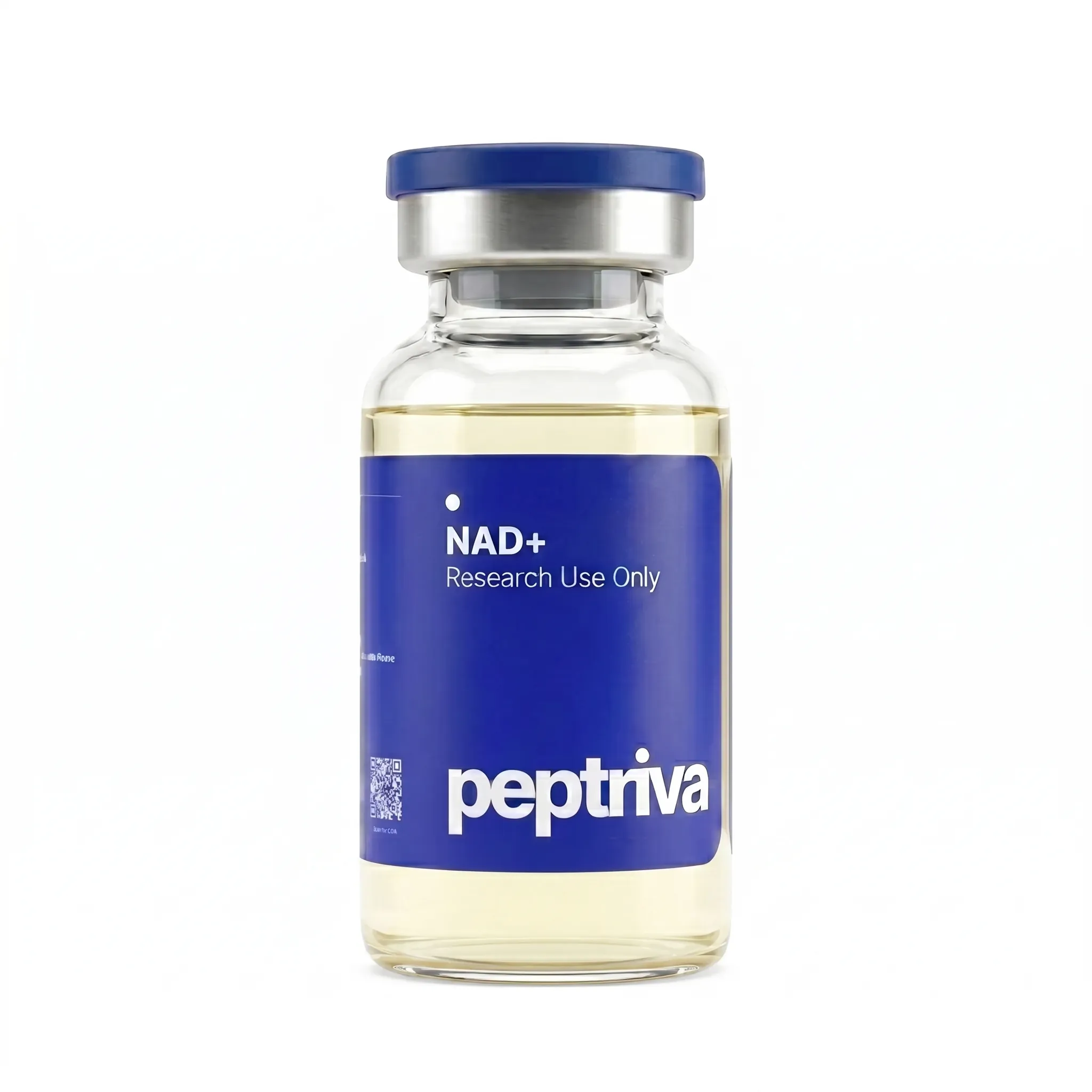
NAD+
The cofactor discussed here, supplied as a research compound with a batch-matched certificate of analysis.
How to read an NAD+ before-and-after
Four checks, and the first one does most of the work:
- Oral precursor or IV? The randomized evidence is entirely the former. A drip testimonial has no trial behind it.
- Measured or reported? The trials used walking speed and grip strength. "More energy" is not an endpoint anyone can check.
- Over what period? Sixty days is the trial timescale. Same-day infusion reports are describing something else.
- At what dose? The studied range is 250–900 mg/day oral. Clinic protocols are not comparable.
Anyone weighing the drip against the capsule is really weighing an untested route with strong testimonials against a tested route with modest results. That is a legitimate choice to think about, and it is easier to make when it is stated that way. Best peptides for anti-aging puts NAD+ alongside the rest of the category.
NAD+
Research-use-only material, sold by the vial with batch documentation. Check the certificate of analysis against the batch you receive.
What to know now
- The randomized evidence is oral precursors, NMN and NR — roughly 230 adults at 250–900 mg/day.
- The measured before-and-after is small gains in walking speed and grip strength, not appearance or same-day energy.
- Intravenous NAD+ has no randomized support for its marketed claims, at $500–$1,000 a session.
- Tissue NAD+ does decline with age, by roughly 30–50% in some tissues. That part is not in dispute.
- Walking speed and grip strength were chosen because they predict functional decline. They are also impossible to photograph.
What we're watching
The obvious missing trial is a randomized comparison of intravenous NAD+ against placebo on any validated endpoint, given how much money the route moves. Nothing about it is technically hard. On the oral side, the useful next step is longer follow-up: sixty days is enough to move grip strength slightly and not enough to say whether it keeps moving. We are watching for trials past six months and for any head-to-head between NMN and NR.
Frequently asked questions
Does NAD+ have real before and after results?
Yes, but not the kind in the photos. Four randomized trials of oral NMN and NR across roughly 230 adults found measurable increases in blood NAD+ and small gains in walking speed and grip strength over about 60 days.
Do NAD+ IV drips work?
No randomized trial supports the marketed claims for intravenous NAD+. That is not proof it does nothing, but it means the strong subjective reports after an infusion have nothing controlled to be checked against, at $500-$1,000 a session.
How long does NAD+ take to work?
The trials measured at about 60 days on oral precursors. Reports of a same-day effect from an infusion are describing a different route on a different timescale from anything that has been tested.
What dose was studied?
Oral NMN and NR in the range of 250 to 900 mg per day. Clinic infusion protocols are not comparable to those figures and were not what the trials administered.
Why did the trials measure grip strength?
Because grip strength and walking speed are validated predictors of functional decline in aging. They are unglamorous endpoints chosen precisely because they can be measured objectively and compared between groups.
What people actually report
These are self-reports, not evidence. No control group, no blinding, and no independent check that the vial held what the label claimed. They are collected here because people asking about NAD+ deserve an answer rather than a refusal, and because what the community believes is itself worth knowing. Quotes are excerpts; each links to the original post.
Self-reports split hard. Many users describe an energy and brain-fog lift within minutes of a subcutaneous shot, fading after a day or two. Others, at the same or higher amounts, report nothing after weeks. Both camps report stinging, painful injections. One enthusiast in these threads quit the shots four months on and moved back to oral capsules. A separate user quit after a week at the highest amount he had tried, having felt nothing throughout. None of this is controlled, blinded or verified. Every account here is an anonymous self-report.
Where the community and the published record disagree. The community's ranking is the inverse of the evidence base. Reddit treats injected NAD+ as the strong form and oral NR or NMN as the weak fallback. The April 2026 Ageing Research Reviews systematic review (Gallagher and Emmanuel, 2026 Apr;116:103057, doi 10.1016/j.arr.2026.103057, PMID 41655607) identified 113 eligible studies: 33 human intervention studies, 28 randomized and 5 nonrandomized, plus 80 rodent studies. Its abstract states verbatim: "No eligible outcomes trials evaluated intravenous or intramuscular NAD+ itself for anti-aging or wellness indications." The human evidence is overwhelmingly oral, though not exclusively: one nonrandomized intravenous NMN study met inclusion and contributed only short-term safety and biomarker data, and an intravenous NAD+ pharmacokinetic pilot was logged as contextual evidence only. That review's own author posted in the r/HubermanLab thread. In January 2026, before publication, he argued injected NAD+ is broken down in circulation before reaching cells and was disputed over several rounds by a commenter citing a narrative review. When he linked the published paper in that same thread on 2026-04-17, the comment sat at one point. The second disagreement is about the rush itself. Users read the immediate hit as proof that depleted NAD+ is being replenished. The highest-voted reply in the r/Biohackers thread, from a self-identified cancer researcher at 69 points, says NAD+ is an electron carrier the body already produces plenty of, so supplementing does not help absent a metabolic or genetic disorder. Another commenter in the same thread, at 8 points, reads the same sensation the opposite way: extracellular NAD+ normally signals tissue damage, so the surge may be an adrenaline response rather than repletion. Worth carrying alongside the review: its competing-interest statement discloses that first author Cory Gallagher owns a management services organization serving an aesthetics clinic, which the statement says does not offer NAD+ infusions.
“Literally there isn’t one study on any IM or SubQ administrations in humans.”
“No noticeable difference other than perhaps waking up maybe after 7 or 7 and a half hours of sleep as opposed to 8 hours”
“I feel like I am 20 again. … [four months later, replying in his own thread] I am taking the NMN but might take a NAD shot again. I quit taking it because I got tired of injecting and the post sting feeling.”
“I started the NAD+ injections last week at 50 mg every other day and holy smokes the energy is amazing, constant and clean.”
“I have cut my NAD+ dose in half....weirdly I cannot quit or the fatigue gets even worse!”
“Highest-liked comment on the video's default comment page, @marcotassone2324 (26 likes): "for anyone saying NAD+ didnt do much for them congratulations that just means your natural NAD levels are healthy so youre already capped or close to it.”
Posts are quoted under fair use and linked to their authors. Nothing on this page is hosted here, and no claim above has been verified beyond confirming that the person wrote it.
References
- Yi, L., Maier, A. B., Tao, R., et al. (2023). The efficacy and safety of β-nicotinamide mononucleotide (NMN) supplementation in healthy middle-aged adults: A randomized, multicenter, double-blind, placebo-controlled, parallel-group, dose-dependent clinical trial. GeroScience, 45(1), 29–43. https://doi.org/10.1007/s11357-022-00705-1
- Martens, C. R., Denman, B. A., Mazzo, M. R., et al. (2018). Chronic nicotinamide riboside supplementation is well-tolerated and elevates NAD+ in healthy middle-aged and older adults. Nature Communications, 9(1), 1286. https://doi.org/10.1038/s41467-018-03421-7
- Yoshino, J., Baur, J. A., & Imai, S. I. (2018). NAD+ intermediates: The biology and therapeutic potential of NMN and NR. Cell Metabolism, 27(3), 513–528. https://doi.org/10.1016/j.cmet.2017.11.002
- Morifuji, M., Higashi, S., Ebihara, S., & Nagata, M. (2024). Ingestion of β-nicotinamide mononucleotide increased blood NAD levels, maintained walking speed, and improved sleep quality in older adults in a double-blind randomized, placebo-controlled study. GeroScience, 46(5), 4671–4688. https://doi.org/10.1007/s11357-024-01204-1
- Katayoshi, T., Uehata, S., Nakashima, N., et al. (2023). Nicotinamide adenine dinucleotide metabolism and arterial stiffness after long-term nicotinamide mononucleotide supplementation: A randomized, double-blind, placebo-controlled trial. Scientific Reports, 13(1), 2786. https://doi.org/10.1038/s41598-023-29787-3
- Pissios, P. (2017). Nicotinamide N-methyltransferase: More than a vitamin B3 clearance enzyme. Trends in Endocrinology & Metabolism, 28(5), 340–353. https://doi.org/10.1016/j.tem.2017.02.004