
Search Matrixyl before and after and you get side-by-side faces. The published record is one vehicle-controlled trial in 93 women, and what it reported was a 15–20% change in wrinkle depth.
The short answer. One controlled human trial sits behind Matrixyl: Robinson 2005, 93 women, 12 weeks.
- The reported result was a 15-20% reduction in wrinkle depth against the vehicle cream, not against bare skin.
- The collagen mechanism comes from Katayama 1993, which was cultured cells, not human skin.
- The second commonly cited 2005 source, Lupo and Cole, is a one-page conference abstract.
Matrixyl has one controlled human trial behind it. Robinson 2005 tested 93 women for 12 weeks. Wrinkle depth fell 15–20% against the plain cream. That gap was measured, not judged from photos. The collagen story comes from cultured cells in 1993. No trial has set it against a retinoid.
What the 2005 trial actually measured
The study everyone is pointing at is Robinson and colleagues, published in the International Journal of Cosmetic Science in 2005. It is the only controlled human trial of palmitoyl pentapeptide-4 that this site has been able to find.
The design was simple and, for a cosmetic ingredient, unusually honest.
- Participants: 93 women with photoaged facial skin.
- Duration: 12 weeks.
- Control: the same moisturizer without the peptide. That is the right comparison.
- Endpoint: wrinkle depth, reported as a 15–20% reduction against the vehicle.
Topical palmitoyl pentapeptide provides improvement in photoaged human facial skin.
Title of Robinson et al., International Journal of Cosmetic Science, 2005That is the whole claim, and the title is the claim. It says improvement. It does not say how much, and the how much is the part the photos are selling. The Matrixyl benefits page walks through the result in more detail.
Why the photos overshoot the trial
A 15–20% reduction in wrinkle depth is a real effect. It is also small, and it is small in a specific way that photographs hide.
First, the number is a gap between two creams. Both groups moisturized for 12 weeks. The vehicle arm was not doing nothing. So the peptide is being credited only with the distance it put between itself and plain cream.
A fifth less depth in a line is not the same as the line going away. Nothing in the published record describes a wrinkle disappearing.
Second, a before-and-after photo is not a measurement. It carries variables the trial controlled and the camera does not:
- Lighting angle. Side light cuts creases in; flat front light erases them.
- Hydration. A freshly moisturized face reads smoother within minutes, peptide or no peptide.
- Expression and head tilt. Millimeters of chin position change every line on the forehead.
- Time of day and sleep. Morning creasing and evening creasing are different faces.
- No control. There is no second photo of the same person using the base cream alone.
The collagen claim comes from a dish in 1993
The mechanism story is older than the trial. KTTKS is a five-residue piece of type I procollagen. Katayama and colleagues reported in the Journal of Biological Chemistry in 1993 that this fragment pushed extracellular matrix production in cultured cells.
A pentapeptide from type I procollagen promotes extracellular matrix production.
Title of Katayama et al., Journal of Biological Chemistry, 1993That is cell culture. Cells in a flask are bathed in the peptide. Skin is not. The gap between those two situations is the entire argument about whether this ingredient does anything on a face.
There is a second 2005 citation that gets quoted alongside Robinson: Lupo and Cole, in the Journal of the American Academy of Dermatology. It is a one-page supplement abstract, page P34. A poster abstract has no methods section you can audit. It is not evidence against the ingredient. It is just not a second trial.
| Source | Year | What it was |
|---|---|---|
| Katayama et al., J Biol Chem | 1993 | Cultured cells, not people |
| Robinson et al., Int J Cosmet Sci | 2005 | 93 women, 12 weeks, vehicle-controlled |
| Lupo & Cole, JAAD | 2005 | One-page conference abstract |
| Choi et al., Biomol Ther | 2014 | In vitro stability and permeation |
| Khalil et al., Pharmaceutics | 2024 | Liposome delivery work, lab only |
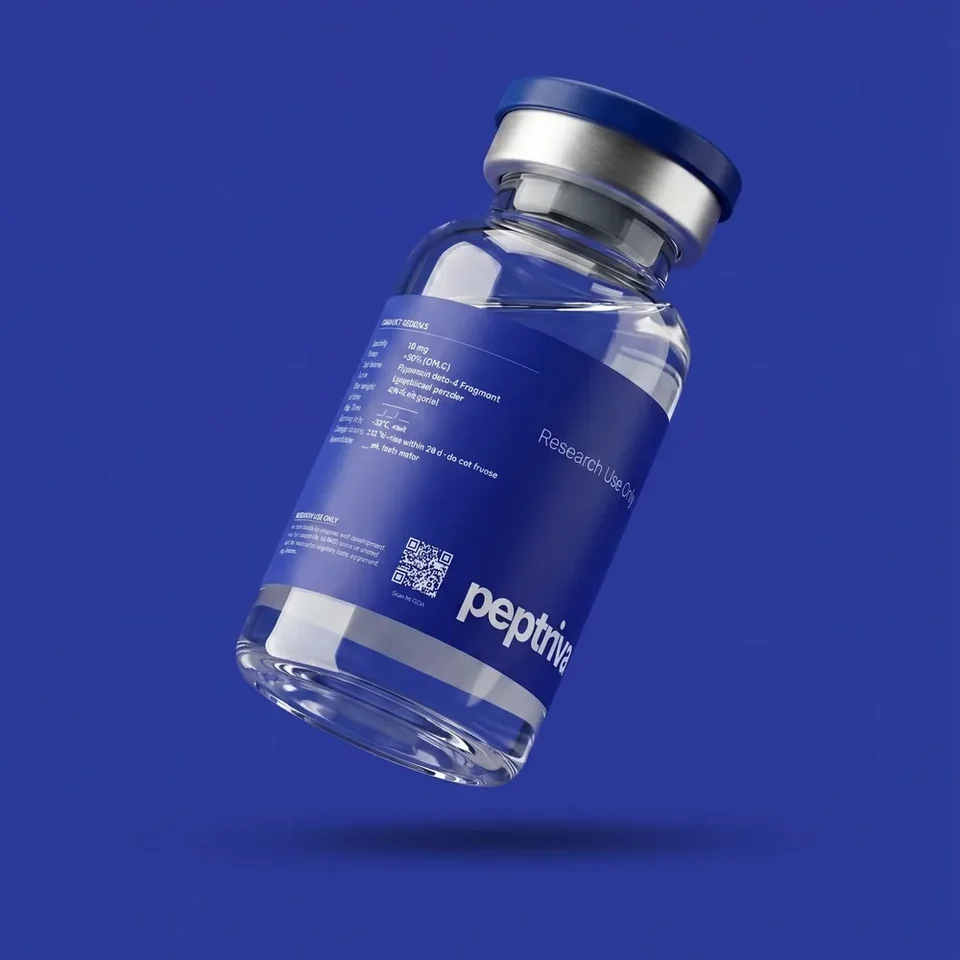
Matrixyl
The compound discussed here, supplied as a research compound with a certificate of analysis matched to the lot.
Does it get in, and how much is in the jar?
KTTKS on its own is water-loving and does not cross the outer skin layer well. That is why the trade ingredient carries a palmitic acid tail, a 16-carbon saturated fatty acid, bolted on to make the molecule greasier.
Choi and colleagues looked at exactly this question in Biomolecules & Therapeutics in 2014, comparing dermal stability and in vitro skin permeation of KTTKS and Pal-KTTKS. In 2024, a group in Pharmaceutics was still building liposomes to carry the same peptide. Delivery work that is still running in 2024 tells you delivery was never considered solved.
Then there is concentration. The raw material is supplied at around 500 ppm peptide. Formulators use it at roughly 3–8% of formula weight. That lands the finished cream near 15–40 ppm of actual peptide.
Most labels say "contains Matrixyl" and stop. Without a percentage, a product tells you nothing about whether it is at the level the 2005 trial used. The complete guide covers the naming, including why Matrixyl 3000 is a different molecule and not a stronger one.
What a cosmetic before-and-after is allowed to claim
This matters because it shapes every photo you see. In the United States, a product that claims to change the structure or function of the body is a drug. A product that claims to change appearance is a cosmetic. Cosmetics do not go through premarket approval for effectiveness.
The FD&C Act does not recognize any such category as "cosmeceuticals."
U.S. Food and Drug Administration, Is It a Cosmetic, a Drug, or Both?So a brand showing you a before-and-after is making an appearance claim on purpose. The moment it says "rebuilds collagen," it has drifted toward a drug claim it cannot support with one 12-week wrinkle-depth study.
In the European Union, Regulation (EC) No 1223/2009 governs cosmetic products and requires that claims not attribute properties a product does not have. The rule exists. Enforcement of a photograph is another matter.
What would actually settle it
The honest position is that Matrixyl has one of the better evidence files in the peptide skincare aisle and that file is still thin. One trial, 93 people, one duration, one outcome.
What is missing is specific and checkable:
- A head-to-head against a retinoid. Retinoids carry 40+ randomized controlled trials in photoaging. No published study pits Matrixyl against one.
- Replication. Robinson 2005 has not been repeated by an independent group that this site can find.
- Longer follow-up. The measured window stops at 12 weeks. Nothing says what month six looks like.
- Dose response. No trial compares 15–40 ppm against higher or lower levels in skin.
Until any of that exists, a photograph is a photograph. The number is 15–20%, it is against a plain cream, and it is the only before-and-after anyone has measured.
Matrixyl
Third-party tested research compounds, each shipped with a batch-matched certificate of analysis showing HPLC purity and mass-spec identity — the documentation this site argues you should hold any supplier to.
What to know now
- One controlled human trial sits behind Matrixyl: Robinson 2005, 93 women, 12 weeks.
- The reported result was a 15-20% reduction in wrinkle depth against the vehicle cream, not against bare skin.
- The collagen mechanism comes from Katayama 1993, which was cultured cells, not human skin.
- The second commonly cited 2005 source, Lupo and Cole, is a one-page conference abstract.
- Finished creams typically carry 15-40 ppm of actual peptide, and most labels never state the level.
- No published study compares Matrixyl head-to-head with a retinoid, which has 40+ photoaging RCTs.
What we're watching
palmitoyl pentapeptide-4 Matrixyl evidence review
Frequently asked questions
How long did it take to see a change in the Matrixyl trial?
Robinson 2005 measured its participants over 12 weeks. That is the timepoint the 15-20% wrinkle-depth figure comes from. The published record does not describe what happens before or after that window.
Is Matrixyl as effective as retinol?
Nobody has run that comparison. Retinoids carry 40+ randomized controlled trials in photoaging. Matrixyl has one vehicle-controlled trial in 93 women. The trial sizes and the evidence volumes are not in the same range.
Is Matrixyl 3000 a stronger version?
No. Matrixyl 3000 is a different peptide pair, not a higher dose of the same molecule. The 2005 trial tested palmitoyl pentapeptide-4. Its result does not transfer to a different ingredient.
Why does my own before-and-after look bigger than 15-20%?
Because a photo is not a measurement. Lighting angle, hydration, expression and time of day move apparent wrinkle depth more than the trial effect did. The trial also had a control cream. Your photos do not.
Has Matrixyl been studied by any route other than on the skin?
Not in any published human study we can find. The 2005 trial applied it topically in a moisturizer. The 1993, 2014 and 2024 papers are all laboratory work in cells or model systems.
Does the FDA approve Matrixyl for wrinkles?
No. The FDA does not approve cosmetics for effectiveness before sale. Its guidance also states the law recognizes no category called cosmeceuticals. A product is a cosmetic, a drug, or both.
What people actually report
These are self-reports, not evidence. No control group, no blinding, and no independent check that the vial held what the label claimed. They are collected here because people asking about Matrixyl deserve an answer rather than a refusal, and because what the community believes is itself worth knowing. Quotes are excerpts; each links to the original post.
Uncontrolled, unverified self-report. The dominant pattern in these posts is not a result but a confound: most posters cannot separate Matrixyl from the rest of their routine, and say so themselves. One reports forehead lines starting to go away, then lists tretinoin, an Epidermal Growth Factor serum and a red light mask in the same thread. Another, five weeks in, cannot tell a smoother forehead from better hydration. A third started Botox while using it. The one poster who finished whole bottles reported brighter, more even tone but no change in their lines. Users also question the evidence base, one stating their understanding that each Matrixyl has a single manufacturer-run study behind it. A skincare creator's own 90-day update tells viewers not to expect quick wrinkle reduction.
Where the community and the published record disagree. The one well-known human trial worked by isolating the peptide. Robinson and colleagues, in the International Journal of Cosmetic Science in 2005, put 3 ppm pal-KTTKS in a plain moisturizer and tested it against the same moisturizer on the other half of the same face, 93 women aged 35 to 55, 12 weeks, double-blind and randomized left-right. The community does the exact opposite. Reddit's flagship Matrixyl before-and-after comes from a poster who, in that same thread, lists tretinoin, an Epidermal Growth Factor serum and a daily red light mask alongside the two peptides, and who answers a skeptic with "It could be just tret."
“It was only when I added Argireline and Matrixyl from the Ordinary into my routine that I noticed they started to go away!”
[B&A] Using Argireline and Matrixyl to get rid of fine lines on my forehead
“I did and after using up the entire bottles I see no change”
Reply on the [B&A] Argireline and Matrixyl forehead thread, six months on
“I’m not sure if that’s from the Matrixyl or just better hydration in general”
Has anyone actually seen long-term results with Matrixyl serums?
“each of the matrixyls only has one study to support its efficacy, performed by the manufacturer”
“Since starting it I have also gotten Botox for migraines so it is difficult to tell if it's actually doing anything.”
Has anyone seen any actual results using Matrixyl+ Argireline?
“if you’re expecting quick wrinkle reduction, you might be disappointed”
Maximum Anti-Aging - How to use Matrixyl in Skincare? (3-month update)
Posts are quoted under fair use and linked to their authors. Nothing on this page is hosted here, and no claim above has been verified beyond confirming that the person wrote it.
References
- Katayama, K., Armendariz-Borunda, J., Raghow, R., Kang, A. H., & Seyer, J. M. (1993). A pentapeptide from type I procollagen promotes extracellular matrix production. Journal of Biological Chemistry, 268(14), 9941–9944. https://doi.org/10.1016/s0021-9258(18)82153-6
- Robinson, L. R., Fitzgerald, N. C., Doughty, D. G., Dawes, N. C., Berge, C. A., & Bissett, D. L. (2005). Topical palmitoyl pentapeptide provides improvement in photoaged human facial skin. International Journal of Cosmetic Science, 27(3), 155–160. https://doi.org/10.1111/j.1467-2494.2005.00261.x
- Lupo, M. P., & Cole, A. L. (2005). Use of a facial moisturizer containing palmitoyl pentapeptide improves the appearance of aging skin. Journal of the American Academy of Dermatology, 52(3), Supplement 1, P34. https://doi.org/10.1016/j.jaad.2004.10.390
- Choi, Y. L., Park, E. J., Kim, E., Na, D. H., & Shin, Y.-H. (2014). Dermal stability and in vitro skin permeation of collagen pentapeptides (KTTKS and palmitoyl-KTTKS). Biomolecules & Therapeutics, 22(4), 321–327. https://doi.org/10.4062/biomolther.2014.053
- Khalil, M., Hamadou, A. H., Yassin, A. E. B., et al. (2024). Liposome encapsulation of the palmitoyl–KTTKS peptide: Structural and functional characterization. Pharmaceutics, 16(2), 219. https://doi.org/10.3390/pharmaceutics16020219
- U.S. Food and Drug Administration. (2024). Is It a Cosmetic, a Drug, or Both? (Or Is It Soap?). https://www.fda.gov/cosmetics/cosmetics-laws-regulations/it-cosmetic-drug-or-both-or-it-soap
- European Commission. (2009). Regulation (EC) No 1223/2009 of the European Parliament and of the Council on cosmetic products. https://eur-lex.europa.eu/legal-content/EN/TXT/?uri=CELEX%3A32009R1223