
Most claimed Matrixyl benefits are real findings attached to the wrong thing. One belongs to the peptide: a 2005 vehicle-controlled trial in 93 women. The rest belong elsewhere, and this page sorts them.
The short answer. One controlled human trial supports Matrixyl: Robinson 2005, n=93, 12 weeks, a 15–20% reduction in wrinkle depth against vehicle.
- The collagen claim comes from Katayama 1993, a cell-culture study using bare KTTKS before the palmitoyl version existed.
- Penetration claims belong to the palmitic acid tail, and a 2024 liposome study shows delivery is still being worked on.
- The Lupo and Cole result tested a finished moisturizer, published as a one-page conference abstract, so it cannot isolate the peptide.
Matrixyl is a trade name for palmitoyl pentapeptide-4. One controlled human trial sits behind it. Robinson 2005 tested 93 women for 12 weeks. Wrinkle depth fell 15–20% against the vehicle. The collagen claim comes from cultured cells in 1993. Matrixyl 3000 is a different peptide pair.
What is Matrixyl, exactly?
Matrixyl is a Sederma trade name. The molecule under it is palmitoyl pentapeptide-4, usually written Pal-KTTKS. KTTKS is a five-residue fragment of type I procollagen. It is tied to palmitic acid, a 16-carbon saturated fatty acid.
That matters for reading claims. The name covers a raw material, a diluted trade solution, and a family of later products that contain different peptides entirely. A benefit proven for one is routinely printed next to another.
- The peptide. Pal-KTTKS, the thing the 2005 trial tested.
- The trade solution. Supplied dilute — around 500 ppm Pal-KTTKS — and used at roughly 3–8% of a formula's weight, which lands the peptide near 15–40 ppm in the finished cream.
- Matrixyl 3000. A different pair of peptides. Not a stronger version of the first one.
The Matrixyl complete guide sets out the chemistry and the naming in full.
Which Matrixyl benefit has a human trial behind it?
One. Wrinkle appearance in photoaged facial skin.
Robinson and colleagues published it in the International Journal of Cosmetic Science in 2005. It ran in 93 women with photoaged facial skin, against a vehicle control, over 12 weeks. Wrinkle depth dropped about 15–20% versus placebo.
Topical palmitoyl pentapeptide provides improvement in photoaged human facial skin.
Title of Robinson et al., International Journal of Cosmetic Science, 2005That is a genuine controlled result, and it is modest. A 15–20% change in a measured wrinkle parameter is not the same as a visible transformation. For scale, retinoids carry 40+ randomized controlled trials in photoaging. Matrixyl carries this one.
Everything else in this article is a benefit that was measured somewhere other than on a human face.
The collagen claim belongs to a 1993 paper on cells in a dish
"Boosts collagen" is the single most common line on a Matrixyl label. It traces to Katayama and colleagues, Journal of Biological Chemistry, 1993.
A pentapeptide from type I procollagen promotes extracellular matrix production.
Title of Katayama et al., Journal of Biological Chemistry, 1993That work was done on cultured fibroblasts, with bare KTTKS, before the palmitoyl tail existed. It is the origin story for the whole ingredient and it is good science. It is not evidence that a cream raises collagen in your dermis.
Three things sit between the dish and the skin: the peptide has to survive the formula, cross the stratum corneum, and reach fibroblasts at a concentration that does anything. A cell culture experiment skips all three by design.
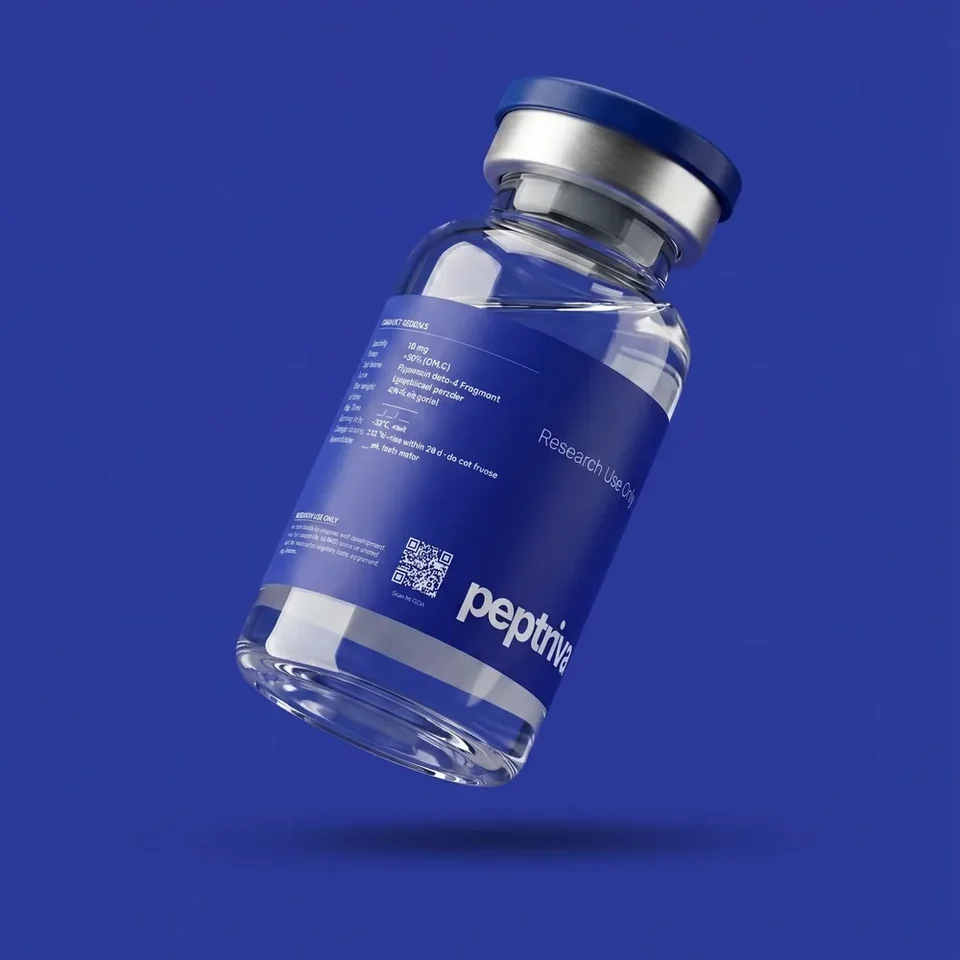
Matrixyl
The compound discussed here, supplied as a research compound with a certificate of analysis matched to the lot.
The penetration claim belongs to the palmitic acid tail
"Enhanced delivery" is a claim about the fatty acid, not the peptide.
Choi and colleagues, Biomolecules & Therapeutics, 2014, compared KTTKS and palmitoyl-KTTKS for stability in skin and for in vitro permeation. That study is why the palmitoyl version exists commercially: the bare pentapeptide does not hold up well in skin, and the lipid tail changes how the molecule behaves at the barrier.
The interesting detail is what came after. In 2024, Khalil and colleagues published a liposome encapsulation study of Pal-KTTKS in Pharmaceutics. Researchers do not build liposomal carriers for a molecule that already gets where it needs to go.
Delivery is still an open research problem nearly twenty years after the trial. Treat "penetrates deeply" as a formulation goal, not a finding.
The "improves aging skin" claim often belongs to the whole jar
Lupo and Cole reported in 2005 that a facial moisturizer containing palmitoyl pentapeptide improved the appearance of aging skin. It appears in the Journal of the American Academy of Dermatology as a supplement abstract, page P34 — a one-page conference entry, not a full paper.
What it tested was a finished moisturizer. Moisturizers improve the appearance of aging skin on their own. Without an arm that isolates the peptide, the result belongs to the product, not the ingredient.
| Claim on the label | What it actually belongs to | Evidence type |
|---|---|---|
| Reduces wrinkle depth | Pal-KTTKS | Vehicle-controlled trial, n=93, 12 weeks |
| Stimulates collagen | Bare KTTKS | Cultured fibroblasts, 1993 |
| Penetrates the skin barrier | The palmitoyl tail | In vitro permeation, 2014 |
| Advanced delivery system | The liposome carrier | Formulation study, 2024 |
| Improves aging skin | The finished moisturizer | Conference abstract, 2005 |
| Firmer, plumper skin | Unassigned | No trial located |
Claims for Matrixyl 3000 sit in a separate column again, because that product is a different peptide pair. Borrowing the 15–20% figure across the two names is the most common error in this category.
Why every label says "appearance of"
Because the wording is regulated. Under US law, a product that claims to change the structure or function of the body is a drug. A product that claims to change appearance is a cosmetic.
A product can be a drug, a cosmetic, or a combination of both, but the term "cosmeceutical" has no meaning under the law.
U.S. Food and Drug Administration, Is It a Cosmetic, a Drug, or Both?In the EU, Regulation (EC) No 1223/2009 requires a safety assessment and evidential support for claims made on cosmetic products. That is why a European label will say a wrinkle looks reduced rather than that collagen was synthesized.
- "Appearance of fine lines" is the legally safe version of the 2005 result.
- "Rebuilds collagen" is a structure claim, and no cosmetic has a trial supporting it here.
- A research vial of Pal-KTTKS is not a cosmetic product. It is not the dilute trade solution that was tested, and no regulator has assessed it as a finished good.
If you are buying raw powder rather than a cream, the identity and purity question is the whole question. See how to read a certificate of analysis, storage temperature, and the legal status page.
Matrixyl
Third-party tested research compounds, each shipped with a batch-matched certificate of analysis showing HPLC purity and mass-spec identity — the documentation this site argues you should hold any supplier to.
What to know now
- One controlled human trial supports Matrixyl: Robinson 2005, n=93, 12 weeks, a 15–20% reduction in wrinkle depth against vehicle.
- The collagen claim comes from Katayama 1993, a cell-culture study using bare KTTKS before the palmitoyl version existed.
- Penetration claims belong to the palmitic acid tail, and a 2024 liposome study shows delivery is still being worked on.
- The Lupo and Cole result tested a finished moisturizer, published as a one-page conference abstract, so it cannot isolate the peptide.
- Matrixyl 3000 is a different peptide pair; the 2005 wrinkle figure does not transfer to it.
- Labels say "appearance of" because US and EU law separates cosmetic claims from drug claims.
What we're watching
Watch for the 15–20% figure printed under a Matrixyl 3000 product. That number came from a 2005 trial of palmitoyl pentapeptide-4, which is a different molecule. Also watch the INCI list: the trade solution is dilute, so the peptide is usually present at parts per million, not percent.
Frequently asked questions
Does Matrixyl really boost collagen?
In cultured fibroblasts, the KTTKS pentapeptide promoted extracellular matrix production. That was Katayama and colleagues in 1993, in a dish. No published human trial has measured dermal collagen after topical Matrixyl. The human result that exists is a change in measured wrinkle depth, not a collagen measurement.
Is Matrixyl as effective as retinol?
The evidence bases are not comparable in size. Retinoids have 40+ randomized controlled trials in photoaging behind them. Matrixyl has one vehicle-controlled trial, in 93 women, reporting a 15–20% reduction in wrinkle depth at 12 weeks. No head-to-head trial of the two has been published that we can locate.
What is the difference between Matrixyl and Matrixyl 3000?
Different molecules. Matrixyl is palmitoyl pentapeptide-4 (Pal-KTTKS). Matrixyl 3000 is a separate peptide pair sold under the same brand family. The 2005 trial data belongs to the first one only. Our complete guide covers the distinction.
How long did the trial run before results appeared?
Robinson and colleagues measured over 12 weeks. Published reports of appearance change in this ingredient class generally fall in an 8–12 week window. That is a description of study timing, not a schedule for anyone to follow.
Is raw Pal-KTTKS powder the same as what was tested?
No. The tested material was a dilute cosmetic trade solution, roughly 500 ppm peptide, formulated into a cream. A research-grade powder has not been assessed as a finished cosmetic by any regulator, and its identity and purity depend entirely on the supplier's documentation.
References
- Katayama, K., Armendariz-Borunda, J., Raghow, R., Kang, A. H., & Seyer, J. M. (1993). A pentapeptide from type I procollagen promotes extracellular matrix production. Journal of Biological Chemistry, 268(14), 9941–9944. https://doi.org/10.1016/s0021-9258(18)82153-6
- Robinson, L. R., Fitzgerald, N. C., Doughty, D. G., Dawes, N. C., Berge, C. A., & Bissett, D. L. (2005). Topical palmitoyl pentapeptide provides improvement in photoaged human facial skin. International Journal of Cosmetic Science, 27(3), 155–160. https://doi.org/10.1111/j.1467-2494.2005.00261.x
- Lupo, M. P., & Cole, A. L. (2005). Use of a facial moisturizer containing palmitoyl pentapeptide improves the appearance of aging skin. Journal of the American Academy of Dermatology, 52(3), Supplement 1, P34. https://doi.org/10.1016/j.jaad.2004.10.390
- Choi, Y. L., Park, E. J., Kim, E., Na, D. H., & Shin, Y.-H. (2014). Dermal stability and in vitro skin permeation of collagen pentapeptides (KTTKS and palmitoyl-KTTKS). Biomolecules & Therapeutics, 22(4), 321–327. https://doi.org/10.4062/biomolther.2014.053
- Khalil, M., Hamadou, A. H., Yassin, A. E. B., et al. (2024). Liposome encapsulation of the palmitoyl–KTTKS peptide: Structural and functional characterization. Pharmaceutics, 16(2), 219. https://doi.org/10.3390/pharmaceutics16020219
- U.S. Food and Drug Administration. (2024). Is It a Cosmetic, a Drug, or Both? (Or Is It Soap?). https://www.fda.gov/cosmetics/cosmetics-laws-regulations/it-cosmetic-drug-or-both-or-it-soap
- European Commission. (2009). Regulation (EC) No 1223/2009 of the European Parliament and of the Council on cosmetic products. https://eur-lex.europa.eu/legal-content/EN/TXT/?uri=CELEX%3A32009R1223