
Search IGF-1 LR3 side effects and you get a confident list. None of it was measured in a study of IGF-1 LR3 in people. Published controlled human data on this compound is zero.
The short answer. Published controlled human trials of IGF-1 LR3: zero. There is no measured side effect rate for this compound.
- The warning list circulating online is mecasermin's FDA label, for children with severe IGF-1 deficiency.
- Mecasermin's label flags hypoglycemia, tonsillar enlargement, intracranial hypertension and more, and is contraindicated in neoplasia.
- Fetal sheep studies found IGF-1 and LR3 blunted glucose-stimulated insulin secretion, and IGF-1 grew the fetal heart.
No human trial has measured side effects of IGF-1 LR3. Published controlled human data is zero. The lists online are copied from mecasermin’s label. That is a different drug, for children with growth failure. The LR3 studies that exist used fetal sheep and mice. WADA bans IGF-1 LR3 under class S2.3.
Does IGF-1 LR3 have a known side effect profile?
No. A side effect profile is a count. It needs people, a dose, a time window, and someone writing down what happened. For IGF-1 LR3 in healthy adults, the number of published controlled trials is zero.
That means there is no denominator. Nobody can tell you how often anything happens, because nobody has counted. We go through the full published record on the IGF-1 LR3 before and after page.
- No dose-ranging study. Nobody has published what happens as the amount goes up in humans.
- No safety follow-up. No trial has tracked users for weeks or months and reported events.
- No lab panel data. No published human glucose, IGFBP or organ measurements for this molecule.
- No long-term data at all. Nothing on neoplasia risk, nothing on growth of tissue over time.
“No reported side effects” and “no study has looked” read the same on a product page. They are not the same thing. Only one of them is true here.
The side effects people quote belong to mecasermin
Almost every IGF-1 LR3 warning list traces back to one document: the FDA prescribing information for Increlex (mecasermin). That is recombinant human IGF-1, approved for severe primary IGF-1 deficiency in children.
The label lists real, documented problems. Hypoglycemia is the one it treats most seriously, which is why the label ties each dose to a meal and uses twice daily, weight-based administration in children. It also lists tonsillar and adenoidal enlargement, intracranial hypertension, slipped capital femoral epiphysis and scoliosis progression, hypersensitivity reactions including anaphylaxis, and lipohypertrophy at injection sites. It is contraindicated in active or suspected neoplasia.
That is a genuine safety record. It belongs to a different molecule in a different population.
| Feature | Mecasermin (Increlex) | IGF-1 LR3 |
|---|---|---|
| Sequence | Native human IGF-1, 70 amino acids | 83 amino acids, with a 13-amino-acid tail and one swap |
| Binding protein grip | Normal; carriers hold most of it | Reduced, so more stays free |
| Population studied | Children with severe IGF-1 deficiency | None published in humans |
| Regulatory status | FDA approved, with a label | Research compound, no label |
| Adverse event counts | Collected in trials | Zero published |
Borrowing a label is not the same as having one. The same borrowing problem runs through the claimed upsides, which we take apart in the IGF-1 LR3 benefits page.
What the animal studies actually measured
The LR3 literature is small and it is not human. It is mostly fetal sheep and mice. What it looked at is worth knowing, because it is not muscle.
White and colleagues infused IGF-1 into late gestation fetal sheep for one week in 2021. Glucose-stimulated insulin secretion went down. The authors traced it to the islet itself.
Reduced glucose-stimulated insulin secretion following a 1-wk IGF-1 infusion in late gestation fetal sheep is due to an intrinsic islet defect.
Title, White et al., American Journal of Physiology — Endocrinology and Metabolism, 2021The same group then used LR3 specifically, acutely, in 2023. Insulin secretion was again blunted during the infusion. Isolated islets afterward did not carry the change.
Attenuated glucose-stimulated insulin secretion during an acute IGF-1 LR3 infusion into fetal sheep does not persist in isolated islets.
Title, White et al., Journal of Developmental Origins of Health and Disease, 2023Jonker and colleagues, also in fetal sheep, reported in 2020 that coronary vascular growth matched IGF-1-stimulated cardiac growth. Read plainly: IGF-1 made the fetal heart grow, and the vessels kept pace in that model. Heart tissue responds to this signal. Nobody has measured what that means in an adult human given LR3.
The one LR3 mouse study most people cite is Engel et al., 2024. Intranasal long R3 IGF-1 changed amyloid plaques in the cortex of male 5XFAD mice and did not preserve cognition. It was a negative result on the outcome that mattered.
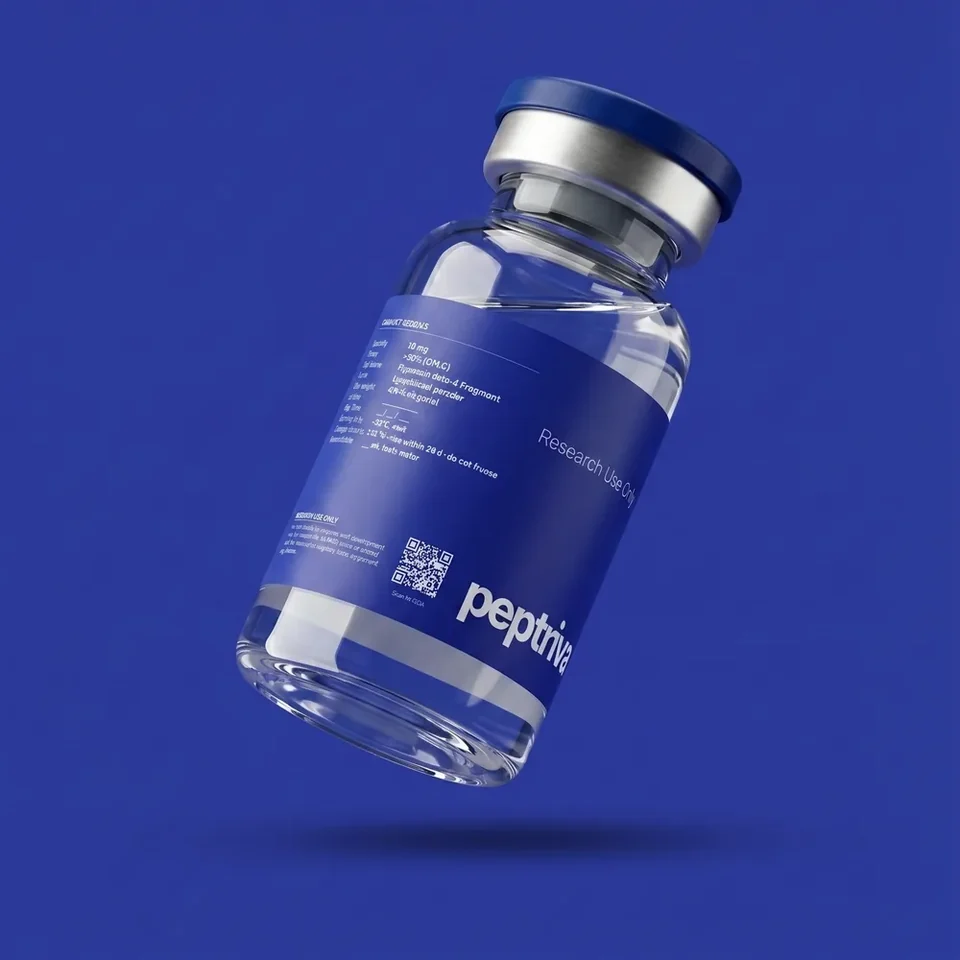
IGF-1 LR3
The compound discussed here, supplied as a research compound with a certificate of analysis matched to the lot.
Why the LR3 change matters for risk, not just effect
Natural IGF-1 is 70 amino acids. LR3 is an 83-amino-acid version: a 13-residue extension on one end plus a single amino acid substitution.
That change weakens its grip on the binding proteins that normally carry IGF-1 around. Those carriers hold 95%+ of the natural hormone at any moment. The modification exists to keep more of the molecule free.
Free fraction cuts both ways. The same property that is sold as potency also means the mecasermin label’s event rates cannot be assumed to transfer. They could understate or overstate. There is no published human data either way.
The structural detail is covered in full in the IGF-1 LR3 complete guide.
The risks that are not biological
Some of what can go wrong with a research vial has nothing to do with IGF-1 at all.
- What is in the vial. LR3 is a recombinant protein. Lu and colleagues published a 2023 method expressing IGF-1 and LR3 IGF-1 fused with xylanase in Pichia pastoris. Yield, folding and purification are production problems, and the buyer sees none of that.
- No label, no lot release. A research vial carries no FDA-reviewed label and no pharmacopeial standard. The only document is whatever third-party testing the seller posts. Read how to read a certificate of analysis before trusting one.
- Degradation. Proteins are sensitive to heat and time. Our storage temperature guide covers what that means for a shipped vial.
- Sanctions. The World Anti-Doping Agency lists IGF-1 and its analogs under class S2.3, prohibited at all times, in and out of competition. For a tested athlete this is a career risk, not a health one.
Listed prices run roughly $40–$80 for smaller vials and $100–$250 for larger ones. Price tells you nothing about identity or purity. Legal status is a separate question again, covered in are peptides legal.
What a real safety record would have to contain
It helps to know what is missing, so you can tell when it finally arrives.
A usable human safety record for IGF-1 LR3 would need named investigators, a defined population, a control arm, and a fixed observation window. It would report glucose behavior, because that is the mecasermin label’s central warning and the sheep studies hit the same system. It would report cardiac measurements, because the fetal sheep work showed IGF-1 driving heart growth. It would report how long people were followed, because neoplasia signals do not appear in weeks.
None of that exists today. Until it does, the honest statement is not “IGF-1 LR3 is safe” and not “IGF-1 LR3 is dangerous.” It is that the measurement has not been made.
IGF-1 LR3
Third-party tested research compounds, each shipped with a batch-matched certificate of analysis showing HPLC purity and mass-spec identity — the documentation this site argues you should hold any supplier to.
What to know now
- Published controlled human trials of IGF-1 LR3: zero. There is no measured side effect rate for this compound.
- The warning list circulating online is mecasermin's FDA label, for children with severe IGF-1 deficiency.
- Mecasermin's label flags hypoglycemia, tonsillar enlargement, intracranial hypertension and more, and is contraindicated in neoplasia.
- Fetal sheep studies found IGF-1 and LR3 blunted glucose-stimulated insulin secretion, and IGF-1 grew the fetal heart.
- The 2024 mouse study of intranasal long R3 IGF-1 changed plaques but failed to preserve cognition.
- WADA bans IGF-1 LR3 under class S2.3, in and out of competition.
What we're watching
Any IGF-1 LR3 side effect list with percentages attached. Those numbers were collected in mecasermin trials in children, not in any study of IGF-1 LR3. If a page cannot name the trial, the trial does not exist.
Frequently asked questions
Does IGF-1 LR3 cause low blood sugar?
No human study of IGF-1 LR3 has reported it, because no such study has been published. Hypoglycemia is the central warning on the FDA label for mecasermin, the approved IGF-1 drug, which is why that label pairs dosing with food in children. Separately, White and colleagues found blunted glucose-stimulated insulin secretion in fetal sheep given IGF-1 for one week, and again during an acute LR3 infusion in 2023. Those are animal findings in a fetal model. They are not a human rate.
Can IGF-1 LR3 cause cancer?
Unknown. No study has measured it. What is on record is that the FDA label for mecasermin lists active or suspected neoplasia as a contraindication. That reflects caution about IGF-1 signaling, not a measured outcome for IGF-1 LR3. A real answer would need long human follow-up, and none has been published.
Does IGF-1 LR3 make organs grow?
In fetal sheep, IGF-1 drove cardiac growth, and Jonker and colleagues reported in 2020 that coronary vascular growth matched it. That is a fetal animal model. No published human study has measured organ size in adults given IGF-1 LR3, so the claim you see repeated online has no human measurement behind it.
Are the side effects dose-dependent?
Nobody knows, because no human dose-ranging study of IGF-1 LR3 has been published. We do not publish doses, schedules or routes for this compound. The only administration details on record come from animal studies, such as the one-week IGF-1 infusion in fetal sheep and the intranasal mouse study, and those do not transfer to people.
Will IGF-1 LR3 show up in anti-doping testing?
It is prohibited. The World Anti-Doping Agency lists IGF-1 and its analogs under class S2.3 on the 2026 Prohibited List, banned at all times. Whether a given sample catches it depends on the laboratory method in use, which WADA does not publish in the list itself. The ban itself is not ambiguous.
Why do vendor pages say side effects are mild?
Because there is no trial to contradict them. With zero published human data, any adverse event claim about IGF-1 LR3 is unfalsifiable from the literature. Absence of reports is a consequence of nobody collecting reports, not evidence of safety.
References
- U.S. Food and Drug Administration. (2019). Increlex (mecasermin [rDNA origin] injection) prescribing information. https://www.accessdata.fda.gov/drugsatfda_docs/label/2019/021839s019lbl.pdf
- White, A., Stremming, J., Boehmer, B. H., et al. (2021). Reduced glucose-stimulated insulin secretion following a 1-wk IGF-1 infusion in late gestation fetal sheep is due to an intrinsic islet defect. American Journal of Physiology — Endocrinology and Metabolism, 320(6), E1138–E1147. https://doi.org/10.1152/ajpendo.00623.2020
- White, A., Stremming, J., Brown, L. D., & Rozance, P. J. (2023). Attenuated glucose-stimulated insulin secretion during an acute IGF-1 LR3 infusion into fetal sheep does not persist in isolated islets. Journal of Developmental Origins of Health and Disease, 14(3), 353–361. https://doi.org/10.1017/S2040174423000090
- Jonker, S. S., Giraud, G. D., Chang, E. I., Elman, M. R., & Louey, S. (2020). Coronary vascular growth matches IGF-1-stimulated cardiac growth in fetal sheep. FASEB Journal, 34(8), 10041–10055. https://doi.org/10.1096/fj.202000215R
- Engel, M. G., Narayan, S., Cui, M. H., et al. (2024). Intranasal long R3 insulin-like growth factor-1 treatment promotes amyloid plaque remodeling in cerebral cortex but fails to preserve cognitive function in male 5XFAD mice. Journal of Alzheimer’s Disease, 103(1), 113–126. https://doi.org/10.1177/13872877241299056
- Lu, Z., Liu, N., Huang, H., et al. (2023). Recombinant expression of IGF-1 and LR3 IGF-1 fused with xylanase in Pichia pastoris. Applied Microbiology and Biotechnology, 107(14), 4543–4551. https://doi.org/10.1007/s00253-023-12606-0
- World Anti-Doping Agency. The Prohibited List 2026. https://www.wada-ama.org/en/prohibited-list