
Search IGF-1 LR3 benefits and you get the same list everywhere: muscle, fat loss, healing, focus. Not one item on that list is supported by a human trial of IGF-1 LR3. No human randomized trial in healthy adults has been published since 2020.
The short answer. No published human trial has measured IGF-1 LR3 for muscle, fat loss, or healing.
- The muscle claim borrows from mecasermin, approved only for children with severe IGF-1 deficiency.
- The only study that gave LR3 for a named benefit, Engel 2024 in mice, failed on cognition.
- The fat loss claim traces to glucose and insulin effects measured in fetal sheep, plus hypoglycemia warnings on the Increlex label.
IGF-1 LR3 has no human trial behind its benefit claims. Each claim is borrowed from a different source. One source is mecasermin, a drug for growth-failure children. Another is IGF-1 infused into fetal sheep. The one LR3 mouse study failed on memory. WADA bans it under S2.3.
What IGF-1 LR3 is claimed to do, and where each claim comes from
IGF-1 LR3 is a lab-made 83-amino-acid version of human IGF-1. It adds a 13-residue tail and swaps one amino acid. That change loosens its grip on the carrier proteins that normally hold 95%+ of natural IGF-1. The chemistry is covered in the IGF-1 LR3 complete guide.
The benefit list is a different thing. It is a stack of borrowed findings. Sort them by what was actually measured and in what, and the list thins out fast.
| Claim | What it traces back to | Who or what was studied |
|---|---|---|
| Builds muscle | General IGF-1 biology. No LR3 trial. | Not tested in humans |
| Burns fat | Insulin-like action on blood glucose | Fetal sheep; children on mecasermin |
| Speeds healing | Nothing published for LR3 | No study |
| Protects the brain | Engel 2024, intranasal LR3 | Male 5XFAD mice |
| Grows organs and heart tissue | Jonker 2020 | Fetal sheep |
| More potent than plain IGF-1 | Binding protein chemistry | Molecular design, not an outcome |
The last row is the one that gets misread. Staying free in the blood longer is a property. It is not a result.
Does IGF-1 LR3 build muscle?
No published human study has measured it. Not lean mass, not strength, not fiber size. The muscle claim rests on what IGF-1 does as a signal, plus animal and cell work, plus gym reports.
The closest regulated comparison is mecasermin, sold as Increlex. That is recombinant human IGF-1, not LR3. The FDA label describes it as:
for the treatment of growth failure in pediatric patients with severe primary IGF-1 deficiency.
FDA, Increlex prescribing information, 2019That is the whole approved use. Children who cannot make IGF-1 grow when they are given it. The label describes injection twice daily with food, under physician care. None of that tells you what happens in an adult who already makes normal IGF-1.
Replacing a hormone in someone who lacks it is a different experiment than adding more to someone who does not. The first has decades of data. The second has zero controlled human trials for LR3.
The one study that tested LR3 for a named benefit
There is a recent study that gave IGF-1 LR3 specifically and asked whether a benefit followed. It is the Engel group's 2024 work in the Journal of Alzheimer's Disease. The subjects were male 5XFAD mice, an Alzheimer's model. The route was intranasal.
The result is in the title:
Intranasal long R3 insulin-like growth factor-1 treatment promotes amyloid plaque remodeling in cerebral cortex but fails to preserve cognitive function in male 5XFAD mice.
Engel et al., Journal of Alzheimer's Disease, 2024So something in the tissue changed. The thing the animals could be tested on did not. That split matters more than it looks. A biomarker moving is the most common way a compound looks like it works before it turns out not to.
- Species: mice, and only male ones.
- Model: a genetic Alzheimer's strain, not healthy aging.
- Outcome: plaque remodeling yes, cognition no.
- Relevance to the nootropic claim: it is the closest direct test, and it is negative.
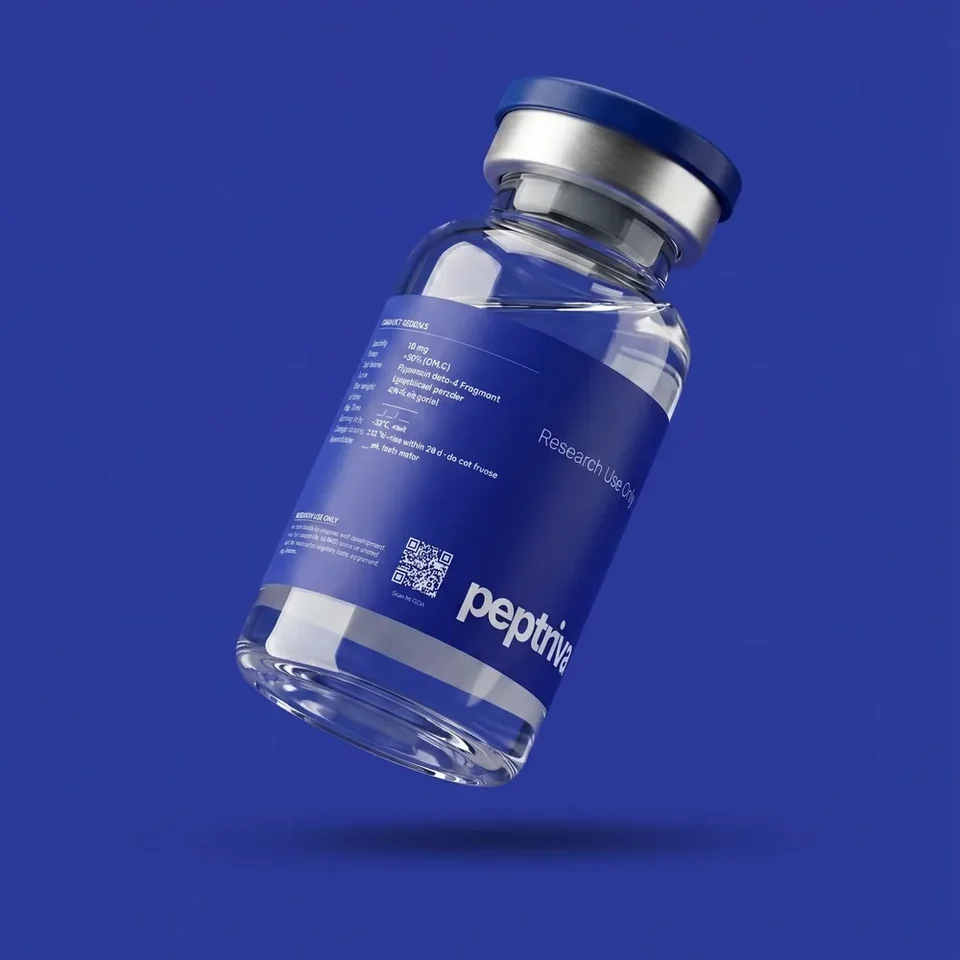
IGF-1 LR3
The compound discussed here, supplied as a research compound with a certificate of analysis matched to the lot.
The fat loss claim is actually a blood sugar effect
IGF-1 looks like insulin and acts a little like it. That is where the fat loss story starts. What researchers have measured is what it does to glucose handling, and most of that work is in fetal sheep.
White and colleagues ran a one-week IGF-1 infusion into late gestation fetal sheep in 2021. Glucose-stimulated insulin secretion fell, and they traced it to a defect inside the islet itself. A 2023 follow-up used an acute 90-minute LR3 infusion and reported:
Attenuated glucose-stimulated insulin secretion during an acute IGF-1 LR3 infusion into fetal sheep does not persist in isolated islets.
White, Stremming, Brown & Rozance, Journal of Developmental Origins of Health and Disease, 2023Read that as a safety signal rather than a benefit. On the human side, the Increlex label names hypoglycemia as the adverse reaction clinicians watch for, which is why the label pairs each dose with food. Low blood sugar is not fat loss.
IGF-1 grows tissue, and it does not pick which tissue
The growth claim is the one with the strongest biology behind it. That is also why it cuts both ways.
Jonker and colleagues reported in FASEB Journal in 2020 that coronary vascular growth matched IGF-1-stimulated cardiac growth in fetal sheep. The heart grew. The vessels kept pace. That is a clean finding about a growth factor doing what a growth factor does.
Nothing in that study was about skeletal muscle in an adult. It was fetal heart tissue. A signal that enlarges organs in a fetus is not a bodybuilding result, and the Increlex label treats unchecked growth as a risk, listing active or suspected neoplasia among its contraindications.
This is the gap the benefit lists skip. Growth-factor signaling is real and non-selective. The published work tells you it does things. It does not tell you those things are good for a healthy adult.
What is actually in a research vial
LR3 is made in cells, not synthesized like a short peptide. Lu and colleagues published a 2023 method in Applied Microbiology and Biotechnology expressing IGF-1 and LR3 IGF-1 in Pichia pastoris yeast, fused with xylanase to help production.
That matters for buyers. A recombinant protein can misfold, clip, or carry host-cell residue, and none of that shows up in a purity percentage alone. Mass spec identity on a batch document is the thing to look for.
- Check what the certificate of analysis actually tested, not just the headline number.
- Proteins are less stable than short peptides, so storage temperature is not a detail.
- Handling after mixing is covered in the reconstitution guide.
General sourcing standards are in our buying guide.
Is IGF-1 LR3 banned?
Yes, in sport. The World Anti-Doping Agency lists IGF-1 and its analogs under section S2.3 of the Prohibited List, banned at all times, in and out of competition.
Legal status for possession is separate from doping status and varies by country. We cover the general picture in are peptides legal. What is settled is the regulatory line: only mecasermin is approved, and only for severe pediatric IGF-1 deficiency. A research vial of LR3 is not an approved drug and carries no approved use.
IGF-1 LR3
Third-party tested research compounds, each shipped with a batch-matched certificate of analysis showing HPLC purity and mass-spec identity — the documentation this site argues you should hold any supplier to.
What to know now
- No published human trial has measured IGF-1 LR3 for muscle, fat loss, or healing.
- The muscle claim borrows from mecasermin, approved only for children with severe IGF-1 deficiency.
- The only study that gave LR3 for a named benefit, Engel 2024 in mice, failed on cognition.
- The fat loss claim traces to glucose and insulin effects measured in fetal sheep, plus hypoglycemia warnings on the Increlex label.
- WADA bans IGF-1 and its analogs under S2.3, at all times.
What we're watching
Hypoglycemia is the adverse reaction the FDA flags on the mecasermin label. A research vial of LR3 carries no label at all.
Frequently asked questions
Does IGF-1 LR3 build muscle in humans?
No published human study has measured it. There is no trial of lean mass, strength, or fiber size with IGF-1 LR3. The claim rests on IGF-1 biology, animal work, and user reports, not on a controlled human result.
Is IGF-1 LR3 the same as Increlex?
No. Increlex is mecasermin, recombinant human IGF-1, approved by the FDA for growth failure in pediatric patients with severe primary IGF-1 deficiency. IGF-1 LR3 is a modified 83-amino-acid analog and is not approved for any use.
Does IGF-1 LR3 burn fat?
Nothing published shows that. What researchers have measured is its effect on glucose and insulin. A 2023 study reported attenuated glucose-stimulated insulin secretion during an acute LR3 infusion in fetal sheep. That is a blood sugar effect, not fat loss.
Does IGF-1 LR3 help the brain?
The one direct test says no on the outcome that counts. Engel and colleagues gave intranasal LR3 to male 5XFAD mice in 2024. Amyloid plaques remodeled, but cognitive function was not preserved.
Is IGF-1 LR3 banned in sport?
Yes. The World Anti-Doping Agency prohibits IGF-1 and its analogs under section S2.3, at all times, in and out of competition.
References
- Engel, M. G., Narayan, S., Cui, M. H., et al. (2024). Intranasal long R3 insulin-like growth factor-1 treatment promotes amyloid plaque remodeling in cerebral cortex but fails to preserve cognitive function in male 5XFAD mice. Journal of Alzheimer’s Disease, 103(1), 113–126. https://doi.org/10.1177/13872877241299056
- White, A., Stremming, J., Boehmer, B. H., et al. (2021). Reduced glucose-stimulated insulin secretion following a 1-wk IGF-1 infusion in late gestation fetal sheep is due to an intrinsic islet defect. American Journal of Physiology — Endocrinology and Metabolism, 320(6), E1138–E1147. https://doi.org/10.1152/ajpendo.00623.2020
- White, A., Stremming, J., Brown, L. D., & Rozance, P. J. (2023). Attenuated glucose-stimulated insulin secretion during an acute IGF-1 LR3 infusion into fetal sheep does not persist in isolated islets. Journal of Developmental Origins of Health and Disease, 14(3), 353–361. https://doi.org/10.1017/S2040174423000090
- Jonker, S. S., Giraud, G. D., Chang, E. I., Elman, M. R., & Louey, S. (2020). Coronary vascular growth matches IGF-1-stimulated cardiac growth in fetal sheep. FASEB Journal, 34(8), 10041–10055. https://doi.org/10.1096/fj.202000215R
- Lu, Z., Liu, N., Huang, H., et al. (2023). Recombinant expression of IGF-1 and LR3 IGF-1 fused with xylanase in Pichia pastoris. Applied Microbiology and Biotechnology, 107(14), 4543–4551. https://doi.org/10.1007/s00253-023-12606-0
- U.S. Food and Drug Administration. (2019). Increlex (mecasermin [rDNA origin] injection) prescribing information. https://www.accessdata.fda.gov/drugsatfda_docs/label/2019/021839s019lbl.pdf
- World Anti-Doping Agency. The Prohibited List 2026. https://www.wada-ama.org/en/prohibited-list