
Search IGF-1 LR3 before and after and you get photographs of arms. The published record behind them contains zero human trials. The studies that used this exact molecule measured sheep insulin and mouse memory.
The short answer. No published human trial has measured IGF-1 LR3 body composition, in either direction.
- The one study using long R3 IGF-1 with a behavioral endpoint, Engel 2024, found no cognitive benefit in mice.
- The living-animal LR3 data is fetal sheep physiology, and it is about insulin secretion, not muscle.
- Mecasermin, the only FDA-approved IGF-1 product, is for severe primary IGF-1 deficiency in children.
No human trial has measured IGF-1 LR3 in healthy adults. Published controlled human data is zero. The LR3 studies that exist used fetal sheep and mice. A 2024 mouse study found no memory benefit. Mecasermin is the only approved IGF-1 drug. WADA bans IGF-1 LR3 under class S2.3.
What has actually been measured
IGF-1 LR3 is a lab-made 83-amino-acid version of human IGF-1. It carries a 13-residue extra tail and one swapped amino acid. That change loosens its grip on the binding proteins that normally hold 95% of natural IGF-1. The complete guide covers the chemistry.
The question here is narrower. What did anyone weigh, scan or photograph before and after giving it?
Four animal studies make up most of the recent record. None of them used a human. None of them measured muscle size or body fat.
| Study | Subject | What was measured | Result |
|---|---|---|---|
| Engel et al., 2024 | 5XFAD mice | Amyloid plaques, cognition | Plaques remodeled, cognition not preserved |
| White et al., 2023 | Fetal sheep | Insulin release during LR3 infusion | Blunted, but not in isolated islets |
| White et al., 2021 | Fetal sheep | Insulin release after IGF-1 infusion | Reduced, from an islet defect |
| Jonker et al., 2020 | Fetal sheep | Heart and coronary vessel growth | Vessel growth kept pace with heart growth |
| — | Humans | Lean mass, body fat | No published trial |
Every row that measured a body changing is a sheep fetus or a mouse. The row a buyer cares about is empty.
The one LR3 study with a real before and after failed
Engel and colleagues published the closest thing to a before-and-after design in 2024. They gave long R3 IGF-1 by the intranasal route to male 5XFAD mice, a strain bred to build amyloid plaques.
Something did change. Plaque structure in the cerebral cortex was remodeled. Then they tested the animals on cognition, and the effect stopped there.
Intranasal long R3 insulin-like growth factor-1 treatment promotes amyloid plaque remodeling in cerebral cortex but fails to preserve cognitive function in male 5XFAD mice.
Engel et al., Journal of Alzheimer’s Disease, 2024That title is the whole lesson. A measurable tissue change happened. The outcome that mattered did not follow. It is a useful reminder when a photo is offered as proof that something worked.
Why are there no human before-and-after studies?
Three reasons, and none of them is that the trial is coming.
- It is a banned substance in sport. The World Anti-Doping Agency lists IGF-1 and its analogs under class S2.3, prohibited at all times. Performance trials in athletes are not run on prohibited growth factors.
- The approved cousin is for children. Mecasermin, sold as Increlex, is recombinant human IGF-1 and is not LR3. The FDA label covers severe primary IGF-1 deficiency in children, given twice daily with food. Growth failure is the endpoint, not adult muscle.
- The animal work is developmental. The sheep studies are fetal physiology. They exist to understand growth in the womb, not hypertrophy in a gym.
So the human record is not thin. It is absent. We say the same thing, with the same sources, on the benefits page.
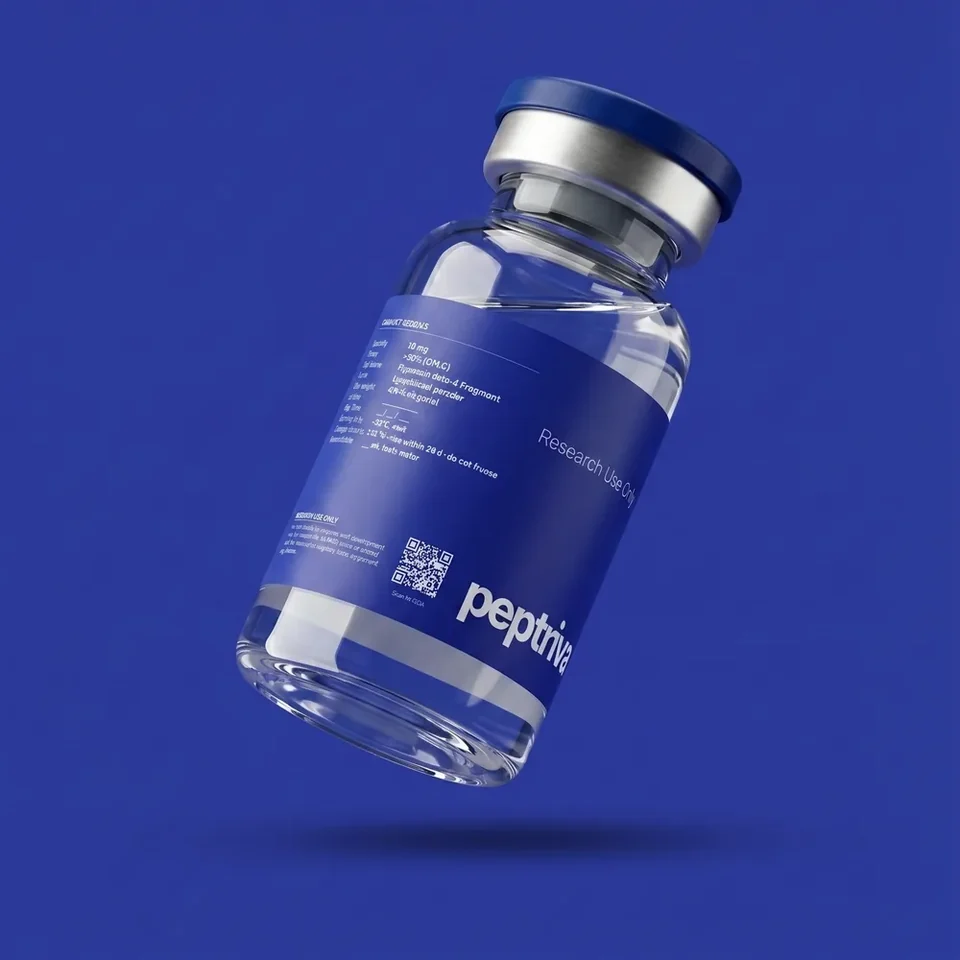
IGF-1 LR3
The compound discussed here, supplied as a research compound with a certificate of analysis matched to the lot.
What the sheep work found, and why it is not reassuring
The most relevant LR3 data in a living animal is about insulin, not muscle.
In 2023, White and colleagues infused IGF-1 LR3 into fetal sheep for 90-minute periods. Glucose-stimulated insulin secretion fell during the infusion. When the islets were removed and tested on their own, the effect was gone.
Attenuated glucose-stimulated insulin secretion during an acute IGF-1 LR3 infusion into fetal sheep does not persist in isolated islets.
White et al., Journal of Developmental Origins of Health and Disease, 2023The 2021 study from the same group ran a one-week IGF-1 infusion instead. There the drop in insulin secretion did persist, and the authors traced it to an intrinsic defect in the islet itself. Jonker and colleagues, working in the same species, found coronary vessel growth kept pace with IGF-1-driven heart growth.
None of that is a fat-loss or muscle result. It is signal that this molecule moves glucose handling and organ growth. The Increlex label names hypoglycemia as a known adverse reaction of IGF-1 therapy, which lines up with the animal direction.
How to read an IGF-1 LR3 before-and-after photo
A photo is a measurement of light. It is not a measurement of lean mass. With no trial to compare against, every image in this category is a single uncontrolled case with an unknown input list.
- What else was in the stack. IGF-1 LR3 is rarely used alone in the accounts that come with photos. Nothing in the image separates the compounds.
- What the training and diet were. A seven-month block of hard training changes a physique on its own.
- What the vial contained. Research-grade material is sold without identity testing unless a third-party report says otherwise.
- No endpoint. No DXA, no circumference, no strength number, no timeline you can audit.
A result with no control arm, no measurement and no verified input is a story about a person, not evidence about a compound.
What you can check instead
The evidence is not checkable. The vial partly is. That is the only before and after available to a buyer here.
IGF-1 LR3 is produced recombinantly. Lu and colleagues reported expressing both IGF-1 and LR3 IGF-1 as xylanase fusions in Pichia pastoris in 2023, which is the kind of process detail a serious supplier can describe. Research vials commonly list at $40–$80, with larger or kit formats toward $100–$250.
Before any of that, read the paperwork. How to read a certificate of analysis explains what identity and purity testing should show and which reports are decorative. Storage temperature matters for a protein this size, and the legal status page covers research-use framing. If you are comparing sellers, our documentation comparison is the place to start.
IGF-1 LR3
Third-party tested research compounds, each shipped with a batch-matched certificate of analysis showing HPLC purity and mass-spec identity — the documentation this site argues you should hold any supplier to.
What to know now
- No published human trial has measured IGF-1 LR3 body composition, in either direction.
- The one study using long R3 IGF-1 with a behavioral endpoint, Engel 2024, found no cognitive benefit in mice.
- The living-animal LR3 data is fetal sheep physiology, and it is about insulin secretion, not muscle.
- Mecasermin, the only FDA-approved IGF-1 product, is for severe primary IGF-1 deficiency in children.
- WADA prohibits IGF-1 and its analogs at all times under class S2.3, which is part of why no performance trial exists.
What we're watching
Watch for before-and-after sets where IGF-1 LR3 was one of several compounds used at once. No published study has isolated it in a person, so no photograph can attribute a change to it.
Frequently asked questions
Is there a human before-and-after study of IGF-1 LR3?
No. We found no published controlled trial of IGF-1 LR3 in healthy adults. The recent studies that used this molecule were run in fetal sheep and in 5XFAD mice, and they measured insulin secretion, organ growth and cognition.
Does IGF-1 LR3 build muscle?
Unknown in humans. No published trial has measured lean mass, strength or body fat in people given IGF-1 LR3. The claim is borrowed from IGF-1 biology and from mecasermin, an approved drug for growth failure in children.
How long until IGF-1 LR3 results show?
There is no answer from the literature, because no human study has defined an outcome or a timeline. The animal work used periods ranging from a 90-minute infusion to one week, and none of those endpoints was appearance.
Is IGF-1 LR3 the same as Increlex?
No. Increlex is mecasermin, recombinant human IGF-1 with the natural 70-amino-acid sequence. IGF-1 LR3 is an 83-amino-acid analog with a 13-residue extension and one substitution. Only mecasermin has an FDA label.
Will IGF-1 LR3 show on a drug test?
The World Anti-Doping Agency prohibits IGF-1 and its analogs at all times under class S2.3 of the Prohibited List. Testing methods and sanctions are a matter for the relevant anti-doping authority.
What can I actually verify before buying?
The documents, not the outcome. A third-party certificate of analysis showing identity and purity, storage handling, and the seller's willingness to publish batch reports are the checkable parts.
What people actually report
These are self-reports, not evidence. No control group, no blinding, and no independent check that the vial held what the label claimed. They are collected here because people asking about Igf 1 Lr3 deserve an answer rather than a refusal, and because what the community believes is itself worth knowing. Quotes are excerpts; each links to the original post.
Uncontrolled, unverified self-reports converge on two things: pumps and muscle fullness inside a few weeks, and blood sugar that posters say drops when food does not follow the shot. Most of the detailed reports are not of the compound on its own. The most detailed success posts also list testosterone, EQ or HGH. The one poster who says it was the first and only peptide he had used spent three days in hospital on liver support, and he raised it as a question rather than a finding, because he had also overdosed on paracetamol that week. The dissent is blunt. One commenter says the gains are "all in your head"; a reviewer put his arm growth at maybe half a centimeter and said he could not pin even that on the compound.
Where the community and the published record disagree. The community treats IGF-1 LR3 as the most direct muscle-builder it has, but the published record is not human. Searching PubMed for the three names it goes by together, "IGF-1 LR3" OR "LR3 IGF-1" OR "Long R3 IGF-1", returns 23 records; the exact phrase "IGF-1 LR3" on its own returns 11. Not one of the 23 is a human trial: zero carry PubMed's clinical-trial or randomized-controlled-trial filter, and the corpus runs to fetal sheep, mice, beef heifers, rat nerve conduits, bovine and chicken cells, and yeast expression systems. The one 2025 paper with growth in its title reads "IGF-1 LR3 does not promote growth in late-gestation growth-restricted fetal sheep" (Am J Physiol Endocrinol Metab, PMID 39679943, https://pubmed.ncbi.nlm.nih.gov/39679943/). So every human data point that exists is a self-report, and the most detailed ones are written by people simultaneously running testosterone, EQ, HGH or all three, which is the one condition under which the compound cannot be credited.
“Hey guys has anyone noticed any gains after using igf-1 lr3? How did your cycle go?”
Does igf-1 lr3 work? Has anyone actually noticed any benefits from it?
“I’m on a heavy dose of igf 1. 100 mcg per day, alongside test and eq at 750 mg each.”
“at first I wasn’t getting much results !!! Then I altered my dose to how I was eating and what I was eating and I noticed a huge improvement.”
“I go to hospital, and they tell me my liver was not functioning well”
“My arms moved maybe half a centimetre, and even that's muddied by better training, more food and everything else being dialled at the same time.”
“how it compares to GH-releasing peptides like CJC-1295 and GHRP-6, and where the line is between performance enhancement and real medical risk”
IGF-1 LR3 vs GH Peptides - The Battle Between Performance & Risk
Posts are quoted under fair use and linked to their authors. Nothing on this page is hosted here, and no claim above has been verified beyond confirming that the person wrote it.
References
- Engel, M. G., Narayan, S., Cui, M. H., et al. (2024). Intranasal long R3 insulin-like growth factor-1 treatment promotes amyloid plaque remodeling in cerebral cortex but fails to preserve cognitive function in male 5XFAD mice. Journal of Alzheimer’s Disease, 103(1), 113–126. https://doi.org/10.1177/13872877241299056
- White, A., Stremming, J., Boehmer, B. H., et al. (2021). Reduced glucose-stimulated insulin secretion following a 1-wk IGF-1 infusion in late gestation fetal sheep is due to an intrinsic islet defect. American Journal of Physiology — Endocrinology and Metabolism, 320(6), E1138–E1147. https://doi.org/10.1152/ajpendo.00623.2020
- White, A., Stremming, J., Brown, L. D., & Rozance, P. J. (2023). Attenuated glucose-stimulated insulin secretion during an acute IGF-1 LR3 infusion into fetal sheep does not persist in isolated islets. Journal of Developmental Origins of Health and Disease, 14(3), 353–361. https://doi.org/10.1017/S2040174423000090
- Jonker, S. S., Giraud, G. D., Chang, E. I., Elman, M. R., & Louey, S. (2020). Coronary vascular growth matches IGF-1-stimulated cardiac growth in fetal sheep. FASEB Journal, 34(8), 10041–10055. https://doi.org/10.1096/fj.202000215R
- Lu, Z., Liu, N., Huang, H., et al. (2023). Recombinant expression of IGF-1 and LR3 IGF-1 fused with xylanase in Pichia pastoris. Applied Microbiology and Biotechnology, 107(14), 4543–4551. https://doi.org/10.1007/s00253-023-12606-0
- U.S. Food and Drug Administration. (2019). Increlex (mecasermin [rDNA origin] injection) prescribing information. https://www.accessdata.fda.gov/drugsatfda_docs/label/2019/021839s019lbl.pdf
- World Anti-Doping Agency. The Prohibited List 2026. https://www.wada-ama.org/en/prohibited-list