
A glutathione before and after is usually two things at once: a skin-lightening claim, and an intravenous route that the US and Philippine regulators have both warned about. The controlled evidence is neither.
The short answer. Glutathione: The controlled skin-lightening evidence is one trial: 46 participants, 8 weeks, topical and oral combined. Not intravenous.
- Oral glutathione is roughly 10–20% bioavailable. Gut enzymes take the tripeptide apart before it reaches circulation.
- The intravenous route in most before-and-after photos carries FDA and Philippine FDA warnings, with reported deaths, Stevens-Johnson syndrome and organ toxicity.
- The FDA-approved drug in this space is the precursor N-acetylcysteine, not glutathione itself.
Glutathione is a three-amino-acid peptide. Cells use it as their main antioxidant. The controlled skin-lightening evidence is one trial: 46 people, 8 weeks, topical and oral together. Swallowed glutathione mostly does not arrive. Gut enzymes take it apart, and only about 10–20% gets through. The injected route in the photos is different. The US and Philippine regulators have both warned against it.
What the controlled trial measured
There is a real study here, which puts glutathione ahead of most of this catalog. A 2021 trial in the dermatology literature enrolled 46 participants and ran for 8 weeks, testing a combination of topical and oral glutathione as a skin-whitening agent.
Note the two things it was not. It was not intravenous. And it was not long: eight weeks is short for a pigmentation endpoint, where seasonal sun exposure alone moves the measurement.
So the trial that exists tested a route and a duration that most before-and-after photos do not represent. The glutathione complete guide covers the wider evidence base.
Why oral glutathione barely arrives
Glutathione is a tripeptide, and the gut treats tripeptides the way it treats food. Enzymes take it apart before it reaches circulation.
Measured oral bioavailability sits around 10–20%, and the classic study on systemic availability of oral glutathione found the dose largely did not survive the trip. That is not a marginal inefficiency. It is most of the dose.
It is not possible to increase circulating glutathione to a clinically beneficial extent by the oral administration of a single dose of 3 g of glutathione.
Witschi et al., European Journal of Clinical Pharmacology, 1992This is the reason the market pushed toward injection in the first place. The absorption problem is real. Solving it by going intravenous is where the safety problem starts.
The intracellular concentrations that make glutathione biologically interesting — the 1–10 mM range inside cells, roughly a million-fold above plasma — are maintained by synthesis, not by swallowing the finished molecule. Glutathione dosage covers what the studies administered.
The IV route in the photos, and what regulators have said
This is the part a results page has an obligation to state plainly, because the photographs and the warnings are about the same practice.
Intravenous glutathione is sold internationally for skin lightening. The US FDA has issued a warning against injectable skin-lightening and skin-bleaching products. The Philippine FDA, in the market where the practice is most established, has issued its own formal warnings.
Reported harms in that literature include deaths, Stevens-Johnson syndrome, and organ toxicity. These are not theoretical risks extrapolated from a mechanism. They are reported outcomes from the exact use the photographs depict.
Two further points that follow from the regulatory position rather than from the pharmacology. There is no approved product, so there is no manufacturing standard behind what goes into a drip. And there is no adverse-event reporting route, so the harms on record are the ones that reached publication.
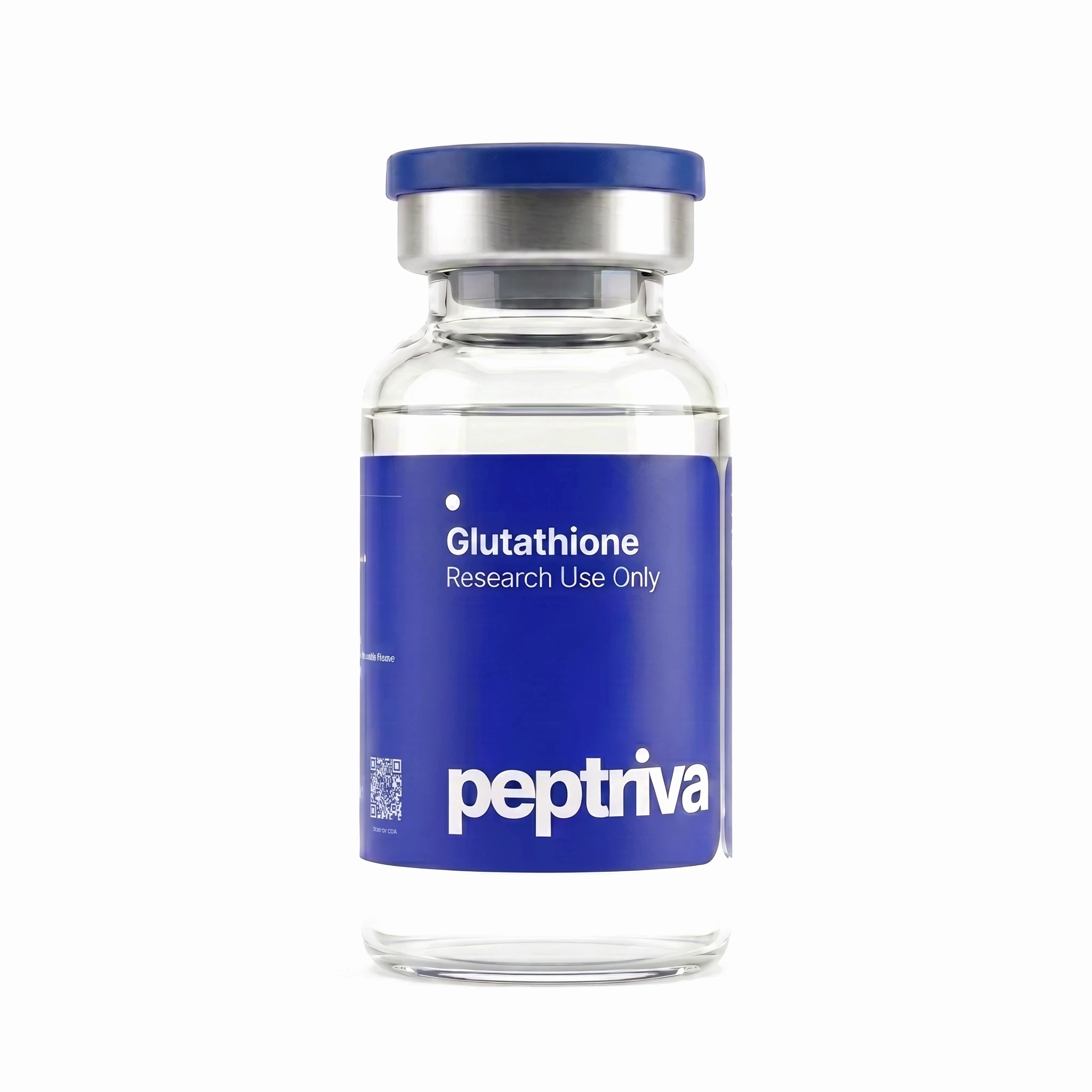
Glutathione
The tripeptide discussed here, supplied as a research compound with a batch-matched certificate of analysis.
What glutathione is actually established for
None of the above makes glutathione a fringe molecule. It is one of the best characterized compounds in human biochemistry, and the confusion is worth clearing up because it cuts in the compound’s favor.
- It is the body’s principal intracellular antioxidant. Cells hold it at millimolar concentrations and regenerate it continuously.
- The approved drug in this space is its precursor. N-acetylcysteine is FDA-approved, for acetaminophen overdose and as a mucolytic in COPD. That is a real label, and it is not glutathione itself.
- Depletion is measurable and matters. Glutathione status is a genuine clinical variable in liver injury and oxidative stress.
No significant changes were observed in biomarkers of oxidative stress, including glutathione status, in this clinical trial of oral glutathione supplementation in healthy adults.
Allen & Bradley, Journal of Alternative and Complementary Medicine, 2011That is a controlled trial of the oral route, and it moved nothing measurable. Worth holding next to any oral product sold on an antioxidant claim.
The gap is between "this molecule is important" and "injecting this molecule lightens skin safely." The first is settled. The second is where the warnings live. Best peptides for skin health puts it alongside the alternatives.
How to read a glutathione before-and-after
Pigmentation photographs are the easiest images in this entire market to produce misleadingly, and mostly not on purpose.
- Lighting and white balance. Skin tone is the single most camera-sensitive thing a photo can claim to show.
- Sun exposure between shots. Eight weeks of avoiding the sun changes pigmentation on its own, and anyone pursuing lightening is usually also avoiding the sun.
- Everything else in the routine. These photos rarely come from someone changing one variable.
- Which route. A drip photo is not evidence for an oral product, and the trial that exists tested topical and oral together.
If the goal is skin, the compound with the most replicated topical evidence in this library is a different one entirely — see GHK-Cu before and after.
Glutathione
Research-use-only material, sold by the vial with batch documentation. Check the certificate of analysis against the batch you receive.
What to know now
- The controlled skin-lightening evidence is one trial: 46 participants, 8 weeks, topical and oral combined. Not intravenous.
- Oral glutathione is roughly 10–20% bioavailable. Gut enzymes take the tripeptide apart before it reaches circulation.
- The intravenous route in most before-and-after photos carries FDA and Philippine FDA warnings, with reported deaths, Stevens-Johnson syndrome and organ toxicity.
- The FDA-approved drug in this space is the precursor N-acetylcysteine, not glutathione itself.
- Pigmentation photos are uniquely sensitive to lighting, white balance and sun avoidance, all of which change between shots.
What we're watching
The useful study would be a longer randomized trial with objective colorimetry rather than photographs, and a route that matches what people actually buy. Eight weeks and a combination arm cannot separate topical from oral, and neither speaks to the intravenous practice the warnings are about. We are also watching whether regulators outside the US and the Philippines formalize positions, since the practice is largely cross-border and enforcement so far has been national.
Frequently asked questions
Does glutathione actually lighten skin?
One controlled trial of 46 participants over 8 weeks tested a topical and oral combination for skin whitening. That is the extent of the controlled evidence. It does not establish an effect for the intravenous route that most before-and-after photos depict.
Is IV glutathione safe?
Regulators say no. The US FDA has warned against injectable skin-lightening products and the Philippine FDA has issued its own warnings. Reported harms include deaths, Stevens-Johnson syndrome and organ toxicity. There is no approved product, so there is no manufacturing standard behind what is in a drip.
Why is oral glutathione considered poorly absorbed?
Because it is a tripeptide and the gut breaks tripeptides apart. Measured oral bioavailability is roughly 10-20%, so most of a swallowed dose does not reach circulation intact.
How long does glutathione take to work?
The controlled trial ran 8 weeks. That is also short enough that seasonal sun exposure alone can move a pigmentation measurement, which is one reason the result is hard to interpret.
Is N-acetylcysteine the same thing?
No. NAC is a precursor the body uses to make glutathione, and it is the FDA-approved drug in this space, for acetaminophen overdose and as a mucolytic. Glutathione itself has no such approval.
What people actually report
These are self-reports, not evidence. No control group, no blinding, and no independent check that the vial held what the label claimed. They are collected here because people asking about Glutathione deserve an answer rather than a refusal, and because what the community believes is itself worth knowing. Quotes are excerpts; each links to the original post.
Self-reports converge on slow and small. People injecting glutathione for skin usually say weeks one to three show nothing, though one poster reports a change by day six. When change does get described it is "brighter and more even, not whiter," and it lands around month two or three. Plenty report nothing at all, including one person who ran both injection routes for ten weeks each. The non-skin effects people name scatter rather than agree: sleep and steadier energy in the most detailed account, "detox," inflammation and organ health elsewhere. Nothing was measured against a control, and the closest anyone comes to a measurement is one user's sleep tracker. These are uncontrolled, unverified self-reports.
Where the community and the published record disagree. The community's working rule is that injecting works and oral is wasted money, and the published evidence runs the other way. Sarkar's 2025 systematic review in the International Journal of Dermatology (64:992-1004, doi:10.1111/ijd.17535) found five randomized controlled trials plus one open-arm study behind oral glutathione, but only one placebo-controlled study of the intravenous route, and its abstract states that "IV glutathione is contraindicated due to lack of efficacy and side effects." The abstract names no trial at all of the intramuscular or subcutaneous injecting that Reddit actually describes.
“Overall, the most noticeable effect has been very sound sleep / more time in deep sleep per my tracker. Have not noticed skin changes.”
Anyone taking Glutathione subq? (r/DIYaesthetics, 41 upvotes, 192 comments)
“Im on week 3, and I havent noticed anything.....”
At what dose& How long for results (r/glutathione, 19 upvotes, 46 comments)
“I didn't see any changes. I tried IM and subQ for 10 weeks each.”
Anyone have pics of glutathione results? (r/DIYaesthetics, 9 upvotes, 26 comments)
“you wont really notice any benefits unless you consider skin lightening to be a benefit.”
“they quit after not seeing results in four weeks, and it takes at least 3 o four months for our skin to respond to most treatment.”
final verdict on glutathione injections? (r/skinwhitening, 35 upvotes, 30 comments, now archived)
“Shockingly, these drips are being offered by beauticians with no medical training, and there's no regulation in place.”
Exposing dangerous glutathione 'skin whitening' IV drips in UK (Channel 4 News, 15:58, 78,901 views)
Posts are quoted under fair use and linked to their authors. Nothing on this page is hosted here, and no claim above has been verified beyond confirming that the person wrote it.
References
- Wahab, S., Anwar, A. I., Zainuddin, A. N., et al. (2021). Combination of topical and oral glutathione as a skin-whitening agent: a double-blind randomized controlled clinical trial. International Journal of Dermatology, 60(8), 1013–1018. https://doi.org/10.1111/ijd.15573
- Witschi, A., Reddy, S., Stofer, B., & Lauterburg, B. H. (1992). The systemic availability of oral glutathione. European Journal of Clinical Pharmacology, 43(6), 667–669. https://doi.org/10.1007/BF02284971
- Allen, J., & Bradley, R. D. (2011). Effects of oral glutathione supplementation on systemic oxidative stress biomarkers in human volunteers. Journal of Alternative and Complementary Medicine, 17(9), 827–833. https://doi.org/10.1089/acm.2010.0716
- Lu, S. C. (2013). Glutathione synthesis. Biochimica et Biophysica Acta, 1830(5), 3143–3153. https://doi.org/10.1016/j.bbagen.2012.09.008
- Forman, H. J., Zhang, H., & Rinna, A. (2009). Glutathione: Overview of its protective roles, measurement, and biosynthesis. Molecular Aspects of Medicine, 30(1–2), 1–12. https://doi.org/10.1016/j.mam.2008.08.006
- Pizzorno, J. (2014). Glutathione! Integrative Medicine: A Clinician's Journal, 13(1), 8–12. PMID 26770075
- U.S. Food and Drug Administration / Philippines FDA. (Various years.) Formal warnings regarding unapproved IV glutathione products for skin lightening, citing documented Stevens-Johnson syndrome, toxic epidermal necrolysis, hepatotoxicity, nephrotoxicity, anaphylaxis, and reported deaths. (Cited here for context; see encyclopedia entry for primary regulatory communications.) https://doi.org/10.1201/9781032721743-12
- U.S. Food and Drug Administration. (2019). FDA in brief: FDA warns against use of glutathione injections for skin lightening due to safety concerns. https://www.fda.gov/news-events/fda-brief/fda-brief-fda-warns-against-use-injectable-skin-lightening-and-skin-bleaching-products
- U.S. Food and Drug Administration. (2022). FDA warning on unapproved IV glutathione products [Regulatory notice]. Retrieved from https://www.fda.gov