
GHK-Cu is two products wearing one name. The cream has controlled human data behind it, and the injectable vial has none at all. Nearly every before-and-after claim online quietly borrows the first to sell the second.
The short answer. GHK-Cu: Route decides everything. Topical GHK-Cu has controlled 12-week cosmetic studies; injectable GHK-Cu has no human trial at all.
- The most-cited topical study ran 12 weeks in 71 women and reported improved skin density, thickness, clarity and wrinkle depth.
- Against comparators it is competitive rather than dominant: collagen production improved in 70% of GHK-Cu-treated women, 50% on vitamin C, 40% on retinoic acid.
- The molecule is small enough to cross skin at 340 Da but too hydrophilic to do it well, which is why formulation carriers exist.
Topical GHK-Cu has real controlled data. The studies ran 12 weeks and tested creams. One of them tested 71 women with sun-damaged skin. Injectable GHK-Cu has no human trial of any kind. No efficacy study. No dose data. No skin endpoint ever measured. The route is the whole difference. Photos never state it.
Two routes, two literatures
GHK is a three-amino-acid peptide, glycyl-L-histidyl-L-lysine, discovered in human plasma in 1973. The copper complex sold as GHK-Cu is the same tripeptide carrying a copper ion, which is where the blue color comes from.
Plasma GHK falls with age. Pickart and Margolina put the level at about 200 ng/mL at age 20 and around 80 ng/mL by 60. That decline is the origin of every replacement argument made for the molecule, on either route.
What follows from it splits cleanly. Applied to skin, GHK-Cu has been tested in controlled cosmetic studies for four decades. Injected, it has been tested in mice. Nothing about the peptide changes between those two sentences; everything about the evidence does.
What the topical studies measured
The cosmetic literature is small-trial work with graded, instrument-assisted endpoints rather than photography. The most-cited study applied a GHK-Cu facial cream for 12 weeks to 71 women with mild to advanced photoaging. It reported increased skin density and thickness, reduced laxity, improved clarity, and reduced fine lines and wrinkle depth.
A companion eye cream study ran the same 12 weeks in 41 women and outperformed both placebo and a vitamin K cream. In a third, GHK-Cu applied to thigh skin improved collagen production in 70% of treated women, against 50% for a vitamin C cream and 40% for retinoic acid.
A number of clinical studies confirmed GHK-Cu's ability to improve appearance of aging skin.
Pickart & Margolina, International Journal of Molecular Sciences, 2018Three caveats belong in the same breath. These are cosmetic endpoints, not medical ones. Several were presented at dermatology meetings rather than published as full papers, so you can't inspect the methods the way you could a journal article's.
The review summarizing them is also written by the peptide's discoverer, who has a commercial research line in it. So the data is real, the effect sizes are modest, and the reporting sits closer to industry than to independent replication.
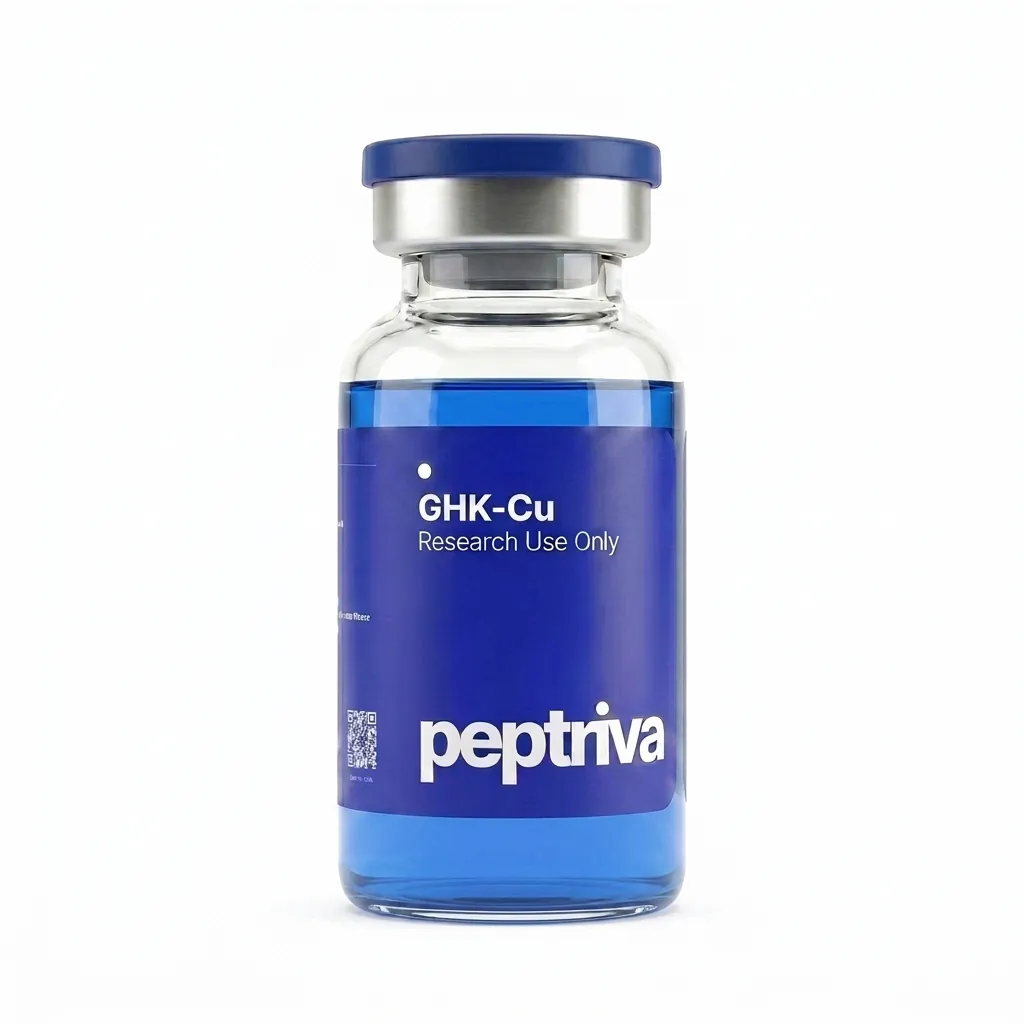
GHK-Cu
The copper-bound tripeptide discussed here, supplied as research-use-only material with a batch-matched certificate of analysis.
Why the molecule barely gets in
Size is not the problem. The free tripeptide is 340 Da and the copper complex about 403 Da, both comfortably under the 500-dalton ceiling below which compounds are generally able to cross intact skin.
Water-loving chemistry is the problem. The stratum corneum is a lipid barrier, and GHK-Cu is hydrophilic, so it sits on the outside of a wall it is small enough to pass.
GHK-Cu is a fairly hydrophilic compound with limited permeation through the lipophilic stratum corneum.
Ogórek et al., Molecules, 2025That's why modern formulation work is mostly about carriers. A 2023 study encapsulated GHK-Cu in lecithin liposomes and reached encapsulation efficiencies of 31.7% and 20.0% for cationic and anionic versions. The loaded peptide inhibited elastase by 48.9% in a dish.
Copper itself does cross human skin under occlusive application. What's unresolved is how much intact peptide arrives, in what state, and whether the cream you bought delivers any of it.
Injectable GHK-Cu: what actually exists
The injectable literature is preclinical, and it is not about skin.
- Colitis in mice. A 2025 study reported GHK-Cu attenuating ulcerative colitis through SIRT1/STAT3 signaling — a systemic anti-inflammatory model, not a cosmetic one.
- Wound hydrogels. GHK peptide nanofibers and copper-tripeptide hydrogels improve healing in animal wound models, delivered into the wound rather than into the bloodstream.
- Hair follicles in vitro. A tripeptide-copper complex increased human hair growth in culture. Culture is not a scalp.
No published trial has injected GHK-Cu into a person and measured anything. There is no human pharmacokinetic data — no half-life, no clearance, no evidence about how much reaches skin. A before-and-after photo from an injectable protocol is testing a hypothesis nobody has published.
Our route comparison lays the two evidence bases side by side. The asymmetry is not subtle, and it runs the opposite way to how the two forms are priced.
What the photos are actually showing
Skin photography is unusually easy to move without moving the skin.
- Light and angle. Fine lines and skin clarity are largely artifacts of lighting direction. The controlled studies used standardized capture and graded scales for exactly this reason.
- Everything else in the routine. Retinoids, vitamin C, sunscreen, acids and hydration all move the same endpoints, and most people start several at once.
- The 12-week window. Skin that is being looked after improves over three months regardless of which active gets the credit.
- Selection. The photo pair that gets posted is the one that worked.
Nothing here says GHK-Cu does nothing. The topical data is among the better evidence bases in cosmetic dermatology, which is a real if modest compliment. It says a photograph cannot distinguish a peptide from a routine, and the studies were designed specifically to do what a photograph cannot.
How to read a GHK-Cu before-and-after
Three questions, in order of how much they change the answer.
- Which route? If the claim is cosmetic and the product is a vial, the evidence being invoked belongs to a cream.
- Measured how? Skin density, thickness, wrinkle depth and collagen production are gradeable. A phone camera is not an endpoint.
- Against what? The useful comparisons in this literature are against placebo, vitamin C and retinoic acid — and against those, GHK-Cu is competitive, not transformative.
For the underlying biology, see our collagen mechanism write-up and the skin-aging evidence review. For what the literature does and does not support on dosing, our dosage page reports the published protocols and stops where they stop.
GHK-Cu
Research-use-only material, sold by the vial with batch documentation. Check the certificate of analysis against the batch you receive.
What to know now
- Route decides everything. Topical GHK-Cu has controlled 12-week cosmetic studies; injectable GHK-Cu has no human trial at all.
- The most-cited topical study ran 12 weeks in 71 women and reported improved skin density, thickness, clarity and wrinkle depth.
- Against comparators it is competitive rather than dominant: collagen production improved in 70% of GHK-Cu-treated women, 50% on vitamin C, 40% on retinoic acid.
- The molecule is small enough to cross skin at 340 Da but too hydrophilic to do it well, which is why formulation carriers exist.
- No human pharmacokinetic data exists for the injectable route, so nobody can say what reaches the skin or how long it stays.
What we're watching
We're waiting on a modern independent trial of topical GHK-Cu. It would need a group with no stake in the ingredient, and full publication rather than a meeting abstract.
The formulation literature is moving faster than the clinical one. Liposomal and hydrogel delivery are finally being characterized properly, which should eventually let somebody test whether delivery was the limiting factor all along.
Frequently asked questions
Does injectable GHK-Cu have before-and-after evidence?
No. No published trial has injected GHK-Cu into people and measured a skin, hair or systemic outcome. The injectable literature is rodent models and cell culture, and there is no human pharmacokinetic data.
How long did the topical studies run?
Twelve weeks, across the facial cream, eye cream and thigh-skin studies. That is the standard cosmetic-dermatology window, and it is the window any honest topical claim should be tied to.
Is GHK-Cu better than retinol or vitamin C?
One head-to-head endpoint exists in the review literature: collagen production in thigh skin at 12 weeks. GHK-Cu improved 70% of treated women, against 50% for a vitamin C cream and 40% for retinoic acid. That's one comparison on one endpoint, not a verdict.
Why is topical evidence stronger than injectable evidence here?
Because the target tissue is the skin. Topical delivery puts the peptide where the studied effects happen, and cosmetic testing has been standard practice for decades. Injection sends it into circulation, where nobody has measured where it goes.
What people actually report
These are self-reports, not evidence. No control group, no blinding, and no independent check that the vial held what the label claimed. They are collected here because people asking about GHK-Cu deserve an answer rather than a refusal, and because what the community believes is itself worth knowing. Quotes are excerpts; each links to the original post.
These are self-reports. No control arm, no blinding, no lab check on the vial. Read that way, they converge. The wins people post are skin wins. The two photo logs here ran five weeks and six weeks. Seborrheic dermatitis comes up again and again. Hair claims are slower and shakier. Several people report little or nothing: at four weeks, at one month, at three months, at 50 days. Blends like GLOW and KLOW come up constantly, so many of these reports do not isolate GHK-Cu. One odd thing recurs across unrelated threads, and it is a report about a needle, not a claim about the body: people say the skin gets harder to push a needle through.
Where the community and the published record disagree. The description on Dr. Alex Tatem's video says GHK-Cu has "legitimate scientific backing in topical form" but that the injectable version has "ZERO published human clinical trials". Yet the self-reports collected here are overwhelmingly subcutaneous injection. The community has inverted its own evidence base: it injects a compound whose human evidence is topical. In r/NooTopics, u/waaaaaardds makes the same point from the other side, "Subq will be less effective than topical", and gets argued with by users who say the opposite. The self-reports settle nothing either way. Several of them run GHK-Cu inside a blend such as GLOW or KLOW, so even the community's own data cannot say which ingredient did anything.
“Did not expect to work this good my seb derm almost gone.”
“So I went back and clipped my hair in the pics ...anyhow, started cycling GHK-CU (GLOW, GHK-CU, or GHK-CU+KPV) around July last year.”
“However, feedback online seems to be mixed. Some said it worked but others said it barely did anything.”
“GHK-cu injections burn like a mother and it keeps hurting for a long time if the GHKcu isn’t diluted enough.”
“I ran a 50 day cycle at 2mg daily via subcutaneous injection and my results were underwhelming.”
“the injectable version currently has ZERO published human clinical trials”
Posts are quoted under fair use and linked to their authors. Nothing on this page is hosted here, and no claim above has been verified beyond confirming that the person wrote it.
References
- Pickart, L., & Thaler, M. M. (1973). Tripeptide in human serum which prolongs survival of normal liver cells and stimulates growth in neoplastic liver. Nature New Biology, 243(124), 85–87. https://doi.org/10.1016/0006-291x(73)91459-9
- Pickart, L., & Margolina, A. (2018). Regenerative and protective actions of the GHK-Cu peptide in the light of the new gene data. International Journal of Molecular Sciences, 19(7), 1987. https://doi.org/10.3390/ijms19071987
- Pickart, L., Vasquez-Soltero, J. M., & Margolina, A. (2015). GHK peptide as a natural modulator of multiple cellular pathways in skin regeneration. BioMed Research International, 2015, 648108. https://doi.org/10.1155/2015/648108
- Dou, Y., Lee, A., Zhu, L., et al. (2020). The potential of GHK as an anti-aging peptide. Aging Pathobiology and Therapeutics, 2(1), 58–61. https://doi.org/10.31491/apt.2020.03.014
- Leyden, J. J., Stephens, T. J., Finkey, M. B., et al. (2002). Skin care benefits of copper peptide containing facial cream. American Academy of Dermatology Annual Meeting Poster Abstract. PubMed search PMID ?term=Leyden+copper+peptide+facial+cream+2002
- Dymek, M., Warszyński, P., & Sikora, E. (2023). GHK Peptide Permeability and Its Effects in Anti-Aging Skincare Topical Formulations. Pharmaceutics, 15(10), 2485. https://doi.org/10.3390/pharmaceutics15102485
- Ogórek, P., Gostińska, K., Wahab, S., et al. (2025). GHK-Cu in cosmetic applications: skin permeation and delivery strategies. Molecules, 30(1), 136. https://doi.org/10.3390/molecules30010136
- Bos, J. D., & Meinardi, M. M. (2000). The 500 Dalton rule for the skin penetration of chemical compounds and drugs. Experimental Dermatology, 9(3), 165–169. https://doi.org/10.1034/j.1600-0625.2000.009003165.x
- Hostynek, J. J., Dreher, F., & Maibach, H. I. (2010). Human stratum corneum penetration by copper: In vivo study after occlusive and semi-occlusive application of the metal as powder. Food and Chemical Toxicology, 48(6), 1741–1745. https://doi.org/10.1016/j.fct.2006.04.003
- Pyo, H. K., Yoo, H. G., Won, C. H., et al. (2007). The effect of tripeptide-copper complex on human hair growth in vitro. Archives of Pharmacal Research, 30(7), 834–839. https://doi.org/10.1007/bf02978833
- Lee, M., Kim, B., Kim, S., et al. (2023). Photo-crosslinkable hyaluronic acid hydrogel with GHK peptide nanofibers for wound healing. Acta Biomaterialia. https://doi.org/10.1016/j.actbio.2023.10.011
- Mao, J., Wei, S., Pang, Z., et al. (2025). GHK-Cu attenuates ulcerative colitis through the SIRT1/STAT3 signaling pathway. Frontiers in Pharmacology, 16, 1551843. https://doi.org/10.3389/fphar.2025.1551843
- Chen, H., Yang, P., Xue, P., et al. (2025). Food-derived tripeptide-copper self-healing hydrogel for infected wound healing. Biomaterials Research, 29, 0139. https://doi.org/10.34133/bmr.0139