
Search glutathione side effects and you get long lists. The controlled human record behind them is one trial in 46 people over 8 weeks. The serious harms on file come from a route that trial never used.
The short answer. Glutathione: The controlled human record is one 8-week trial in 46 people, too small and short to detect rare harm.
- Serious documented harms attach to unapproved intravenous glutathione: Stevens-Johnson syndrome, toxic epidermal necrolysis, liver and kidney injury, anaphylaxis and deaths.
- Oral glutathione absorbs poorly, roughly 10–20%, which limits both harm and effect.
- Sotler and colleagues note antioxidants can act as prooxidants depending on dose and tissue conditions; this has not been tested for supplemental glutathione in people.
Glutathione is a three-amino-acid peptide made by every cell. The oral safety record is thin. One 8-week trial in 46 people is the controlled data. The intravenous route is where harm shows up. Regulators cite Stevens-Johnson syndrome, organ damage and deaths. Long-term safety in healthy people is untested.
What the safety record actually contains
Almost every glutathione side effect list is written from mechanism, not from measurement. So it is worth naming what has been measured.
The controlled trial people point to is Wahab and colleagues, published in the International Journal of Dermatology in 2021. It was double-blind, randomized and placebo-controlled. It ran 8 weeks in 46 people. It combined topical and oral glutathione in the active arm.
That is the strongest skin-lightening evidence in existence for this compound. It is also, by size and length, a weak safety instrument.
- Too small for rare events. A reaction that happens in one person in a few thousand cannot appear in a group of 46.
- Too short for chronic effects. 8 weeks says nothing about a year of daily use.
- Two products at once. Topical and oral were given together, so a reaction could not be assigned to either.
- Healthy volunteers. The trial does not describe what happens in liver disease, kidney disease or pregnancy.
Other oral work on this site is in the same range. Trials used 250 mg and 1,000 mg a day for six months, and 500 mg twice a day for four weeks. Those are reports of what was administered, not instructions. The glutathione dosage page lists each one.
Why the injected route is where the harm is
The documented serious harms all attach to intravenous glutathione sold for skin whitening. Both the US FDA and the Philippines FDA have issued formal warnings about it.
Formal warnings regarding unapproved IV glutathione products for skin lightening, citing documented Stevens-Johnson syndrome, toxic epidermal necrolysis, hepatotoxicity, nephrotoxicity, anaphylaxis, and reported deaths.
Summary of US FDA and Philippines FDA regulatory communicationsRead that list again. Stevens-Johnson syndrome and toxic epidermal necrolysis are severe skin reactions. Hepatotoxicity is liver injury. Nephrotoxicity is kidney injury. Anaphylaxis can kill in minutes. And deaths are on the record.
There is no FDA-approved intravenous glutathione product for skin lightening. The FDA's 2022 notice covers unapproved products. An unapproved injectable has no reviewed safety file, no verified sterility standard and no dose ceiling anyone checked.
Published intravenous work used 600 mg twice daily and 1,400 mg three times a week. Those are study records. The clinic market and the gray market are not bound by them.
| Route | Controlled human data | Documented serious harms |
|---|---|---|
| Oral | One 8-week RCT, 46 people | None reported in that trial |
| Topical | Same trial, given with oral | Not separable from oral arm |
| Intravenous | No approved indication for lightening | SJS, TEN, liver and kidney injury, anaphylaxis, deaths |
The skin-lightening evidence page takes the regulator filings apart in detail.
Does oral glutathione have side effects?
The short answer is that published oral trials report few problems, and the main reason may be that most of the dose never arrives.
Glutathione is a tripeptide, molecular weight 307 g/mol. Gut gamma-glutamyl transferase cuts it apart before absorption. Only about 10–20% gets through intact, with one estimate at 17–22%. Cells then rebuild their own supply from amino acids.
GSH is synthesized in the cytosol in two ATP-requiring enzymatic steps.
Lu, Biochimica et Biophysica Acta, 2013So the swallowed capsule is competing with a system that already holds glutathione at 1–10 mM inside the cell, mostly in reduced form at roughly 100:1. A supplement that mostly does not absorb is unlikely to produce dramatic toxicity. It is also unlikely to produce dramatic anything. The redox cycling page explains why.
Low reported harm is not the same as demonstrated safety. Nobody has run a large, long safety study of oral glutathione in healthy people. The absence of reports is partly an absence of looking.
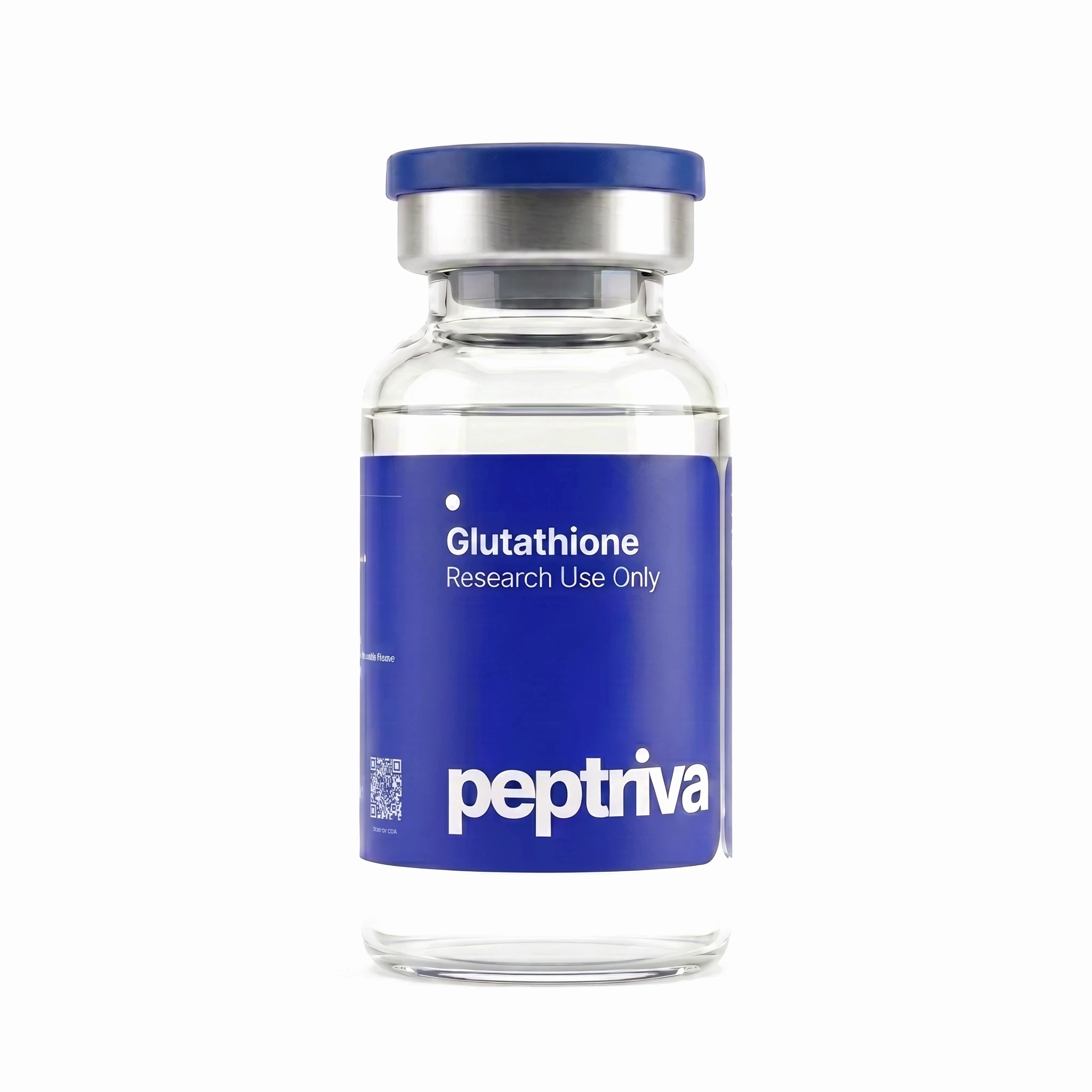
Glutathione
The compound discussed here, supplied as a research compound with a certificate of analysis matched to the lot.
Can an antioxidant cause harm?
It can, at least in principle, and this is the part the supplement pages skip. Antioxidants are not one-way molecules. The same chemistry that donates an electron can, in the wrong conditions, take one.
Antioxidants can display prooxidant activity, depending on dose and on the redox conditions of the surrounding tissue.
Sotler et al., Acta Clinica Croatica, 2019Forman and colleagues make a related point in Molecular Aspects of Medicine: reactive oxygen species are also signals, not only damage. A cell that is pushed too far toward reduction loses information, not just stress.
Two more mechanistic questions have no human answer for supplemental glutathione:
- NADPH supply. Recycling used glutathione runs on NADPH. In G6PD deficiency, that supply is limited. What extra glutathione does in those people has not been tested.
- Melanin loss. Melanin absorbs ultraviolet light. No study has measured whether lowering the melanin index changes sun-related risk over time.
Neither of these is a reported side effect. Both are open questions, which is a different and more honest category.
What has never been checked
This is the useful list, because it is the one no vendor prints.
- Beyond six months. The longest oral trial cited on this site ran six months. Years of use is unstudied.
- Pregnancy and breastfeeding. No controlled data.
- Drug interactions. Glutathione conjugation is a major detoxification pathway. No trial has measured whether supplementation shifts how another drug clears.
- Injection safety in non-clinical settings. Zero approved products means zero reviewed sterility file.
- The precursor comparison. N-acetylcysteine is the FDA-approved drug in this family, used for acetaminophen overdose. Its human safety database is far larger than glutathione's.
On NAC pharmacokinetics, the newest published work we were able to cite is an LC-MS/MS study in chickens, which reported a plasma half-life of 0.65–0.81 h. That is a poultry science paper, not a human one, and it is quoted here only to mark how thin even the precursor literature can be. The complete guide covers the NAC relationship.
What a buyer can verify before anything else
You cannot verify a safety profile that has not been generated. You can verify the vial.
Ask for a third-party certificate of analysis matched to the lot number, not a generic PDF. Check that it names identity and purity by mass spectrometry and HPLC. Then check storage temperature, because a degraded peptide is a different molecule from the one on the label.
These are research compounds. Nothing on this page is a protocol, and the approval status of N-acetylcysteine as a hospital drug is not the status of a research vial of glutathione.
If you want the results side rather than the safety side, the before and after page covers what the photographs are and are not showing.
Glutathione
Research-use-only material, sold by the vial with batch documentation. Check the certificate of analysis against the batch you receive.
What to know now
- The controlled human record is one 8-week trial in 46 people, too small and short to detect rare harm.
- Serious documented harms attach to unapproved intravenous glutathione: Stevens-Johnson syndrome, toxic epidermal necrolysis, liver and kidney injury, anaphylaxis and deaths.
- Oral glutathione absorbs poorly, roughly 10–20%, which limits both harm and effect.
- Sotler and colleagues note antioxidants can act as prooxidants depending on dose and tissue conditions; this has not been tested for supplemental glutathione in people.
- Pregnancy, G6PD deficiency, drug interactions and use beyond six months are all unstudied.
- Low reported side effects is not the same as demonstrated safety. Nobody has run the large study.
What we're watching
IV glutathione FDA warning skin whitening explained
Frequently asked questions
What are the most serious glutathione side effects on record?
They come from the intravenous route. Regulatory warnings summarized by the US FDA and the Philippines FDA cite Stevens-Johnson syndrome, toxic epidermal necrolysis, liver injury, kidney injury, anaphylaxis and reported deaths. None of these were reported in the oral trial literature.
Does oral glutathione cause side effects?
Published oral trials are small and short and report little. Only about 10–20% of a swallowed dose survives gut enzymes, so most of it never reaches the blood. That thin record is not the same as a demonstrated safety profile.
Is intravenous glutathione approved?
Not for skin lightening. The FDA issued a notice in 2022 about unapproved IV glutathione products. An unapproved injectable has no reviewed safety dossier and no verified sterility standard.
Can glutathione act as a prooxidant?
Sotler and colleagues wrote in Acta Clinica Croatica in 2019 that antioxidants can show prooxidant activity depending on dose and tissue redox conditions. Whether supplemental glutathione does this in people has not been measured.
How long has glutathione been tested for safety?
The longest oral trial referenced on this site ran six months. There is no published long-term safety study in healthy people, and no data in pregnancy or in G6PD deficiency.
References
- Wahab, S., Anwar, A. I., Zainuddin, A. N., et al. (2021). Combination of topical and oral glutathione as a skin-whitening agent: a double-blind randomized controlled clinical trial. International Journal of Dermatology, 60(8), 1013–1018. https://doi.org/10.1111/ijd.15573
- U.S. Food and Drug Administration. (2022). FDA warning on unapproved IV glutathione products [Regulatory notice]. Retrieved from https://www.fda.gov
- U.S. Food and Drug Administration / Philippines FDA. (Various years.) Formal warnings regarding unapproved IV glutathione products for skin lightening, citing documented Stevens-Johnson syndrome, toxic epidermal necrolysis, hepatotoxicity, nephrotoxicity, anaphylaxis, and reported deaths. (Cited here for context; see encyclopedia entry for primary regulatory communications.) https://doi.org/10.1201/9781032721743-12
- Sotler, R., Poljsšak, B., Dahmane, R., et al. (2019). Prooxidant activities of antioxidants and their impact on health. Acta Clinica Croatica, 58(4), 726–736. https://doi.org/10.20471/acc.2019.58.04.20
- Lu, S. C. (2013). Glutathione synthesis. Biochimica et Biophysica Acta, 1830(5), 3143–3153. https://doi.org/10.1016/j.bbagen.2012.09.008
- Forman, H. J., Zhang, H., & Rinna, A. (2009). Glutathione: Overview of its protective roles, measurement, and biosynthesis. Molecular Aspects of Medicine, 30(1–2), 1–12. https://doi.org/10.1016/j.mam.2008.08.006
- Zhang, Y., Chen, J., Lin, W., et al. (2025). Quantitative LC-MS/MS profiling of N-acetylcysteine in chicken plasma: Method validation and pharmacokinetic characterization. Poultry Science, 104(11), 105777. https://doi.org/10.1016/j.psj.2025.105777