
Search epithalon side effects and you get tidy lists. None of them come from a trial. Registered Western trials of this four-amino-acid peptide from 2020 to 2026 number zero, so there is no adverse event table to read.
The short answer. No controlled human trial of Epithalon has been published, so no documented side effect profile exists.
- Registered Western trials from 2020 to 2026 number zero, and there is no pharmacovigilance channel collecting reports.
- The one Western study, Al-Dulaimi 2025 at Brunel University London, found Epitalon engaging the ALT pathway in cancer cells.
- Every other published study measures cells or animals, and none was designed to detect harm.
No controlled human trial of Epithalon has been published. So no side effect list exists either. Registered Western trials from 2020 to 2026 number zero. The published work sits in cells and animals. None of it was designed to find harm. One 2025 Brunel paper did flag a cancer-cell pathway.
Why there is no epithalon side effect list
A side effect list is a byproduct of a trial. Someone gives a compound to people, watches them for a set time, writes down everything that happens, and compares it to a group that got nothing. That process has not happened with Epithalon.
Registered Western trials from 2020 to 2026 number zero. The Russian work people cite ran roughly 1990 to 2010, came almost entirely from one institute in Saint Petersburg, and sits mostly in Russian-language journals. Much of it used Epithalamin, a cattle pineal extract, not this synthetic peptide. We go through that body of work on the Russian aging trials page.
So when a vendor page says Epithalon is “well tolerated with no reported side effects,” that sentence is true in the same way it is true that no one has reported side effects from a compound nobody systematically watched. Absence of reports is not evidence of safety. It is absence of looking.
There is also no pharmacovigilance channel. Epithalon is not an approved medicine in the United States. No regulator collects reports on it, no manufacturer files them, and no database aggregates them. A prescription drug accumulates a safety record for years after launch. A research vial accumulates forum posts.
The one safety signal that is actually in the literature
There is a real finding, and it is not about nausea or injection sites. It is mechanistic, it is recent, and it is Western.
Al-Dulaimi and colleagues at Brunel University London published in Biogerontology in 2025. They treated human cell lines and measured telomere length. Telomeres got longer. The route depended on the cell. In normal cells, telomerase went up. In cancer cells, a second pathway switched on.
Epitalon increases telomere length in human cell lines through telomerase upregulation or ALT activity.
Al-Dulaimi, Thomas, Matta & Roberts — title, Biogerontology, 2025ALT stands for alternative lengthening of telomeres. It is the backup route cancer cells use to keep dividing when telomerase is not available. The paper reports Epitalon engaging it. That is the single most safety-relevant sentence published about this peptide, and it appears in the title of the only Western study of it.
Two things that sentence does not say. It does not say Epithalon causes cancer. It does not say it is safe either. It says a compound sold for longevity turned on a pathway cancer biology cares about, in a dish, and nobody has followed that up in an organism. The mechanism is unpacked further on the telomerase mechanism page.
What the studies actually watched for
The modern literature on this peptide is small, and every entry in it is a model system. Here is what each one measured. None of these are toxicology studies, and none were designed to detect harm.
| Study | Model | Endpoint measured |
|---|---|---|
| Al-Dulaimi 2025, Biogerontology | Human cell lines | Telomere length, telomerase, ALT |
| Gatta 2025, Stem Cell Reviews | In vitro diabetic retinopathy model | Delayed wound healing in cells |
| Ullah 2025, Life Sciences | Bovine oocytes and embryos | Maturation rate, post-thaw development |
| Yue 2022, Aging | Mouse oocytes | Post-ovulatory aging damage |
| Khavinson 2020, Molecules | Cells during neurogenesis | Gene expression, protein synthesis |
| Ivko 2020, Advances in Gerontology | Human pineal and thymus cells in vitro | Mitochondrial staining, L7A protein |
| Ivko 2024, Advances in Gerontology | Buccal epithelium | Cellular aging marker proteins |
Read that column of endpoints again. Telomere length. Wound closure. Oocyte maturation. Protein expression. Not one of them is blood pressure, liver enzymes, white cell count, tumor incidence, or mortality. The studies were asking whether the peptide does something. They were not asking what else it does.
- No dose-ranging in humans. The exposures on record are in-dish concentrations and animal amounts. The cell work used figures like 0.05 µg/mL over 4 days; mouse work used about 1 µg per mouse. See the dosage page for what each study administered.
- No control arms in people. Without one, nothing observed can be separated from time, expectation, or whatever else the person was doing.
- No long-term follow-up. A telomere-active compound would need years of surveillance, not weeks. That surveillance has not been run.
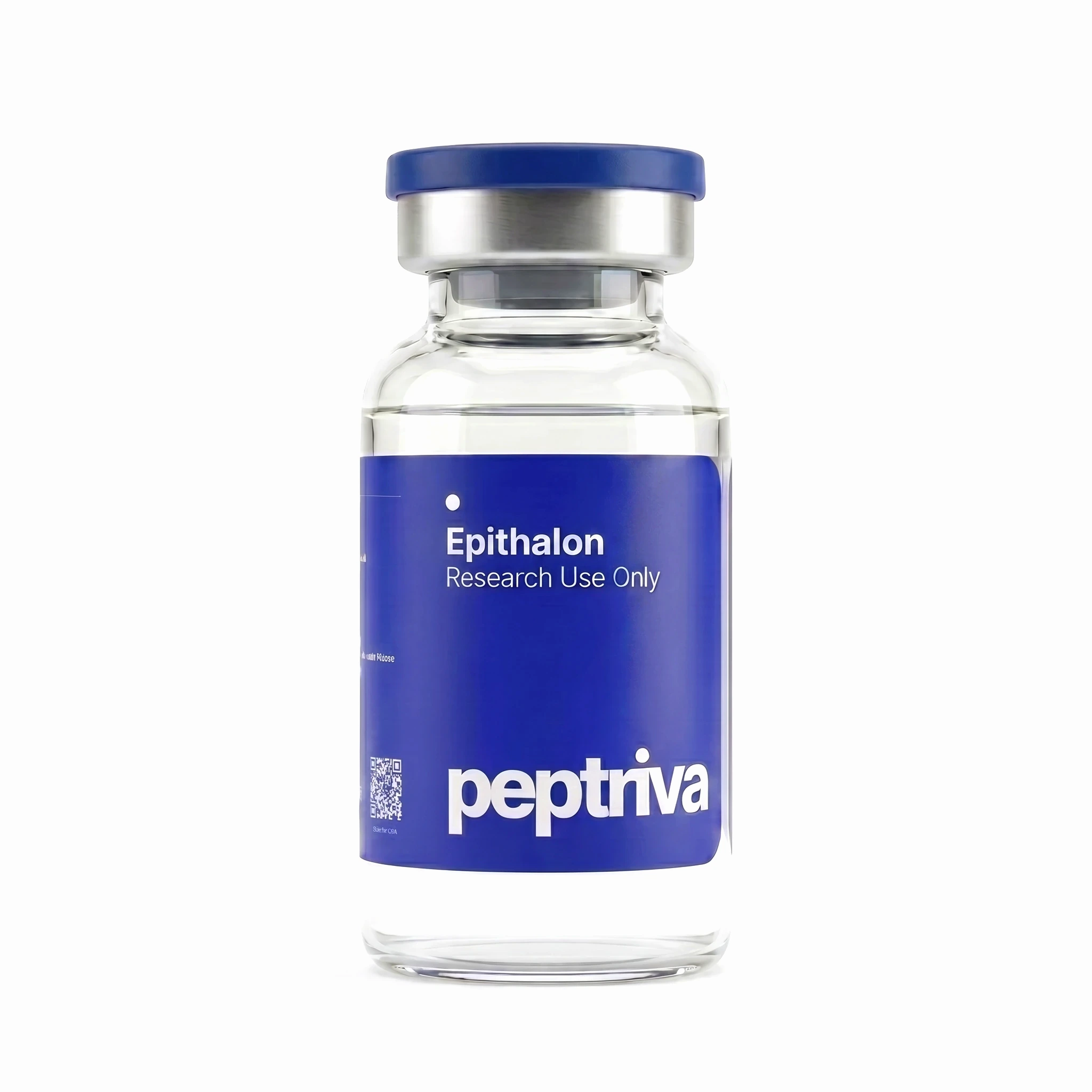
Epithalon
The compound discussed here, supplied as a research compound with a certificate of analysis matched to the lot.
Risks that have been hypothesized but never measured
This section is speculative by necessity, and it is worth being explicit about that. These are the concerns a pharmacologist would raise about a 390 g/mol tetrapeptide that acts on telomerase and the pineal gland. None of them have been tested in a human being.
- Telomerase and cell proliferation. Telomerase activation is the mechanism that lets a cell keep dividing. That is the point of the compound and also the reason the ALT finding matters. Nobody has run a tumor-incidence study.
- Pineal and melatonin signaling. The peptide came from a pineal extract and is claimed to affect melatonin output. Sleep and circadian effects have not been measured with controls.
- Immune and thymic tissue. One Russian paper worked in thymus cells. What chronic exposure does to immune function is unstudied.
- Interactions. Zero interaction studies exist, with drugs, with other peptides, or with anything else.
The most recent overview of the field was published in International Journal of Molecular Sciences in 2025. Its title is worth reading literally.
Overview of Epitalon — Highly Bioactive Pineal Tetrapeptide with Promising Properties.
Araj, Brzezik, Mádra-Gackowska & Szeleszczuk — title, IJMS, 2025The word in that title is “promising.” Not proven, and not safe. After roughly three decades of research on this molecule, a 2025 review still describes it as a bioactive compound with properties worth investigating. That is an accurate summary and a modest one.
The risks that come from the vial, not the molecule
There is a second category of harm here, and it is the one most likely to actually happen to someone. It has nothing to do with Epithalon's pharmacology.
Research peptides are sold without the manufacturing oversight applied to medicines. What is in the vial is whatever the synthesis produced and whatever survived shipping. The checkable items are purity documentation, sterility, water, and storage.
A third-party certificate of analysis with a recent date and a matching lot number is the only document that connects the label to the contents. If a seller cannot produce one for the lot you are looking at, you do not know what the powder is. How to read a COA covers what to check.
Technique matters too, for the same unglamorous reasons it matters in any lab: non-sterile handling and the wrong diluent cause problems that have nothing to do with the peptide. See reconstitution and bacteriostatic water. Legal status is a separate question again, covered on the peptide legality page.
What a real epithalon safety record would look like
It is worth spelling out the gap concretely, because “more research is needed” hides how large it is.
| Evidence type | What it would show | Exists for Epithalon |
|---|---|---|
| Phase I dose escalation | Tolerability and exposure limits in people | None published |
| Randomized controlled trial | Adverse events against a placebo arm | None published |
| Formal toxicology | Organ effects, genotoxicity, carcinogenicity | Not located |
| Long-term surveillance | Tumor incidence over years | None |
| Post-market reporting | Real-world adverse events | No channel exists |
| Cell and animal work | Mechanism, not safety | Yes — this is the whole record |
Five rows empty, one row full, and the full row is about mechanism. That is the honest shape of the answer. For what the efficacy side looks like, the before and after page runs the same exercise, and the complete guide covers the compound end to end.
Epithalon
Research-use-only material, sold by the vial with batch documentation. Check the certificate of analysis against the batch you receive.
What to know now
- No controlled human trial of Epithalon has been published, so no documented side effect profile exists.
- Registered Western trials from 2020 to 2026 number zero, and there is no pharmacovigilance channel collecting reports.
- The one Western study, Al-Dulaimi 2025 at Brunel University London, found Epitalon engaging the ALT pathway in cancer cells.
- Every other published study measures cells or animals, and none was designed to detect harm.
- "No reported side effects" reflects an absence of systematic observation, not a record of safety.
- The most likely practical risks are vial-level: unverified purity, non-sterile handling, and storage.
What we're watching
Epithalon telomerase and the ALT pathway explained
Frequently asked questions
Does Epithalon cause cancer?
Nobody knows, because no study has looked in a living human. The relevant finding is mechanistic. Al-Dulaimi and colleagues at Brunel University London reported in 2025 that Epitalon lengthened telomeres in human cell lines, through telomerase in some cells and through ALT activity in cancer cells. ALT is a pathway cancer cells use to keep dividing. That is a flag, not a measured outcome. No tumor-incidence study has been run.
What side effects do people report from Epithalon?
Self-reported accounts circulate on forums and vendor pages. There is no system that collects or verifies them. Epithalon is not an approved medicine in the United States, so no regulator maintains an adverse event database for it. Anonymous reports cannot separate a drug effect from coincidence, from the injection itself, or from whatever else the person was taking.
Is Epithalon safe for long-term use?
There is no evidence either way. The Russian work most often cited ran roughly 1990 to 2010, came almost entirely from one institute, and largely used Epithalamin, a cattle pineal extract rather than the synthetic peptide. Registered Western trials from 2020 to 2026 number zero. A compound that acts on telomeres would need years of surveillance to answer this question, and that surveillance does not exist.
Is Epithalon FDA approved?
No. There is no FDA-approved Epithalon product. It is sold as a research chemical, which means it has not been reviewed for safety, purity, or effectiveness in people. The approval status of any drug it is compared to is not its status.
Are there injection site reactions with Epithalon?
No published trial has recorded them, because no published trial has administered it to people under observation. Injection-related problems in this market usually trace back to handling: non-sterile technique, the wrong diluent, or degraded product. Those risks belong to the vial and the process, not to the molecule.
Why do vendor pages say it has no side effects?
Because no one has catalogued any. That sentence describes a gap in the literature, not a finding. A statement like it would be impossible to make about an approved drug, where years of trial and post-market data fill a label. Here the label is empty because the page was never written.
References
- Al-Dulaimi, S., Thomas, R., Matta, S., & Roberts, T. (2025). Epitalon increases telomere length in human cell lines through telomerase upregulation or ALT activity. Biogerontology, 26(5), 178. https://doi.org/10.1007/s10522-025-10315-x
- Araj, S. K., Brzezik, J., Mądra-Gackowska, K., & Szeleszczuk, Ł. (2025). Overview of Epitalon — Highly Bioactive Pineal Tetrapeptide with Promising Properties. International Journal of Molecular Sciences, 26(6), 2691. https://doi.org/10.3390/ijms26062691
- Khavinson, V., Diomede, F., Mironova, E., et al. (2020). AEDG peptide (epitalon) stimulates gene expression and protein synthesis during neurogenesis: Possible epigenetic mechanism. Molecules, 25(3), 609. https://doi.org/10.3390/molecules25030609
- Yue, X., Liu, S. L., Guo, J. N., et al. (2022). Epitalon protects against post-ovulatory aging-related damage of mouse oocytes. Aging (Albany NY), 14(7), 3191–3202. https://doi.org/10.18632/aging.204007
- Gatta, M., Dovizio, M., Milillo, C., et al. (2025). The antioxidant tetrapeptide epitalon enhances delayed wound healing in an in vitro model of diabetic retinopathy. Stem Cell Reviews and Reports, 21(6), 1822–1834. https://doi.org/10.1007/s12015-025-10911-x
- Ullah, S., Haider, Z., Perera, C. D., et al. (2025). Epitalon-activated telomerase enhances bovine oocyte maturation rate and post-thawed embryo development. Life Sciences, 362, 123381. https://doi.org/10.1016/j.lfs.2025.123381
- Ivko, O. M., Trofimova, S. V., Trofimov, A. V., Sharkovich, Z., & Mogilev, V. A. (2024). Peptidergic regulation of expression of cellular aging marker proteins in buccal epithelium [Russian]. Advances in Gerontology, 37(5), 516–524. PMID 39742404
- Ivko, O. M., Drobintseva, A. O., Leont′eva, D. O., Kvetnoy, I. M., Polyakova, V. O., & Linkova, N. S. (2020). The influence of AEDG and KE peptides on mitochondria stain and L7A ribosomes protein expression during human pineal gland and thymus cell senescence in vitro [Russian]. Advances in Gerontology, 33(4), 741–747. PMID 33342107