
Search Epithalon before and after and you get faces. The published before-and-afters are telomere length in cell lines, mouse oocytes and bovine embryos. Controlled human trials of the peptide number zero.
The short answer. Controlled human trials of epithalon number zero; registered Western trials from 2020 to 2026 are zero.
- Every published positive result is in cells, mouse oocytes or bovine oocytes.
- The 2025 Brunel paper confirmed longer telomeres in cell lines and also flagged ALT activity in cancer cells.
- Most "human trial" claims describe Epithalamin, a cattle gland extract, not the four-amino-acid peptide.
Epithalon is a synthetic four-amino-acid peptide. No controlled human trial of it has been published. Registered Western trials from 2020 to 2026 number zero. Every measured change is in cells or animals. A 2025 Brunel paper found longer telomeres in cell lines. It also saw a cancer-cell pathway switch on.
What the published studies actually measured
There is a simple way to read this literature. Look at what received the peptide, and what was counted afterward. Neither column has a person in it.
| Paper | What got the peptide | What was measured |
|---|---|---|
| Al-Dulaimi, Biogerontology, 2025 | Human cell lines in culture | Telomere length, telomerase, ALT markers |
| Ullah, Life Sciences, 2025 | Bovine oocytes | Maturation rate, post-thaw embryo development |
| Yue, Aging, 2022 | Mouse oocytes after ovulation | Aging-related damage to the oocyte |
| Gatta, Stem Cell Rev Rep, 2025 | Cells in a diabetic retinopathy model | Delayed wound closure in the dish |
| Khavinson, Molecules, 2020 | Cell culture, neurogenesis model | Gene expression, protein synthesis |
| Ivko, Adv Gerontol, 2020 | Human pineal and thymus cells in vitro | Mitochondrial stain, L7A ribosomal protein |
| Ivko, Adv Gerontol, 2024 | Buccal epithelium | Cellular aging marker proteins |
Not one of those endpoints is weight, skin, sleep, energy, strength or a photograph. The titles say it themselves.
Epitalon increases telomere length in human cell lines through telomerase upregulation or ALT activity.
Al-Dulaimi et al., Biogerontology, 2025 — paper titleEpitalon-activated telomerase enhances bovine oocyte maturation rate and post-thawed embryo development.
Ullah et al., Life Sciences, 2025 — paper titleA 2025 review in the International Journal of Molecular Sciences gathered this body of work under the word “promising.” Promising is a description of preclinical data. It is not a result in a person.
Are there human before and after studies of epithalon?
No. Registered Western randomized trials of the peptide from 2020 to 2026 number zero. There is no published controlled study with a treated group, a placebo group, and a measurement taken twice.
That means the gap is not “small trials” or “early trials.” It is the whole category.
- No human pharmacokinetics. We found no published study of how much of a 390 g/mol tetrapeptide reaches blood, or for how long.
- No controlled appearance or body-composition endpoint. Nothing published measures skin, hair, weight or photographs.
- No human telomere outcome. The telomere data come from cell lines, not from blood samples in volunteers.
- No safety trial. There is no controlled adverse-event dataset in people.
The human-sounding studies people cite are mostly about Epithalamin, a cattle pineal gland extract, run in Russian-language journals between 1990 to 2010. That is a different substance from the four-amino-acid peptide in the vial. The Russian aging trials page separates the two.
The one Western lab that checked, and the part vendors skip
In 2025, a group at Brunel University London ran the experiment independently. Human cell lines, telomere length measured, telomerase measured. Telomeres got longer. That part of the sales page holds up in a dish.
The same paper found something else. In cancer cell lines, the peptide was associated with ALT activity. ALT is alternative lengthening of telomeres, a separate pathway that some tumors use to keep dividing.
The only independent Western replication of the telomere claim is also the paper that raised a cancer-cell concern. Both findings are in the same study. Marketing quotes the first half.
No one has followed that up in an animal or a person. The mechanism argument is laid out in full on the telomerase mechanism page.
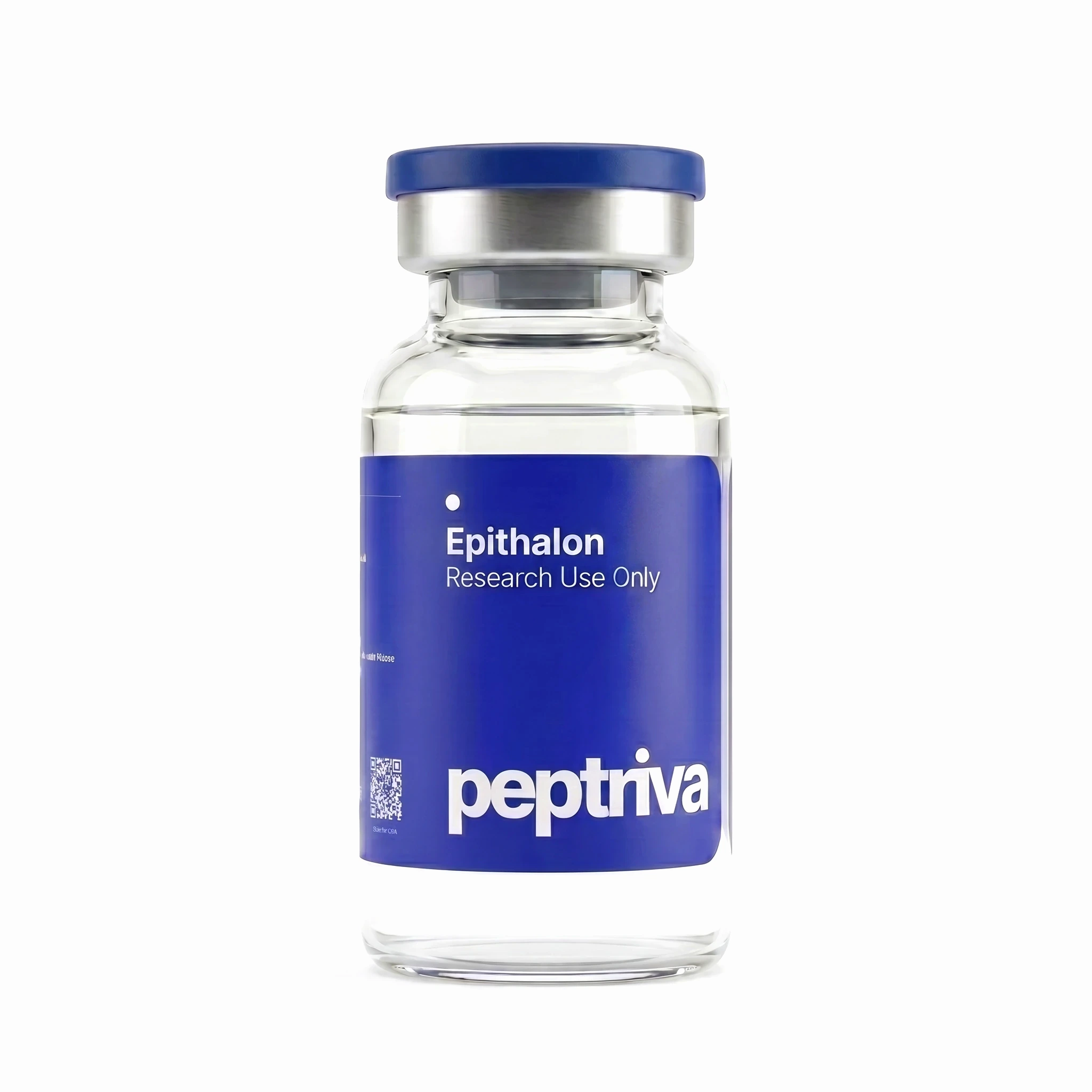
Epithalon
The compound discussed here, supplied as a research compound with a certificate of analysis matched to the lot.
Why a telomere result is not a photograph
A cell in a flask sits in a fixed concentration of peptide for days. Published dish work has run at concentrations as low as 0.05 µg/mL over 4 days, and as high as 0.1 mM in other experiments. Mouse work has used around 1 µg per mouse.
None of that tells you what a person's tissue is exposed to. Four amino acids is a small molecule by peptide standards, and small peptides are cleared fast. Without human pharmacokinetics, the step from flask to face is not a small step. It is unmeasured.
The antioxidant tetrapeptide epitalon enhances delayed wound healing in an in vitro model of diabetic retinopathy.
Gatta et al., Stem Cell Reviews and Reports, 2025 — paper titleRead “in vitro model” as a boundary, not a technicality. It names the room the result happened in. What each study administered is itemized on the dosage page, which reports the studies and authors nothing.
What people report, and what else could explain it
The common user reports are sleep, calm, energy and skin. Those are real experiences. They are also the four outcomes most sensitive to expectation, and none of them has been measured against a placebo for this peptide.
The sleep claim usually traces back to the pineal story: epithalon came from a pineal extract, the pineal gland makes melatonin, so the peptide is said to restore melatonin rhythm. The published pineal work is cell work. A 2020 Russian paper looked at mitochondrial stain and ribosomal protein L7A in human pineal and thymus cells in vitro. That is a bench finding about senescent cells, not a sleep study.
- No baseline. Most before photos are not standardized for light, posture, time of day or hydration.
- Stacking. Epithalon is often run alongside other compounds, diet changes or new sleep habits.
- Selection. People who feel nothing rarely post a set of photos.
- Vial contents. Without a third-party assay, the identity and purity of what was injected is unverified.
That last one is checkable before anything else is. How to read a certificate of analysis covers what a real assay looks like, and storage temperature covers how fast small peptides degrade.
What a real epithalon before and after would look like
The useful thing about this literature is that it shows what a measurable endpoint would be. Two of them already exist as assays.
A 2024 Russian paper measured cellular aging marker proteins in buccal epithelium, the cells from the inside of the cheek. That is a sample anyone can give, and it produces a number rather than an impression. Leukocyte telomere length from a blood draw is the other obvious candidate, since telomere length is the claim being made.
A before and after worth the name has two timepoints, a control group, and a measurement that does not depend on who is holding the camera. Nothing published on epithalon has all three.
Until that study exists, the honest summary of the evidence is the one on the complete guide: a confirmed cell-culture effect, an unresolved cancer-cell signal, and no human outcome data at all.
Epithalon
Research-use-only material, sold by the vial with batch documentation. Check the certificate of analysis against the batch you receive.
What to know now
- Controlled human trials of epithalon number zero; registered Western trials from 2020 to 2026 are zero.
- Every published positive result is in cells, mouse oocytes or bovine oocytes.
- The 2025 Brunel paper confirmed longer telomeres in cell lines and also flagged ALT activity in cancer cells.
- Most "human trial" claims describe Epithalamin, a cattle gland extract, not the four-amino-acid peptide.
- There is no published human pharmacokinetic data, so the dish-to-person step is unmeasured.
- Buccal epithelium markers and leukocyte telomere length are the endpoints that could actually be checked.
What we're watching
Any epithalon before-and-after you find online is uncontrolled self-report. The published endpoints are telomere length in cell lines, mouse oocytes, bovine embryos and marker proteins in cheek cells. If a seller cites clinical trials, check the species, and check whether the paper is about Epithalamin, the cattle pineal extract, rather than the AEDG peptide.
Frequently asked questions
Are there real epithalon before and after photos from a study?
No. No published study used a photograph as an outcome. The measured outcomes were telomere length, gene and protein expression, oocyte maturation and wound closure in a dish.
How long does epithalon take to show results?
No study has measured a time course in people. Cell work ran as short as 4 days. There is no human data to convert that into weeks or months.
Does epithalon lengthen telomeres in humans?
Unknown. The 2025 Brunel paper measured longer telomeres in human cell lines in culture. No study has measured telomere length in a living person given the peptide.
Why do the Russian studies look like human results?
Most of them tested Epithalamin, a bovine pineal gland extract, between 1990 and 2010. That is not the same as the synthetic AEDG peptide sold today.
What can I verify before buying?
The document side. A third-party certificate of analysis with identity and purity, and storage handling. The efficacy side has no human trial to verify.
What people actually report
These are self-reports, not evidence. No control group, no blinding, and no independent check that the vial held what the label claimed. They are collected here because people asking about Epithalon deserve an answer rather than a refusal, and because what the community believes is itself worth knowing. Quotes are excerpts; each links to the original post.
Uncontrolled self-report, no blinding and no lab work: nearly all epitalon talk is about sleep, not aging. Users describe faster sleep onset and a reset body clock inside a 10 to 20 day cycle, then say it fades weeks after stopping. Reported dosing is contested. Daily amounts users name run from 100 mcg to 2 mg, while the widely repeated 5 to 10 mg figures are usually described as a whole cycle rather than a daily dose. Dissent is loud. Many report nothing at all, and defenders reply that epitalon is not something you feel.
Where the community and the published record disagree. The community judges epitalon on how sleep feels over a 10 to 20 day cycle. The published human work reads out on a different clock and a different molecule. Khavinson and Morozov assessed 266 people over 60 across 6 to 8 years, and the agents were Epithalamin, the bovine pineal extract epitalon was isolated from, and the thymic peptide Thymalin, not the tetrapeptide in the vial. The telomere result that sells epitalon by name was in telomerase-negative human fetal fibroblast culture. So the reason people buy it has never been measured in a person, and the thing they measure was never an endpoint. The dose argument runs on the same fault line: users themselves trace the 5 to 10 mg protocols back to the Russian extract literature, and ClinicalTrials.gov lists no registered study under epitalon, epithalon or epithalamin to settle it.
“Epitalon didnt do anything!! Waste of money for me.”
“The data backs up my anecdotal experience of significantly better sleep.”
“My Circadian Rhythm has fully been reseted, went from sleeping around 12pm the next day to now sleeping early (10pm-12am)”
“like most other peptides out there, the benefits are marginal at best and have an affiliate link attached”
“The protocol calling for 5mg+ doses is wrong. It's a poor translation from a Russian study.”
“Big flaws with Khavinson’s studies”
I Investigated Epitalon's Claims - The Results Were Disappointing
“clinically assessed the geroprotective effects of thymic (Thymalin) and pineal (Epithalamin) peptide bioregulators in 266 elderly and older persons during 6-8 years”
“Addition of Epithalon peptide in telomerase-negative human fetal fibroblast culture induced expression of the catalytical subunit, enzymatic activity of telomerase, and telomere elongation”
Epithalon peptide induces telomerase activity and telomere elongation in human somatic cells
“totalCount: 0”
Posts are quoted under fair use and linked to their authors. Nothing on this page is hosted here, and no claim above has been verified beyond confirming that the person wrote it.
References
- Al-Dulaimi, S., Thomas, R., Matta, S., & Roberts, T. (2025). Epitalon increases telomere length in human cell lines through telomerase upregulation or ALT activity. Biogerontology, 26(5), 178. https://doi.org/10.1007/s10522-025-10315-x
- Araj, S. K., Brzezik, J., Mądra-Gackowska, K., & Szeleszczuk, Ł. (2025). Overview of Epitalon — Highly Bioactive Pineal Tetrapeptide with Promising Properties. International Journal of Molecular Sciences, 26(6), 2691. https://doi.org/10.3390/ijms26062691
- Khavinson, V., Diomede, F., Mironova, E., et al. (2020). AEDG peptide (epitalon) stimulates gene expression and protein synthesis during neurogenesis: Possible epigenetic mechanism. Molecules, 25(3), 609. https://doi.org/10.3390/molecules25030609
- Yue, X., Liu, S. L., Guo, J. N., et al. (2022). Epitalon protects against post-ovulatory aging-related damage of mouse oocytes. Aging (Albany NY), 14(7), 3191–3202. https://doi.org/10.18632/aging.204007
- Gatta, M., Dovizio, M., Milillo, C., et al. (2025). The antioxidant tetrapeptide epitalon enhances delayed wound healing in an in vitro model of diabetic retinopathy. Stem Cell Reviews and Reports, 21(6), 1822–1834. https://doi.org/10.1007/s12015-025-10911-x
- Ullah, S., Haider, Z., Perera, C. D., et al. (2025). Epitalon-activated telomerase enhances bovine oocyte maturation rate and post-thawed embryo development. Life Sciences, 362, 123381. https://doi.org/10.1016/j.lfs.2025.123381
- Ivko, O. M., Trofimova, S. V., Trofimov, A. V., Sharkovich, Z., & Mogilev, V. A. (2024). Peptidergic regulation of expression of cellular aging marker proteins in buccal epithelium [Russian]. Advances in Gerontology, 37(5), 516–524. PMID 39742404
- Ivko, O. M., Drobintseva, A. O., Leont′eva, D. O., Kvetnoy, I. M., Polyakova, V. O., & Linkova, N. S. (2020). The influence of AEDG and KE peptides on mitochondria stain and L7A ribosomes protein expression during human pineal gland and thymus cell senescence in vitro [Russian]. Advances in Gerontology, 33(4), 741–747. PMID 33342107