
Searches for cartalax side effects usually return a line saying none are known. That is accurate in the narrowest sense. No human trial has ever measured this peptide, so there is nothing to report from. PubMed holds roughly 4 papers on it, all in cells and animals.
The short answer. No human trial has ever measured Cartalax, so no side effect profile exists in the literature.
- PubMed returns about 4 papers on the AED tripeptide since 2015, all preclinical and all from one lab group.
- Sellers claiming "no known side effects" are describing an empty file, not a monitored safety record.
- Epitalon is a different peptide, AEDG with 4 amino acids; its data does not transfer to AED.
Cartalax is the AED tripeptide, about 333 Da. No human trial has ever tested it. So no side effect list exists. PubMed holds about 4 papers since 2015. All are preclinical and from one lab group. An empty record is not a clean record.
What the Cartalax safety record actually contains
Start with the index. A PubMed search covering “AED tripeptide”, “Cartalax” and “Ala-Glu-Asp peptide” from 2015 forward returns about 4 papers. All are preclinical. All trace back to the same group in Saint Petersburg.
Zero Western RCTs have tested it in people. That number drives everything else on this page.
- No Phase I trial. There is no published first-in-human study, so no dose-limiting toxicity has ever been described.
- No human pharmacokinetics. Nobody has published what the body does with the peptide after it is given.
- No adverse event registry. It is not an approved drug anywhere, so no regulator collects reports on it.
- No long-term follow-up. Chronic exposure in humans has not been measured at any duration.
The nearest thing to a mechanism paper is Ashapkin and colleagues in Molecular Biology Reports, 2020. Short peptides were applied to human mesenchymal stem cell cultures at nanomolar concentrations, and expression of about 5 genes shifted. That is a dish. It carries no safety information about a person.
Gene expression in human mesenchymal stem cell aging cultures: Modulation by short peptides.
Ashapkin et al., Molecular Biology Reports, 2020 — the title names the endpoint, and it is not safetyOur Cartalax complete guide walks the full paper trail.
Why "no reported side effects" is not a safety finding
Reports need a reporting system. Side effect lists on drug labels exist because thousands of people took the compound while someone recorded what happened to them, including in the placebo arm.
None of that machinery has ever been pointed at this peptide. There is no trial, no monitoring board, no post-market surveillance and no case series.
Absence of evidence of harm is not evidence of safety. With zero human studies, a seller claiming a clean safety profile is describing the size of the literature, not the behavior of the molecule.
Rare events are the part that hides longest. A reaction occurring in one person out of a thousand will not appear until roughly that many people have been watched carefully. Nobody has watched any.
Is Cartalax safety data the same as Epitalon safety data?
No. They are different molecules, and this is the most common swap in Cartalax marketing.
Epitalon is the AEDG peptide, a tetrapeptide of 4 amino acids. Cartalax is AED, a tripeptide of three, about 333 Da. One amino acid of difference is not a rounding error in peptide chemistry. It changes charge, shape and binding.
Overview of Epitalon — Highly Bioactive Pineal Tetrapeptide with Promising Properties.
Araj, Brzezik, Mádra-Gackowska & Szeleszczuk, International Journal of Molecular Sciences, 2025That 2025 review is about Epitalon. Khavinson and colleagues in Molecules, 2020 also studied AEDG, not AED, when they reported gene expression and protein synthesis effects during neurogenesis. Neither paper tested the tripeptide people are buying.
Borrowed benefit claims get the same treatment on our Cartalax benefits page. Borrowed safety claims deserve more suspicion, not less, because the reader has no way to check them against a label.
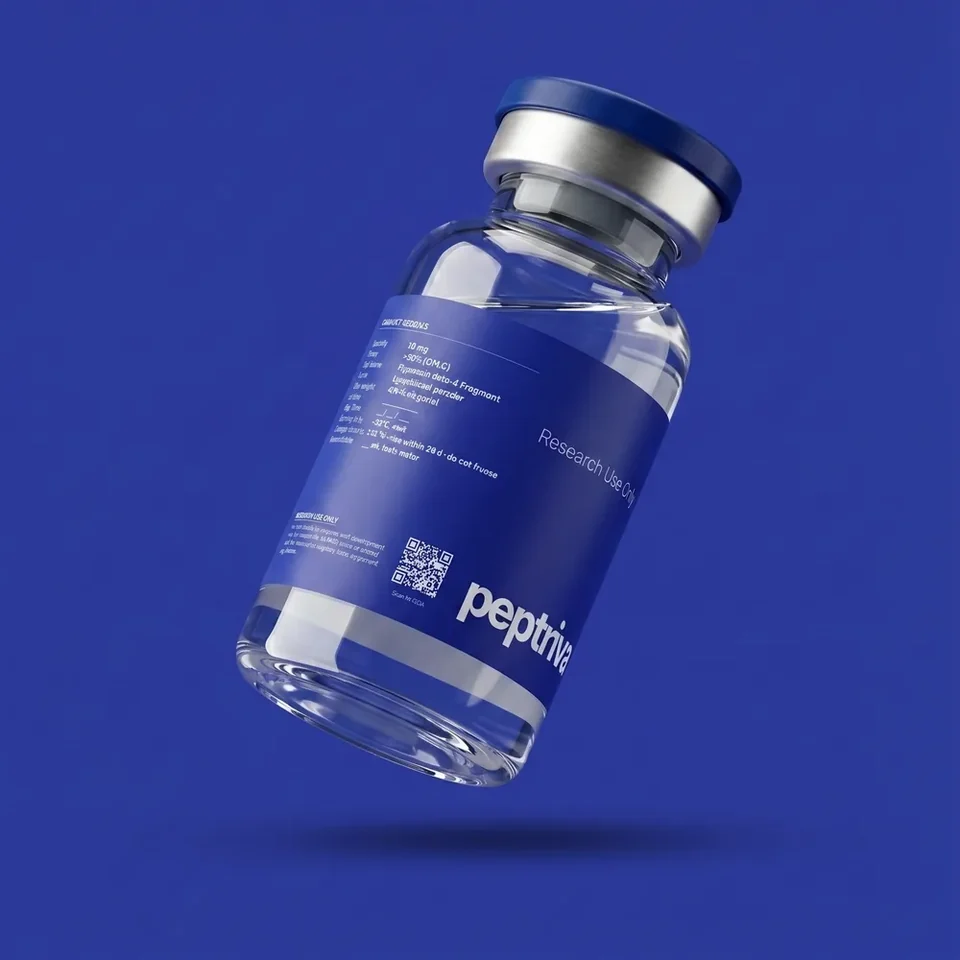
Cartalax
The compound discussed here, supplied as a research compound with a certificate of analysis matched to the lot.
What a documented safety record looks like next to this one
Cartalax is sold mostly for joints. Osteoarthritis is a condition with enormous reach. The GBD 2021 Osteoarthritis Collaborators, writing in The Lancet Rheumatology, put the global total at 595 million people living with it in 2020.
A market that large attracts compounds faster than it attracts trials. Here is what exists for this one.
| Safety evidence type | What exists for Cartalax |
|---|---|
| Randomized controlled trials | None published |
| Phase I human tolerability | None published |
| Human pharmacokinetics | None published |
| Regulatory approval anywhere | None |
| Independent replication | None — the ~4 papers share one group |
| Cell and animal work | Yes, roughly 4 papers since 2015 |
The preclinical work is real research. It is just not the kind of evidence that produces a side effect profile. The before and after page covers what outcome data is missing for the same reason.
The risks that do not depend on the molecule
Even with an unstudied peptide, some hazards are knowable, because they come from the vial rather than the chemistry.
- Identity. Nothing in a lyophilized powder tells you it is AED. A mass spectrometry result near 333 Da is the check, and it belongs on a certificate of analysis.
- Purity and residues. Synthesis leaves byproducts and solvents. HPLC purity and endotoxin testing are the documents that address this.
- Sterility and handling. Contamination risk sits in the water and the technique, not the peptide. See our bacteriostatic water guide and reconstitution notes.
- Degradation. Short peptides are sensitive to heat and light. Storage temperature changes what is in the vial weeks later.
None of this makes the compound safe. It only removes the failures that have nothing to do with the research question.
Cartalax
Research-use-only material, sold by the vial with batch documentation. Check the certificate of analysis against the batch you receive.
What to know now
- No human trial has ever measured Cartalax, so no side effect profile exists in the literature.
- PubMed returns about 4 papers on the AED tripeptide since 2015, all preclinical and all from one lab group.
- Sellers claiming "no known side effects" are describing an empty file, not a monitored safety record.
- Epitalon is a different peptide, AEDG with 4 amino acids; its data does not transfer to AED.
- The checkable risks are vial-level: identity near 333 Da, HPLC purity, sterility and storage.
What we're watching
Watch for product pages that cite Epitalon or AEDG papers under a Cartalax heading. That one-letter swap is the main way a thin safety record gets made to look full. Also watch for the phrase "well tolerated" with no trial attached to it, and for certificates of analysis that show purity but never confirm molecular weight.
Frequently asked questions
Does Cartalax have side effects?
Unknown. No human trial has ever tested it, so nothing has been systematically recorded. The published work is about 4 preclinical papers. A compound with no safety studies is not the same as a compound shown to be safe.
Has Cartalax toxicity ever been studied in people?
Not in the indexed literature. There is no published Phase I study, no maximum tolerated dose work and no human pharmacokinetics. Zero Western randomized controlled trials have tested the AED tripeptide.
Is Cartalax safe for long-term use?
There is no evidence either way. Long-term safety requires follow-up in people over months or years, and no such study has been published. Anyone stating a long-term profile is going beyond the record.
Can Epitalon safety data be applied to Cartalax?
No. Epitalon is the AEDG tetrapeptide, four amino acids. Cartalax is AED, three amino acids, about 333 Da. Reviews such as the 2025 IJMS overview describe Epitalon, not this peptide.
Is Cartalax legal to buy?
It is sold as a research chemical, not an approved drug, and status varies by country. Our page on whether peptides are legal covers the framework. Research-use labeling is not a safety statement.
References
- PubMed search: “AED tripeptide” OR “Cartalax” OR “Ala-Glu-Asp peptide”, 2015–2026. pubmed.ncbi.nlm.nih.gov PMID ?term=AED+tripeptide+Khavinson
- Ashapkin, V., Khavinson, V., Shilovsky, G., Linkova, N., & Vanyushin, B. (2020). Gene expression in human mesenchymal stem cell aging cultures: Modulation by short peptides. Molecular Biology Reports, 47(6), 4323–4329. https://doi.org/10.1007/s11033-020-05506-3
- Araj, S. K., Brzezik, J., Mądra-Gackowska, K., & Szeleszczuk, Ł. (2025). Overview of Epitalon — Highly Bioactive Pineal Tetrapeptide with Promising Properties. International Journal of Molecular Sciences, 26(6), 2691. https://doi.org/10.3390/ijms26062691
- Khavinson, V., Diomede, F., Mironova, E., et al. (2020). AEDG peptide (epitalon) stimulates gene expression and protein synthesis during neurogenesis: Possible epigenetic mechanism. Molecules, 25(3), 609. https://doi.org/10.3390/molecules25030609
- GBD 2021 Osteoarthritis Collaborators. (2023). Global, regional, and national burden of osteoarthritis, 1990–2020 and projections to 2050: A systematic analysis for the Global Burden of Disease Study 2021. The Lancet Rheumatology, 5(9), e508–e522. https://doi.org/10.1016/S2665-9913(23)00163-7