
Ask about argireline side effects and the real answer is about sample size. The published human record on this peptide is three studies. The biggest randomized one enrolled 60 subjects, and it was built to measure wrinkles, not harm.
The short answer. No published Argireline study was designed to measure adverse events.
- The largest randomized trial enrolled 60 subjects over 8–12 weeks.
- At 889 Da the peptide sits well above the 500 Da penetration threshold.
- No published human trial has injected Argireline by any route.
What side effects have actually been reported?
Almost nothing, and that is a statement about the studies, not about the molecule.
The founding paper is Blanes-Mira and colleagues, International Journal of Cosmetic Science, 2002. It applied an emulsion containing the hexapeptide to 10 women and reported a 30% cut in wrinkle depth. There was no control group. A study with ten people and no placebo arm cannot tell you how often a cream stings, flakes or reddens, because it has no comparison for any of those things.
The best-designed study is Wang and colleagues, American Journal of Clinical Dermatology, 2013. That one was randomized and placebo-controlled in 60 subjects in China. It reported roughly 16% improvement versus baseline, which sits inside the 10–27% band that controlled work keeps landing in. Its job was efficacy.
None of the published human studies on Argireline was designed as a safety trial. So there is no published rate for irritation, redness, dryness or allergy. "No reported side effects" and "nobody counted" look identical from the outside.
The before-and-after numbers get taken apart in full on the Argireline before and after page.
How big is the safety record, exactly?
Small enough to fit in one table. These are the human studies this site has read.
| Study | Design | Participants | What it measured |
|---|---|---|---|
| Blanes-Mira, 2002 | Uncontrolled, topical emulsion | 10 women | Wrinkle depth (30%) |
| Wang, 2013 | Randomized, placebo-controlled | 60 subjects | Wrinkle measures (16% vs. baseline) |
| An, 2019 | Microneedle patch, peptide plus EGF | Korean adults | Wrinkle parameters, combined product |
Two details matter more than the totals. The 2019 Annals of Dermatology patch study combined acetyl hexapeptide-8 with epidermal growth factor in a cross-linked hyaluronic acid microneedle. Anything good or bad in that study belongs to the whole product, not to the peptide.
And a microneedle patch is a different exposure than a cream. It punches through the barrier that normally keeps most of the peptide out. Safety observations from a leave-on lotion do not transfer to anything that breaches skin.
- Duration. Published work runs 8–12 weeks. There is no multi-year follow-up.
- Population. Adult women with facial wrinkles. No pregnancy data, no pediatric data.
- Endpoint. Wrinkle depth, every time. Adverse events were never the question being asked.
Can Argireline cause botulinum-like paralysis?
No published human case says so, and the mechanism argues against it twice over.
Argireline is a synthetic mimic of the N-terminal end of SNAP-25. Botulinum neurotoxin attacks the same protein, but it is an enzyme: it cleaves SNAP-25 apart so the SNARE complex cannot pull the vesicle to the membrane. Megighian and colleagues describe that destruction in PeerJ, 2015. Argireline does not cut anything. It competes for a slot. Those are not the same kind of event, and they do not scale the same way.
Measured against injected toxin, topical Argireline lands at roughly 1–5% of the magnitude. Controlled trials put it at 10–27% wrinkle reduction, while injected toxin studies report 60–80%+.
The second brake is the skin itself. Argireline weighs 889 Da. The classic threshold for passive skin penetration is 500 Da.
The molecular weight of a compound must be under 500 Dalton to allow skin absorption.
Bos & Meinardi, Experimental Dermatology, 2000The same property that caps the benefit also caps the risk. A molecule that struggles to reach the dermis is not going to reach a motor nerve somewhere else in your body.
The mechanism is covered in more depth in the Argireline complete guide.
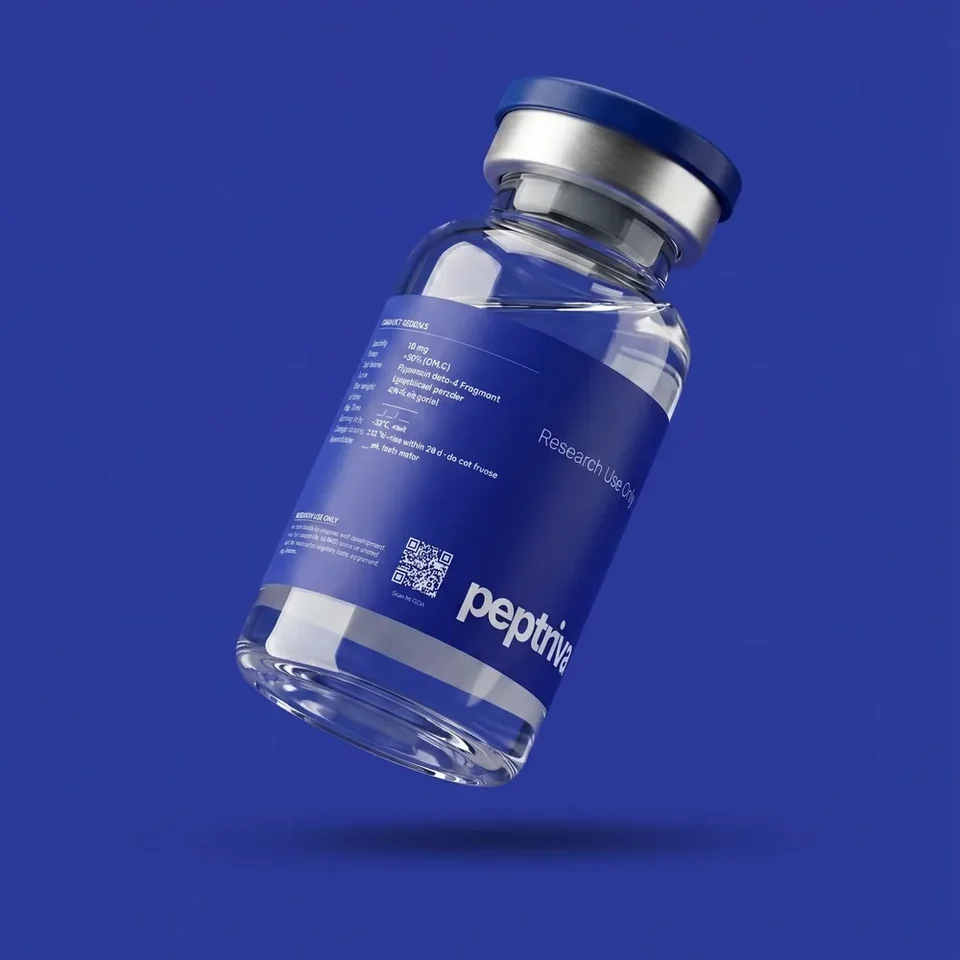
Argireline
The compound discussed here, supplied as a research compound with a certificate of analysis matched to the lot.
Did anyone review this for safety before it went on sale?
Not in the way most people assume. Argireline is sold as a cosmetic ingredient, and cosmetics are regulated differently from drugs in the United States.
Cosmetic products and ingredients, other than color additives, do not need FDA approval before they go on the market.
U.S. Food and Drug Administration, Cosmetics & U.S. Law, 2024So the absence of an FDA action against Argireline is not a safety clearance. It means no premarket file was ever opened. Responsibility for substantiating safety sits with the company selling the product.
A research-grade powder sits further out still. It is not a finished cosmetic that a formulator tested, and it is typically labeled not for human use. What that label means legally is covered on the peptide legality page.
What the safety record does not cover
This is the part that matters if you are buying powder rather than a finished cream.
- Injection. We found no published human trial that injected Argireline. The entire evidence base is topical or microneedle. Nothing in it speaks to what happens under the skin.
- Long-term use. Trials stopped at 8–12 weeks. Nothing published follows users for years.
- Pregnancy and breastfeeding. No data at all.
- Eyes and mucosa. No data on contact with the eye itself.
- Self-mixed strength. Published creams were formulated and tested at known concentrations. A reconstituted powder is not.
- Purity. Nothing in the literature tells you what is in a particular vial.
That last one is the practical risk, and it is not really a risk of the peptide. It is a risk of the supply. A third-party assay is the only document that addresses it; see how to read a certificate of analysis and storage temperature for how material degrades after it arrives.
How to judge a product when the safety data is this thin
You are judging the seller's paperwork, because the literature cannot do it for you.
| Question | What answers it | What does not |
|---|---|---|
| Is this actually Argireline? | Third-party HPLC and mass spec on the batch | "99% purity" printed on the label |
| How strong is it? | Stated concentration in a finished formula | "Clinical strength" |
| Is it FDA approved? | Nothing. Cosmetics get no premarket approval | "FDA registered facility" |
| Will it work like toxin? | Controlled trials at 10–27% | Before-and-after photos |
Claims of 60–80%+ wrinkle reduction from a topical peptide are borrowing injected-toxin numbers. That is the single most common misread in this category. General sourcing checks are on the buying guide.
Argireline
Third-party tested research compounds, each shipped with a batch-matched certificate of analysis showing HPLC purity and mass-spec identity — the documentation this site argues you should hold any supplier to.
What to know now
- No published Argireline study was designed to measure adverse events.
- The largest randomized trial enrolled 60 subjects over 8–12 weeks.
- At 889 Da the peptide sits well above the 500 Da penetration threshold.
- No published human trial has injected Argireline by any route.
- Cosmetic ingredients get no FDA premarket approval, so absence of action is not clearance.
What we're watching
Watch for safety claims that lean on the word "natural" or on the absence of reported problems. Nobody has published an irritation rate for Argireline, because no study counted one. Watch too for sellers who cite 60–80% wrinkle reduction: those figures come from injected botulinum toxin studies, not from this peptide.
Frequently asked questions
Is Argireline safe to use every day?
There is no published trial long enough to answer that. The randomized work ran 8–12 weeks on adult facial skin and measured wrinkles, not harm. We do not author usage instructions. What we can report is that no serious adverse event from topical Argireline appears in the three human studies we have read.
Can Argireline cause muscle weakness or headaches?
No published human case report describes it. The mechanism and the physics both argue against it. Argireline competes within the SNARE complex rather than cleaving SNAP-25 the way botulinum toxin does, and at 889 Da it is above the 500 Da threshold Bos and Meinardi described for skin absorption. Very little is reaching deeper tissue.
Does Argireline irritate skin?
Possibly, like most leave-on cosmetic actives, but no study has published a rate. That gap is the honest answer. Irritation in a finished product can also come from the solvent, preservative or fragrance rather than the peptide, and none of the published trials separated those.
Is Argireline safer than Botox?
They are not in the same risk category, because they are not the same kind of product. Botulinum toxin is an injected prescription drug with a documented adverse event profile. Argireline is a topical cosmetic ingredient with roughly 1–5% of the magnitude of effect and almost no safety literature. Lower exposure, but also far less measurement.
What about injecting Argireline?
We found no published human trial that injected it, so there is no safety or efficacy record for that route at all. Every study in the literature applied it to the skin surface or delivered it in a microneedle patch. This site does not provide routes, doses or protocols.
References
- Blanes-Mira, C., Clemente, J., Jodas, G., Gil, A., Fernández-Ballester, G., Ponsati, B., Gutiérrez, L., Pérez-Payá, E., & Ferrer-Montiel, A. (2002). A synthetic hexapeptide (Argireline) with antiwrinkle activity. International Journal of Cosmetic Science, 24(5), 303–310. https://doi.org/10.1046/j.1467-2494.2002.00153.x
- Wang, Y., Wang, M., Xiao, S., Pan, P., Li, P., & Huo, J. (2013). The anti-wrinkle efficacy of Argireline, a synthetic hexapeptide, in Chinese subjects: A randomized, placebo-controlled study. American Journal of Clinical Dermatology, 14(2), 147–153. https://doi.org/10.1007/s40257-013-0009-9
- An, J. S., Lee, H. J., Yoon, M. S., & Kim, D. H. (2019). Anti-wrinkle efficacy of cross-linked hyaluronic acid–based microneedle patch with acetyl hexapeptide-8 and epidermal growth factor on Korean skin. Annals of Dermatology, 31(3), 263–271. https://doi.org/10.5021/ad.2019.31.3.263
- Megighian, A., Pirazzini, M., Lista, F., Rossetto, O., & Montecucco, C. (2015). The destructive effect of botulinum neurotoxins on the SNARE protein: SNAP-25 and synaptic membrane fusion. PeerJ, 3, e1065. https://doi.org/10.7717/peerj.1065
- Bos, J. D., & Meinardi, M. M. (2000). The 500 Dalton rule for the skin penetration of chemical compounds and drugs. Experimental Dermatology, 9(3), 165–169. https://doi.org/10.1034/j.1600-0625.2000.009003165.x
- U.S. Food and Drug Administration. (2024). Cosmetics & U.S. Law: How FDA Regulates Cosmetics. https://www.fda.gov/cosmetics/cosmetics-laws-regulations/fda-authority-over-cosmetics-how-cosmetics-are-not-fda-approved-are-fda-regulated