
Search Argireline before and after and you get galleries. The measured record starts with 10 women, no control group, and a 30% figure published in 2002.
The short answer. Argireline: The 30% figure comes from a 2002 study of 10 women with no control group.
- Randomized, placebo-controlled work reports a smaller 10–27% range over 8–12 weeks.
- Argireline mimics part of SNAP-25; botulinum toxin destroys it. The mechanisms are not equivalent.
- At 889 Da the peptide sits well above the 500 Dalton skin-penetration rule of thumb.
Argireline is a cosmetic peptide. It is not injected botulinum toxin. The famous 30% came from 10 women. That 2002 study had no control group. Randomized trials since report 10–27% instead. At 889 Da it barely crosses skin.
What the 30% figure actually measured
The number under almost every Argireline listing comes from one paper. Blanes-Mira and colleagues published it in the International Journal of Cosmetic Science in 2002. It reported a reduction in wrinkle depth of up to 30%.
Here is what sat under that number.
- Ten women. The human arm ran with 10 participants.
- No control group. Nobody received a vehicle cream for comparison.
- No blinding described. Everyone knew what was being applied.
- An emulsion, not a vial. The peptide was carried in an oil-in-water cream at a stated percentage.
A result from 10 people with no comparison arm is a signal to go and test. It is not a before and after. Skin hydration alone changes how a wrinkle reads under a camera, and a moisturizing base does that on its own.
The 2002 paper is real, peer reviewed, and often cited. It is also the weakest design in the compound's file, and it produced the largest number. Those two facts belong in the same sentence.
The full development history sits in the Argireline complete guide.
What the randomized trials found instead
Better studies came later, and the effect got smaller. Wang and colleagues ran a randomized, placebo-controlled study in Chinese subjects, published in the American Journal of Clinical Dermatology in 2013, with 60 subjects.
Across the randomized work, reported wrinkle reductions land in a band of 10–27%. The low end of that band is around 16% against baseline. The measurements ran over 8–12 weeks, not days.
| Study | Design | What it can support |
|---|---|---|
| Blanes-Mira 2002 | 10 women, no control, unblinded | A hypothesis, up to 30% |
| Wang 2013 | 60 subjects, randomized, placebo-controlled | A real but modest effect, inside the 10–27% band |
| An 2019 | Microneedle patch, peptide plus growth factor | Not the peptide alone |
The 2019 study, by An and colleagues in Annals of Dermatology, is worth a second look. It delivered acetyl hexapeptide-8 in a cross-linked hyaluronic acid microneedle patch, alongside epidermal growth factor. Two actives and a delivery device that punctures skin. Whatever that patch did, you cannot assign it to the peptide, and you cannot assign it to a cream.
Is Argireline the same thing as Botox?
No. The mechanisms rhyme. The magnitudes do not.
Botulinum neurotoxin is injected into muscle and enzymatically destroys SNAP-25, the protein that lets a nerve release its signal. Megighian and colleagues described that cleavage in PeerJ in 2015: the protein is cut, and synaptic membrane fusion fails. Clinical effect from an injection typically runs 3–4 months.
Argireline is a synthetic hexapeptide that mimics a piece of SNAP-25 and competes during complex assembly. It sits in a cream on the surface of the skin. It cuts nothing.
We have put the gap at roughly 1–5% of the magnitude of injected toxin. A photo showing a toxin-sized change credited to a serum is not showing you this ingredient.
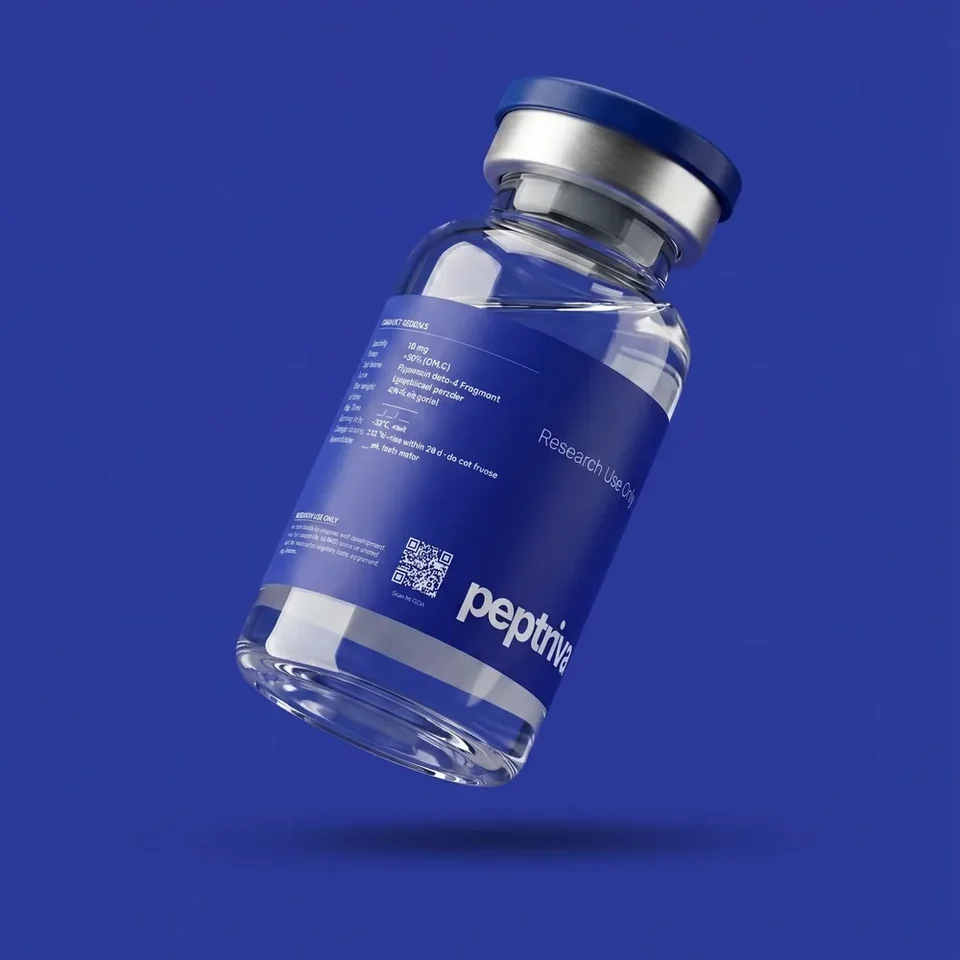
Argireline
The compound discussed here, supplied as a research compound with a certificate of analysis matched to the lot.
Why 889 Daltons decides the whole argument
Argireline weighs 889 Da. Bos and Meinardi set out the standard rule of thumb in Experimental Dermatology in 2000: molecules much above 500 Da do not cross intact skin well.
All common contact allergens, the most commonly used topical dermatological drugs, and all agents used in transdermal drug-delivery systems are under 500 Dalton.
Bos & Meinardi, Experimental Dermatology, 2000That is a rule of thumb, not a wall. But it explains two things at once. It explains why the measured effects are modest rather than dramatic. It also explains why the more recent work reaches for microneedles instead of a cream.
So a before-and-after set has a hidden variable that almost nobody discloses: how the peptide got in, if it got in. A serum, a patch and a rolled skin surface are three different experiments.
What a before-and-after photo cannot show you
The trials measured wrinkle depth with instruments, under set conditions, against a comparison group. A photo pair does none of that.
- Lighting angle. Side light deepens a crease. Flat front light erases it.
- Hydration. Any occlusive base plumps the stratum corneum within hours.
- Expression. A relaxed brow and an engaged brow are not the same face.
- Co-treatment. Retinoids, sunscreen, fillers and time are rarely listed.
- Selection. You see the pairs that worked, never the ones that did not.
Claims of 60–80%+ wrinkle reduction circulate widely in marketing copy. Nothing in the published record supports a figure of that size for this ingredient. The published ceiling is the uncontrolled 30%, and the controlled range is lower.
What "FDA approved" means here, and what to check
It means nothing for a cosmetic peptide, because cosmetics are not approved in the first place.
Cosmetic products and ingredients, other than color additives, do not need FDA approval before they go on the market.
U.S. Food and Drug Administration, Cosmetics & U.S. Law, 2024So the seal on a box tells you nothing. What is checkable is the paperwork on the specific lot you are holding: identity, purity and how it was stored. Start with how to read a certificate of analysis, then storage temperature. The legal picture for research material is covered in are peptides legal, and sourcing documents are compared in where to buy peptides online.
Argireline
Third-party tested research compounds, each shipped with a batch-matched certificate of analysis showing HPLC purity and mass-spec identity — the documentation this site argues you should hold any supplier to.
What to know now
- The 30% figure comes from a 2002 study of 10 women with no control group.
- Randomized, placebo-controlled work reports a smaller 10–27% range over 8–12 weeks.
- Argireline mimics part of SNAP-25; botulinum toxin destroys it. The mechanisms are not equivalent.
- At 889 Da the peptide sits well above the 500 Dalton skin-penetration rule of thumb.
- The 2019 microneedle study combined the peptide with a growth factor, so the peptide's own effect is not isolated.
- Marketing claims of 60–80%+ wrinkle reduction have no support in the published record.
What we're watching
Watch for a randomized trial that tests the peptide alone against its own vehicle cream, with instrument-measured wrinkle depth and a stated delivery method. Until a study separates the peptide from the base it is carried in, the honest range stays at 10–27%.
Frequently asked questions
How long did it take for Argireline to show a change in studies?
The randomized studies measured over roughly 8 to 12 weeks. The 2002 uncontrolled report was shorter. None of that is an instruction for use; it is the timeframe over which researchers took their measurements.
Is Argireline as strong as Botox?
No. Injected botulinum toxin cleaves the SNAP-25 protein and typically lasts 3 to 4 months per treatment. Argireline is a topical peptide with measured wrinkle reductions in the 10 to 27% range. We put the gap at roughly 1 to 5% of the magnitude.
What concentration did the studies use?
Published topical work has used strengths in the 5 to 10% range, with the 2002 paper using an oil-in-water emulsion. That is what the studies applied. It is not advice on what to apply.
Why do before-and-after photos look so much better than the trial numbers?
Photos are not controlled. Lighting angle, skin hydration, facial expression, other products and simple selection of the best pair all move the image more than a 10 to 27% change in measured wrinkle depth would.
Is Argireline FDA approved?
No, and no cosmetic ingredient is. The FDA states that cosmetic products and ingredients, other than color additives, do not need approval before going on the market. Approval status of a drug the compound resembles is never the status of the cosmetic or the research vial.
What people actually report
These are self-reports, not evidence. No control group, no blinding, and no independent check that the vial held what the label claimed. They are collected here because people asking about Argireline deserve an answer rather than a refusal, and because what the community believes is itself worth knowing. Quotes are excerpts; each links to the original post.
Label this uncontrolled self-report. No controls, no blinding, no measurement past the poster's own photos. Users converge on small. Fine forehead lines look softer in before-and-after posts, and the low price keeps people going: one r/SkincareAddiction poster, ten days in, said it was not Botox results but that she was pleased for about $10. Almost nobody isolates it. Reports run alongside Matrixyl, tretinoin, marine collagen, even Botox, and the posters say so themselves. They also flag the weakness in their own evidence, one noting the lighting in her two photos was not the same. The dissent is blunt. One r/30PlusSkinCare reviewer scored Argireline Solution 10% at 1 out of 5 after more than three months of daily use.
Where the community and the published record disagree. The community's explanation is muscular. The phrase is "botox in a bottle," and the poster behind the most-shared before-and-after explained her results in a comment by saying argireline "blocks neurotransmitters that cause muscle contractions." The published human-skin work says the peptide never gets near a muscle. Kraeling et al., Cutaneous and Ocular Toxicology 2015 (PMID 24754410), applied a 10% acetyl hexapeptide-8 emulsion to human cadaver skin at 2 mg/cm2 for 24 hours. They recovered 0.22% of the applied dose in the stratum corneum and 0.01% in the epidermis, and detected none in the dermis or in the buffer beneath the skin. A 2025 review in International Journal of Molecular Sciences (PMID 40565185) says the peptide's "ability to reach neuromuscular junctions remains uncertain." So whatever people are photographing is happening in the layers above the one their own mechanism story requires. The community borrowed Botox's mechanism to describe a molecule that, in the human penetration data, stops at the surface.
“Obviously argireline isn’t as effective as botox but it might do the trick for you if your fine lines are premature like mine.”
[B&A] Using Argireline and Matrixyl to get rid of fine lines on my forehead
“Argireline Solution 10%: 1/5. They market this product as "botox in a bottle". Not even close.”
My honest review of every The Ordinary product I've tried so far
“I've been using argireline on my forehead for 10 days. It's not the exact same lighting but I tried to get as close as possible.”
“I've been using Argireline on my forehead & eye area for about a year now & am wondering if it's doing anything.”
“I tried a combination of Argireline, Matrixyl and powdered marine collagen for 6 months.”
Does Argireline work like botox in a bottle? 6 month results forehead wrinkles
“Does Argireline work like Botox in a bottle?”
Is ARGIRELINE BOTOX IN A BOTTLE? 🤔 DERMATOLOGIST @DrDrayzday
Posts are quoted under fair use and linked to their authors. Nothing on this page is hosted here, and no claim above has been verified beyond confirming that the person wrote it.
References
- Blanes-Mira, C., Clemente, J., Jodas, G., Gil, A., Fernández-Ballester, G., Ponsati, B., Gutiérrez, L., Pérez-Payá, E., & Ferrer-Montiel, A. (2002). A synthetic hexapeptide (Argireline) with antiwrinkle activity. International Journal of Cosmetic Science, 24(5), 303–310. https://doi.org/10.1046/j.1467-2494.2002.00153.x
- Wang, Y., Wang, M., Xiao, S., Pan, P., Li, P., & Huo, J. (2013). The anti-wrinkle efficacy of Argireline, a synthetic hexapeptide, in Chinese subjects: A randomized, placebo-controlled study. American Journal of Clinical Dermatology, 14(2), 147–153. https://doi.org/10.1007/s40257-013-0009-9
- An, J. S., Lee, H. J., Yoon, M. S., & Kim, D. H. (2019). Anti-wrinkle efficacy of cross-linked hyaluronic acid–based microneedle patch with acetyl hexapeptide-8 and epidermal growth factor on Korean skin. Annals of Dermatology, 31(3), 263–271. https://doi.org/10.5021/ad.2019.31.3.263
- Megighian, A., Pirazzini, M., Lista, F., Rossetto, O., & Montecucco, C. (2015). The destructive effect of botulinum neurotoxins on the SNARE protein: SNAP-25 and synaptic membrane fusion. PeerJ, 3, e1065. https://doi.org/10.7717/peerj.1065
- Bos, J. D., & Meinardi, M. M. (2000). The 500 Dalton rule for the skin penetration of chemical compounds and drugs. Experimental Dermatology, 9(3), 165–169. https://doi.org/10.1034/j.1600-0625.2000.009003165.x
- U.S. Food and Drug Administration. (2024). Cosmetics & U.S. Law: How FDA Regulates Cosmetics. https://www.fda.gov/cosmetics/cosmetics-laws-regulations/fda-authority-over-cosmetics-how-cosmetics-are-not-fda-approved-are-fda-regulated