
Pages listing TB-500 side effects are describing something nobody measured. Human trials of TB-500 number zero. With no trial, there is no adverse event table, no dropout rate, and no dose-limiting toxicity.
The short answer. Human trials of TB-500 number zero, so no side effect has been measured in people.
- Thymosin beta-4 is 43 amino acids; many TB-500 vials hold a 7-amino-acid fragment. Safety data on one is not data on the other.
- The preclinical biology spans vessels, immune cells, kidney tissue and cell migration. That breadth is why "no known side effects" cannot be earned.
- Cancer risk in humans has zero studies behind it for this compound. Not reassuring, not alarming, absent.
TB-500 has no human safety record. Human trials of the compound number zero. Nothing has measured its side effects in people. The parent peptide, thymosin beta-4, is 43 amino acids. Many vials hold a 7-amino-acid fragment instead. Safety data on one form is not data on the other.
Does TB-500 have side effects?
Unknown. That is the honest answer, and it is not a hedge.
Side effects are a study output. A trial enrolls people, gives a defined amount of a defined molecule, and counts what goes wrong in both arms. Human trials of TB-500 number zero. So there is nothing to count from.
Two 2026 reviews looked at this class of injectable peptides for musculoskeletal and athletic use. Both sort them into approved and unapproved. TB-500 sits on the unapproved side, with no clinical dataset behind it.
Safety and efficacy of approved and unapproved peptide therapies for musculoskeletal injuries and athletic performance.
Title of the 2026 Sports Medicine review by Mendias and AwanInjectable peptide therapy: A primer for orthopaedic and sports medicine physicians.
Title of the 2026 American Journal of Sports Medicine primer, Mayfield and colleaguesA reviewer writing a primer for physicians is describing a gap, not a product label. What follows is what fills that gap, and what does not.
Why thymosin beta-4's record is not TB-500's record
"TB-500" is a market name, not a single molecule. The parent peptide is thymosin beta-4, a natural 43-amino-acid chain found in nearly every human cell. Many vials sold as TB-500 contain a synthetic 7-amino-acid fragment, Ac-LKKTETQ, instead.
The 2026 Sports Medicine review flags exactly this supply problem. A vial may hold the full peptide, the fragment, or something else. That matters more for safety than for anything else, because a safety claim is a claim about a specific molecule at a specific amount.
| Molecule | Length | Human record |
|---|---|---|
| Thymosin beta-4 (full length) | 43 amino acids | Reached Phase II/III testing in clinical programs for other indications |
| Ac-LKKTETQ (the fragment) | 7 amino acids | No trials found |
| Ac-SDKP (cleavage product) | 4 amino acids | Animal and cell work on vessel repair |
| "TB-500" as sold | Not specified on most labels | Zero human trials |
Borrowing the parent molecule's tolerability and attaching it to a fragment is the single most common move in TB-500 marketing. The two peptides are related. They are not interchangeable, and no study has compared their safety head to head.
We take the forms apart in the TB-500 complete guide, and the binding chemistry in the actin-binding mechanism page.
The theoretical concerns nobody has tested in people
The reason "no known side effects" is an unearnable phrase here is the biology itself. Thymosin beta-4 binds G-actin one to one. G-actin builds the cell's skeleton, so that binding steers how cells move and how new vessels form.
A 2021 Frontiers in Endocrinology review mapped those effects across heart, eye, liver, kidney and gut models.
Progress on the Function and Application of Thymosin β4.
Title of the 2021 Frontiers in Endocrinology review by Xing and colleaguesThe published work since then keeps widening that map, all of it in animals or cells:
- Vascular. A 2025 European Heart Journal study placed thymosin beta-4 downstream of CCN5 in injury-induced vessel narrowing.
- Immune. A 2025 Journal of Allergy and Clinical Immunology paper tied airway thymosin beta-4 expression to relief of allergic asthma in a mouse model.
- Kidney. A 2023 review in the International Journal of Molecular Sciences examined its role in the kidney glomerulus.
- Infection. A 2021 Mediators of Inflammation study reported recombinant human thymosin beta-4 protecting mice against a coronavirus.
- Grafts and metabolism. A 2025 Free Radical Biology and Medicine paper described it aiding mitochondrial transfer between cells in fat graft survival.
Read that list as a safety document and it says one thing. This molecule touches vessel growth, immune signaling, kidney tissue and cell migration in preclinical models. Those are the properties being sold as benefits. They are also the properties that would require monitoring in a trial, and no trial has monitored them.
Cancer risk is the concern people ask about most, because angiogenesis and cell migration are also tumor behaviors. The data on that for TB-500 in humans is zero studies. Not reassuring, not alarming. Absent.
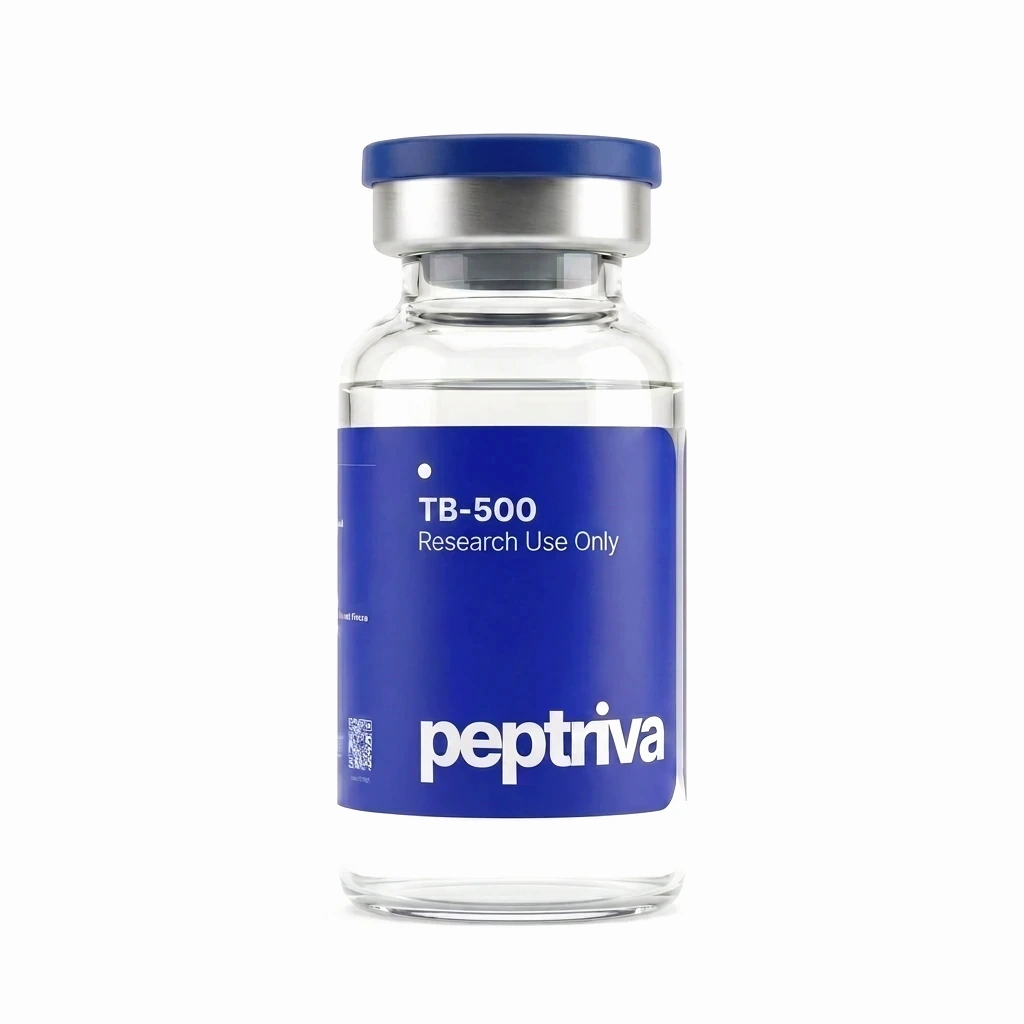
TB-500
The compound discussed here, supplied as a research compound with a certificate of analysis matched to the lot.
What forum reports can and cannot tell you
Search long enough and you find anecdotes. Tiredness, a flushed feeling, soreness where the needle went. None of it is data, for reasons that have nothing to do with whether the person was honest.
- No denominator. You see the reports that got posted. You cannot see how many people injected and said nothing.
- No control arm. Fatigue and soreness happen to people who inject saline too.
- No confirmed contents. If the vial was never identity-tested, the report is about an unknown powder.
- No reporting system. There is no adverse event registry for research peptides, so nothing aggregates.
Injection-site reactions are worth separating out. Redness, swelling and irritation belong to the act of injecting and to sterile technique, not to any particular peptide. Contamination risk sits in the same bucket. Our guides on reconstitution, bacteriostatic water and storage temperature cover the handling side, which is the part of the risk picture you can actually control.
What you can check instead
You cannot check a safety profile that does not exist. You can check the vial.
The first question is which peptide is in it. A certificate of analysis matched to your lot number should name the sequence and give a purity figure, usually by HPLC and mass spec. Without that, "TB-500" tells you nothing about the molecule. How to read a certificate of analysis walks through what a real one contains.
Identity testing does not make a compound safe. It only means you know which unstudied molecule you are handling. That is a lower bar than most vendors clear, and a much lower bar than a safety record.
Peptriva lists TB-500 as a 10 mg vial at $89.99, with bacteriostatic water sold separately. Reconstituted in 2 mL, a 10 mg vial gives 5 mg/mL; our TB-500 concentration calculator does that arithmetic without publishing a dose, because no published human dose exists.
On the legal side, research peptides are not approved drugs and are not sold for human use. The legality page sets out what that status actually means. What TB-500 has behind it on the benefits side is covered in TB-500 benefits, and the heart data in TB-500 cardiac research.
TB-500
Research-use-only material, sold by the vial with batch documentation. Check the certificate of analysis against the batch you receive.
What to know now
- Human trials of TB-500 number zero, so no side effect has been measured in people.
- Thymosin beta-4 is 43 amino acids; many TB-500 vials hold a 7-amino-acid fragment. Safety data on one is not data on the other.
- The preclinical biology spans vessels, immune cells, kidney tissue and cell migration. That breadth is why "no known side effects" cannot be earned.
- Cancer risk in humans has zero studies behind it for this compound. Not reassuring, not alarming, absent.
- Forum reports have no denominator, no control arm and no confirmed vial contents.
- What you can verify is identity and purity from a lot-matched certificate of analysis.
What we're watching
Watch for the word "side effects" on any TB-500 page that never names a study. If the page has no trial, dose, duration or comparison arm behind its list, the list was written, not measured.
Frequently asked questions
Is TB-500 safe?
Nobody knows. Safety is a measurement, and no human trial of TB-500 has made it. The 2026 Sports Medicine review by Mendias and Awan groups it with unapproved peptide therapies. Anything stated as a safety profile is borrowed from the parent molecule, thymosin beta-4, or from animal work.
Does TB-500 cause cancer?
There is no human evidence either way. The concern is mechanistic: thymosin beta-4 promotes cell migration and vessel growth in preclinical models, and tumors use those same processes. No study has tested cancer risk from TB-500 in people, so the count of studies on that question is zero.
What side effects do people report online?
Reports usually mention tiredness, flushing and soreness at the injection site. None of it is usable data. There is no reporting registry, no denominator, no placebo comparison, and usually no confirmation of what the vial contained. Injection-site reactions in particular track sterile technique rather than any specific peptide.
Is TB-500 FDA approved?
No. Full-length thymosin beta-4 has reached Phase II/III testing in clinical programs for other indications, but that status belongs to the pharmaceutical molecule in those trials. It is not the status of a research vial labeled TB-500, which is not approved and is not sold for human use.
Does TB-500 affect the heart or kidneys?
In animal and cell models, thymosin beta-4 has effects in both. A 2025 European Heart Journal study placed it downstream of CCN5 in injury-induced vessel narrowing, and a 2023 International Journal of Molecular Sciences review examined its role in the kidney glomerulus. No human study has measured cardiac or renal effects of TB-500 as sold.
Can you tell which peptide is in a TB-500 vial?
Only with testing. The label rarely specifies whether it holds full-length thymosin beta-4 or the 7-amino-acid fragment Ac-LKKTETQ. A certificate of analysis matched to your lot number, naming the sequence with a purity figure, is the only way to know which molecule you have.
References
- Mendias, C. L., & Awan, T. M. (2026). Safety and efficacy of approved and unapproved peptide therapies for musculoskeletal injuries and athletic performance. Sports Medicine. https://doi.org/10.1007/s40279-026-02437-0
- Mayfield, C. K., Bolia, I. K., Feingold, C. L., et al. (2026). Injectable peptide therapy: A primer for orthopaedic and sports medicine physicians. American Journal of Sports Medicine, 54(1), 223–229. https://doi.org/10.1177/03635465251357593
- Xing, Y., Ye, Y., Zuo, H., & Li, Y. (2021). Progress on the Function and Application of Thymosin β4. Frontiers in Endocrinology, 12, 767785. https://doi.org/10.3389/fendo.2021.767785
- Ying, Y., Lin, C., Tao, N., et al. (2023). Thymosin β4 and actin: Binding modes, biological functions and clinical applications. Current Protein and Peptide Science, 24(1), 78–88. https://doi.org/10.2174/1389203724666221201093500
- Zhang, Q., Li, H., Zhuang, T., et al. (2025). CCN5 suppresses injury-induced vascular restenosis via thymosin β4 and Cd9 pathway. European Heart Journal, 46(17), 1645–1658. https://doi.org/10.1093/eurheartj/ehae911
- Li, Y., Chen, Z., Han, M., et al. (2025). Plasmacytoid dendritic cells alleviate allergic asthma via airway epithelial cell-dependent thymosin β4 expression. Journal of Allergy and Clinical Immunology, 156(1), 171–185. https://doi.org/10.1016/j.jaci.2025.01.047
- Mason, W. J., & Vasilopoulou, E. (2023). The pathophysiological role of thymosin β4 in the kidney glomerulus. International Journal of Molecular Sciences, 24(9), 7684. https://doi.org/10.3390/ijms24097684
- Yu, R., Mao, Y., Li, K., et al. (2021). Recombinant human thymosin beta-4 protects against mouse coronavirus infection. Mediators of Inflammation, 2021, 9979032. https://doi.org/10.1155/2021/9979032
- Zhang, X., Lin, Y., Li, H., Wang, Q., & Mu, D. (2025). Enhancing fat graft survival: Thymosin beta-4 facilitates mitochondrial transfer from ADSCs via tunneling nanotubes. Free Radical Biology and Medicine, 228, 281–298. https://doi.org/10.1016/j.freeradbiomed.2024.12.061