
Search TB-500 benefits and you get a list: tendon repair, flexibility, less inflammation, faster recovery. Nearly every item on it traces back to thymosin beta-4, a 43-amino-acid peptide, studied in animals and cells. Human trials of TB-500 itself: zero.
The short answer. Human trials of TB-500 number zero, for injury or anything else.
- The strong benefit data belong to thymosin beta-4, a 43-amino-acid peptide, in animals and cells.
- Many vials hold a 7-amino-acid fragment, Ac-LKKTETQ, which is related but not the same molecule.
- Blood-vessel results often trace to Ac-SDKP, a 4-amino-acid cleavage product, not to what is sold.
TB-500 benefit claims come from thymosin beta-4 research. That parent peptide is 43 amino acids long. Many vials hold a 7-amino-acid fragment instead. Human trials of TB-500 number zero. The strong data sit in animal and cell models. Each benefit belongs to the molecule that was tested.
What are TB-500's benefits supposed to be?
The claim list is fairly standard across the market. It usually runs like this.
- Faster tendon, ligament and muscle repair after injury.
- Less inflammation in injured tissue.
- More flexibility and less stiffness.
- New blood vessel growth into damaged areas.
- Heart repair after a cardiac injury.
- Hair, skin and eye benefits, depending on the seller.
Every one of those items has a paper behind it. That is the honest part. The problem is which molecule the paper used, and which species.
No published human trial has tested TB-500 for injury recovery, athletic performance, or any of the claims above. Not one. The 2026 reviews in Sports Medicine and the American Journal of Sports Medicine both place it among unapproved peptides in use without that evidence.
One name, two different molecules
Thymosin beta-4 (Tβ4) is a real, natural peptide. It is 43 amino acids long and nearly every human cell holds some. It binds G-actin at a 1:1 ratio, and G-actin builds the internal skeleton of a cell. That is why Tβ4 steers how cells move.
"TB-500" is a market name. Sometimes it means full-length Tβ4. Often it means a synthetic 7-amino-acid piece, Ac-LKKTETQ, which carries the actin-binding part and little else. A separate 4-amino-acid cleavage product, Ac-SDKP, does much of the blood-vessel work in the literature.
Reviews in Sports Medicine and the American Journal of Sports Medicine call them related but distinct. You often cannot tell which form you are getting.
wheretobuypeptides.org, TB-500 complete guideSo a benefit is only as good as the molecule it was measured on. We take the binding apart in the actin-binding mechanism page, and the full identity problem in the TB-500 complete guide.
Each benefit, traced to the molecule it belongs to
This is the table the marketing pages leave out. The left column is the claim. The right column is what was actually in the syringe or the dish.
| Claimed benefit | Published source | Model | Molecule tested |
|---|---|---|---|
| Cell migration, tissue repair | Ying et al., Current Protein and Peptide Science, 2023 | Cell and animal | Full-length Tβ4, actin binding |
| Heart repair: reduced scar size, improved left ventricular function, higher capillary density | Xing et al., Frontiers in Endocrinology, 2021 | Animal | Full-length Tβ4 |
| Blood vessel repair after stenting | Zhang et al., European Heart Journal, 2025 | Animal, vascular injury | Tβ4 pathway, Ac-SDKP fragment |
| Anti-inflammatory, airway | Li et al., Journal of Allergy and Clinical Immunology, 2025 | Mouse asthma | The body's own Tβ4 expression |
| Kidney protection | Mason & Vasilopoulou, IJMS, 2023 | Animal and cell, glomerulus | Full-length Tβ4 |
| Antiviral effect | Yu et al., Mediators of Inflammation, 2021 | Mouse coronavirus | Recombinant human Tβ4 |
| Fat graft survival | Zhang et al., Free Radical Biology and Medicine, 2025 | Cells and grafts | Tβ4, mitochondrial transfer |
| Faster recovery in athletes | No trial found | None | None |
Read down the last two columns. Every strong result is an animal, a mouse, or a dish, and almost all of it belongs to the 43-amino-acid parent rather than the fragment.
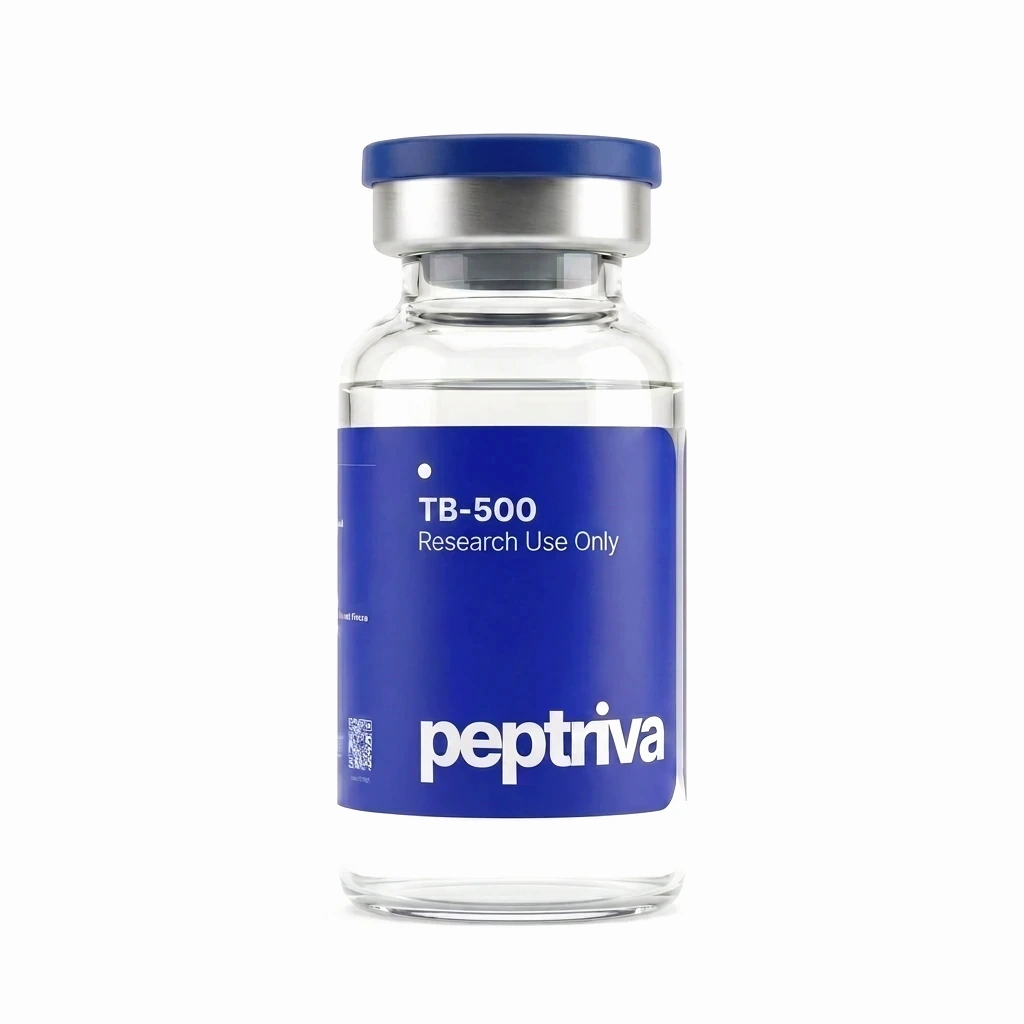
TB-500
The compound discussed here, supplied as a research compound with a certificate of analysis matched to the lot.
Does TB-500 heal injuries in people?
There is no published human trial that answers that. Zero randomized trials, zero controlled trials, and no case series we can point to for TB-500 in tendon, muscle or ligament injury.
Two 2026 reviews looked at this exact market. Mendias and Awan, in Sports Medicine, covered approved and unapproved peptides for musculoskeletal injury and athletic performance. Mayfield and colleagues, in the American Journal of Sports Medicine, wrote a primer on injectable peptide therapy for sports physicians. Both treat TB-500 as an unapproved compound without human efficacy data.
The Sports Medicine review also raises the supply problem. A vial sold as TB-500 may hold the parent peptide, the fragment, or something else entirely.
That matters more than any single study. If you cannot say which peptide is in the vial, you cannot borrow a result from either literature.
The best-supported benefits are ones nobody sells it for
Here is the odd part of the Tβ4 record. The research keeps moving, but it moves away from sports injury.
- Kidney. Mason and Vasilopoulou mapped Tβ4 in the glomerulus in 2023.
- Airway. A 2025 JACI paper tied asthma relief in mice to epithelial Tβ4 expression, not injected peptide.
- Infection. Recombinant human Tβ4 protected mice against a coronavirus in a 2021 study.
- Grafted fat. A 2025 paper found Tβ4 helped move mitochondria between cells through tunneling nanotubes.
- Brain development. A 2024 Nature Neuroscience study traced secreted peptides from the subcommissural organ shaping the developing brain.
None of that is a reason to inject a research vial. Several of those results depend on the body making its own Tβ4, which is a different thing again.
The 2021 Xing review mapped effects in heart, eye, liver, kidney and gut models. That work belongs to the 43-amino-acid parent. It does not belong to the 7-amino-acid fragment.
wheretobuypeptides.org, TB-500 cardiac researchThe cardiac case is the clearest example, and we walk through it in the TB-500 cardiac research page.
What you can actually check
You cannot check a benefit. You can check a document. That is the part worth spending time on.
Ask which peptide the vial contains, by sequence, and ask for the paperwork that shows it. Reading a certificate of analysis explains what mass spec and HPLC results should look like, and what a missing sequence line means.
The arithmetic is also checkable. A 10 mg vial in 2 mL of bacteriostatic water is 5 mg/mL. That is math, not advice. There is no published human dose for TB-500, and we do not supply one. See the concentration calculator, reconstitution basics and storage temperature for the handling side, and the legal status page for where research compounds sit.
TB-500
Research-use-only material, sold by the vial with batch documentation. Check the certificate of analysis against the batch you receive.
What to know now
- Human trials of TB-500 number zero, for injury or anything else.
- The strong benefit data belong to thymosin beta-4, a 43-amino-acid peptide, in animals and cells.
- Many vials hold a 7-amino-acid fragment, Ac-LKKTETQ, which is related but not the same molecule.
- Blood-vessel results often trace to Ac-SDKP, a 4-amino-acid cleavage product, not to what is sold.
- The 2026 Sports Medicine review flags that vial contents may be the parent, the fragment, or something else.
- A certificate of analysis with a sequence check is the only claim here you can verify yourself.
What we're watching
Watch for pages that cite thymosin beta-4 heart or kidney papers while selling the 7-amino-acid fragment. Ask which sequence is in the vial, and ask for the analysis that shows it.
Frequently asked questions
What does TB-500 actually do?
In cells, the parent peptide thymosin beta-4 binds G-actin at a 1:1 ratio and influences how cells move. That is the best-mapped part. What that translates to in a person given TB-500 has never been tested in a published human trial.
Is TB-500 the same as thymosin beta-4?
Not always. Thymosin beta-4 is the natural 43-amino-acid peptide. TB-500 is a market name that may mean that peptide or a synthetic 7-amino-acid fragment, Ac-LKKTETQ. The 2026 reviews call them related but distinct.
Are there any human studies on TB-500 benefits?
We found none for injury recovery or athletic performance. The published record is animal and cell work on thymosin beta-4, plus review articles that describe TB-500 as unapproved and unproven in people.
Does TB-500 help hair growth?
There is no published human trial of TB-500 for hair. Thymosin beta-4 appears in a wide range of animal and cell models, summarized by Xing and colleagues in 2021, but that work is not a hair result in humans.
Why do the heart claims keep coming up?
Because the animal cardiac data on thymosin beta-4 are genuinely interesting: reduced scar size, improved left ventricular function, higher capillary density. A 2025 European Heart Journal paper placed thymosin beta-4 downstream of CCN5 in vascular injury. None of that used TB-500 as sold, in people.
References
- Mendias, C. L., & Awan, T. M. (2026). Safety and efficacy of approved and unapproved peptide therapies for musculoskeletal injuries and athletic performance. Sports Medicine. https://doi.org/10.1007/s40279-026-02437-0
- Mayfield, C. K., Bolia, I. K., Feingold, C. L., et al. (2026). Injectable peptide therapy: A primer for orthopaedic and sports medicine physicians. American Journal of Sports Medicine, 54(1), 223–229. https://doi.org/10.1177/03635465251357593
- Xing, Y., Ye, Y., Zuo, H., & Li, Y. (2021). Progress on the Function and Application of Thymosin β4. Frontiers in Endocrinology, 12, 767785. https://doi.org/10.3389/fendo.2021.767785
- Ying, Y., Lin, C., Tao, N., et al. (2023). Thymosin β4 and actin: Binding modes, biological functions and clinical applications. Current Protein and Peptide Science, 24(1), 78–88. https://doi.org/10.2174/1389203724666221201093500
- Zhang, Q., Li, H., Zhuang, T., et al. (2025). CCN5 suppresses injury-induced vascular restenosis via thymosin β4 and Cd9 pathway. European Heart Journal, 46(17), 1645–1658. https://doi.org/10.1093/eurheartj/ehae911
- Li, Y., Chen, Z., Han, M., et al. (2025). Plasmacytoid dendritic cells alleviate allergic asthma via airway epithelial cell-dependent thymosin β4 expression. Journal of Allergy and Clinical Immunology, 156(1), 171–185. https://doi.org/10.1016/j.jaci.2025.01.047
- Zhang, T., Ai, D., Wei, P., et al. (2024). The subcommissural organ regulates brain development via secreted peptides. Nature Neuroscience, 27(6), 1103–1115. https://doi.org/10.1038/s41593-024-01639-x
- Mason, W. J., & Vasilopoulou, E. (2023). The pathophysiological role of thymosin β4 in the kidney glomerulus. International Journal of Molecular Sciences, 24(9), 7684. https://doi.org/10.3390/ijms24097684
- Zhang, X., Lin, Y., Li, H., Wang, Q., & Mu, D. (2025). Enhancing fat graft survival: Thymosin beta-4 facilitates mitochondrial transfer from ADSCs via tunneling nanotubes. Free Radical Biology and Medicine, 228, 281–298. https://doi.org/10.1016/j.freeradbiomed.2024.12.061
- Yu, R., Mao, Y., Li, K., et al. (2021). Recombinant human thymosin beta-4 protects against mouse coronavirus infection. Mediators of Inflammation, 2021, 9979032. https://doi.org/10.1155/2021/9979032