
The short answer. -20°C for long-term lyophilized storage, 2–8°C for active inventory and reconstituted vials, room temperature for transit only.
- Lyophilized = years: properly stored lyophilized peptides are stable for 12–36 months at refrigerated temperature; longer at -20°C.
- Reconstituted = 28 days: the standard in-use window for bacteriostatic-water-reconstituted vials at 2–8°C, by pharmaceutical convention.
- Room temperature = hours to days: not a storage state; reconstituted peptides degrade rapidly off-refrigeration.
Peptide storage has no single answer, and that is the part most guides skip. The shelf life you get depends on four things: whether the vial is freeze-dried or in solution, what it was reconstituted with, what temperature it sits at, and how long ago it was first punctured.
Store peptides by state, not by habit. A freeze-dried vial keeps 12–24 months at −20°C. The same vial keeps 12–36 months in a fridge at 2–8°C.
Reconstitution changes everything. With bacteriostatic water you get a 28-day window at 2–8°C. Left on the bench, that drops to hours or days.
Below: the three temperature tiers, and the failure modes that eat each one.
Peptides break down three ways, and good storage fights all three. Water plus heat splits the peptide bond (hydrolysis). Oxygen and light wreck the sensitive amino acids: methionine, cysteine, tryptophan. Mechanical stress — freeze-thaw cycles, shaking, weird pH — warps the 3D shape that makes the molecule work.
Every storage rule we’ll cover is a counter to one of these. Cold slows everything. Freeze-drying removes the water, so hydrolysis can’t happen. Dark vials block oxidation. Minimal handling protects the shape. Four levers, repeated forever.
How long does a freeze-dried vial last?
Lyophilized (freeze-dried) peptide is the most stable form you can buy. The drying process pulls nearly all water out, leaving a dry cake under vacuum or inert gas. No water means no hydrolysis. No oxygen means no oxidation. The cake holds as long as the seal holds and the temperature stays in range.
Three tiers cover a sealed vial:
- −20°C freezer — long-term storage. 12–24 months or more. This is where inventory you are not actively working from belongs.
- 2–8°C fridge — active inventory. 12–36 months depending on the molecule. The working tier, and the one most handling errors happen in.
- Room temperature — transit only. Up to 2 weeks for most peptides in the sealed lyophilized state. It is a state a vial passes through, not one it lives in.
The freezer is your safest bet. The fridge is where you keep what you’re using. Room temp is a transit state, not a storage one.
What about −80°C ultra-low freezers? Mostly unnecessary for third-party tested research peptides. The freeze-thaw stress of pulling a vial out of −80°C on each access actually damages more than the colder storage prevents. Stick with −20°C for long-term and 2–8°C for active use. Save −80°C for the rare high-sensitivity cases the manufacturer flags.
What changes the moment you reconstitute?
Adding water restarts the hydrolysis clock. From the moment diluent enters the vial, the peptide is slowly degrading. The tiers shift. The volume of diluent you chose at reconstitution also fixes the concentration you will be storing — the peptide calculator is where that arithmetic belongs, and it is worth settling before the vial goes into the fridge.
For a multi-dose vial reconstituted with bacteriostatic water (sterile water with 0.9% benzyl alcohol, a mild preservative), the standard in-use window is 28 days at 2–8°C. That matches the standard in-use window documented for preserved multi-dose preparations. The benzyl alcohol suppresses bacterial growth once the vial septum has been punctured. The fridge slows the chemistry. Twenty-eight days is the safe outer edge.
Past 28 days, two things go wrong at once. The preservative loses effectiveness, so contamination becomes a real risk. And cumulative hydrolysis has chewed up some of the peptide. Both compound.
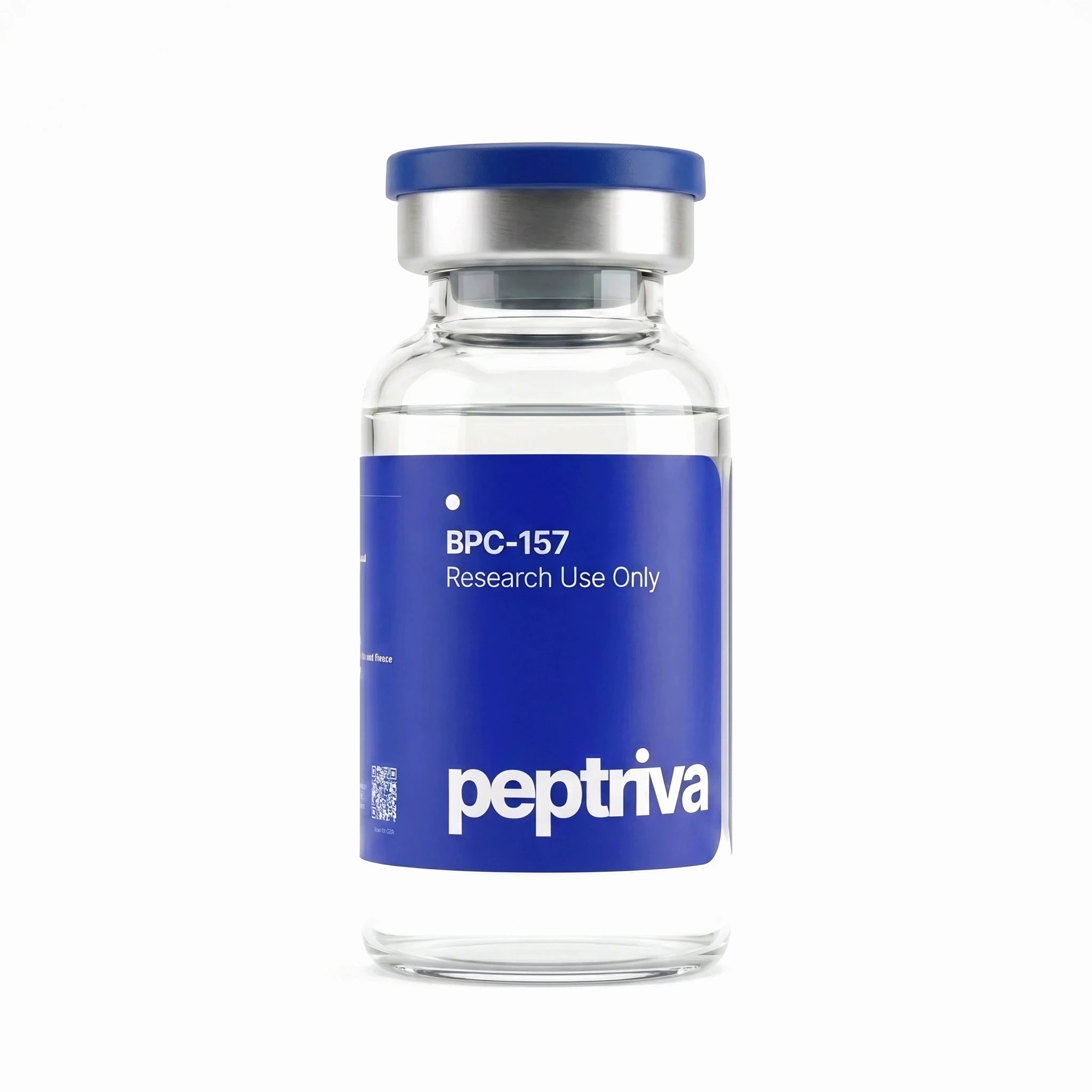
BPC-157
The reference lyophilized vial used to develop the storage stability framework in this guide. Lab-verified identity and purity.
When do light and moisture matter?
Beyond temperature, two other environmental factors can wreck a vial: light and moisture. They show up across multiple peptide classes, so they’re worth knowing.
Light sensitivity. Peptides containing tryptophan, tyrosine, phenylalanine, or cysteine can photo-oxidize under UV. Glutathione is the classic example. It needs amber vials or dark storage at all times. NAD+ (technically a nucleotide cofactor, not a peptide, but handled the same way) is also light-sensitive.
If a peptide has documented light sensitivity, use amber vials, opaque boxes, and keep it out of fluorescent or UV light. If there’s no light-sensitivity note in the docs, normal refrigerated storage in clear glass is fine.
Moisture sensitivity. A freeze-dried peptide that lost its seal is in trouble. A cracked stopper, damaged crimp, or condensation inside the vial means atmospheric moisture is getting in. That accelerates hydrolysis even in the fridge.
Three visual red flags: the cake has collapsed (powder looks melted or shrunken instead of structured), the cake changed color, or you can see moisture droplets inside. Any of these and you discard the vial.
The rule of thumb: a freeze-dried cake should look exactly the way it shipped. Anything different — collapse, discoloration, fragments, melting — means it’s compromised.
Where this falls short: The 28-day window and 12–36 month shelf life are pharmaceutical conventions, not peptide-specific data. Individual molecules vary. The numbers are conservative for stable peptides like BPC-157 and may be generous for sensitive ones like GLP-1 analogs without lipidation. Always defer to manufacturer-specific stability documentation when you have it.
The single most actionable mental model for peptide storage is the three temperature tiers and what they suppress: −20°C arrests almost all degradation pathways, 2–8°C suppresses them enough for working inventory, and room temperature is a transit-only state. Crossing tiers should always be deliberate, not accidental.
— Wang, International Journal of Pharmaceutics, summary of peptide stability principles
The physical and chemical degradation pathways of a protein in solution — hydrolysis, oxidation, deamidation, aggregation — are all temperature-dependent, and all of them proceed in the aqueous state in ways they cannot in the dried state. Removing water is the single most effective stabilizing intervention available.
— Summarizing Wang, Instability, stabilization, and formulation of liquid protein pharmaceuticals, Int. J. Pharm. 1999
Should you aliquot for longer storage?
Aliquoting means splitting a reconstituted vial into multiple smaller single-use vials. Each one gets opened exactly once and thrown away. You skip the repeated punctures into one multi-dose vial.
The upside is real. Each aliquot sees only one needle entry, which eliminates the cumulative contamination risk. If you freeze the aliquots, you also avoid repeated freeze-thaw cycles on the same solution.
The downside: aliquoting adds a sterile transfer step. That’s another failure point. You need alcohol-swabbed septa, sterile syringes, sterile receiving vials, and a clean transfer environment.
Done right, aliquoting can stretch your working window past 28 days by storing frozen single-use vials at −20°C and thawing them one at a time. Done sloppily, you’ve just multiplied your contamination vectors.
Quick guide. Small number of experimental accesses over a few weeks? Stick with the original multi-dose vial — simplest path. Larger experimental runs, longer timelines, or a peptide with shorter native stability? Aliquot and freeze.
Either way the in-use window assumes aseptic technique on every access. The vial-handling section of the routes guide sets out what that means at the septum, and the injection-sites page covers the protocol side of the same subject.
The three-tier summary, in one block: −20°C freezer — freeze-dried vials for long-term (12–24 months); single-use frozen aliquots for extended working windows. 2–8°C fridge — active inventory; reconstituted vials within the 28-day window. Room temperature — transit only; never a storage state.
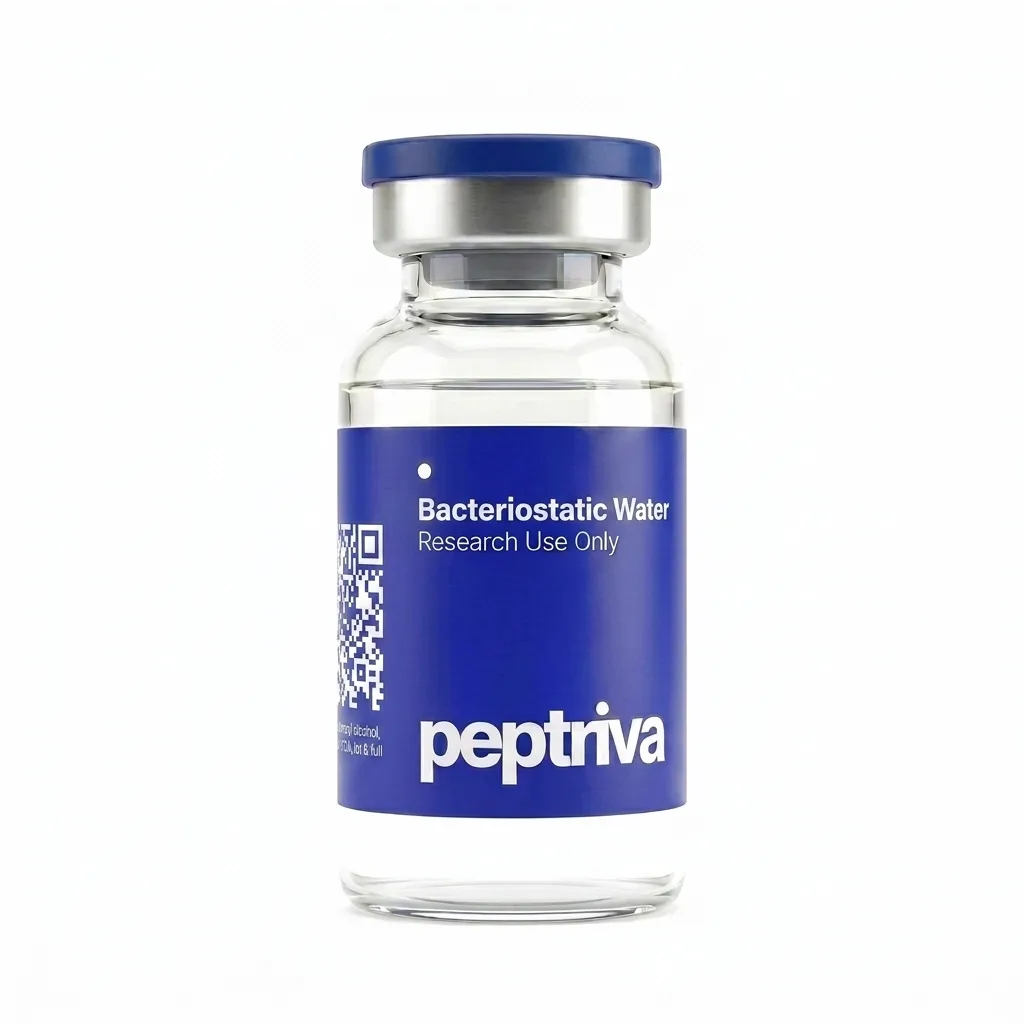
Bacteriostatic Water
Bacteriostatic water · 10 mL sterile vial, 0.9% benzyl alcohol. The diluent referenced across the storage and stability protocols in this guide. Sealed sterile presentation.
Why freeze-thaw cycling matters
Freeze-thaw is the most overlooked stability stressor. Every cycle hits the peptide with a phase transition. That creates mechanical and osmotic stress on the molecular structure.
One cycle? Most peptides tolerate it without measurable damage. Repeated cycles? That’s where you lose material, especially in peptides with complex 3D structure.
Three rules. First, do not freeze a reconstituted multi-dose vial intended for use across the 28-day window. Keep it refrigerated and accept the standard timeline. Second, if freezing a solution is required, aliquot it first so each portion sees only one freeze and one thaw. Third, do not use a frost-free home freezer for lyophilized vials — the defrost cycles create temperature swings that degrade peptides. A dedicated lab −20°C freezer with stable temperature is appropriate.
Key questions for procurement and handling documentation
When sourcing or characterizing a third-party tested research peptide, the following points should be confirmed against the manufacturer’s stability documentation or certificate of analysis:
- What is the manufacturer-documented stability window for this specific peptide? The 12–36 month range varies by compound. The CoA or lot-specific stability data is authoritative.
- Is this peptide light-sensitive? Most are not. Some (glutathione, NAD+) are. The stability documentation should specify.
- What is the in-use window once reconstituted with bacteriostatic water? The 28-day convention may not apply to every compound’s stability profile.
- Is the multi-dose vial format appropriate for the planned experimental timeline? Depends on access frequency, working window, and the available sterile-transfer setup.
- What visual indicators signal a compromised vial for this compound? Cake collapse, discoloration, cloudiness after reconstitution, and particulates are common markers — signs can be peptide-specific.
What to know now
- Three-tier framework: -20°C for long-term lyophilized storage, 2–8°C for active inventory and reconstituted vials, room temperature for transit only.
- Lyophilized = years: properly stored lyophilized peptides are stable for 12–36 months at refrigerated temperature; longer at -20°C.
- Reconstituted = 28 days: the standard in-use window for bacteriostatic-water-reconstituted vials at 2–8°C, by pharmaceutical convention.
- Room temperature = hours to days: not a storage state; reconstituted peptides degrade rapidly off-refrigeration.
- Light sensitivity: specific peptides (glutathione, NAD+, others) require amber-vial or dark storage; documentation should specify.
- Moisture sensitivity: lyophilized cakes that show collapse, discoloration, or visible moisture should be discarded — these indicate seal failure.
- Freeze–thaw discipline: single cycle usually tolerated; repeated cycling is cumulatively damaging. Aliquot before freezing if multiple separate accesses are planned.
- Aliquoting trade-off: extends stability window but introduces additional sterile-transfer failure points; appropriate when the working window exceeds 28 days.
What we’re watching
Two trends. First, peptide-specific stability data is becoming more common as the research market matures. The 28-day convention is a general baseline. Individual molecules vary, and explicit documentation is showing up more often. Second, some pharmaceutical products are shifting to prefilled single-dose syringes that eliminate the in-use window question entirely. That’s mostly outside third-party tested work, but it may shape how stability data gets documented for the field.
References
- Wang, W. (1999). Instability, stabilization, and formulation of liquid protein pharmaceuticals. International Journal of Pharmaceutics, 185(2), 129–188. https://doi.org/10.1016/s0378-5173(99)00152-0
- United States Pharmacopeia. Bacteriostatic Water for Injection, USP. Monograph in current USP-NF. https://doi.org/10.4135/9781412963855.n1200
- American Society of Health-System Pharmacists (ASHP). Handbook on Injectable Drugs. Bethesda, MD: ASHP, current edition. https://doi.org/10.3109/9780824706081.014
- Manning, M. C., Chou, D. K., Murphy, B. M., et al. (2010). Stability of protein pharmaceuticals: An update. Pharmaceutical Research, 27(4), 544–575. https://doi.org/10.1007/s11095-009-0045-6