
No human MOTS-c dosage has ever been established, and we couldn't find a single trial that looked for one. Every dose in the published record came from a mouse, at 0.5 to 15 mg/kg into the abdominal cavity. Rodent milligrams per kilogram don't convert to people.
The short answer. There is no established human dose for MOTS-c. No dose-finding trial has been published, and no randomized trial of injected MOTS-c has been published at all.
- The mouse studies used 0.5 to 15 mg/kg/day intraperitoneally — a 30-fold spread, by a route people do not use.
- Multiplying a mouse mg/kg by human body weight gives 35–1,050 mg/day for a 70 kg adult, which is the method being wrong rather than the dose being large.
- The FDA's surface-area conversion divides a mouse dose by 12.3, and even then produces a Phase 1 starting point, not a therapeutic dose.
There is no established human dose for MOTS-c, because no trial has ever looked for one. No randomized trial of injected MOTS-c has been published at all. The mouse studies used 0.5 to 15 mg/kg per day, injected into the abdominal cavity. That is a 30-fold spread within a single species, by a route people do not use.
The table below reports every dose of MOTS-c the studies cited on this page administered, exactly as each one gave it; every row is a mouse, so none of it is a human dose and none of it converts into one.
| Study | Species | Dose | Route | Duration | n |
|---|---|---|---|---|---|
| Lee et al., 2015 | Mouse (C57BL/6) | 5 mg/kg/day | Intraperitoneal | 7 days | — |
| Lee et al., 2015 | Mouse (CD-1, high-fat diet) | 0.5 mg/kg/day | Intraperitoneal | 8 weeks | — |
| Reynolds et al., 2021 | Mouse (CD-1) | 5 and 15 mg/kg/day | Intraperitoneal | 2 weeks | — |
| Reynolds et al., 2021 | Mouse (C57BL/6N, aged) | 15 mg/kg, three times a week | Intraperitoneal | From 23.5 months of age | — |
A dash means we have no sourced figure for that cell and have not estimated one. There is no human row because no trial has administered MOTS-c to a person, so there is no established human dose, and a mouse milligram-per-kilogram figure is not one waiting to be divided.
What the human record contains
Nothing that answers the dosing question. MOTS-c is a 16-amino-acid peptide encoded inside the mitochondrial genome, discovered by Lee and colleagues in 2015. It is real, it is endogenous, and it circulates in human plasma. What it has never had is an interventional trial.
Human MOTS-c data are observational: measurements of the peptide people already make, and how those levels track with age, exercise and disease. Nobody has injected synthetic MOTS-c into a randomized cohort and reported what happened. A 2023 review in Frontiers in Endocrinology put the position plainly.
MOTS-c has been used less frequently in disease treatment, and no effective method of applying MOTS-c in the clinic has been developed.
Zheng et al., Frontiers in Endocrinology, 2023That sentence is from a review arguing for the molecule's therapeutic potential. When the optimistic reading concedes there is no established route into the clinic, a dosing chart is not summarizing evidence. It is filling a hole.
The doses the mouse studies used
The table at the top of this page carries the numbers, with the study attached to each one. Every row is intraperitoneal, meaning injected into the abdominal cavity. That's a laboratory route, not a human one.
Two things are worth noticing before you reach for a calculator. The first is the spread. The same laboratory used 0.5 mg/kg in one experiment and 15 mg/kg in another, and those doses were picked to produce a measurable effect in a mouse.
The second is that the highest and lowest both worked, on the endpoints each study measured. That tells you the curve is unresolved even in the animal.
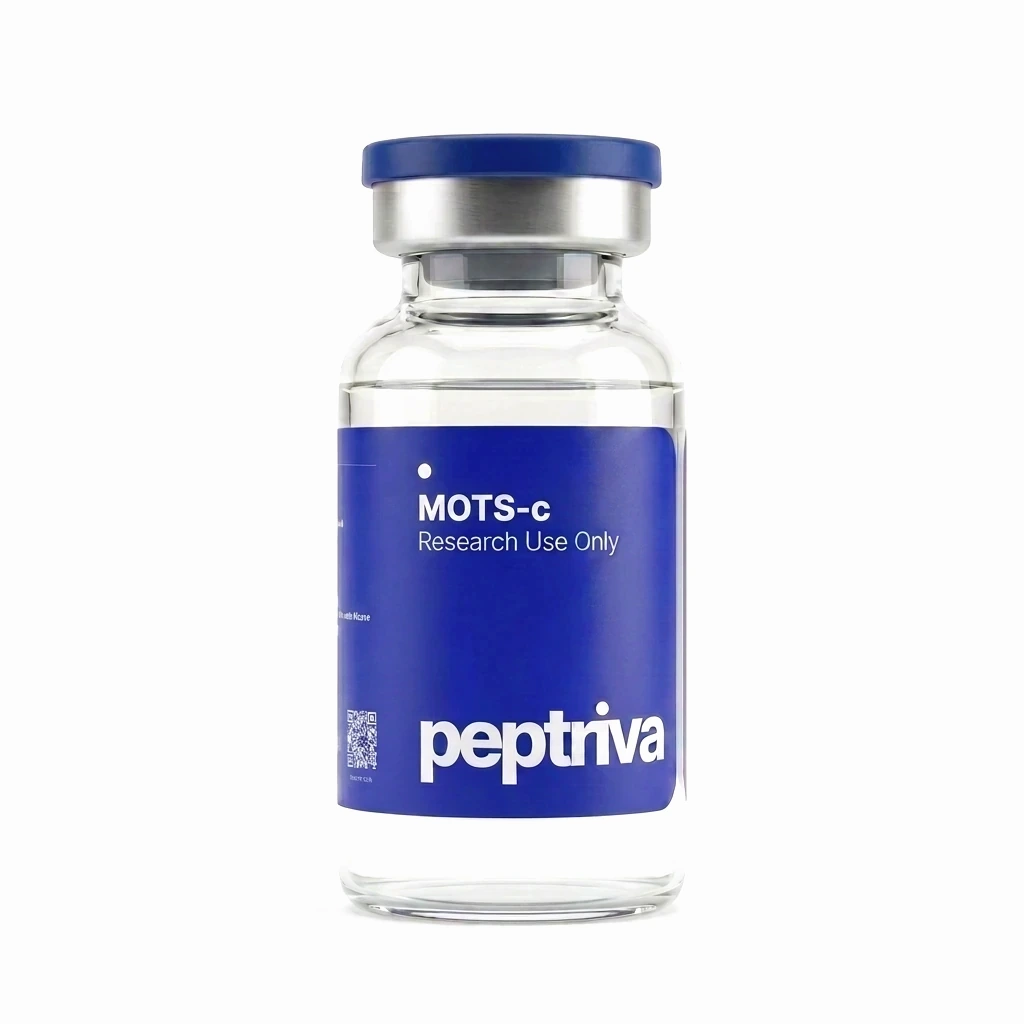
MOTS-c
The mitochondrial-derived peptide discussed across the preclinical literature reviewed here. Research use only, supplied with a batch-matched certificate of analysis.
Why mouse milligrams do not convert
The arithmetic people reach for is simple: take the mouse dose in mg/kg, multiply by human body weight. Run it across the published range and a 70 kg adult gets 35 mg to 1,050 mg per day.
A 10 mg vial is a rounding error against the bottom of that. The number is absurd because the method is wrong.
Interspecies dose translation is not multiplication. The FDA's guidance on first-in-human starting doses converts animal doses by body surface area, not body weight. Small animals run far higher metabolic rates per unit mass.
The published table divides a mouse dose by 12.3, not by nothing. Applied to the MOTS-c range, that gives roughly 2.8 mg to 85 mg a day for a 70 kg adult. Still a 30-fold band, and still not a dose.
Why not a dose? Because the human equivalent dose in that guidance comes from the highest animal dose that produced no adverse effect. It exists to set the opening rung of a Phase 1 safety study, before a further safety factor is applied on top.
It's the number you start a trial at, not the number a trial concluded with. For MOTS-c, that trial hasn't been run.
Where the numbers on dosing charts come from
Search the term and you'll find charts that agree with each other on a milligram figure and a weekly schedule. The agreement isn't evidence. We traced the figures back, and the chain runs through three places, none of which is a study.
- Vial arithmetic. Vials are sold at 5, 10 and 20 mg. A protocol that divides a vial into a convenient number of equal draws produces a tidy number that reflects the packaging, not the pharmacology.
- Naive scaling. Somebody multiplied a rodent mg/kg by body weight, got a figure that fit in a vial, and published it. The step that would have been wrong either way was skipped.
- Repetition. One source is reworded by the next until convergence looks like consensus. Convergence without an underlying measurement is an echo.
Kumagai and colleagues have since shown MOTS-c binds and activates CK2 directly, and separately that it suppresses myostatin signaling. The mechanism work is genuinely good. Good mechanism doesn't produce a dose. Only a dose-finding study does that, and this peptide has never had one.
What is actually knowable
Two things, and both are worth separating from the dosing question.
- The endogenous signal is measurable. Acute high-intensity exercise raises MOTS-c in human skeletal muscle and plasma, and circulating levels fall with age. That is a real human observation. It is a concentration, not a dose, and nobody has established what administration reproduces it.
- The material is verifiable. Whether a vial contains MOTS-c at the stated purity has a real answer, from a batch-matched certificate of analysis showing HPLC purity and mass-spec identity. Given how much else here is unsettled, checking the one thing that can be checked is the minimum.
Evidence that exercise training results in chronic changes in MDP expression within tissues and the circulation is conflicting. [It] may depend on the mode, duration, intensity of training plan and participant characteristics.
Woodhead & Merry, Biochimica et Biophysica Acta, 2021We report what trials administered. For MOTS-c there's nothing to report, and the useful thing we can do is say so instead of publishing a chart.
If you already hold a number, it came from somewhere other than a published study. Our calculator will convert it into syringe units perfectly, and that's the trap. Easy arithmetic on an unsourced input still gives you an unsourced answer.
MOTS-c
Research-use-only material, sold by the vial with batch documentation. Check the certificate of analysis against the batch you receive.
MOTS-c is one of the rows with no human figure at all in our peptide dosage chart, which reports every compound in the library the same way: what a study gave, or nothing.
What to know now
- There is no established human dose for MOTS-c. No dose-finding trial has been published, and no randomized trial of injected MOTS-c has been published at all.
- The mouse studies used 0.5 to 15 mg/kg/day intraperitoneally — a 30-fold spread, by a route people do not use.
- Multiplying a mouse mg/kg by human body weight gives 35–1,050 mg/day for a 70 kg adult, which is the method being wrong rather than the dose being large.
- The FDA's surface-area conversion divides a mouse dose by 12.3, and even then produces a Phase 1 starting point, not a therapeutic dose.
- Human MOTS-c data are observational. Exercise raises endogenous levels; that is a concentration, not a dose.
What we're watching
A registered Phase 1 trial would change this page completely. The mechanism work is strong: CK2 binding, myostatin suppression and AMPK activation, all replicated across groups. That makes the missing interventional study the field's most conspicuous gap rather than a sign of a dead end.
We're watching for a dose-ranging arm too. A safety study without one would leave this question open even after the first humans are dosed.
Frequently asked questions
What is the correct MOTS-c dose?
There isn't an established one. No human dose-finding trial has been published, so any specific milligram figure is reconstructed rather than measured.
What doses did the MOTS-c studies use?
Between 0.5 and 15 mg/kg per day, injected intraperitoneally in mice. Lee et al. (2015) used 5 mg/kg/day for a week and 0.5 mg/kg/day for eight weeks; Reynolds et al. (2021) used 5 and 15 mg/kg/day, and 15 mg/kg three times weekly in old mice.
Can I convert the mouse dose to a human dose?
Not by multiplying by body weight. Interspecies translation uses body surface area, and the FDA's table divides a mouse dose by 12.3. Even done correctly the output is a starting point for a Phase 1 safety trial, not a dose.
Has MOTS-c ever been tested in humans?
Not as an injected treatment in a randomized trial. Human MOTS-c work is observational — measuring the peptide people already produce, and how those levels move with exercise, age and disease.
References
- Lee, C., Zeng, J., Drew, B. G., et al. (2015). The mitochondrial-derived peptide MOTS-c promotes metabolic homeostasis and reduces obesity and insulin resistance. Cell Metabolism, 21(3), 443–454. https://doi.org/10.1016/j.cmet.2015.02.009
- Reynolds, J. C., Lai, R. W., Woodhead, J. S. T., et al. (2021). MOTS-c is an exercise-induced mitochondrial-encoded regulator of age-dependent physical decline and muscle homeostasis. Nature Communications, 12, 470. https://doi.org/10.1038/s41467-020-20790-0
- Kumagai, H., Coelho, A. R., Wan, J., et al. (2021). MOTS-c reduces myostatin and muscle atrophy signaling. American Journal of Physiology — Endocrinology and Metabolism, 320(4), E680–E690. https://doi.org/10.1152/ajpendo.00275.2020
- Kumagai, H., Kim, S. J., Miller, B., et al. (2024). MOTS-c modulates skeletal muscle function by directly binding and activating CK2. iScience, 27(11), 111212. https://doi.org/10.1016/j.isci.2024.111212
- Zheng, Y., Wei, Z., & Wang, T. (2023). MOTS-c: A promising mitochondrial-derived peptide for therapeutic exploitation. Frontiers in Endocrinology, 14, 1120533. https://doi.org/10.3389/fendo.2023.1120533
- Kim, S. J., Miller, B., Kumagai, H., Silverstein, A. R., Flores, M., & Yen, K. (2020). Mitochondrial-derived peptides in aging and age-related diseases. GeroScience, 43(3), 1113–1121. https://doi.org/10.1007/s11357-020-00262-5
- Woodhead, J. S. T., & Merry, T. L. (2021). Mitochondrial-derived peptides and exercise. Biochimica et Biophysica Acta — General Subjects, 1865(12), 130011. https://doi.org/10.1016/j.bbagen.2021.130011
- Yin, Y., Pan, Y., He, J., et al. (2021). The mitochondrial-derived peptide MOTS-c relieves hyperglycemia and insulin resistance in gestational diabetes mellitus. Pharmacological Research, 175, 105987. https://doi.org/10.1016/j.phrs.2021.105987
- U.S. Food and Drug Administration, Center for Drug Evaluation and Research. (2005). Guidance for industry: Estimating the maximum safe starting dose in initial clinical trials for therapeutics in adult healthy volunteers. https://www.fda.gov/media/72309/download