
The whole published ipamorelin dosage record is one human trial that gave 0.03 mg/kg into a vein, twice a day, and missed its endpoint. Everything else is animal potency data. Neither produces the charts you'll see passed around, and that gap is the story.
The short answer. Ipamorelin: One published human trial exists. It gave 0.03 mg/kg intravenously, twice daily, for up to seven days after bowel surgery, and missed its primary endpoint.
- Raun's 1998 figures are potency measures: 80 nmol/kg in rats and 2.3 nmol/kg in swine. An ED50 compares molecules; it does not prescribe a dose.
- The compound's real finding is selectivity — no ACTH or cortisol rise at more than 200 times the dose that half-maximally released growth hormone.
- Converting nmol/kg to a human milligram figure needs both a molar-to-mass step and a body-surface-area species conversion, and still lands on a Phase 1 starting point.
There is no set ipamorelin dose. A Phase 1 study gave 4.21 to 140.45 nmol/kg into a vein, in 40 healthy men. A Phase 2 trial gave 0.03 mg/kg twice a day after bowel surgery, and missed its endpoint. A larger trial ran 320 people and never published.
The table below reports what the studies cited on this page administered, in the units each one used; the animal rows are potency measurements rather than treatment doses, and nothing in the table has been converted into a human amount.
| Study | Species | Dose | Route | Duration | n |
|---|---|---|---|---|---|
| Beck et al., 2014 — Phase 2, postoperative ileus | Human | 0.03 mg/kg, twice daily | Intravenous | First postoperative day until day seven or discharge | 114 analyzed |
| Gobburu et al. 1999 — Phase 1 | Human (healthy men) | 4.21, 14.02, 42.13, 84.27 and 140.45 nmol/kg | Intravenous infusion over 15 minutes | Single dose per level | 8 per level, 40 total |
| NCT01280344 — Phase 2b, unpublished | Human (bowel resection) | 0.03 mg/kg twice daily; 0.06 mg/kg twice daily; 0.06 mg/kg three times daily | Intravenous | — | 320 |
| Raun et al., 1998 — pharmacology | Rat (anesthetized) | ED50 80 ± 42 nmol/kg — a potency coordinate, not a treatment dose | — | — | — |
| Raun et al., 1998 — pharmacology | Swine (conscious) | ED50 2.3 ± 0.03 nmol/kg — a potency coordinate, not a treatment dose | — | — | — |
| Lu et al., 2024 — cisplatin-induced weight loss | Ferret | 1 to 3 mg/kg | Intraperitoneal | — | — |
A dash means we have no sourced figure for that cell and have not estimated one. One human row exists, it was intravenous and weight-scaled, and it did not beat placebo, which is why there is still no established ipamorelin dose for any of the uses this term is searched for.
The only human dose on record
Beck and colleagues ran a Phase 2 proof-of-concept trial in adults undergoing small and large bowel resection. The intervention was intravenous ipamorelin at 0.03 mg/kg, twice daily, from the first postoperative day until day seven or discharge. It was multicenter, double-blind and placebo-controlled, with 114 patients in the analysis.
Median time to tolerating a solid meal was 25.3 hours on ipamorelin against 32.6 hours on placebo — a difference in the right direction that did not reach significance (p = 0.15). Treatment-emergent adverse events ran at 87.5% on drug and 94.8% on placebo, which is what a well-tolerated compound looks like in a post-surgical population.
There were no significant differences between ipamorelin and placebo in the key and secondary efficacy analyses.
Beck et al., International Journal of Colorectal Disease, 2014That is the whole human dosing record. The program did not go further, and no controlled trial has tested ipamorelin for muscle, fat, recovery, sleep or aging since. A dose exists; a dose for any of the reasons people actually search this term does not.
What Raun's 1998 pharmacology measured
The compound's founding paper is the source of nearly every figure quoted about it, and it is worth being precise about what those figures are. Raun and colleagues at Novo Nordisk reported:
| Preparation | Measure | Value | Comparator (GHRP-6) |
|---|---|---|---|
| Primary rat pituitary cells | EC50, in vitro | 1.3 ± 0.4 nmol/L | 2.2 ± 0.3 nmol/L |
| Anesthetized rats | ED50, GH release | 80 ± 42 nmol/kg | 115 ± 36 nmol/kg |
| Conscious swine | ED50, GH release | 2.3 ± 0.03 nmol/kg | 3.9 ± 1.4 nmol/kg |
| Swine, side-axis hormones | ACTH and cortisol | No significant rise at >200× the GH ED50 | Both elevated |
An ED50 is the dose that produces half the maximum response in that preparation. It's a potency coordinate for comparing molecules, which is exactly what the paper used it for: ipamorelin against GHRP-6 and GHRP-2.
It isn't a therapeutic dose. The 35-fold difference between the rat and swine figures shows why treating it as one would be a mistake.
Ipamorelin is the first GHRP-receptor agonist with a selectivity for GH release similar to that displayed by GHRH.
Raun et al., European Journal of Endocrinology, 1998That claim — selectivity, not potency — is what the paper actually established, and it has held up. The interesting part is the last row of the table: no cortisol or ACTH response even at doses more than 200 times the one that half-maximally released growth hormone. Selectivity is a property of the molecule. It is not a dose either.
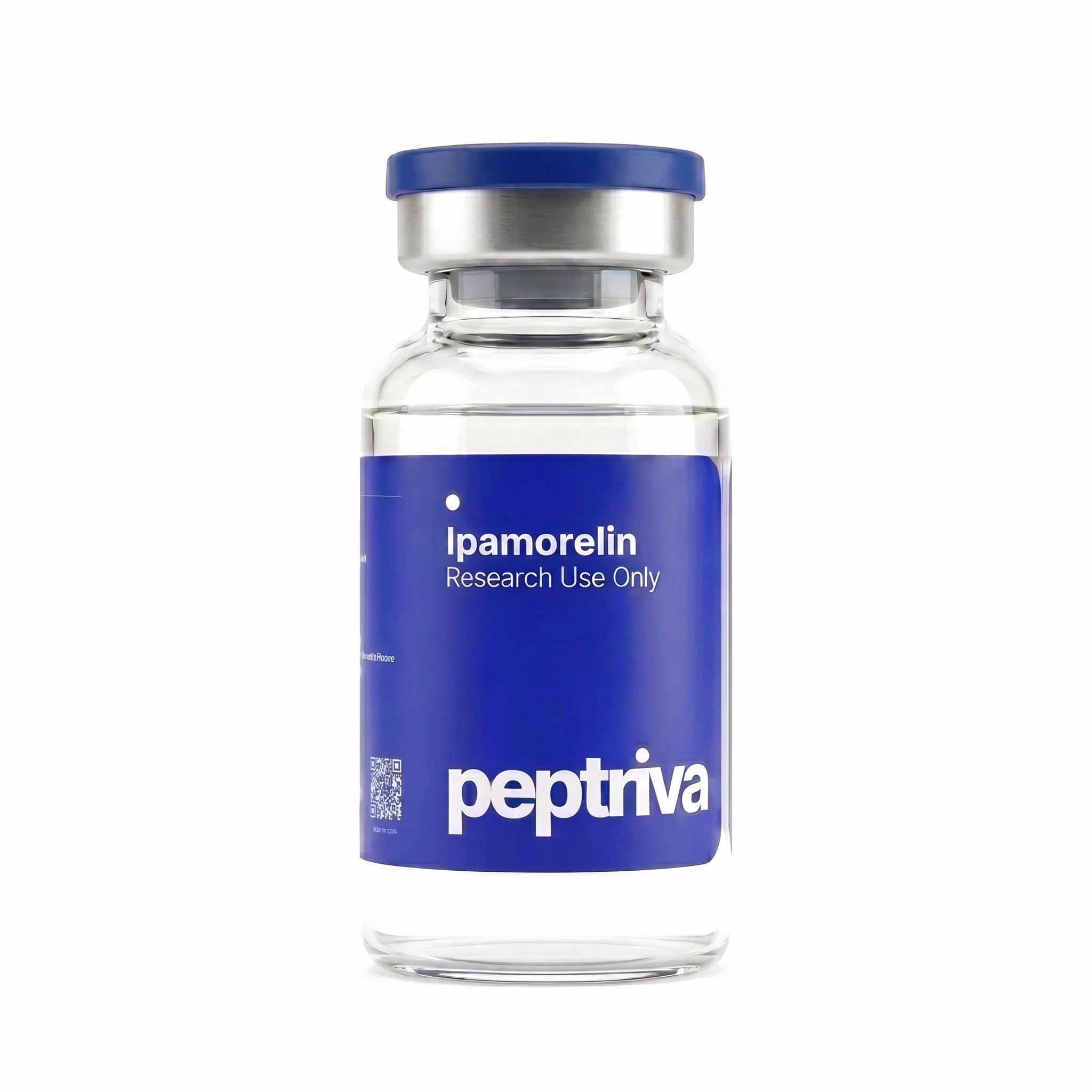
Ipamorelin
The reference secretagogue cited across the pharmacology reviewed in this article. Research use only, supplied with a batch-matched certificate of analysis.
Why nmol/kg does not become milligrams
Two conversions stand between an animal ED50 and a human number, and both are commonly skipped.
The first is molar to mass. A dose in nanomoles counts molecules. A dose in micrograms weighs them. Converting needs the molecular weight, and the result is still a swine number.
The second is species to species. The FDA's guidance on first-in-human starting doses converts animal doses by body surface area, not body weight, dividing a rat dose by 6.2.
Even done correctly, what you get is the opening rung of a Phase 1 safety study. It comes from a no-adverse-effect level, and a further safety factor is applied on top.
Then there's the range problem. The 2024 ferret work used 1 to 3 mg/kg intraperitoneally, a mass-per-weight dose three orders of magnitude away from a swine ED50 in nanomoles. A 2024 study in a cichlid fish used the compound to probe the reproductive axis.
Different species, different routes, different questions, different units. Averaging across them produces a number with no referent.
For scale rather than as a target: the one human dose, 0.03 mg/kg, works out to roughly 2 mg per administration for a 70 kg adult. That was given intravenously, twice a day. A standard research vial holds 5 mg.
What the dosing charts are built from
Not the trial. If the circulating schedules had been derived from Beck's protocol they would be intravenous, weight-scaled and twice daily, and they are none of those things. What they are built from:
- Biomarker dose-finding, generalized. Early clinical pharmacology in this class established which amounts produce a growth hormone pulse without obvious acute side effects. That is a hormone response, not a clinical outcome, and it was never validated against one.
- Vial convenience. A 5 mg vial divides tidily into a round number of draws. The tidiness comes from the packaging.
- Repetition. One forum figure reworded into a supplier's copy, then into an article, then into a chart. Convergence across sources is not independent confirmation when the sources are copies.
There is also a documented reason to distrust any fixed long-term schedule for this class. Ghigo's review recorded that the growth hormone response to these peptides undergoes partial desensitization — more during continuous infusion, less during intermittent dosing. Whatever a chart says about week eight, no study of ipamorelin has measured it.
What is actually established
Three things, none of which is a dose.
- Selectivity. Ipamorelin releases growth hormone without moving cortisol, ACTH, prolactin, FSH, LH or TSH in the swine work — the property that made it a useful pharmacological tool and the reason it still appears as a reference compound.
- The class safety gap. Reviews of growth hormone secretagogues are consistent: few long-term, rigorously controlled studies exist, and the flagged concern is a fall in insulin sensitivity with rising blood glucose.
- The material. Whether a vial holds ipamorelin at the stated purity is answerable from a batch-matched certificate of analysis. Reading a COA covers what the document has to show.
To date, few long-term, rigorously controlled studies have examined the efficacy and safety of GHSs…
Sigalos & Pastuszak, Sexual Medicine Reviews, 2018Our line is the same on every dosing page. We report what trials administered, and where nothing was administered we say so. For ipamorelin, one trial administered 0.03 mg/kg intravenously to post-surgical patients and didn't beat placebo. That's the sentence a dosage page owes you.
The complete guide covers the rest of the evidence base. The blend page covers what happens when this compound is paired with a GHRH analog.
Ipamorelin
Research-use-only material, sold by the vial with batch documentation. Check the certificate of analysis against the batch you receive.
That single trial is how ipamorelin appears in our peptide dosage chart, which reports what each study administered rather than what the charts elsewhere assert.
The two human studies most write-ups miss
Ipamorelin has a published Phase 1. Gobburu and colleagues gave five ascending intravenous doses — 4.21 to 140.45 nmol/kg over 15 minutes — to eight healthy men at each level, 40 in total. Growth hormone rose at every level, and the terminal half-life was about two hours.
There is also a second Phase 2. A dose-finding study in 320 bowel-resection patients tested 0.03 mg/kg twice daily, 0.06 mg/kg twice daily and 0.06 mg/kg three times daily. It completed in 2014, posted no results, and has never been published.
That unpublished trial holds the highest ipamorelin dose ever given to a person on record. Its silence is the most informative thing about it.
A per-kilogram figure has to be turned into a volume before it means anything at a bench, and the peptide calculator does that conversion. The arithmetic is sound whatever you feed it, which is the part to watch. For what was measured rather than dosed, see ipamorelin before and after.
What to know now
- One published human trial exists. It gave 0.03 mg/kg intravenously, twice daily, for up to seven days after bowel surgery, and missed its primary endpoint.
- Raun's 1998 figures are potency measures: 80 nmol/kg in rats and 2.3 nmol/kg in swine. An ED50 compares molecules; it does not prescribe a dose.
- The compound's real finding is selectivity — no ACTH or cortisol rise at more than 200 times the dose that half-maximally released growth hormone.
- Converting nmol/kg to a human milligram figure needs both a molar-to-mass step and a body-surface-area species conversion, and still lands on a Phase 1 starting point.
- No controlled trial has tested ipamorelin for muscle, fat, recovery, sleep or aging. There is no dose for those uses because there is no study.
What we're watching
One thing would change this page: a registered trial with a dose-ranging arm, in a population anyone is actually interested in. Ipamorelin's pharmacology is clean enough that it's still a plausible tool compound, and the ghrelin-receptor class has kept moving.
Whether any sponsor takes ipamorelin itself back into the clinic is the open question. We're also watching the class-level insulin-sensitivity signal, since that's the finding most likely to matter at any dose.
Frequently asked questions
What is the correct ipamorelin dose?
There isn't an established one for the uses this term is usually searched for. The only published human dose is 0.03 mg/kg intravenously twice daily, from a Phase 2 trial in postoperative ileus that did not beat placebo.
What dose did the ipamorelin human trial use?
0.03 mg/kg by intravenous infusion, twice a day, from postoperative day one until day seven or discharge. Beck et al. (2014) analyzed 114 patients; median time to a tolerated meal was 25.3 hours versus 32.6 on placebo, p = 0.15.
What does 80 nmol/kg mean in Raun's rat study?
It is the ED50 — the dose producing half the maximum growth hormone response in anesthetized rats. It was reported to compare ipamorelin against GHRP-6, not to recommend an amount. The swine ED50 in the same paper was 2.3 nmol/kg, 35 times lower.
Why can't I convert the animal dose to a human dose?
Two steps get skipped. Nanomoles have to be converted to mass using the molecular weight, and species have to be converted by body surface area rather than body weight. Done properly, the answer is a Phase 1 starting dose, not a therapeutic one.
Is ipamorelin safe at the doses people use?
Unknown, because those doses have not been studied. The class reviews note few long-term controlled studies of growth hormone secretagogues, with reduced insulin sensitivity the recurring concern.
References
- Raun, K., Hansen, B. S., Johansen, N. L., et al. (1998). Ipamorelin, the first selective growth hormone secretagogue. European Journal of Endocrinology, 139(5), 552–561. https://doi.org/10.1530/eje.0.1390552
- Beck, D. E., Sweeney, W. B., McCarter, M. D., & the Ipamorelin 201 Study Group. (2014). Prospective, randomized, controlled, proof-of-concept study of the ghrelin mimetic ipamorelin for the management of postoperative ileus in bowel resection patients. International Journal of Colorectal Disease, 29(12), 1527–1534. https://doi.org/10.1007/s00384-014-2030-8
- Lu, Z., Ngan, M. P., Liu, J. Y. H., et al. (2024). The growth hormone secretagogue receptor 1a agonists, anamorelin and ipamorelin, inhibit cisplatin-induced weight loss in ferrets. Physiology & Behavior, 284, 114644. https://doi.org/10.1016/j.physbeh.2024.114644
- Gouda, M., & Ganesh, C. B. (2024). The influence of ghrelin agonist ipamorelin acetate on the hypothalamic-pituitary-testicular axis in a cichlid fish. Animal Reproduction Science, 268, 107550. https://doi.org/10.1016/j.anireprosci.2024.107550
- Ghigo, E., Arvat, E., Muccioli, G., & Camanni, F. (1997). Growth hormone-releasing peptides. European Journal of Endocrinology, 136(5), 445–460. https://doi.org/10.1530/eje.0.1360445
- Sigalos, J. T., & Pastuszak, A. W. (2018). The safety and efficacy of growth hormone secretagogues. Sexual Medicine Reviews, 6(1), 45–53. https://doi.org/10.1016/j.sxmr.2017.02.004
- Sinha, D. K., Balasubramanian, A., Tatem, A. J., et al. (2020). Beyond the androgen receptor: the role of growth hormone secretagogues in the modern management of body composition in hypogonadal males. Translational Andrology and Urology, 9(Suppl 2), S149–S159. https://doi.org/10.21037/tau.2019.11.30
- Huang, Z., Lu, X., Huang, L., et al. (2021). Stimulation of endogenous pulsatile growth hormone secretion by activation of growth hormone secretagogue receptor reduces the fat accumulation and improves the insulin sensitivity in obese mice. FASEB Journal, 35(1), e21269. https://doi.org/10.1096/fj.202001924RR
- U.S. Food and Drug Administration, Center for Drug Evaluation and Research. (2005). Guidance for industry: Estimating the maximum safe starting dose in initial clinical trials for therapeutics in adult healthy volunteers. https://www.fda.gov/media/72309/download
- Gobburu, J. V., Agersø, H., Jusko, W. J., & Ynddal, L. (1999). Pharmacokinetic-pharmacodynamic modeling of ipamorelin, a growth hormone releasing peptide, in human volunteers. Pharmaceutical Research, 16(9), 1412–1416. https://doi.org/10.1023/a:1018955126402
- ClinicalTrials.gov. Phase II double-blind placebo-controlled dose-finding study to evaluate safety/efficacy of ipamorelin compared to placebo for recovery of gastrointestinal function following bowel resection (NCT01280344). No results posted. https://clinicaltrials.gov/study/NCT01280344